03-09-2026
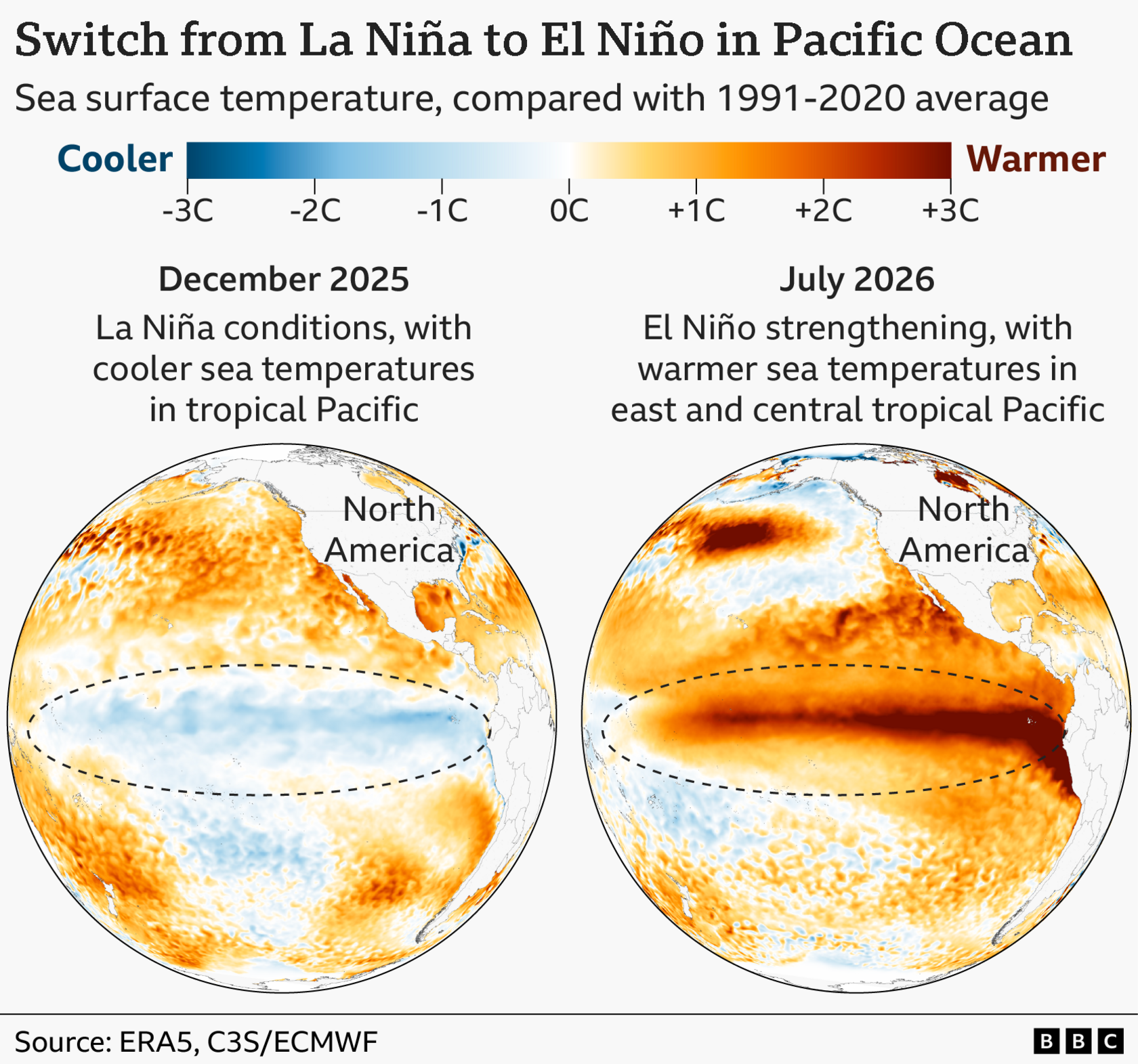
The World Meteorological Organization (WMO) has warned that the current El Niño event could become the strongest recorded since monitoring began about four decades ago. The naturally occurring climate phenomenon, which warms surface waters in the central and eastern equatorial Pacific Ocean, is expected to intensify to “very strong” levels in the coming months and is almost certain to continue through February. Its peak is forecast for the end of 2026, but its effects could continue into 2027.
WMO chief Celeste Saulo said the event could become “off the charts” if its current trajectory continues. The agency warned that stronger El Niño conditions will increase the likelihood of floods, droughts, extreme heat and disruptive rainfall patterns around the world. UN Secretary-General Antonio Guterres said the phenomenon was being “supersized” as the planet enters a “danger zone of extreme weather.”
El Niño is not caused by climate change, but scientists expect it to intensify the effects of a planet already warming because of fossil-fuel emissions. Ocean heat can remain in the atmosphere and contribute to higher global temperatures the following year. The powerful 2023–24 El Niño helped make 2024 the warmest year on record, and the WMO said another temperature record could be broken.
Authorities and climate-sensitive sectors, including agriculture, health, energy and water, have been urged to prepare immediately. El Niño commonly produces drought in parts of Australia, Indonesia and the Amazon, disrupts monsoon patterns in India, and alters rainfall across tropical regions. WMO forecasts for September to November indicate above-normal temperatures across almost all land areas. Sea-surface temperature anomalies have already risen from 1.5 degrees Celsius above average to weekly values of 2.2–2.6 degrees, while some subsurface Pacific waters were more than 8 degrees above average.
Entities: El Niño, World Meteorological Organization (WMO), Celeste Saulo, Antonio Guterres, United Nations • Tone: urgent • Sentiment: negative • Intent: warn
03-09-2026
The World Meteorological Organization (WMO) warns that the current El Niño event could intensify to an exceptional, potentially record-setting level in the coming months and persist through February 2027. The agency estimates there is a nearly 100 percent probability that the phenomenon will continue through February, its highest level of certainty in an El Niño/La Niña update.
El Niño is a naturally occurring climate pattern caused by unusually warm surface waters in the central and eastern equatorial Pacific Ocean. It alters global wind, pressure and rainfall patterns, increasing the risks of drought, flooding and extreme heat in distant regions. WMO Secretary-General Celeste Saulo said that, if current trends continue, the event could be stronger than any recorded since monitoring began four decades ago, describing it as “off the charts.”
The phenomenon is expected to peak near the end of 2026, while its climatic effects may continue into 2027 because ocean heat is released gradually into the atmosphere. The strong 2023–24 El Niño helped make 2024 the warmest year on record, and Saulo warned that this record could be broken again.
The WMO says El Niño is not caused by human-driven climate change, but it is likely to intensify the effects of a planet already warming because of fossil-fuel use. Forecasts for September through November indicate above-normal temperatures across almost all land areas and major shifts in rainfall. Regions such as the Amazon, Indonesia and Australia could experience drought, while India may face disrupted monsoons.
Ocean measurements show continued strengthening: temperatures in the central-eastern equatorial Pacific were up to 2.6°C above average in mid-August, while some subsurface waters were more than 8°C above normal. UN officials urged governments and climate-sensitive sectors, including agriculture, health, energy and water, to prepare immediately for worsening impacts.
Entities: El Niño, World Meteorological Organization (WMO), Celeste Saulo, Antonio Guterres, Wilfran Moufouma-Okia • Tone: urgent • Sentiment: negative • Intent: warn
03-09-2026
The world is entering what UN Secretary-General António Guterres calls a “danger zone of extreme weather” as a rapidly intensifying El Niño develops in the Pacific Ocean. The World Meteorological Organization (WMO) says the event could be the strongest in more than 70 years and may influence global weather patterns until at least February 2027.
El Niño occurs when changes in Pacific wind patterns allow unusually warm water to move eastward, releasing heat into the atmosphere. Sea-surface temperatures in the central and eastern tropical Pacific are already more than 2°C above average and could approach 4°C above average, while temperatures below the surface are more than 8°C above normal in some areas. The phenomenon is expected to worsen existing climate-related heat extremes.
Forecasts indicate increased drought and wildfire risks across parts of South-East Asia, Central America and northern South America. Indonesia is responding to fires that have burned more than 107,000 hectares, while Panama is reducing traffic through the Panama Canal because of anticipated lower rainfall and falling water levels. In contrast, heavier rainfall is expected in parts of eastern Africa, southern Brazil and the southern United States, increasing the risk of flooding and landslides.
Australia is concerned about further marine heatwaves, coral bleaching and damage to fisheries, although forecasts suggest the Great Barrier Reef may avoid the worst conditions this year. China expects multiple typhoons, and Peru, Ecuador and Brazil face risks from flash floods and landslides. Australia and other countries are expanding early-warning systems, medical assistance, emergency planning and environmental monitoring. The United States has deployed the USNS Comfort to Peru to provide medical and technical support.
The WMO is undertaking a major effort to distribute forecasts to vulnerable communities. Scientists stress that preparedness, rather than alarm, is essential, while warning that poverty, exposed housing and fragile infrastructure can magnify El Niño’s effects.
Entities: El Niño, World Meteorological Organization (WMO), António Guterres, Celeste Saulo, Pacific Ocean • Tone: urgent • Sentiment: negative • Intent: warn
03-09-2026
The United Nations is warning that an intensifying El Niño climate pattern could cause widespread disruption to communities, economies and global commodity markets through February 2027. UN officials describe the event as unusually powerful, with tropical eastern Pacific sea-surface temperatures more than 2 degrees Celsius above normal in July and early August, while subsurface temperatures were more than 8 degrees above average.
The World Meteorological Organization expects heightened risks of floods, droughts and extreme heat. Asia-Pacific and Latin American countries are expected to experience the most immediate effects. Guatemala, Honduras and El Salvador are already facing erratic weather, drought and severe crop losses, while Indonesia is dealing with destructive wildfires. El Salvador has declared a state of emergency over drought conditions linked to El Niño.
The climate pattern is also threatening food supplies and commodity prices worldwide. A weaker monsoon in India could reduce production of rice, sugar, cotton and soybeans. In Peru, officials say anchovy fishing has suffered a devastating decline; anchovies are widely used in livestock feed. Markets for corn, cocoa and coffee could also be affected, creating consequences well beyond the regions experiencing the weather directly.
Energy systems and extractive industries face risks as well. Extreme and unpredictable weather could disrupt hydropower, wind and solar generation, energy demand, oil and gas production and refining, and mining operations. UN Secretary-General António Guterres said the world is entering a danger zone of extreme weather and must act quickly to protect people and pursue climate action. El Niño is a naturally occurring pattern that alternates with La Niña every two to seven years, but the current event’s scale and intensity have prompted heightened concern.
Entities: El Niño, United Nations, World Meteorological Organization (WMO), António Guterres, Celeste Saulo • Tone: urgent • Sentiment: negative • Intent: warn
03-09-2026
The World Meteorological Organization (WMO) says the current El Niño weather phenomenon is expected to intensify into a “very strong” event and persist until at least February 2027. The agency warns that the event could become stronger than any El Niño recorded since systematic monitoring began four decades ago, potentially exceeding the limits of existing classification charts.
El Niño is a naturally recurring climate pattern that develops when surface waters in the central and eastern equatorial Pacific Ocean become unusually warm. It occurs every two to seven years and is not directly caused by climate change, although scientists say global heating can amplify its effects. The phenomenon disrupts winds, pressure systems and rainfall patterns worldwide. Australia, Indonesia and parts of the Amazon often experience drought, while East Africa and the southern United States can face unusually heavy rainfall.
WMO Secretary-General Celeste Saulo said there is an exceptionally high likelihood—nearly 100%—that El Niño will continue through February 2027. Tropical Pacific sea-surface temperatures are already well above average, while subsurface temperatures in some areas were more than 8 degrees Celsius above normal in July and early August. Although the event is expected to peak toward the end of the year, its effects could continue into 2027. The WMO also noted that global temperatures are often especially high after an El Niño; the 2023–2024 event contributed to 2024 becoming the warmest year on record, and another record may soon be broken.
UN Secretary-General António Guterres described the phenomenon as being “supersized” and said the planet was entering “uncharted waters.” Saulo warned that intensifying drought, flooding and extreme heat could multiply and cascade, damaging communities, economies and global supply chains. She urged governments to prepare climate-sensitive sectors, emphasizing that there is no time to lose.
Entities: El Niño, World Meteorological Organization (WMO), United Nations, António Guterres, Celeste Saulo • Tone: urgent • Sentiment: negative • Intent: warn