03-09-2026
Australia is sending 15 specialist drone operators to Nepal to support search-and-rescue efforts after devastating flash floods. The deployment includes personnel from Fire and Rescue New South Wales and the Queensland Fire Department, bringing the number of Australian personnel assisting in Nepal to 34, including 19 already dispatched. The specialists will use advanced drones for mapping and thermal imaging, helping Nepali authorities identify survivors and locate missing people in areas that remain difficult to access because of destroyed infrastructure and poor communications.
Nepal’s death toll has reached approximately 1,200, while about 4,200 people remain missing. Thirty-eight Australians are also unaccounted for, prompting Foreign Minister Penny Wong to express “grave concerns” while urging people to “hold on to hope.” Nepali authorities have mobilised about 20,000 search-and-rescue personnel and are investigating locations identified by Australia, including Hotel Kailash and Hotel Royal Himalaya. Australia is also providing telecommunications data that could help determine the last known locations of missing Australians.
Prime Minister Anthony Albanese announced an additional $3 million in humanitarian assistance, bringing Australia’s total aid package to approximately $11 million. An RAAF C-17A aircraft has already delivered relief supplies, including hygiene kits, menstrual hygiene kits, solar lights and shelter tool kits. The supplies are intended to help communities facing severe shortages of clean water, sanitation and hygiene services; Oxfam estimates that around 50,000 people lack immediate access to these essentials.
Oxfam’s Nepal representative said the disaster demonstrated the growing risks posed by climate change and called for governments and donors to invest in preparedness and resilience before future disasters occur.
Entities: Nepal, Australia, Penny Wong, Anthony Albanese, Nepali flash flooding • Tone: urgent • Sentiment: negative • Intent: inform
03-09-2026
The Al Jazeera report describes families in Nepal carrying out symbolic funerals for relatives who remain missing after devastating floods. The ceremonies are taking place about a week after the disaster, as search efforts have apparently not recovered the victims’ bodies and the likelihood of finding survivors begins to decline.
Instead of using the bodies of their loved ones, families are creating effigies from kusha grass. These effigies serve as substitutes during the funeral rites, allowing families to perform ceremonies despite the continued uncertainty surrounding the missing people. The report emphasizes the emotional and cultural weight of this situation: relatives are being forced to mourn without confirmation or physical remains, while still holding on to diminishing hopes that some missing people may be found alive.
The floods have caused deaths and disappearances in Nepal, although the supplied report does not provide a total number of casualties, identify the affected communities, or describe the ongoing rescue operation in detail. It focuses instead on the families’ response to the prolonged absence of their loved ones and on the transition from active hope to symbolic mourning.
Published on 3 September 2026, the report presents these funerals as a poignant consequence of the flooding and the difficulty of recovering victims after the disaster. The use of kusha-grass effigies illustrates how families are adapting funeral practices to cope with loss, uncertainty, and the absence of bodies. Overall, the report is a brief, somber account of mourning amid a continuing flood crisis in Nepal.
Entities: Nepal, Nepal floods, Missing flood victims, Symbolic funerals, Kusha grass effigies • Tone: emotional • Sentiment: negative • Intent: inform
03-09-2026
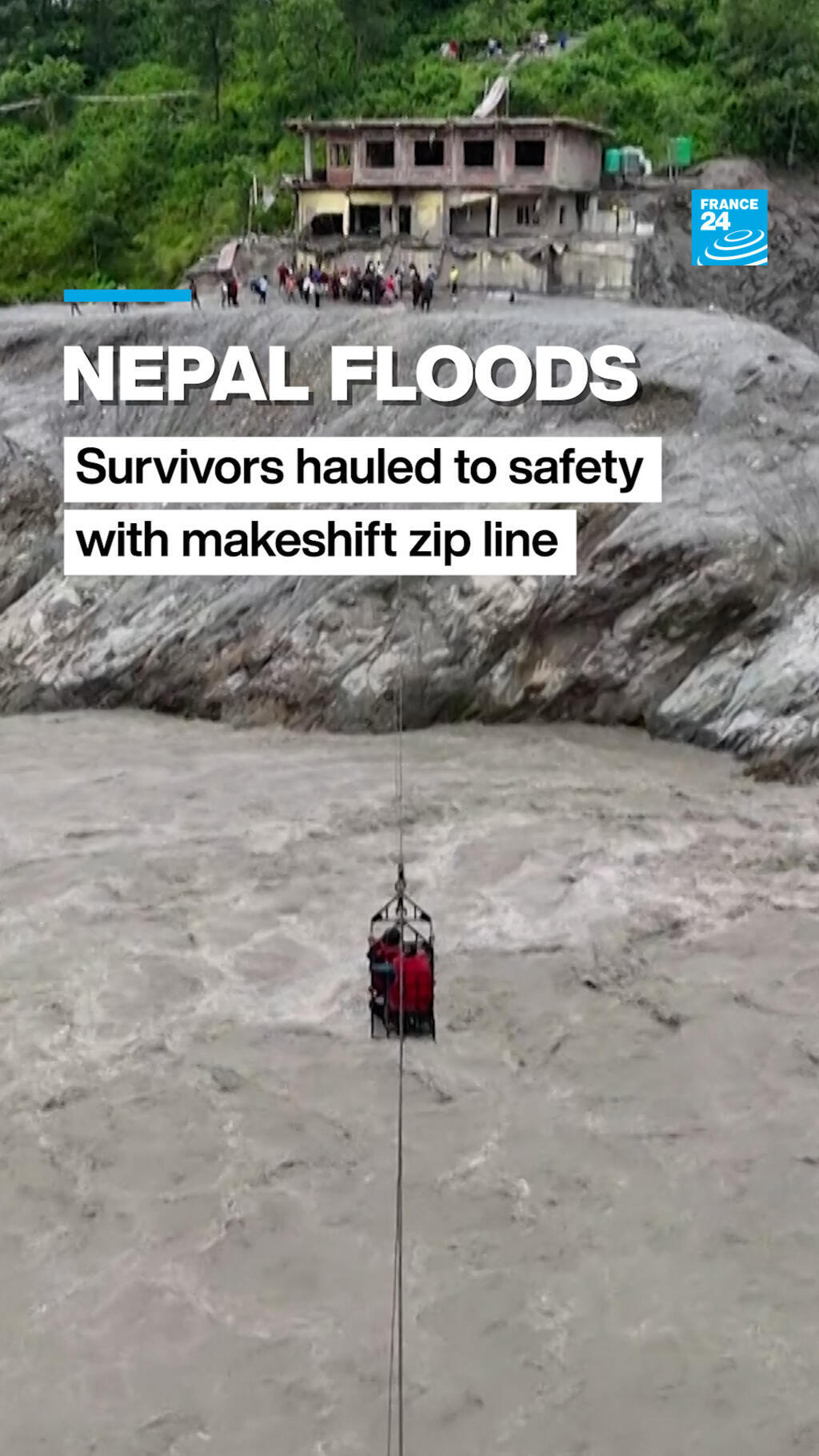
A France 24 video report describes an emergency rescue effort in Nepal following deadly flash floods that struck the country the previous week. The floods caused the Trishuli River to swell and swept away bridges, cutting off residents from the outside world. With normal routes destroyed or inaccessible, Nepali authorities erected a makeshift zip line across the river to transport stranded people to safety. The improvised crossing enabled residents to travel over the dangerous, swollen waters rather than attempt to cross the river directly. The operation was particularly important because isolated communities urgently needed access to medical treatment, medicines, food, and other essential supplies. The report presents the zip line as a temporary emergency-response measure intended to reconnect affected residents with assistance after the flooding disrupted local infrastructure. It does not provide further details about the number of people rescued, the precise location of the crossing, the number of fatalities, or the extent of damage beyond the destruction of bridges and the isolation of communities. The video was issued by France 24 on September 3, 2026, and focuses on the practical challenges faced by survivors in the immediate aftermath of the disaster. The report’s concise, factual presentation highlights both the continuing humanitarian needs created by the floods and the improvised methods authorities are using to reach residents who remain cut off.
Entities: Nepal, Trishuli River, Nepali authorities, France 24, Deadly flash floods • Tone: neutral • Sentiment: negative • Intent: inform
03-09-2026
The France 24 report examines how Nepal is identifying victims whose remains were recovered after devastating floods swept through parts of the country on August 26, 2026. Many of the bodies are in an advanced stage of decomposition, making visual identification difficult or impossible. Authorities have therefore begun burying unidentified remains for public-health reasons, while attempting to preserve the information needed to identify them later.
Before each burial, officials collect DNA samples from the remains and assign an identification number to each set of samples. Relatives of people reported missing can then visit designated DNA collection centres to provide their own samples. Investigators compare the genetic profiles of family members with those obtained from the recovered bodies, hoping to establish identities and reunite families with their missing relatives.
The report focuses on one such DNA collection centre operating inside the police hospital in Kathmandu. The centre represents part of Nepal’s broader effort to manage the aftermath of the flooding, which has produced large numbers of missing people and unidentified victims. The process is especially important because burial may occur before an identity is confirmed, and DNA records can provide a scientific basis for later identification.
The short video, produced by France 24 correspondents and filmed by Shahzaib WAHLAH, presents DNA collection as a crucial humanitarian and forensic response to the disaster. It highlights both the practical difficulties caused by the condition of the remains and the emotional burden placed on families waiting for information about their missing relatives.
Entities: Nepal, Kathmandu, France 24, Shahzaib WAHLAH, August 26, 2026 floods • Tone: analytical • Sentiment: negative • Intent: inform
03-09-2026
Global Affairs Canada has confirmed that a Canadian citizen previously reported missing during flash flooding in Nepal has been found safe. However, the agency says the whereabouts of 29 other Canadians and permanent residents in Nepal and Tibet remain unknown. That figure may change as officials receive new information and make contact with people in areas affected by the disaster.
Search and rescue efforts continue despite dangerous conditions and damaged infrastructure. Nepalese police are asking families of missing people to provide Canadian, foreign, or local telephone numbers, which could help authorities determine the individuals’ locations through geolocation. DNA collection is also underway to support identification efforts, and Global Affairs Canada will contact people who need to provide samples.
Canada is contributing to the wider relief operation by sending more than 18,000 emergency supply kits from its stockpiles. The kits include shelters, tools, hygiene products, and solar lights. Ottawa has also committed $5 million to emergency relief efforts in Nepal.
Nepal’s foreign ministry reported that 324 foreign nationals had been rescued, while 590 people from 39 countries remained missing after the floods on Aug. 26. Nepal’s disaster management agency reported at least 1,204 deaths and more than 4,200 people missing. The disaster has prompted international rescue and relief efforts, including work by a Calgary-based charity led by Darren Tosh. The article emphasizes that the situation remains fluid and that families are still waiting for information about loved ones.
Entities: Nepal, Tibet, Global Affairs Canada, Nepal police, Nepal’s foreign ministry • Tone: urgent • Sentiment: negative • Intent: inform
03-09-2026
The supplied NPR excerpt reports on the aftermath of flash floods in Nepal, focusing on families whose loved ones remain missing eight days after the disaster. Unable to locate their relatives, some families are performing symbolic cremations. These rituals appear to provide a culturally meaningful response to an uncertain and painful situation, although the excerpt does not explain the specific practices or whether the missing people are presumed dead. The report frames the story around grief, uncertainty, and the difficulty families face when flooding prevents them from recovering or identifying loved ones.
The article is identified as a World report published by NPR on September 3, 2026, and is credited to journalist Diaa Hadid. It was broadcast on Morning Edition and includes a 3-minute, 46-second audio segment. However, the provided content contains only the headline, a brief summary sentence, and publication and audio metadata; it does not include the full written report, interviews, quotations, casualty figures, specific locations in Nepal, or information about government and emergency-responder actions. Consequently, the available excerpt supports a focused summary of the families' symbolic cremations and emotional circumstances, but not a broader account of the floods or their humanitarian consequences. The central news value is the way survivors and relatives are coping with the unresolved disappearance of loved ones in the disaster's immediate aftermath.
Entities: Nepal, Nepal's flash floods, Families of missing people, Missing loved ones, Symbolic cremations • Tone: emotional • Sentiment: negative • Intent: inform
03-09-2026
The article is a brief Al Jazeera Newsfeed report about an emergency rescue operation in Rasuwa, Nepal. It describes the intensifying search for hundreds of workers who are believed to be trapped inside hydropower tunnels. Al Jazeera correspondent Jessica Washington is given exclusive access to the rescue crews working at the site.
According to the article’s description, rescuers are attempting to reach the workers by digging and blasting through layers of mud and rock. The wording indicates that the tunnels have been obstructed or sealed by unstable material, making the rescue effort difficult and potentially dangerous. The operation is presented as active and ongoing, with crews working to clear a path into the underground hydropower infrastructure.
The report emphasizes both the scale of the emergency and the hazardous conditions facing rescuers. The reference to “hundreds of workers” suggests that the incident affects a large number of people, although the supplied text does not provide an exact figure, the workers’ identities, or details about their condition. It also does not state what caused the mud and rock blockage, how long the workers have been trapped, whether contact has been established, or whether anyone has been rescued.
The central focus is the rescue response rather than broader political or environmental analysis. Through Washington’s access to the crews, the report appears intended to show viewers the physical challenges of the operation and the urgency of reaching the workers. The article was published on September 3, 2026, but the provided excerpt contains no subsequent update on the outcome of the search.
Entities: Al Jazeera, Jessica Washington, Rasuwa, Nepal, Nepal, rescue crews • Tone: urgent • Sentiment: negative • Intent: inform
03-09-2026
The article follows Ram Kumar Rijal, a Nepali resident of Dubai who is mourning the destruction of his hometown, Trishuli Bazar in Nepal’s Nuwakot district. More than 100 of his friends, neighbours and former business associates were swept away when catastrophic flooding devastated the area. Rijal says that more than 570 people from his village are gone, including more than 110 whom he knew personally. He also lost a nephew who worked at a hydropower plant, where many workers remain missing.
Rijal learned about the scale of the disaster through phone calls and messages from Nepal. His wife, two sons and granddaughter survived after fleeing the swollen Trishuli River, but many families lost relatives, homes and livelihoods. The flood destroyed bridges, farms, shops and entire settlements, while muddy water carrying boulders, trees and sediment flattened communities. Rijal’s family home survived, but his riverside land and cup-manufacturing business were severely affected because suppliers and customers disappeared.
The wider disaster has killed more than 1,200 people and left more than 4,200 missing, according to the article. Rescuers are searching for hundreds of workers believed to be trapped at hydropower projects, with Indian military personnel assisting in some operations. The flooding is believed to have been triggered by a glacial collapse that sent ice, rock, mud and debris through Himalayan valleys.
The article also describes acts of courage. Rajendra Dawadi, a classmate of Rijal and the principal of a local school, evacuated all 900 children before floodwater destroyed the building. However, a teacher and the school bell-ringer, who had served for 45 years, died. Rijal says warnings were ignored because similar alerts the previous year had caused little damage, leaving people on bridges filming the approaching water. The report ends with Rijal describing the immense grief and dislocation faced by survivors.
Entities: Ram Kumar Rijal, Trishuli Bazar, Nuwakot district, Nepal, Dubai and the UAE, Trishuli River • Tone: emotional • Sentiment: negative • Intent: inform
03-09-2026
The article reports on an international relief response to a major disaster in Nepal and the involvement of Canadians, particularly Calgary-based aid worker Darren Tosh. Tosh, a response manager with Samaritan’s Purse Canada, travelled to Nepal shortly after the disaster to coordinate emergency assistance. He says relief teams must act quickly because many affected residents have lost everything.
A Samaritan’s Purse aircraft carrying 40 tonnes of supplies from southern Alberta arrived in Kathmandu, joining teams from South Korea, Australia, the United States and other countries. However, delivering aid beyond the capital remains difficult. The hardest-hit areas are several hours from Kathmandu, and some remote villages cannot be reached by road. Tosh estimates that approximately 3,000 households remain inaccessible and may require helicopter deliveries.
The disaster is also causing distress in Calgary, which is home to tens of thousands of people with connections to Nepal. Members of the Nepalese Community Society of Calgary have been sharing updates and supporting one another while waiting for information about relatives and friends. Community member Ghanendra “Ray” Neupane said a friend’s aunt and uncle remain missing, with little hope of finding them.
Despite the destruction, Tosh and Neupane emphasize Nepal’s resilience, noting that the country is still recovering from a major earthquake a decade ago. Relief teams aim not only to distribute supplies but also to offer emotional support and hope. The article encourages Canadians to contribute through Samaritan’s Purse, the Canadian Red Cross or local Nepalese community organizations.
The article contains an apparent inconsistency: its headline, video references and related material describe floods or a flash flood, while the main text repeatedly refers to an earthquake.
Entities: Nepal disaster and humanitarian crisis, Nepal floods and flash flooding, Earthquake references in the article, Darren Tosh, Samaritan’s Purse Canada • Tone: urgent • Sentiment: negative • Intent: inform