31-10-2026
Residents evacuated from the Russian-occupied city of Oleshky have arrived in Ukrainian-controlled territory during a localised ceasefire in the southern Kherson region. The truce, described as the most significant since Russia’s 2022 invasion, began at 3am local time on Tuesday and was expected to last until Sunday evening. The White House said it was brokered with help from US first lady Melania Trump, and the evacuation was a rare joint humanitarian effort by Russia and Ukraine.
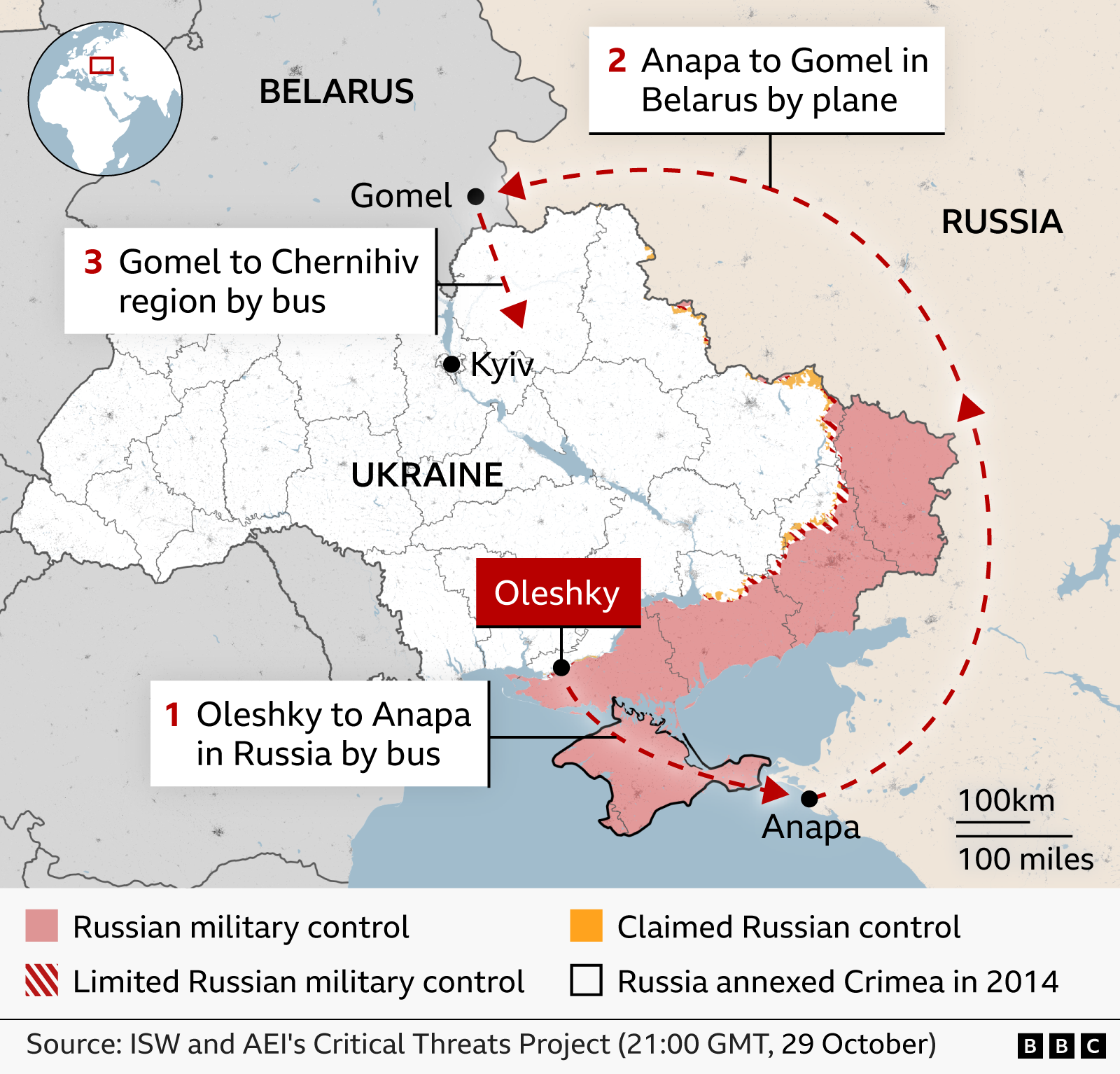
Bus convoys carrying civilians began the journey out of the war-ravaged region on Friday. Oleshky’s estimated 2,000 remaining residents were offered the choice of travelling to Ukrainian- or Russian-held territory or staying in the city, where food and medical supplies had been replenished. Russia’s Ministry of Defense said evacuees bound for Ukrainian-held territory were taken to Anapa in Russia and then flown to Homel in Belarus, accompanied by Ukraine’s commissioner for human rights, Dmytro Lubinets. The two countries have not said how many people left, although Melania Trump wrote on social media that the convoy could safely evacuate more than 750.
At the Ukrainian-Belarusian border, relatives and volunteers waited alongside aid tents, coffee stands and supplies for evacuees’ pets. Among them were people hoping to reunite with family members they had not seen for years. Liza Paliy said she had expected to return after a month or two when she fled with her mother and sister, leaving her father behind; more than two years had passed. Daria Pavlyn was waiting for her father, Mykhailo, whom she had not heard from in about a month. He stayed behind after arrangements for the family home and animals fell through, despite a nearby strike killing two neighbours. Pavlyn said her father had feared the difficult journey out, particularly without Russian documents.
Entities: Oleshky, Kherson region, Ukraine, Russia, Belarus • Tone: neutral • Sentiment: negative • Intent: inform
31-10-2026
The US State Department has approved a sale of 500 Patriot PAC-3 missile interceptors to Ukraine, valued at $US2.1 billion, or about $3 billion. The approval comes as Ukraine seeks more air-defence weapons to counter increasingly frequent Russian missile attacks, including strikes on civilian and energy infrastructure. The article describes the Patriot system as particularly effective against fast-moving ballistic missiles and presents the sale as a significant defensive-weapons commitment since the start of Donald Trump’s second administration.
The approval does not mean the missiles will arrive soon. The interceptors have not yet been manufactured, and people briefed on the decision expect delivery only a couple of years into the 2030s. Ukraine’s Ministry of Defence is pressing the Pentagon to accelerate delivery, potentially by transferring missiles already held in US stocks and replenishing them with newly produced interceptors later.
Canada, Germany and Norway are among the contributors helping fund the purchase through the US JUMPSTART program. Additional funding will come from Ukraine’s national resources, including financing from the European Union’s Ukraine Support Loan. JUMPSTART has also been used to purchase other weapons for Ukraine.
The article places the sale against wider strains on US weapons supplies. The United States has provided weapons to allies and used munitions in its own operations in Iran, while concerns persist about stocks of air-defence and precision-guided weapons. Lockheed Martin, the main contractor, is expanding PAC-3 production under a major US Army contract, but Pentagon negotiators are urging contractors to increase output more quickly. The urgency is underscored by recent Russian attacks that killed civilians in Dnipro, other provincial cities and Kyiv.
Entities: Ukraine, United States Department of State, Patriot PAC-3 missile interceptors, Russia, Donald Trump • Tone: analytical • Sentiment: negative • Intent: inform
31-10-2026
The article reports that hundreds of residents were evacuated from Oleshky, a town in Russian-occupied territory, under a localized ceasefire. It says the ceasefire was brokered by U.S. First Lady Melania Trump and describes the evacuation as a rare instance of humanitarian coordination between Russia and Ukraine along the front line. The report does not provide further details about when the evacuation took place, how many people were moved, where they were taken, or the conditions under which the operation was conducted. It also offers no accounts from residents or officials and does not explain the ceasefire’s duration or scope. The headline and brief description frame the evacuation as a significant humanitarian event amid the Russia-Ukraine conflict, but the available text is limited to those central facts. The item was published on October 31, 2026. Overall, it presents a short news update about civilian evacuation and cooperation between opposing sides, without additional context or analysis.
Entities: Melania Trump, Oleshky, Russia, Ukraine, United States • Tone: neutral • Sentiment: neutral • Intent: inform
31-10-2026
The United States has approved a possible sale of 500 Patriot PAC-3 interceptor missiles to Ukraine, valued at an estimated $2.1 billion. Announced by the State Department, the package includes missiles, parts and support and would be a significant step in supplying defensive weapons to Ukraine during President Donald Trump’s second administration. The Patriot system is considered especially effective against fast-moving ballistic missiles, which Ukraine needs to counter Russia’s expanding missile attacks.
The approval follows weeks of reported delays and tensions between Washington and Kyiv. Ukrainian President Volodymyr Zelenskyy said Ukraine had waited almost a month for the United States to approve critical missile supplies, as Russian strikes intensified against energy and civilian infrastructure. Recent attacks included a drone strike that killed at least 14 people at a crowded rail platform in Dnipro, as well as deadly strikes in two other cities and Kyiv.
Even with the approval, the missiles are unlikely to arrive soon. The PAC-3 interceptors have not yet been manufactured, and people briefed on the decision said delivery is not expected until a couple of years into the 2030s. Ukraine will fund the purchase through contributions from Canada, Germany and Norway under the US JUMPSTART programme, alongside national funds financed through the European Union’s Ukraine Support Loan.
Lockheed Martin is the principal contractor. The company has said that a US Army contract worth up to $58.6 billion will help it meet a pledge to triple PAC-3 production capacity by the end of 2030, with production previously announced as reaching 2,000 interceptors annually. The article also notes pressure on contractors to accelerate output and concerns about US inventories, given weapons transfers to allies and heavy US munitions use in operations in Iran.
Entities: United States, Ukraine, Patriot PAC-3 interceptors, Volodymyr Zelenskyy, Donald Trump • Tone: analytical • Sentiment: negative • Intent: inform
31-10-2026
Residents evacuated from the Russian-occupied Ukrainian city of Oleshky have reunited with relatives in Chernihiv after enduring years of isolation and severe shortages. The emotional arrivals included two sisters who ran to embrace their father, whom they had not seen for three years, and an elderly couple who brought their cat after losing their home to fire. Some evacuees were so frail they needed stretchers, wheelchairs or crutches.
The evacuation followed a local humanitarian ceasefire, which Ukrainian President Volodymyr Zelensky said was brokered with help from US First Lady Melania Trump. Residents travelled from Oleshky through Russian-occupied territory to southern Russia, then flew to Belarus before crossing into Ukraine. The oldest evacuee was 94 and the youngest was one. A convoy of 25 buses, with room for 750 people, and ambulances took residents out during a four-hour window after routes were cleared of mines. The ceasefire also enabled aid deliveries.
Oleshky, once home to 24,000 people, has faced extensive destruction and a lack of food, water, gas and electricity. Escape had been especially dangerous because roads were mined and exposed to drone attacks; one person who fled earlier described crossing 24km of minefields. Several hundred people chose to remain, with Ukrainian and Russian officials saying humanitarian aid would be provided to them.
The operation involved Ukrainian human rights ombudsman Dmytro Lubinets and Russian counterpart Yana Lantratova. Their cooperation drew criticism from some Ukrainians because of Russia’s occupation and the suffering inflicted on the city’s residents. Meanwhile, fighting continued elsewhere: Zelensky reported Russian attacks on Ukrainian energy infrastructure, while Ukraine’s military said it struck a Russian missile-fuel producer. Ukraine, Russia and the US were expected to resume ceasefire talks in Abu Dhabi in early November.
Entities: Oleshky, Chernihiv, Kherson region, Volodymyr Zelensky, Melania Trump • Tone: emotional • Sentiment: negative • Intent: inform
31-10-2026
Residents evacuated from the Russian-occupied Ukrainian city of Oleshky have described years of danger, deprivation and fear after reaching government-controlled northern Ukraine. Olha and Viacheslav, who lived in the city with their adult children, called their experience “horror” and said they felt they had returned from hell. Oleshky was captured by Russian forces in the opening days of the full-scale invasion in February 2022. Its position between the Dnipro River and Russian forces, together with mined routes and drone attacks, made escape perilous. As food supplies dwindled, residents risked crossing minefields to find food; some who stayed indoors reportedly cooked garden weeds to survive.
A humanitarian ceasefire in the Kherson region, brokered by US First Lady Melania Trump, created a short opportunity to leave. Residents had four hours on Friday to evacuate, with 25 buses arranged for as many as 750 people and ambulances for those with limited mobility. The evacuees travelled through Russian-occupied territory and southern Russia, then flew to Belarus before arriving by bus at a military facility in Chernihiv on Saturday. Some elderly people were so weak they had to be carried on stretchers, while families reunited emotionally on the tarmac.
Among those arriving was Mykhailo Palii, whose daughters had feared they might never see him again. He described damage to his home and attacks he had concealed from his family to spare them worry. Tetiana and Volodymyr said their home had burned down three years earlier and they had since lived in a neighbour’s abandoned house. They were relieved to leave, but evacuees remain concerned for people still in Oleshky. Up to 6,000 people were believed to remain in the city and surrounding area, including 1,700 in the city itself. Those who escaped now face finding housing and work and rebuilding their lives. Olha’s family will stay with acquaintances, while Palii plans to take whatever work he can find.
Entities: Oleshky, Chernihiv, Ukraine, Belarus, Kherson region • Tone: emotional • Sentiment: negative • Intent: inform
31-10-2026
Residents evacuated from the Russian-occupied city of Oleshky have reached Ukrainian-held territory after a humanitarian operation conducted during a six-day localized ceasefire in Ukraine’s Kherson region. President Volodymyr Zelenskyy said the evacuees crossed into Ukraine through the Chernihiv region and would receive assistance, thanking the United States and Melania Trump for mediation. The journey took residents by bus and plane through Russia and Belarus. Ukrainian authorities withheld the number of evacuees and the crossing’s location, citing the safety of people who stayed behind and of potential future missions.
The ceasefire began early Tuesday and was expected to last until Sunday evening. Oleshky’s estimated 2,000 remaining residents were offered the option of travelling to Ukrainian- or Russian-held territory, or staying in the city with replenished food and medical supplies. Fighting and drone activity had disrupted supply routes; residents said deliveries stopped in May, leaving hundreds facing starvation. Russia’s Defence Ministry said people headed for Ukraine travelled first to Anapa and then to Homel, Belarus, accompanied by Ukraine’s human rights commissioner Dmytro Lubinets. Russian representatives said some residents chose to settle in Russia, and Russian media showed arrivals in Crimea.
Families gathered at the border to welcome evacuees, with volunteers, aid tents, food, medical support and pet supplies on hand. The article recounts the anticipation of Liza Paliy, who had not seen her father for more than two years, and Daria Pavlyn, who was hoping to reunite with her father after losing contact with him. The operation was presented as a rare joint humanitarian effort amid the war. Melania Trump said the convoy could evacuate more than 750 people, though Russian and Ukrainian officials did not publish a total. Pope Leo also urged both sides to permit aid and civilian evacuations. The article concludes by noting Zelenskyy’s welcome of U.S. approval for Ukraine to purchase 500 Patriot interceptors, alongside his warning that delivery could take years while Russian attacks on energy infrastructure continued.
Entities: Oleshky, Volodymyr Zelenskyy, Melania Trump, Pope Leo, Kherson region • Tone: neutral • Sentiment: negative • Intent: inform
31-10-2026
Residents evacuated from the Russian-occupied Ukrainian city of Oleshky crossed into Ukrainian-held territory on Saturday during a temporary ceasefire brokered by the United States. The civilians traveled by bus and plane through Russia and Belarus, under an arrangement brokered by U.S. first lady Melania Trump. Oleshky, in the Kherson region, has been occupied since the early days of the war and faces severe humanitarian conditions. The ceasefire began Tuesday and was expected to last until Sunday evening.
An estimated 2,000 people remained in Oleshky. Residents could choose to travel to Ukrainian- or Russian-held territory, or stay in the city with additional food and medical supplies. Those returning to Ukraine went first to Anapa, Russia, then flew to Homel, Belarus, before continuing home. Authorities withheld the number of evacuees and the border crossing location to protect people who stayed behind and future humanitarian operations. The U.S. first lady said the convoy could safely evacuate more than 750 people. The Red Cross, Doctors Without Borders and World Central Kitchen supported relatives waiting at the border, where volunteers also provided aid and supplies for pets.
The article describes families hoping to reunite after years of separation. Liza Paliy had not seen her father for more than two and a half years. Daria Pavlyn was waiting for her father, Mykhailo, who had remained in occupied territory after his family left; she said he feared the difficult journey, particularly without Russian documents. Pope Leo XIV also urged Russian and Ukrainian leaders to permit aid deliveries and civilian evacuations.
Fighting continued elsewhere despite the localized truce. Russian officials reported Ukrainian drone attacks in Bryansk and Bashkortostan, with deaths and injuries in Bryansk and a fire reported in Ufa. Russia’s Defense Ministry said it shot down 433 Ukrainian drones overnight. Ukrainian President Volodymyr Zelenskyy said Russian drone attacks struck energy and railway infrastructure, leaving 280,000 households in the Dnipro and Kyiv regions without power. Repair crews were working to restore electricity.
Entities: Oleshky, Kherson region, Ukraine, Russia, Melania Trump • Tone: analytical • Sentiment: negative • Intent: inform
31-10-2026
The U.S. State Department approved the proposed sale of 500 Patriot missile defense systems to Ukraine for $2.1 billion. Ukraine will pay for the purchase using donations from Canada and European allies, including Germany and Norway; the State Department said no U.S. funds are involved. It described the sale as supporting U.S. foreign policy and national security objectives by strengthening a partner that contributes to stability in Europe. Lockheed Martin is the principal contractor, and the department said the sale would not adversely affect U.S. defense readiness.
Ukrainian President Volodymyr Zelenskyy welcomed the decision and thanked President Trump, but warned that delivery could take years. He urged the United States and European allies to provide Ukraine with Patriot systems from their existing stockpiles now, then replenish those supplies with the missiles purchased for Ukraine in the coming years. Zelenskyy said Russia had carried out more than 30 strikes on Ukrainian energy infrastructure in the preceding two weeks, targeting systems that sustain life in cities and communities. He stressed that protection was needed when threats arose, not at some later date.
Ukraine has repeatedly warned that its Patriot supplies are dwindling. The country uses the systems to intercept Russian strikes and has previously accused the United States of slowing deliveries of these critical missiles. The sale announcement comes amid tensions between Zelenskyy and Trump, including criticism of Trump for waiving new sanctions on Russia shortly before they were expected to take effect.
Entities: Volodymyr Zelenskyy, Donald Trump, United States State Department, Lockheed Martin, Ukraine • Tone: analytical • Sentiment: negative • Intent: inform
31-10-2026
Residents evacuated from the Russian-occupied city of Oleshky in Ukraine’s southern Kherson region arrived in Ukraine on Saturday after travelling through Belarus under a localised humanitarian truce between Kyiv and Moscow. Video shared by Dmytro Lubinets, Ukraine’s Parliament Commissioner for Human Rights, showed evacuees stepping off a bus decorated with Ukrainian flags and reuniting with loved ones. Lubinets said the mission had been completed and thanked US First Lady Melania Trump for helping broker the arrangement. President Volodymyr Zelenskyy said the evacuees crossed into Ukraine in the northern Chernihiv region and would receive assistance. They had previously arrived in Gomel, southeastern Belarus, before continuing their journey.
On Friday, Melania Trump said a convoy was prepared to evacuate more than 750 people who chose to leave Oleshky. The planned convoy included 25 buses, 50 medical professionals and ambulances. The localised ceasefire was scheduled to last until Sunday evening.
The article also reports the effects of overnight Russian strikes on Ukraine’s electricity infrastructure. Zelenskyy said approximately 280,000 households were without power: about 200,000 in Dnipro and the surrounding region, and at least 80,000 in the Kyiv region. He said repair crews were working to restore electricity. According to Zelenskyy, Russian forces struck a combined heat and power plant in Kyiv on Friday night, as well as four electrical substations in the eastern Dnipro region and other targets.
Entities: Oleshky, Kherson region, Ukraine, Belarus, Kyiv • Tone: neutral • Sentiment: neutral • Intent: inform
31-10-2026
Ukrainian President Volodymyr Zelenskyy thanked the United States for approving the sale of 500 Patriot PAC-3 interceptor missiles to Ukraine, but warned that the weapons may not arrive for years. The US State Department announced the $2.1 billion package as Ukraine continues to face Russian missile and drone attacks. Zelenskyy said the interceptors could provide a highly effective defence during the winter of 2026–2027, but stressed that the stated delivery schedule—potentially beginning only in a few years—does not match Ukraine’s immediate needs. He urged the United States and other partners to provide available missiles now and replenish their own stocks later with production already contracted and funded by Ukraine and its allies.
The article describes growing concern about Ukraine’s air-defence capacity as winter approaches. Zelenskyy had said earlier in the week that Kyiv had been waiting nearly a month for US Defence Secretary Pete Hegseth to approve a batch of missiles for the Patriot and NASAMS systems. Ukraine has repeatedly sought more interceptors to protect against Russian attacks, particularly because Russia has targeted the country’s power grid during past winters. Dwindling interceptor stocks, the article says, have encouraged Russia to increase missile attacks in recent months, raising fears of a particularly harsh winter for Ukrainians.
Patriot systems can counter several kinds of threats, including aircraft and ballistic missiles. Ukraine obtains most of its Patriots through NATO’s Prioritised Ukraine Requirements List (PURL), which enables allies and partners to fund purchases of US military equipment and ammunition for Ukraine. NATO reported that, by June 2026, participating allies had committed more than $6 billion in defence equipment through the initiative.
Entities: Volodymyr Zelenskyy, United States, Ukraine, Russia, Pete Hegseth • Tone: analytical • Sentiment: negative • Intent: inform
31-10-2026
Residents evacuated from the Russian-occupied Ukrainian city of Oleshky arrived in Ukrainian-held territory on Saturday, October 31, and reunited with family members after a rare, temporary truce. The evacuation route passed through Belarus, and the operation followed a ceasefire in the Kherson region brokered by US First Lady Melania Trump. Ukrainian and Russian officials had visited Oleshky together the previous day to deliver aid and organize departures, a rare instance of cooperation between the sides.
Oleshky has been under Russian occupation since 2022. Residents endured intense fighting and severe shortages of food, water, and medicine, while many were unable to leave. Evacuees told AFP they had resorted to eating grass and hunting animals to survive. One resident, Valera, said there was no bread and the shops were closed. Yelyzaveta Paliy, 19, was reunited with her father, whom she had last seen in January 2024 when she and other family members left the city. Her father said there was “no life there anymore.”
The truce, which began early Tuesday and was due to end Sunday evening, was described as the longest pause in fighting anywhere along the front line since Russia’s full-scale invasion began in February 2022. Kyiv estimated that about 2,000 people remained in Oleshky before the operation, down from a pre-invasion population of 24,000. Neither Moscow nor Kyiv gave a figure for how many people were evacuated, and authorities said some residents wished to stay.
The article also notes the broader toll of the war, Russia’s occupation of Ukrainian territory, and plans for US-mediated talks to resume in November. Separately, Kyiv faced electricity shortages after Russian strikes on energy infrastructure.
Entities: Oleshky, Kherson region, Belarus, Chernigiv region, Ukraine • Tone: neutral • Sentiment: negative • Intent: inform
31-10-2026
Hundreds of Ukrainians were evacuated from Russian-occupied Oleshky in the southern Kherson region and reached Ukrainian-controlled territory on Saturday after a temporary cease-fire enabled a humanitarian operation. The cease-fire, which began Tuesday and was due to end Sunday at 11 p.m., followed calls from First Lady Melania Trump and Pope Leo XIV. Roads were cleared of mines, aid was delivered, and buses were used to evacuate 750 people.
Residents described severe deprivation and danger during the occupation. By September, Oleshky had reportedly run short of food, electricity, medicine, and other essentials. Evacuees recounted surviving on food left in apartments and facing frequent drones and perilous streets. One resident said landmines and drone strikes were killing people daily in the town, which had a prewar population of 24,000.
The evacuees traveled through Crimea to Belarus, then entered Ukraine’s Chernihiv region, where they were welcomed with Ukrainian food. Some families reunited after nearly five years apart, including Larisa and her husband, Ukrainian serviceman Dmytro. The oldest person evacuated was 94 and the youngest was about one year old; pets were also brought out. Larisa said she had lost a third of her body weight during the occupation.
Ukrainian President Volodymyr Zelensky thanked the United States and Melania Trump, and credited international attention with helping rescue people. Human Rights Commissioner Dmytro Lubinets accompanied the evacuees, becoming the first senior Ukrainian official to enter Russian-occupied territory since the war began. He said he hoped the operation would become a model rather than an isolated case.
Zelensky also said the United States, Ukraine, and Russia were preparing for a trilateral meeting in the first half of November, with Turkey discussed as a possible host. He argued that the Oleshky operation demonstrated that de-escalation was possible and that Russia should be pressed toward peace.
Entities: Oleshky, Kherson region, Chernihiv region, Crimea, Belarus • Tone: emotional • Sentiment: neutral • Intent: inform
31-10-2026
A humanitarian evacuation brought residents of Russian-occupied Oleshky into Ukrainian-held territory during a temporary cease-fire in Ukraine’s Kherson region. Evacuees arrived at the Ukrainian-Belarusian border after traveling through Russia and Belarus, where family members, volunteers and aid organizations welcomed them with food, coffee and support. Some reunions had followed years of separation. Residents described dangerous conditions in Oleshky, including drone attacks, landmines and severe shortages of staple foods. About 2,000 people were still in the town when the truce began; residents could leave for either Ukrainian- or Russian-held territory, or stay with replenished supplies. Ukrainian authorities have not disclosed how many people left or the details of the route, citing the safety of residents and future humanitarian operations. Melania Trump said the convoy could safely evacuate more than 750 people. Ukraine’s human rights ombudsman, Dmytro Lubinets, said evacuees ranged from toddlers to 94-year-olds and included people traveling with pets. He called the mission a possible model for future humanitarian crises. Some evacuees who chose Russian-controlled territory were taken to a shelter in Simferopol, Crimea, where Russian officials said they would receive assistance with housing, documents and medical care. Separately, Ukrainian President Volodymyr Zelenskyy welcomed US approval of a proposed $2.1 billion sale of 500 Patriot interceptors, funded by Canada, Germany and Norway, but urged partners to provide weapons from existing stocks because the new missiles could take years to arrive. He also said Russian attacks on Ukraine’s energy infrastructure had continued, with more than 30 strikes on power-grid targets during the first two weeks of October.
Entities: Oleshky, Kherson region, Ukrainian-Belarusian border, Dmytro Lubinets, Melania Trump • Tone: neutral • Sentiment: neutral • Intent: inform