30-10-2026
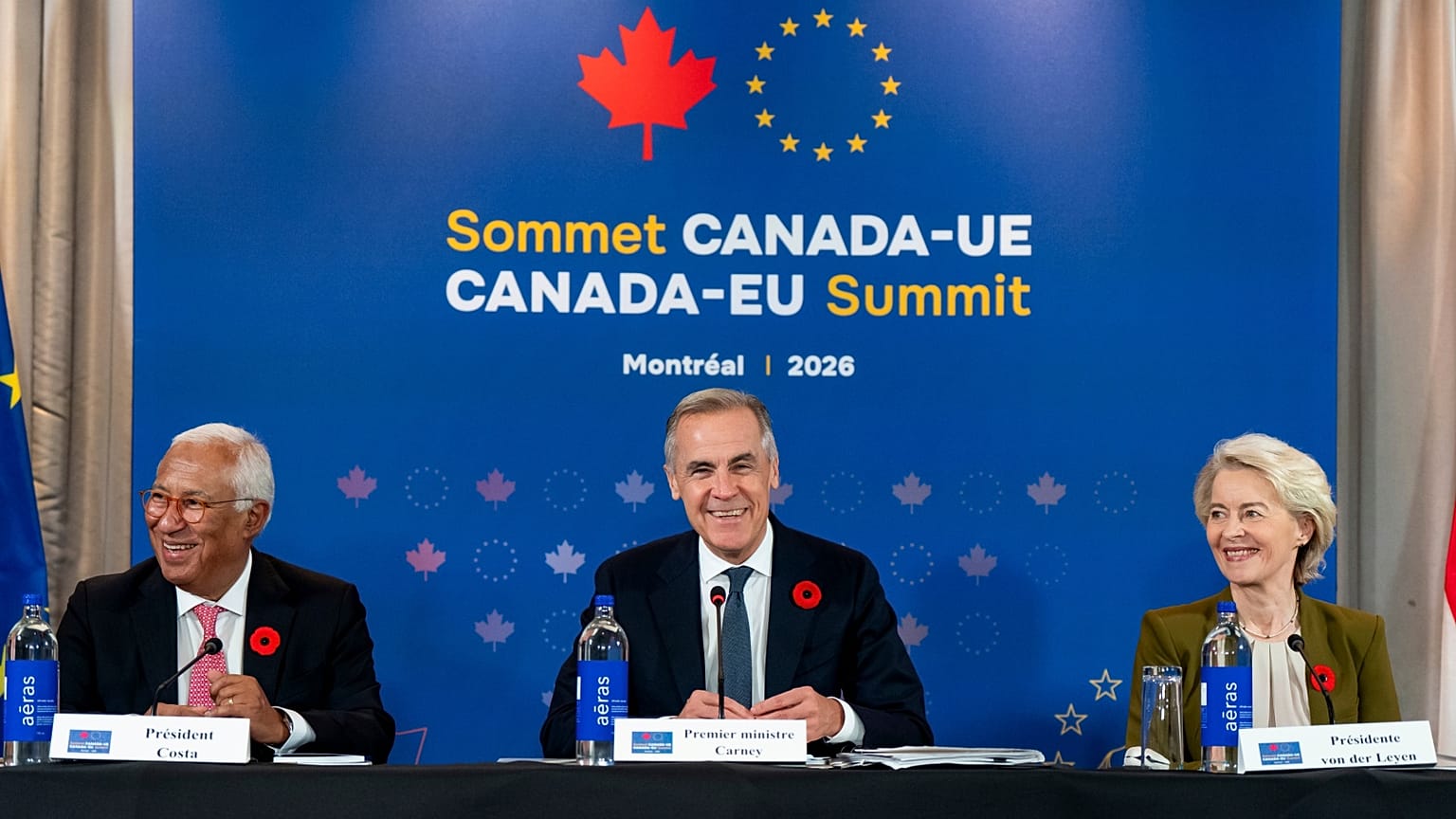
In an interview with DW in Montreal, Canadian Prime Minister Mark Carney said Canada has recognized that it is too economically dependent on the United States and must strengthen its domestic economy while expanding partnerships with like-minded countries. His remarks came as Canadian and European Union officials discussed a closer relationship at a summit, including a possible “associate membership” arrangement for Canada. Carney supports the term, describing the goal as the closest partnership possible without full EU membership, which Canada cannot pursue because it is not geographically in Europe.
Carney said closer ties with Europe are not intended to form a bloc against the United States. Canada and the US remain close partners and NATO allies, he said, and there are still many opportunities for cooperation. However, he sees scope for deeper Canada-EU cooperation in some areas. Existing connections include the Comprehensive Economic and Trade Agreement (CETA), research collaboration, Horizon Europe and Erasmus+ student exchanges. Potential areas for expanded work include space technology, artificial intelligence and critical minerals.
Asked about tensions with US President Donald Trump, Carney said the longstanding bonds between Canadians and Americans would endure regardless of who leads either country. He described his approach to dealing with Trump as being direct and clear about bottom lines, while showing respect and keeping negotiations focused on core issues. Carney acknowledged that the scale of Canada’s relationship with the US would be very difficult to replace, but said tensions have reinforced the importance of diversifying partnerships.
On the risk that closer EU ties could prompt further US tariffs or other punitive action, Carney said Canada has already been living with trade measures it considers unjustified under the countries’ trade agreement. He characterized the EU discussions as a positive partnership intended to help address global challenges, rather than an effort directed against any other country.
Entities: Mark Carney, Donald Trump, Ursula von der Leyen, Antonio Costa, Friedrich Merz • Tone: analytical • Sentiment: neutral • Intent: inform
30-10-2026
Canadian Prime Minister Mark Carney says Canada and the European Union aim to conclude negotiations by June 2027 on a new “associate membership” arrangement, which would make Canada the bloc’s first associate member. The proposal has no precedent and is not provided for in EU treaties, which reserve full membership for European states. Its practical scope—including policy, programmes and governance—has yet to be negotiated.
The initiative was proposed by European Commission President Ursula von der Leyen in September, without broad prior discussion with EU member states. Germany opposed using the term “associate member” in the summit’s joint declaration, which instead describes an “ever closer association.” Carney initially appeared hesitant, citing possible implications for Canadian sovereignty, but at a bilateral summit in Montréal he publicly backed the goal of the “deepest possible partnership short of accession.” Von der Leyen said there was broad support among member states for closer ties, while European Council President António Costa also avoided the disputed label.
The leaders identified potential benefits and areas for expanded cooperation. Canada could be fully integrated into the EU’s Horizon and Erasmus programmes and participate in a €90 billion support loan for Ukraine. The summit also advanced cooperation on digital trade, energy, critical raw materials, supercomputing, artificial intelligence and satellite technology.
The European Commission and Canadian government plan to hold a college-to-cabinet meeting in the spring to develop the proposal. Carney is expected at an EU leaders’ summit in June, where he hopes to conclude negotiations. Ratification across Europe remains unresolved; Carney has said he will put the proposal to a vote in Canada’s parliament. Germany’s opposition may be connected to Chancellor Friedrich Merz’s earlier use of the associate-member concept in discussions about Ukraine, though Commission officials’ view of his motives is reported as speculation. Ukraine rejected that model, insisting it seeks full EU membership.
Entities: Mark Carney, Ursula von der Leyen, Friedrich Merz, António Costa, Canada • Tone: analytical • Sentiment: neutral • Intent: inform
30-10-2026
The article reports that the European Union and Canada are preparing to deepen their relationship at a summit in Montréal, with Donald Trump’s return to the US presidency providing a major impetus. Tariffs, threats to annex Canada, hostility toward multilateral institutions and closer US ties with Russia have weakened European confidence in Washington. Canada’s dependence on the US economy has likewise made the search for alternative partners increasingly urgent. Both sides see their shared exposure as a reason to cooperate more closely.
European Commission President Ursula von der Leyen has proposed making Canada the EU’s first “associate member,” while Canadian Prime Minister Mark Carney has advocated an “alliance for the future” that protects members’ ability to make independent choices and remains open to others. The summit agenda includes trade, investment, supply chains, artificial intelligence, climate, security, the Arctic and Canadian participation in EU programmes such as Horizon and Erasmus. Critical minerals and liquefied natural gas are also priorities, as the EU seeks alternatives to Chinese supplies and additional energy sources.
Ukraine is another central issue. The article says Ukraine faces a €70 billion gap in its 2027 budget; the EU is prepared to provide roughly €46 billion and wants allies, including Canada, to cover the remainder with new assistance. The high-level EU delegation and proposals for closer links among governments, parliaments and courts signal that the initiative is intended to be institutionally significant.
The effort has encountered disagreement over terminology. Germany pushed to remove “associate membership” from the summit declaration, which instead refers to an “ever closer association.” Von der Leyen nevertheless defended an arrangement short of accession but closer to membership than previous partnerships, and Carney publicly supported the associate-member idea. The article presents the summit as the beginning of an ambitious, but still partly uncharted, partnership.
Entities: European Union (EU), Canada, Donald Trump, Ursula von der Leyen, Mark Carney • Tone: analytical • Sentiment: neutral • Intent: analyze
30-10-2026
Canada and the European Union have announced the “Alliance for the Future,” a new partnership intended to strengthen cooperation between like-minded countries amid geopolitical uncertainty. Unveiled by Canadian Prime Minister Mark Carney and European Commission President Ursula von der Leyen at a Montreal summit, the alliance is open to other countries. The leaders described it as a way to protect citizens and create greater stability as societies face climate disruption, weakening democratic norms and the use of trade as political pressure.
The summit produced several practical commitments. Canada agreed to contribute to a €90bn support loan for Ukraine, and the parties said future talks would address a more integrated market, reduced trade and travel barriers, and expanded educational opportunities. They also agreed to connect Canada to Europe’s supercomputing network, allowing Canadian researchers and companies to use European machines to train AI models.
The initiative reflects Canada’s efforts to diversify its partnerships as trade tensions with the United States and dependence on US companies—particularly in defence and technology—raise concerns. Carney cited the planned merger of Canadian AI company Cohere and Germany’s Aleph Alpha, alongside a potential C$1.6bn Canadian government stake in Cohere, as an example of building alternatives to American technology giants. He also warned that essential technologies could be influenced by companies or political actors whose interests differ from Canada’s.
The leaders renewed discussion of Canada becoming an EU “associate member,” though the designation remains undefined and some EU members worry it could confuse countries seeking full membership. Its scope is expected to be discussed at a 2027 summit. The meeting also exposed domestic tensions: Quebec Premier Paul St-Pierre Plamondon skipped the event after Ottawa declined to let him address it publicly, criticizing what he saw as Quebec’s diminished influence.
Entities: Mark Carney, Ursula von der Leyen, Antonio Costa, Paul St-Pierre Plamondon, Canada • Tone: analytical • Sentiment: neutral • Intent: inform
30-10-2026
The supplied page content does not include the article itself. It contains the Global News headline, extensive site navigation and sharing controls, followed by reader comments. The headline indicates that Canada and the European Union have presented a vision for closer ties in what they describe as a “dangerous and divided” world, but the article’s details, arguments, named participants, and proposals are absent. The comments reflect sharply divided reactions: some commenters welcome closer EU ties or international study opportunities, while others oppose the idea, question its democratic legitimacy, or criticize Prime Minister Mark Carney and his government. Several comments also discuss trade, affordability, military capacity, and claims about Canada joining the EU. These are reader opinions and are not a substitute for the missing news report. Consequently, the article’s overall tone, sentiment, and intent cannot be reliably assessed from the headline and page clutter alone. The available material supports only a limited extraction of entities and topics associated with the headline and comments. A complete analysis would require the article body.
Entities: Canada, European Union (EU), Global News, Mark Carney, Canada–EU relations • Tone: analytical • Sentiment: neutral • Intent: inform