30-09-2026
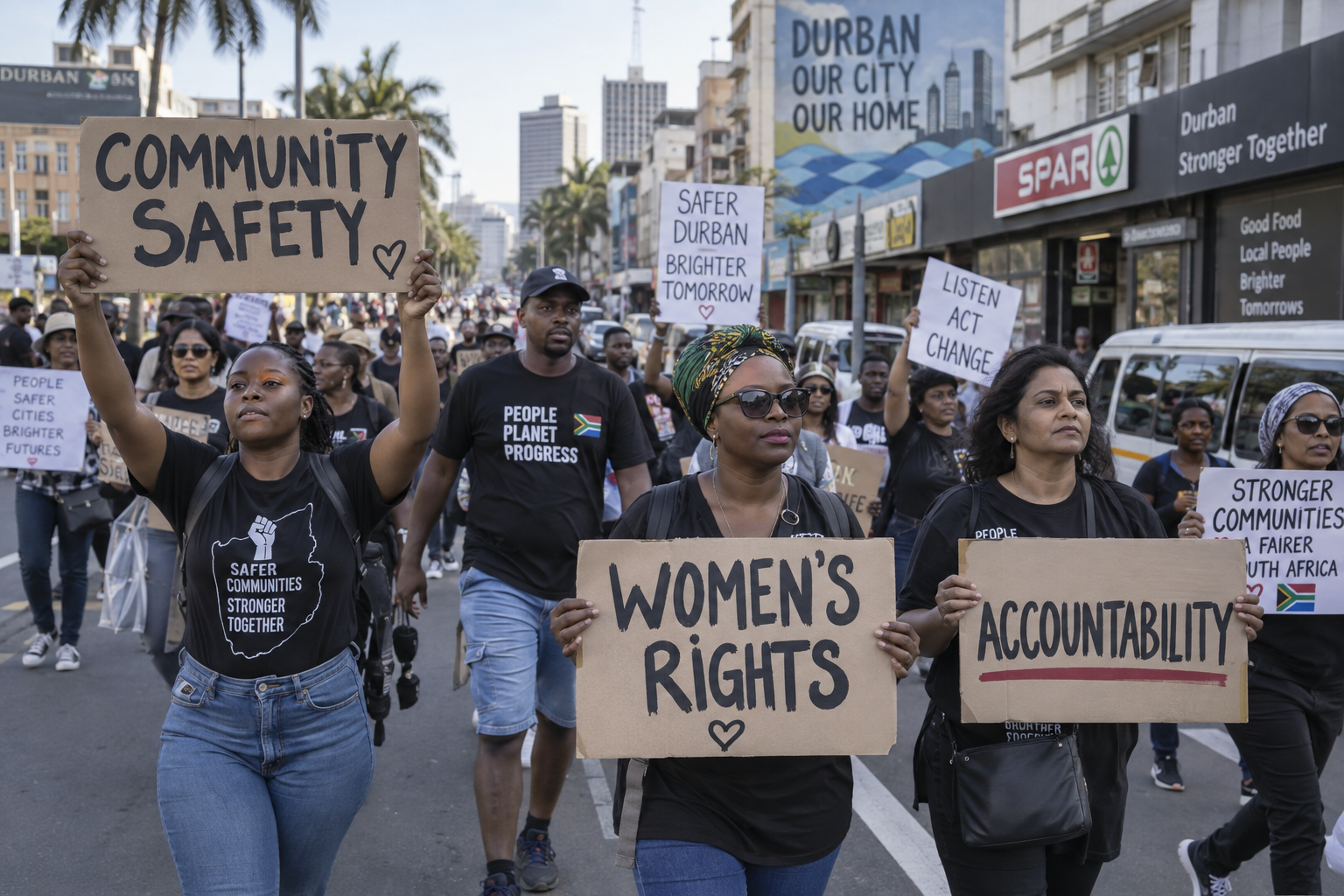
Hundreds of people protested in Durban on Wednesday against undocumented immigration, as part of demonstrations organized across several South African provinces by the anti-migrant group March and March. The group had set September 30 as an unofficial deadline for undocumented immigrants to leave the country. The protests took place amid an intense anti-immigration campaign that has persisted for several months and has been associated with violence against foreign citizens. The article reports that several immigrants have been killed, while noting that South African and foreign authorities dispute the official death toll. It also cites an AFP tally, based on figures released by African governments that have repatriated their nationals, saying more than 200,000 people have fled South Africa.
Organisers said the demonstrations also denounced gender-based violence. The issue has drawn renewed attention after a series of femicides shocked the country. At least 11 women have been killed in Ekurhuleni, east of Johannesburg, since mid-July, and the discovery of their bodies has renewed alarm about persistently high levels of violence against women. On Tuesday, President Cyril Ramaphosa announced new measures intended to better protect women. The article presents the immigration protests and concern over violence against women as concurrent issues raised by the organisers, while also placing the demonstrations in the context of anti-immigrant violence, disputed death figures, and large-scale departures from the country.
Entities: Durban, South Africa, March and March, September 30 protest deadline, Undocumented immigration • Tone: neutral • Sentiment: negative • Intent: inform
30-09-2026
Hundreds of people marched in Durban, South Africa, on Wednesday, September 30, protesting illegal immigration. The demonstrations were organized by March and March, an anti-migrant movement that had identified September 30 as an unofficial deadline for undocumented immigrants to leave the country. The group also staged protests in several other provinces, making the action part of a broader campaign rather than an isolated city event.
The article places the marches amid months of heightened anti-immigration activity in South Africa. That campaign has been accompanied by violence against foreign citizens, and several immigrants have been killed. However, the official death toll is disputed by South African and foreign authorities, so the article does not give a settled figure. It also reports that more than 200,000 people have left South Africa. That estimate comes from an AFP tally based on figures published by African governments that repatriated their nationals.
Organisers said the demonstrations had an additional focus: denouncing gender-based violence. Their statement came after a series of femicides shocked the country. The report therefore describes marches addressing both opposition to undocumented immigration and concern about violence against women, while noting the wider consequences of the anti-immigration campaign, including deaths and substantial departures from the country. It provides no detailed account of the organisers’ demands regarding gender-based violence, the circumstances of the deaths, or the disputed death toll. Overall, it is a concise report on the scope and stated purposes of the protests and the tense context in which they took place.
Entities: Durban, South Africa, March and March, Africanews, AFP • Tone: neutral • Sentiment: negative • Intent: inform
30-09-2026
South African President Cyril Ramaphosa has announced new measures to address gender-based violence after the deaths of at least 11 women in Ekurhuleni, east of Johannesburg, since mid-July prompted widespread public anger and renewed concern about violence against women. Authorities are investigating whether the killings are connected, but police have not found evidence that a single perpetrator was responsible. Four people are in police custody in connection with the murders, and a multidisciplinary national emergency response has been established to support the investigation.
The measures include a nationwide audit of women’s safety, due within 60 days. Local authorities are to identify high-risk locations, such as areas with broken streetlights, abandoned buildings, and poorly secured parks. Ramaphosa also announced a crackdown on alcohol abuse and directed police and the National Prosecuting Authority to review unresolved cases involving murder, attempted murder, rape, and other gender-based violence within 90 days.
Ramaphosa acknowledged that the government’s previous efforts had not been sufficient, despite gender-based violence being declared a national disaster the year before. The recent victims included women in their 20s and 30s; some were found stripped of their clothes and showed signs of sexual assault. Their deaths have intensified fear in the area, which remains on high alert while the investigation continues.
The article places the killings within a wider national crisis. South Africa recorded 5,427 homicides from April to July, and UN Women says the country’s femicide rate is among the highest in the world. Ramaphosa said the anger of women and the nation was justified and called for substantially more action.
Entities: Cyril Ramaphosa, South Africa, Ekurhuleni, Johannesburg, National Prosecuting Authority • Tone: urgent • Sentiment: negative • Intent: inform
30-09-2026
The article reports that South African President Cyril Ramaphosa has announced new measures to combat femicide and gender-based violence. The announcement follows the discovery, since July, of the bodies of at least 11 women in an area east of Johannesburg. Those killings have prompted a nationwide outcry and demands for action. The article presents the president’s response as a government action prompted by the scale and public impact of the killings, but the provided text does not describe what the new measures involve, when they will take effect, or which agencies will carry them out. It also gives no further information about the victims, the circumstances of their deaths, any suspects, or the investigations. The report is therefore a brief account of the announcement and the events that preceded it, rather than a detailed explanation of South Africa’s response to femicide and gender-based violence. Its central point is that the discovery of at least 11 women’s bodies east of Johannesburg has intensified public pressure, and that Ramaphosa has responded by announcing measures to address the broader problem. No additional policy details or outcomes are provided in the supplied article text.
Entities: South Africa, Cyril Ramaphosa, Johannesburg, Femicide, Gender-based violence • Tone: urgent • Sentiment: negative • Intent: inform
30-09-2026
South African President Cyril Ramaphosa has announced a national emergency response and measures to improve women’s safety after 12 women’s bodies were found in an area east of Johannesburg over a two-month period. The discoveries have prompted public outcry amid South Africa’s exceptionally high levels of gender-based violence. Four arrests have been made, but police have not found evidence that the killings were committed by one perpetrator, despite public fears that they might be connected.
Ramaphosa acknowledged that the government has not done enough to protect women and girls. He called for every municipality to conduct an immediate women’s safety audit, identify high-risk locations, and address hazards such as broken streetlights, overgrown public spaces, abandoned buildings, unsafe transport routes, and poorly secured parks. He also announced an enforcement package aimed at reducing alcohol-related violence, while stressing that alcohol neither causes nor excuses gender-based violence and that perpetrators remain responsible.
The president argued that preventing violence requires deeper social change as well as policing and legislation. He said it begins with attitudes that treat women as inferior, normalize male control, and confuse jealousy or coercion with love and protection. He called on men and boys to take the lead in ending violence, and said women should not have to give up freedom to stay safe.
The article places the announcement in the context of South Africa’s high homicide rates: 5,427 people were murdered between April and June this year. Although police statistics do not break down victims by gender, the South African Human Rights Commission reported that 569 women were killed and 1,052 survived attempted murder during that same period.
Entities: Cyril Ramaphosa, South Africa, Johannesburg, South African Police, South African Human Rights Commission • Tone: analytical • Sentiment: negative • Intent: inform
30-09-2026
South African president Cyril Ramaphosa has urged men to challenge harassment and abuse of women, as public grief and anger grow following the discovery of 11 women’s bodies in Ekurhuleni since 15 July. Eight of the bodies were found in the three weeks before his televised address, including Elizabeth “Tsontso” Moselakgomo, who was found on 12 September after going missing while out for a run after work.
Ramaphosa acknowledged that the government had not done enough to protect women and announced several measures. Police are to review unsolved murders, attempted murders and serious sexual offences against women and children, and produce within 60 days a funded plan to reduce the forensic backlog. Local governments have five months to address safety problems such as broken streetlights, overgrown public spaces and abandoned buildings. Five ministers are also to develop a plan within 60 days to reduce alcohol-fuelled violence. Ramaphosa stressed that alcohol does not cause or excuse gender-based violence and that perpetrators remain responsible.
Police have arrested suspects in three of the killings. Ramaphosa said investigators had found no evidence that a serial killer was responsible for all 11 deaths, but that every possibility remained under investigation. He called on men to speak up when relatives, friends or colleagues harass or abuse women, saying the burden of responding to male violence had been placed on women for too long.
Activists questioned whether the measures would lead to meaningful change, noting that the issues have been discussed for years, including after 2019 protests. Amnesty International South Africa’s Shenilla Mohamed said the deadlines would matter only if they resulted in action and consequences for inaction. Sonke Gender Justice representatives Mpiwa Mangwiro-Tsanga and Bafana Khumalo argued that investigations and safer public spaces are necessary but insufficient: the response remains focused on what happens after violence and lacks a comprehensive prevention strategy.
Entities: Cyril Ramaphosa, South Africa, Ekurhuleni, Johannesburg, Elizabeth “Tsontso” Moselakgomo • Tone: analytical • Sentiment: negative • Intent: inform