30-07-2026
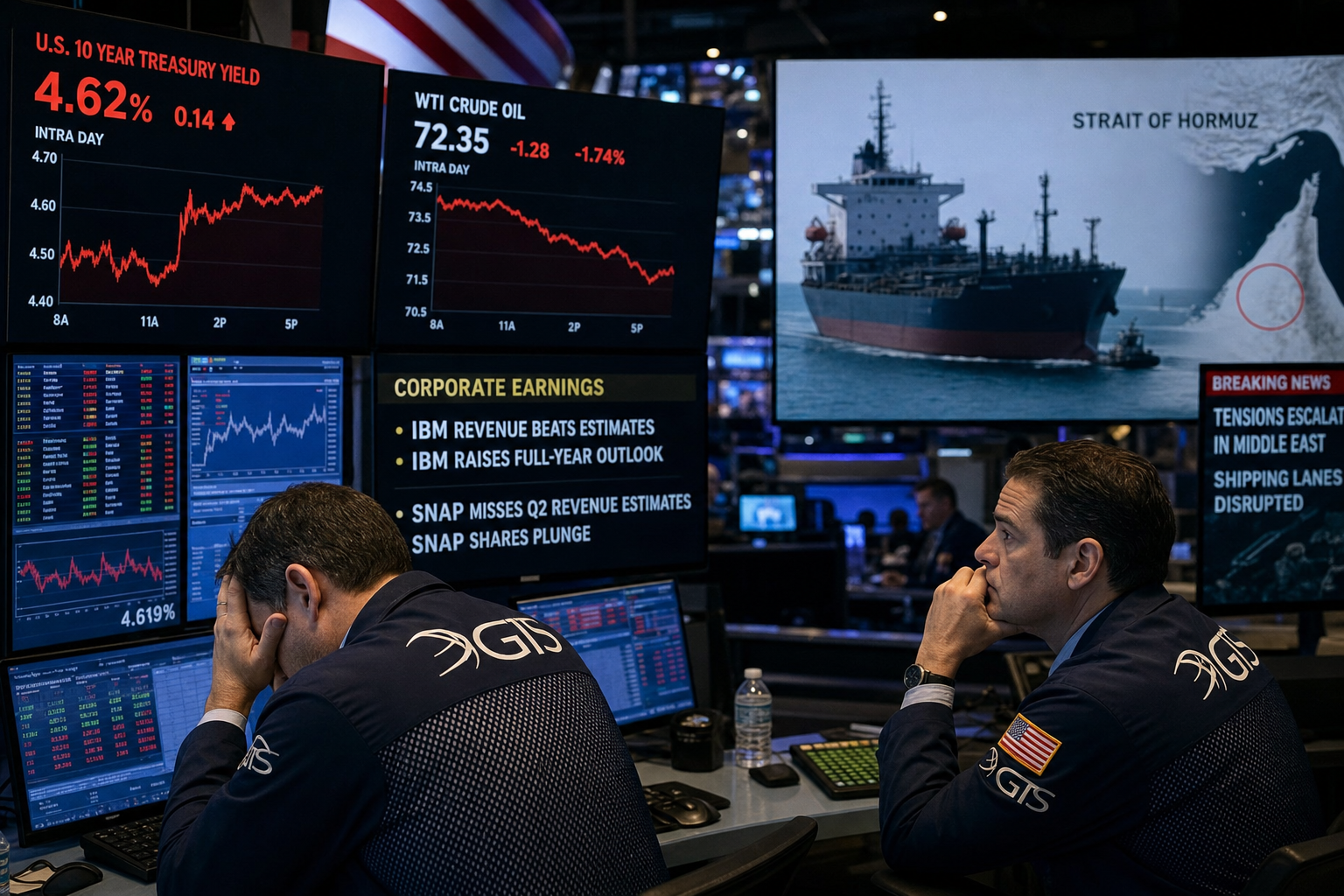
CNBC’s Daily Open highlights a market environment dominated by multiple simultaneous sources of tension: a divided Federal Reserve decision, escalating U.S.-Iran conflict, and major earnings-driven moves in technology stocks. The Federal Reserve held interest rates steady at 3.5%-3.75% in a 9-3 split decision, which unsettled investors and helped push Treasury yields higher while equities sold off sharply. The Dow Jones Industrial Average suffered its worst drop since April 2025, reflecting broader market anxiety over the Fed’s internal disagreement and uncertainty about future policy direction.
At the same time, geopolitical risk intensified after President Donald Trump threatened Iran with a “beating” following a surprise attack, while U.S. Central Command struck Iran in response. Those developments drove oil prices sharply higher, with Brent crude and West Texas Intermediate both surging. The article frames these events as part of a broader rise in “fighting,” both literal and metaphorical, across politics, monetary policy, and markets.
In corporate news, Meta was punished by investors after its second-quarter results missed forecasts and its guidance disappointed, causing the stock to plunge nearly 10%. In contrast, Microsoft rallied after posting stronger-than-expected fiscal fourth-quarter revenue and reaffirming steady capital expenditure plans for 2026. The article closes by turning to the global AI competition, noting that the United States wants Asian countries to adopt American AI systems, but China remains competitive thanks to cheaper offerings. Overall, the piece combines market-moving headlines with a broader geopolitical and strategic lens on U.S.-China technology competition.
Entities: Federal Reserve, Kevin Warsh, Donald Trump, Iran, U.S. Central Command • Tone: analytical • Sentiment: negative • Intent: inform
30-07-2026
Shell reported a much stronger-than-expected second-quarter profit, with adjusted earnings nearly doubling from the previous quarter and more than doubling from a year earlier, as the company benefited from higher oil and gas prices driven by conflict in the Middle East. The British energy major posted adjusted earnings of $9.84 billion for April through June, exceeding analyst forecasts of $8.79 billion and also topping Shell’s own company-provided estimate of $8.92 billion. The result underscores how major energy producers are gaining a short-term boost from elevated fossil-fuel prices amid the Iran war and broader regional instability.
The article places Shell’s performance in the context of a wider rally in energy stocks and commodity prices. Shell’s second-quarter adjusted earnings rose sharply from $4.26 billion in the same period last year and from $6.92 billion in the first quarter of 2026. The article notes that the United States launched its first airstrike in the Middle East since pausing its bombing campaign, after U.S. Central Command described the strikes as a response to attempted Iranian attacks on American forces. That backdrop helps explain the market environment supporting oil majors. Despite Shell’s strong year-to-date share gain of about 21%, the company is said to be trailing several peers, including BP, TotalEnergies, Exxon Mobil, and Chevron. The piece is framed as breaking news and focuses primarily on Shell’s earnings surprise and the geopolitical driver behind it.
Entities: Shell, BP, TotalEnergies, Exxon Mobil, Chevron • Tone: analytical • Sentiment: positive • Intent: inform
30-07-2026
The article examines how rising attacks and threats around major maritime chokepoints — especially the Strait of Hormuz, the Red Sea, the Black Sea, and the Sea of Azov — are disrupting global shipping and exposing the fragility of trade routes that carry most of the world’s merchandise. It argues that drones and missiles are changing maritime warfare by making it cheaper for smaller actors to threaten commercial vessels, ports, and infrastructure, with consequences that ripple into energy, food, and consumer-goods prices worldwide. The piece highlights Russia-Ukraine maritime attacks in the Black Sea and Sea of Azov as a major example, noting disrupted grain, oil, coal, and steel flows and the degradation of Russia’s Black Sea fleet.
The article then turns to the Strait of Hormuz, where shipowners are facing both physical threats and uncertainty about whether passage is safe. Even when governments say a route is open, shipping companies, insurers, and crews make their own risk calculations, often leading to rerouting, higher insurance premiums, inventory buffers, and surcharges. Experts quoted in the story argue that these disruptions are not isolated events but part of a broader shift toward maritime corridors becoming battlegrounds in a changing geopolitical order. The Panama Canal is presented as a possible next flashpoint, given geopolitical tensions and potential weather-related constraints. Overall, the article portrays a world in which maritime logistics are increasingly central to conflict, and where companies must prepare for persistent transportation uncertainty rather than temporary disruptions.
Entities: Strait of Hormuz, Red Sea, Black Sea, Sea of Azov, Panama Canal • Tone: analytical • Sentiment: negative • Intent: inform