30-07-2026
Japan’s south-western Kyushu region is reeling after a powerful earthquake triggered more than 100 aftershocks and left at least 13 people dead, with several others still missing and many more reported in cardiac arrest pending official confirmation. Rescue teams are searching collapsed and damaged buildings, including a paper factory and an Aeon Mall in Kumamoto prefecture, where an explosion and partial floor collapse trapped or unaccounted for multiple workers and shoppers. Prime Minister Sanae Takaichi described the situation as a race against time, while authorities warned residents to remain alert for potentially strong aftershocks in the coming days. The quake also caused widespread disruption, including power cuts, suspended trains, damaged roads and bridges, and fires in some buildings. Thousands of residents have been evacuated, and officials are taking precautions against heatstroke as rescue operations continue in extreme heat. The article also includes eyewitness accounts from residents and tourists describing shock, fear, and confusion during the quake.
Entities: Kyushu, Kumamoto prefecture, Kumamoto city, Yatsushiro City, Kashima • Tone: urgent • Sentiment: negative • Intent: inform
30-07-2026
A powerful earthquake in southwestern Japan killed at least 18 people and injured at least 62, with officials warning the death toll could rise as rescue teams searched for survivors. The hardest-hit areas included a damaged Aeon Mall in Kashima and a Nippon Paper Industries factory in nearby Yatsushiro, where collapses and a suspected gas explosion left people trapped or missing. Soldiers, firefighters, emergency workers, and Japan’s Self Defense Forces, joined by rescuers from Taiwan, combed through wreckage under sweltering conditions, while families and witnesses waited anxiously for news of missing relatives and friends.
The quake, measured by the U.S. Geological Survey at magnitude 6.8, caused major damage across Kumamoto prefecture on the island of Kyushu. Around 34,900 homes remained without electricity and about 15,000 lacked running water, forcing more than 8,800 people into over 400 shelters. Transport disruptions continued as bullet train service remained suspended, though Aso Kumamoto airport reopened with some flight cancellations. Prime Minister Sanae Takaichi said the government was preparing aid deliveries and pledged a full rescue effort, emphasizing that the operation was a race against time. The article also notes that Kumamoto was struck by a deadly earthquake in 2016, underscoring Japan’s vulnerability as one of the world’s most quake-prone countries.
Entities: Kumamoto, Japan, Kyushu, Kashima city, Aeon Mall • Tone: urgent • Sentiment: negative • Intent: inform
30-07-2026
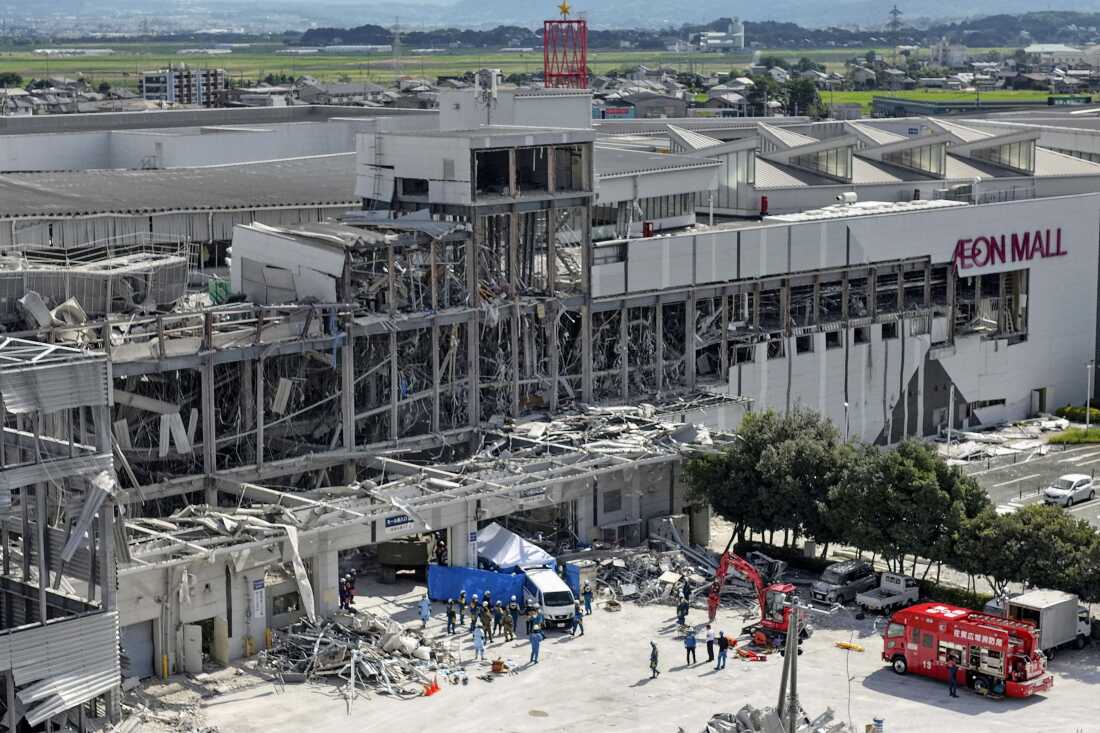
A powerful earthquake in Japan's Kumamoto Prefecture destroyed a recently reopened Aeon Mall that had symbolized the region’s recovery from the devastating 2016 Kumamoto earthquake. The mall, which had undergone years of reconstruction and seismic upgrades, was forced to evacuate about 200 shoppers after the quake struck. Roughly an hour later, a major explosion tore through the building, blowing off exterior walls and exposing the steel structure, while 20 to 30 employees were reported unaccounted for. Rescue efforts were delayed because of the danger of aftershocks. Local officials said at least 50 people were injured across the region, and authorities also reported multiple fires and a temporary closure of Kumamoto Airport. The quake initially prompted a brief tsunami advisory for parts of Kyushu, later lifted. Witnesses reported smelling gas before the explosion, raising concern that a gas leak may have contributed. The article emphasizes both the scale of the damage and the symbolic loss, since the mall had been rebuilt as a visible marker of Kumamoto’s recovery and reopening after the 2016 disaster.
Entities: Aeon Mall, Kumamoto Prefecture, Kumamoto, Japan, 2016 Kumamoto earthquake • Tone: urgent • Sentiment: negative • Intent: inform
30-07-2026
Rescue efforts in southwestern Japan were intensifying but hope of finding more survivors was fading two days after a magnitude 7.1 earthquake struck Kumamoto Prefecture on Kyushu. The quake caused widespread damage, including a deadly explosion at Aeon Mall Kumamoto, the collapse of a factory chimney in Yatsushiro, and the flattening of homes in rural communities. At least 23 people were reported dead by local authorities, while the national government gave a higher police-based figure of 28, noting that some cases might later prove unrelated to the earthquake. Another 63 people were injured, five seriously, and the number missing remained unclear.
The disaster disrupted daily life across the region: tens of thousands of homes lost power, water service remained interrupted in some areas, and more than 10,000 people spent the night in roughly 400 evacuation shelters. Officials warned of illness and heat stress as temperatures were expected to reach 33 C (91 F), prompting a heat stroke alert. Accounts from survivors highlighted the desperation of rescue efforts, with families pulling loved ones from rubble and waiting anxiously for updates near collapsed structures. The article emphasizes the scale of the destruction, the strain on emergency services, and the uncertainty surrounding the final death toll and number of missing people.
Entities: Japan, Kyushu, Kumamoto Prefecture, Kumamoto, Kashima • Tone: urgent • Sentiment: negative • Intent: inform
30-07-2026
The article reports that the death toll from a major earthquake in south-western Japan has risen to 28, with at least 62 people injured and the number likely to increase as search-and-rescue operations continue. The 6.8-magnitude quake struck Kumamoto prefecture on the island of Kyushu, causing widespread destruction to homes, a shopping mall, a paper mill, and industrial facilities. Rescue work is being hampered by extreme heat of up to 35C and a strong 5.8 aftershock, while around 5,000 Self-Defence Forces personnel and other emergency workers search for survivors and recover bodies.
A major focus of the response is the Aeon mall in Kashima, where a gas explosion followed evacuations and killed six of the 12 people pulled from the rubble. The company said shop workers returned to the building after evacuation and its president publicly apologized, acknowledging the explosion was not anticipated and remains under investigation. At the Nippon Paper mill in Yatsushiro, workers were trapped after a chimney collapsed; five are confirmed dead, two were badly injured, and four others were still being searched for. The quake also killed a Vietnamese technical intern at a factory when a crane fell on him.
The disaster has caused major infrastructure damage, leaving nearly 23,000 homes without electricity and 75,000 without running water, while about 15,000 people have been evacuated to shelters. Japan’s defence minister said supplies including coolers, water, and food were being airlifted and shipped to affected areas. The article also notes the quake’s impact on industry: Toyota, Honda, Sony, Renesas, and Tokyo Electron have halted or paused operations, while TSMC resumed production. Authorities and residents described the quake as one of the strongest in living memory, and officials said Kyushu’s industrial base is now facing significant disruption even as recovery efforts continue.
Entities: Japan, Kumamoto prefecture, Kyushu, Kashima, Yatsushiro • Tone: urgent • Sentiment: negative • Intent: inform