29-09-2026
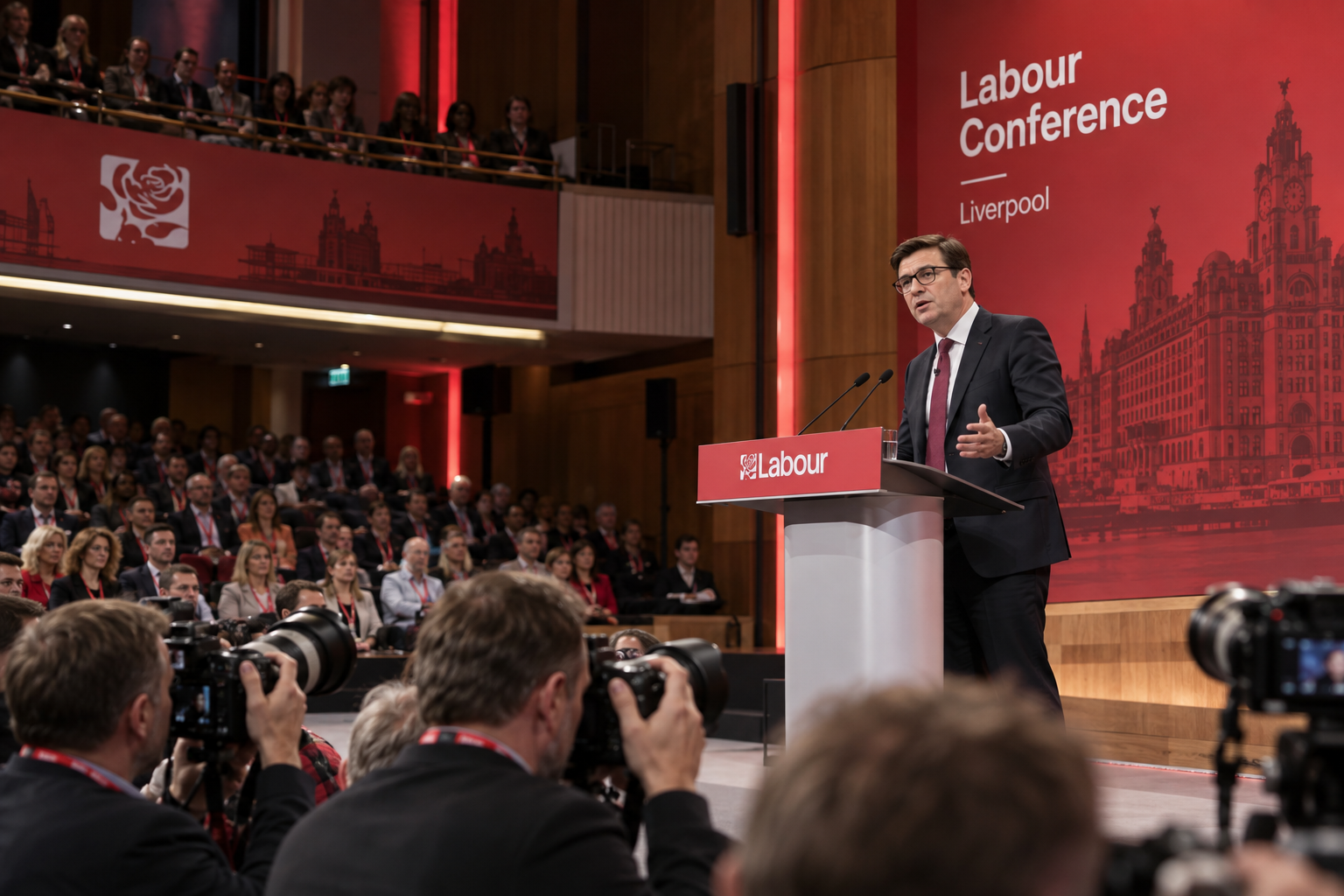
At the Labour Party conference in Liverpool, Prime Minister Andy Burnham presented his government as a break with what he called “politics as usual,” promising to restore hope through an honest discussion of Britain’s problems. He invoked Clement Attlee’s post-war Labour government and the creation of the National Health Service as examples of government acting in the public interest. Burnham argued that decades of deindustrialization, deregulation, privatization, austerity and Brexit had left power concentrated and communities neglected. He identified social care, youth unemployment and greater public control of essential services such as energy, water and housing as issues his government must address.
The article emphasizes the constraints on Burnham’s ambitions. Britain faces sluggish growth, cost-of-living pressures and strained public finances, while borrowing costs have risen. His government must also contend with prior Labour commitments and financial markets’ reluctance to tolerate additional borrowing. Burnham promised a fully funded National Care System by the next election, scheduled for 2029, and announced a commission on electoral reform. Labour intends to campaign for a voting system in which every vote counts, while Burnham invited other parties to help develop reform proposals.
Labour faces political competition from Reform UK on the right, the Green Party on the left, and nationalist parties in the UK’s devolved nations. The article reports that some conference attendees respond positively to Burnham’s ability to understand public concerns and communicate optimism, while calling for priorities including council housing, wealth taxes and closer ties with Europe. Burnham acknowledged that Brexit had done more harm than good but offered few details on a future relationship with Europe. Overall, the speech’s hopeful message is set against substantial fiscal, political and policy challenges.
Entities: Andy Burnham, Keir Starmer, Clement Attlee, Angela Rayner, Labour Party • Tone: analytical • Sentiment: neutral • Intent: analyze
29-09-2026
In his first speech as UK prime minister at Labour’s annual conference in Liverpool, Andy Burnham presented a long-term programme he described as a “new path” for Britain. He promised a new social contract, greater public control over essential services, changes to the electoral system, more authority for local leaders and a renewed relationship with the European Union. Burnham also defended plans for a free National Care Service in England, saying it would support people living with illness or disabilities, though it would not be introduced until after the next general election, expected in 2029.
The speech was personal and emotional: Burnham paused while recalling his father, who died earlier in the month from Alzheimer’s. He acknowledged that his proposals could carry a political cost and that some people would disagree with them. His plans include reversing privatisation in areas such as water, reindustrialising the country, ending rough sleeping and building council housing. He said his government would introduce a bill to repeal the ban on public ownership of water companies introduced under Margaret Thatcher.
The proposals face significant financial and political challenges. The Health Foundation estimates that a social-care system modelled on the NHS could cost almost £19 billion a year. Burnham suggested changing the pension triple lock to help fund his programme, drawing criticism from Reform UK leader Nigel Farage. The UK is also contending with weak economic growth, high borrowing costs and energy prices, as well as pressure to increase defence spending to meet NATO commitments.
Burnham said Brexit had done “more harm than good” and promised to present options for future EU ties at a planned summit. His speech received praise from some conference attendees, but a YouGov poll showed Labour trailing Reform by one percentage point. He also announced a new government body to invest in the electricity grid, aiming to reduce energy costs.
Entities: Andy Burnham, Labour Party, Liverpool, United Kingdom, European Union • Tone: analytical • Sentiment: neutral • Intent: inform
29-09-2026
New British Prime Minister Andy Burnham used a speech at the Labour Party’s annual conference to outline a broad programme for changing the country. He promised a “new social contract for the 21st century,” including a rethink of Britain’s relationship with the European Union and its other European neighbours, reform of the electoral system, and a new social care service. His vision also included more social housing, better education and more affordable care for older people.
Burnham, who became leader of the UK’s governing party two months earlier, presented the proposals as a response to difficult times. He argued that limited or incremental measures would not be enough, saying, “Small things will not get us through what are difficult times.” At the same time, he acknowledged that the country’s economic constraints make delivering the plans politically risky. The article reports that he said funding for the changes would have to come from welfare and pension spending, highlighting potential trade-offs behind the programme.
The speech was described as tough-love and crowd-pleasing, combining ambitious pledges with a warning about their costs. Overall, the article focuses on the scale of Burnham’s proposed reforms and the political and economic risks associated with implementing them. It does not provide details about the specific reforms, their cost, or how any changes to welfare and pensions would be made.
Entities: Andy Burnham, United Kingdom, European Union, Labour Party, Associated Press • Tone: analytical • Sentiment: neutral • Intent: inform
29-09-2026
Damien McElroy argues that UK Prime Minister Andy Burnham is right to rule out a general election before 2029. In the article’s view, political stability is valuable amid international turmoil, and another rapid change in leadership could deepen the impression of a country lurching between political options. Burnham has been in office for just over two months, but his popularity among Labour members and his consensual, empathetic approach have given the party a sense of unity and direction.
An early election would offer little clear advantage in a political landscape where several parties are competitive in different regions. Burnham is also constrained by Labour’s 2024 manifesto, especially its commitment not to raise three major taxes, while the UK faces a debt crisis and limited government resources. McElroy presents the decision to serve out the parliamentary term as a harder but potentially more beneficial course: Burnham can confront economic pressures, make difficult decisions and establish a record before asking voters for another mandate.
The article praises Burnham for not adopting the “doom” narrative of elite commentators, while acknowledging that fiscal and welfare pressures will require choices. It also points to speculation about possible tax changes as a source of destabilising uncertainty, citing pension withdrawals ahead of budget announcements. Finally, McElroy describes a less divided Labour conference in Liverpool, attributing part of the improved mood to Burnham’s approach and policies, including sanctions on West Bank settlements. The supplied article ends mid-sentence while discussing the government’s policy on US defensive operations in the Strait of Hormuz.
Entities: Andy Burnham, Damien McElroy, Keir Starmer, Justin Madders, Rachel Reeves • Tone: analytical • Sentiment: positive • Intent: persuade
29-09-2026
At the Labour Party conference, UK Prime Minister Andy Burnham described Brexit as having “done more harm than good” and signalled a substantial change in the government’s approach to the European Union. He announced an EU summit, expected in November, to discuss long-term options for a closer relationship with the UK’s largest trading partner. Possibilities could include rejoining the single market and customs union, or eventually returning to the EU, potentially following another referendum. Burnham said the country needed clarity about its future relationship with Europe, while stopping short of endorsing a particular option. The article notes polling suggesting that almost two-thirds of Britons regard leaving the EU as a mistake, and that an average of 61 per cent would vote to rejoin, compared with the 2016 result in which 52 per cent voted to leave. The article also links post-Brexit immigration concerns to the political gains of Nigel Farage’s Reform party. Beyond Europe, Burnham promised wide-ranging domestic changes: replacing the pensions triple lock with a double lock from 2030, using savings to support a universal National Care Service, considering proportional representation through a new commission, and building a publicly controlled electricity grid and more council housing. He also pledged £2 bus journeys, continued support for Ukraine, and support for a two-state solution in the Middle East. The speech was presented as a deliberate break from conventional political messaging, with Burnham arguing that Britain had been on the wrong path and that a new economy and political approach were needed.
Entities: Andy Burnham, Labour Party conference, United Kingdom, European Union, Brexit • Tone: analytical • Sentiment: neutral • Intent: inform