29-07-2026
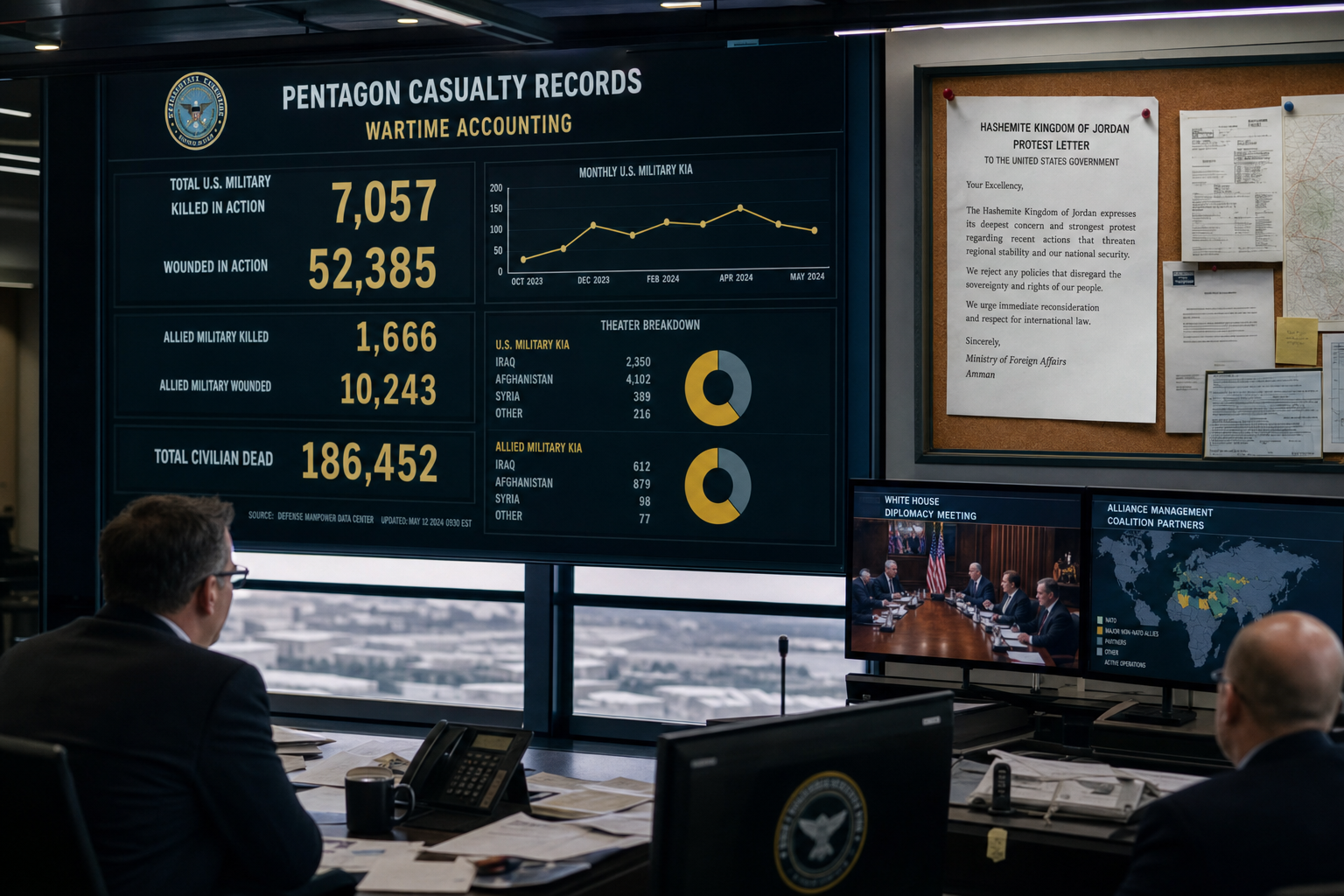
The article reports that the Pentagon’s public casualty database has been updated to list four U.S. service members killed in Jordan and Iraq in July under “Overseas Operations Casualties,” separating them from 14 others who are listed as deaths tied to the war with Iran under the Defense Department’s Operation Epic Fury designation. The database had briefly shown the four deaths within the Iran-war tally, but those names were later removed, reducing the war death count from 18 to 14. The New York Times reported that unnamed sources attributed the discrepancy to the timing of a ceasefire, but CBS notes the four service members died after President Trump said military action had resumed on July 7. The four killed were 1st Lt. Tyler James Feehan, Sgt. Angel S. Rampersad, Pvt. Isabella Gonzales, and Sgt. Michael Emmanuel Swinton.
Pentagon spokesperson Sean Parnell said the inconsistencies were due to “site errors” and a “temporary data disruption” in the Defense Casualty Analysis System, insisting the anomalies were being fixed. He also criticized the New York Times for allegedly pushing a “completely fake story.” The article describes broader confusion over how the Pentagon categorized deaths and injuries connected to the conflict, noting that earlier casualty releases also initially misclassified some deaths under Operation Inherent Resolve before being amended.
The story further highlights criticism of the Pentagon’s limited transparency about injuries during the conflict. CBS News reports that nearly 100 service members have been injured since July 7, with Parnell saying 96% had returned to duty and most injuries were minor concussions. However, the Pentagon has not briefed reporters on the Iran war since May, and officials have not commented on the four deaths’ classification. The article ends by noting the casualty website’s wounded count had changed significantly from earlier figures, underscoring ongoing uncertainty about the official tally.
Entities: Pentagon, Defense Department, Defense Casualty Analysis System, Operation Epic Fury, Operation Inherent Resolve • Tone: analytical • Sentiment: negative • Intent: inform
29-07-2026
President Trump held separate closed-door meetings at the White House with Ukrainian President Volodymyr Zelenskyy and Israeli Prime Minister Benjamin Netanyahu, as the wars in Ukraine and Iran remained central international crises. The meetings took place without reporters present and were later described by Trump on Truth Social as productive, with “many important subjects” discussed with Netanyahu and a meeting with Zelenskyy that “went very well.” Zelenskyy said he and Trump discussed licensing for the production of Patriot missile interceptors, a critical defense need for Ukraine, along with broader diplomatic efforts that he said should be reinvigorated. He also thanked the United States for its continued support and offered condolences over the death of Sen. Lindsey Graham, whom he called a true friend of Ukraine.
The article notes that Trump and Zelenskyy had met earlier in the month on the sidelines of NATO in Turkey, where Trump said the U.S. would allow Ukraine to build its own Patriot missiles. After the Zelenskyy meeting, Trump met Netanyahu behind closed doors, though no official readout was released. The article highlights some tension and distance in Trump’s relationship with Netanyahu, contrasting Trump’s historically strong support for the Israeli leader with recent comments urging him to take a “softer touch” and be more responsible regarding Lebanon. Trump also dismissed suggestions that Netanyahu would brief him on Iran’s underground nuclear site at Pickaxe Mountain, saying he did not need Netanyahu to tell him what was happening there and implying Netanyahu wanted to keep the U.S. engaged.
Entities: Donald Trump, Volodymyr Zelenskyy, Benjamin Netanyahu, Sen. Lindsey Graham, White House • Tone: analytical • Sentiment: neutral • Intent: inform
29-07-2026
An open letter signed by hundreds of Jordanian political, legal, and public figures is urging the government to remove U.S. troops from Jordan, reflecting rare public dissent in a country where criticism of the state is often constrained. The signatories argue that the American military presence exposes Jordan to security, political, and economic dangers and could drag the kingdom into a regional war in which it is not a direct participant. Their concerns have intensified as Iranian missiles and drones have increasingly targeted U.S. forces and installations in Jordan, triggering sirens and raising fears that Jordan is being pulled deeper into the Iran-Israel-U.S. conflict.
The article explains that Jordan hosts about 4,000 U.S. soldiers and serves as a key hub for American military operations in the Middle East. Although the Jordanian government has remained aligned with Washington, analysts say this is driven partly by the country’s dependence on U.S. aid, which totaled $1.65 billion last year. The war has also worsened Jordan’s already fragile economy, damaging tourism and adding pressure to a kingdom facing high unemployment and limited natural resources.
The piece highlights the political risks faced by those speaking out. Signatories say they fear arrest or retaliation, and past examples of state crackdowns reinforce those concerns. Public debate in parliament revealed anger toward the U.S. military presence, while local media reportedly avoided publishing the letter. Experts quoted in the article say the open letter is significant but may not spark broad mass dissent because fear and self-censorship remain strong. Overall, the story portrays a tense moment in Jordan, where public frustration, security fears, and dependence on U.S. support are colliding.
Entities: Jordan, United States, Iran, Israel, U.S. forces • Tone: analytical • Sentiment: negative • Intent: inform