28-07-2026
US President Donald Trump said there were “very friendly negotiations” and “good talks” underway regarding the conflict with Iran, suggesting a possible end to the war after three straight days without exchanged strikes. Speaking aboard Air Force One, Trump said he was optimistic but warned that the United States would resume military action if the talks failed. Tehran denied that any direct negotiations were taking place. The pause in fighting followed nearly two weeks of daily US strikes and tit-for-tat attacks, which had effectively undone the earlier June ceasefire and heightened tensions around the Strait of Hormuz, a critical oil shipping route.
The article places the pause in the broader context of the US-Iran war, which began after US and Israeli strikes on 28 February and drew retaliatory missile and drone attacks from Iran on US bases and Israeli targets. A June memorandum of understanding briefly sought to stop military operations and reopen the Strait of Hormuz, but attacks resumed after Iranian forces struck tankers in the waterway on 13 July. Washington then restarted air strikes and a naval blockade, while Tehran retaliated again across the Middle East. The reporting also notes the economic impact of de-escalation hopes, with oil prices falling sharply, and addresses Trump’s dismissal of claims that US ammunition stockpiles were running low. White House officials insisted the US military had ample munitions and that defense contractors were being pushed to produce more weapons.
Entities: Donald Trump, Iran, Tehran, United States, White House • Tone: analytical • Sentiment: neutral • Intent: inform
28-07-2026
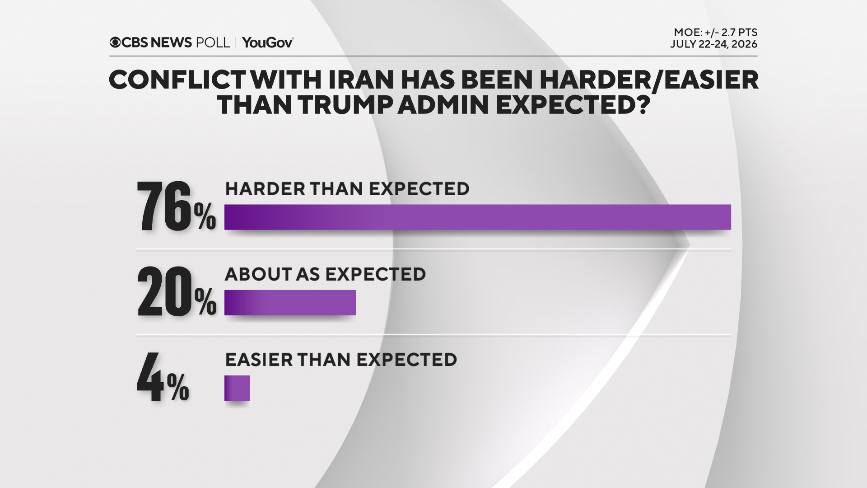
A CBS News/YouGov poll finds that Americans remain deeply uncertain and frustrated about the Iran conflict, with many saying they still do not understand what is happening day to day and believing the fighting is not going well. The survey suggests that most people expect the conflict to continue for months or even years, and a large share think it has been harder than the Trump administration expected. Public priorities remain consistent: most Americans want the United States to open the Strait of Hormuz, stop Iran’s nuclear program, and prevent Iran from threatening the region. At the same time, the majority preference is to end the war rather than seek additional concessions, although support for ending it immediately has declined since a ceasefire deal fell apart, especially among Republicans. Younger Americans are more likely than older ones to favor ending the war. The article also notes that Trump’s handling of the conflict is viewed as offering little clarity, with many saying he makes the situation sound better than it is. Broader views on the domestic economy remain negative but stable, and gas prices, inflation, and tariffs continue to weigh on public opinion. Overall approval of U.S. action in Iran remains net negative and stable, while the public does not see a clear alternative approach from either party.
Entities: Iran, Strait of Hormuz, Trump administration, President Trump, Republicans • Tone: analytical • Sentiment: negative • Intent: inform
28-07-2026
In this Face the Nation transcript, U.S. Ambassador to the United Nations Mike Waltz defends the Trump administration’s approach to Iran, arguing that the president’s goals are to stop Iran from obtaining a nuclear weapon, protect regional security, and pressure the Iranian regime through a mix of military readiness and diplomacy. Waltz says the recent pause in bombing is intended to give negotiations room to continue, while making clear that additional U.S. military assets are moving into the region and that “all options are on the table.”
The interview also touches on reports about U.S. military stockpiles, with Waltz rejecting claims that the U.S. lacks needed precision munitions or interceptors and instead emphasizing that Iranian military capabilities have been severely degraded. Brennan presses him on whether there has been a final decision by the president regarding further strikes, but Waltz says that decision remains pending.
The conversation expands to broader geopolitical concerns, including alleged Russian support for Iran and the Russia-Iran military relationship, especially involving drones and drone technology. Waltz says the president has warned both Vladimir Putin and Xi Jinping not to assist Iran. The transcript concludes with discussion of a Saudi-U.S. civilian nuclear deal, which Waltz frames as part of a broader U.S. nuclear strategy and says does not include providing Saudi Arabia enrichment technology. Overall, the interview presents the administration as pursuing a force-backed diplomatic strategy to curb Iran’s nuclear ambitions while advancing U.S. nuclear cooperation with allies.
Entities: Mike Waltz, Margaret Brennan, United Nations, Face the Nation, Donald Trump • Tone: analytical • Sentiment: neutral • Intent: inform
28-07-2026
In this CBS News interview-focused article, U.S. ambassador to the United Nations Mike Waltz argues that the recent pause in U.S. strikes against Iran is creating an opening for diplomacy, while also stressing that the U.S. is not reducing its military posture in the region. Waltz praises President Trump as a leader who is giving peace a chance and says additional military assets are being deployed to the Middle East, countering reports that U.S. weapons stocks are running low. The article places these remarks in the context of a 13-day bombing campaign that followed the collapse of a prior ceasefire, as well as a temporary pause by Tehran. It also notes that Iranian and Omani officials have been holding constructive discussions, with Oman receiving praise for its diplomatic role.
The piece broadens into a broader debate over U.S. policy toward Iran by highlighting sharply different views from Senators Bernie Sanders and John Kennedy. Sanders calls for renewed diplomacy, arguing that further conflict harms Americans through higher gas prices and economic strain. Kennedy, by contrast, urges a tougher approach, opposing immediate withdrawal, advocating tighter sanctions, and suggesting continued pressure on Iran, including strikes on a suspected nuclear site. The article also references a CBS News poll showing the public feels uncertain and frustrated about the conflict, and believes the war is not going well even while supporting goals such as limiting Iran’s nuclear ambitions and securing the Strait of Hormuz.
Entities: Mike Waltz, U.N. ambassador, United Nations, President Trump, Iran • Tone: analytical • Sentiment: neutral • Intent: inform
28-07-2026
Oil prices fell on Tuesday as a temporary pause in fighting between the United States and Iran held, easing fears of an immediate escalation in the Middle East that could disrupt global energy supplies. Brent crude for September delivery dropped more than 1% to $87.24 a barrel, while West Texas Intermediate fell 1.22% to $81.6 a barrel. The market reaction reflected hopes that the conflict, which has rattled oil traders because of its potential to affect shipping lanes and energy infrastructure, might not intensify right away.
The article notes that Tehran denied reports it had agreed to a 10-day ceasefire with the U.S., though hostilities were still temporarily paused. That pause followed reports that the U.S. had limited munitions stockpiles, influencing military decision-making. President Donald Trump had earlier told Axios he was considering a “massive attack” on Iran, but later backed away from those plans, according to reporting by The New York Times, amid concerns about weapons stockpiles. Trump also told reporters aboard Air Force One that the military had “plenty” of ordnance.
Despite the drop in prices, the article emphasizes that risks remain elevated. The Commonwealth Bank of Australia said the decline reflects reduced fears of an immediate escalation, but warned that global energy supply risks are still high. In particular, the bank said disputes over the Strait of Hormuz, a crucial oil shipping route, could reignite hostilities and again threaten energy flows.
Entities: Oil prices, Brent crude, West Texas Intermediate (WTI), United States, Iran • Tone: analytical • Sentiment: negative • Intent: inform
28-07-2026
The article is a live news update on the effects of the US-Iran conflict on global markets, regional diplomacy, and military developments. The biggest immediate market reaction is a sharp drop in oil prices after President Donald Trump said the United States had paused strikes on Iran at Tehran’s request, while warning that attacks could resume if a ceasefire deal is not reached. Brent crude and US oil both fell significantly, reflecting trader hopes for de-escalation, but the article emphasizes that the situation remains fragile because Iran says it is not currently negotiating with the US and regional tensions continue to spread.
The report also tracks related security incidents and diplomatic efforts across the Middle East. Jordan said it shot down a drone that violated its airspace, and Saudi Arabia reported intercepting drones launched from Iraq toward oil facilities in its eastern regions. Several countries condemned those attacks, while Oman launched diplomatic outreach to seek a political solution. The article notes that shipping through the Strait of Hormuz remains below normal levels and that traders remain concerned about disruption to both Gulf and Red Sea export routes.
On the political front, Trump is set to host Ukrainian President Volodymyr Zelensky and Israeli Prime Minister Benjamin Netanyahu at the White House for separate discussions. Those meetings are expected to focus on the war in Iran, the Russia-Ukraine peace process, and broader Middle East diplomacy, including Lebanon and the Abraham Accords. Overall, the article presents a fast-moving but unstable pause in hostilities, with oil markets, shipping, and diplomacy all reacting to the possibility that the conflict could flare up again.
Entities: Donald Trump, Volodymyr Zelensky, Benjamin Netanyahu, Iran, United States • Tone: analytical • Sentiment: neutral • Intent: inform
28-07-2026
The article examines how Benjamin Netanyahu’s upcoming meeting with Donald Trump is unfolding under very different circumstances than previous visits, with the once warmly aligned relationship now strained by disagreements over Iran, Lebanon, Syria, Saudi Arabia, Turkey, and Trump’s broader regional strategy. Netanyahu is seeking to use the meeting to shore up ties with Trump ahead of Israel’s October election and to secure reassurance on key security issues, including advanced U.S. arms sales to Turkey, potential U.S.-Saudi nuclear cooperation, and a new long-term U.S.-Israel defense pact. But Trump appears increasingly frustrated with Netanyahu’s approach, especially after the Iran war failed to produce the decisive outcome Trump had expected and after Israel’s continued regional military operations complicated Trump’s desire for de-escalation. The article suggests that the relationship remains strategically important for both leaders, yet it is now marked by tension, political calculation, and diverging priorities. Trump still offers Netanyahu valuable political support, while Netanyahu hopes direct engagement can bypass internal administration resistance and preserve Israel’s military and diplomatic interests. The article also situates the meeting in the context of Netanyahu’s fragile reelection prospects, indicating that his diplomacy with Trump is tied closely to domestic political survival.
Entities: Benjamin Netanyahu, Donald Trump, Iran, Tehran, Lebanon • Tone: analytical • Sentiment: neutral • Intent: inform
28-07-2026
President Trump said he sees a “good chance” for renewed diplomacy with Iran, but the article questions what he actually hopes to achieve after two weeks of U.S. airstrikes failed to force major concessions. Trump said military pressure had driven Iran back toward talks and warned he could quickly resume strikes if negotiations did not produce results. Iran denied seeking talks under pressure and signaled it would communicate only through intermediaries such as Qatar and Pakistan. The central unresolved issue is restoring free navigation through the Strait of Hormuz, where shipping has been disrupted by Iranian actions and U.S. retaliation, sending oil prices higher and rattling markets.
The piece frames Trump’s approach as uncertain and unstable: he paused strikes over the weekend after warnings that the U.S. was short on interceptors and munitions, though he denied supply problems. Meanwhile, Israeli Prime Minister Benjamin Netanyahu is set to visit the White House and is expected to press Trump to continue the war, while some Republican leaders are urging him to end it because rising gas prices could hurt them politically ahead of the midterms. The article also notes efforts by U.S. and British officials to discuss an international coalition to protect shipping in the strait, suggesting Trump may need allied help after trying to act alone. Overall, the story portrays a conflict that is militarily inconclusive, diplomatically murky, and politically risky for the administration.
Entities: Donald Trump, Iran, Benjamin Netanyahu, Strait of Hormuz, Qatar • Tone: analytical • Sentiment: negative • Intent: analyze
28-07-2026
Israeli Prime Minister Benjamin Netanyahu is set to meet US President Donald Trump at the White House on July 28 in their first in-person talks since the outbreak of the Iran war, a meeting closely watched for signs of unity between the two leaders and their governments. The visit comes after months of public strain and sharp disagreements over the conduct of the war, with relations marked by Trump’s earlier criticism of Netanyahu and Netanyahu’s effort to downplay the tensions as tactical differences. The central issue on the agenda is Iran, but the meeting is also expected to address broader regional security concerns, including the implementation of the US-backed Israel-Lebanon deal, the future of the Abraham Accords, and the stalled reconstruction of Gaza.
The article frames the meeting as politically important for both leaders. For Trump, the discussion is likely to emphasize Iran and regional normalization efforts, while for Netanyahu it offers a chance to reassure allies and adversaries that there is no lasting rupture in US-Israel ties. Analysts quoted in the story suggest the leaders are more aligned on goals than on tactics, even if they disagree on timing and operational details. The piece also places the visit in domestic political context: Netanyahu is preparing for elections in Israel, faces public criticism over the failures that preceded Hamas’s October 7, 2023 attack, and is trailing in polls. Overall, the article highlights how the meeting is meant to project stability and coordination amid ongoing war, diplomatic uncertainty, and pressure on both leaders.
Entities: Benjamin Netanyahu, Donald Trump, Israel, United States, Iran • Tone: analytical • Sentiment: neutral • Intent: inform
28-07-2026
This CBS News transcript captures Vermont Sen. Bernie Sanders on "Face the Nation" discussing U.S. policy toward Iran, Democratic electoral strategy, and the broader struggle inside the Democratic Party between progressives and the party establishment. Sanders argues that the war in Iran is unconstitutional and illegal, says Congress has already voted for a War Powers Resolution, and calls for immediate negotiations to end the conflict and stop economic fallout such as rising gas prices. He also pivots to domestic politics, praising progressive candidates such as Troy Jackson, Abdul El-Sayed, and Peggy Flanagan as working-class challengers to a "rigged economy" dominated by billionaires and super PACs. Throughout the interview, Sanders frames inequality, campaign finance, and healthcare as central political issues, criticizing establishment figures like Rahm Emanuel and arguing that voters are increasingly drawn to progressive, grassroots candidates.
The interview is combative but measured, with Sanders repeatedly defending his endorsements and rejecting the idea that progressive candidates are hurting Democrats. He insists that the real problem is billionaire influence and a political system that protects the status quo. The transcript ends mid-answer as Brennan presses Sanders on whether a progressive in Michigan can defeat Republicans in a swing state.
Entities: Bernie Sanders, Margaret Brennan, Pete Hegseth, Donald Trump, Iran war • Tone: analytical • Sentiment: neutral • Intent: inform