29-07-2026
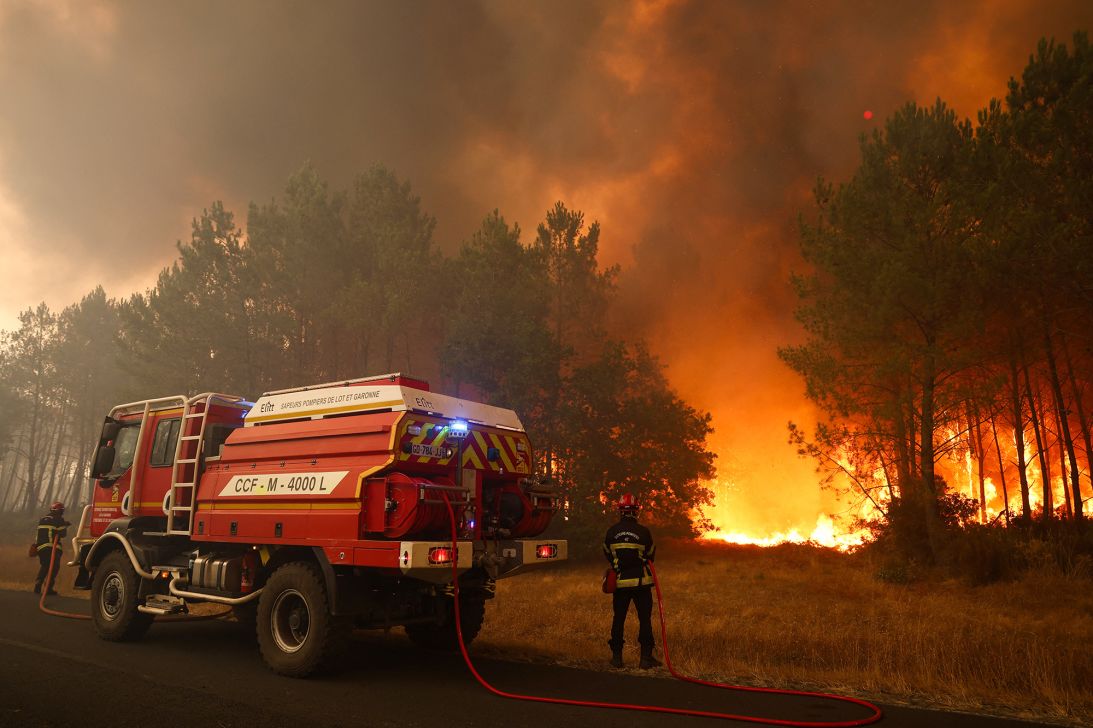
Firefighters in south-west France are battling renewed wildfires in the Gironde region as the area prepares for another intense heatwave that could push temperatures to 40C. The blazes, which have already forced widespread evacuations and destroyed homes, have intensified again in multiple locations, leaving officials warning that the situation remains dangerous and far from under control. About 2,000 firefighters have been deployed in Gironde, where the fires have spread through countryside between Bordeaux and the coast, and authorities have ordered new evacuations from campsites near Lacanau.
The article places the French crisis in a broader European context, noting that Spain and Portugal are also fighting severe wildfires amid extreme summer heat. In Spain, some evacuation orders have been lifted, allowing tens of thousands to return home, though officials still warn of difficult days ahead. In Portugal, hundreds of firefighters are tackling a major blaze in the Guarda area. In France, smoke and ash have affected Bordeaux and nearby communities, disrupting daily life, closing restaurants, and driving tourists away, even as officials say the city itself is not currently under direct threat.
Authorities in France are also treating the fires as a serious security and public safety issue. The health minister has urged residents to stay indoors because of air pollution, while the interior minister says many arrests have been made in connection with the fires. The article also highlights the strain on firefighters and the economic damage to tourism and local businesses, with residents and business owners describing the situation as unprecedented and catastrophic.
Entities: Gironde, Bordeaux, France, Spain, Portugal • Tone: urgent • Sentiment: negative • Intent: inform
29-07-2026
A major wildfire on France’s southern Atlantic coast is threatening communities near Bordeaux and forcing mass evacuations as firefighters battle an unusually fast-moving blaze. Officials say more than 2,500 firefighters are working to contain the fire, which has burned an area four times the size of Paris in less than a week and has injured at least 84 firefighters, destroyed more than 200 homes, and displaced more than 220,000 people. A second fire near Biscarrosse has also forced tens of thousands to flee, including residents of a nursing home and a children’s summer camp.
The article centers on American tourist Rebecca Papin from Tennessee, who became trapped in Biscarrosse with her two children after missing the evacuation order while sleeping. She describes being unable to leave because roads are blocked and fire threatens the only route out of town. Her experience illustrates the fear and confusion residents and visitors face as authorities tighten restrictions for safety.
The story also widens to the broader crisis in Spain, where the government has declared a national emergency as crews fight large fires near Madrid and Valencia, and one person has died. Scientists and officials link the fires to extreme heat and drought, noting that Western Europe has just recorded its hottest June on record. With another heat wave forecast to hit France and much of Western Europe, temperatures could reach 104 degrees Fahrenheit, worsening already dangerous conditions and raising fears that the fires may continue or intensify for weeks.
Entities: France, Bordeaux, Biscarrosse, Spain, Madrid • Tone: urgent • Sentiment: negative • Intent: inform
29-07-2026
Europe is facing a new era of extreme wildfires, according to the CNN article, as massive blazes in France and Spain display behavior once more associated with megafires in the United States, Canada, and Australia. The fires in southwestern France have burned with such intensity that they generated a pyrocumulonimbus cloud, a rare fire-induced thunderstorm, while Spain is battling its largest wildfire on record near Ávila. Experts say the scale, speed, and unpredictability of these fires reflect the growing impact of climate change, which is producing a “whiplash effect” of unusually wet conditions followed by severe heat waves that create explosive fuel loads. More than 300,000 people have been evacuated across both countries, and the fires have already scorched more than 116,000 hectares in France alone. French President Emmanuel Macron described the crisis as unprecedented and the hardest since World War II. Scientists warn that such fires may become increasingly common across Europe as fossil fuel-driven warming continues, potentially leading to larger, more destructive fire complexes and long-term damage to public health, economies, and the relationship between people and the land.
Entities: Europe, France, Spain, Bordeaux, Gironde • Tone: urgent • Sentiment: negative • Intent: inform
29-07-2026
The article centers on the village of Le Porge in France’s Gironde region, which has become emblematic of the country’s wildfire crisis. According to the report, before-and-after images illustrate the destructive scale of the fires, showing how quickly the landscape and nearby communities were transformed by the flames. As the wildfire advanced, authorities evacuated Le Porge, forcing most of its 3,500 residents to leave their homes behind in order to avoid danger.
The piece uses the village as a vivid example of the broader emergency facing France, where wildfires have caused widespread damage to land, property, and local life. The emphasis is less on a detailed chronological account and more on the human and visual impact of the fires: the evacuation of an entire town, the loss of normalcy for residents, and the stark contrast between the village before and after the blaze. The framing suggests a crisis that is both immediate and deeply disruptive, with the village serving as a symbol of how wildfire devastation reaches beyond burned terrain to affect communities, housing, and everyday life. The article is presented in a video-news format, underscoring the visual evidence of destruction and the urgency of the situation.
Entities: France, Gironde region, Le Porge, Isaac Ewart, CNN • Tone: urgent • Sentiment: negative • Intent: inform
29-07-2026
Massive wildfires in southwestern France are threatening critical defense, aerospace, and nuclear-adjacent industrial sites near Bordeaux as the country enters its fourth major heat wave of the year. The fires, fueled by high temperatures, dry conditions, and strong winds, have already burned more than 104,000 acres in the Gironde region and forced widespread evacuations, including residents, workers, and holidaymakers. French authorities have deployed military personnel and emergency teams to protect strategic facilities and assist firefighters.
The article highlights particular concern over sites in and around Saint-Médard-en-Jalles, Sainte-Hélène, and Le Barp, where factories and research centers are associated with missile propellants, rocket components, military materials, and aerospace production. According to reports cited in the article, some facilities were evacuated or closed as a precaution, and officials emphasized that there was no immediate risk of radioactive leakage at one research site because no nuclear materials were present. The fires have also disrupted thousands of businesses, destroyed homes, and added strain to a region already grappling with one of Europe’s worst wildfire seasons in decades.
The piece frames the situation as both a natural disaster and a strategic security issue, underscoring how climate-driven extreme weather can threaten critical infrastructure as well as communities. It situates the Bordeaux-area fires within a broader European crisis that has forced hundreds of thousands of evacuations across France and Spain.
Entities: France, Bordeaux, Gironde region, Emmanuel Macron, Roland Lescure • Tone: urgent • Sentiment: negative • Intent: inform
29-07-2026
France and Spain are both contending with major wildfire emergencies amid extreme heat and drought, though Spain has begun easing some evacuation restrictions as conditions improve slightly. In Spain, residents in 15 municipalities west of Madrid were allowed to return home after evacuation orders were lifted, but the damage was severe: blackened debris, burnt-out cars, and dozens of homes destroyed or damaged. Spanish officials described the fire as devastating, while Prime Minister Pedro Sanchez said the country was beginning to “turn the tide,” even as a new heatwave threatened to worsen conditions again.
In France, however, the situation remained more dangerous. The largest French wildfire since 1949, raging west of Bordeaux, had already forced more than 220,000 people to flee, destroyed 240 homes, and displaced tens of thousands more in the Gironde and Landes regions. Authorities said the fire had stabilized, allowing nearly 60,000 evacuees from three villages to return, but multiple nearby blazes reignited and hot, windy weather raised fears of fresh evacuations. Officials warned that the coming heatwave and dry winds could reignite fires and disrupt containment efforts.
The article places these fires in the wider context of Europe’s worsening climate conditions, with scientists linking repeated heatwaves and drought to human-caused climate change. It highlights the strain on emergency services, the displacement of residents, and the economic impact, including around 130,000 workers unable to work in France. Overall, the piece underscores that despite some signs of progress in Spain, western Europe remains under severe wildfire threat.
Entities: France, Spain, Madrid, Bordeaux, Gironde • Tone: urgent • Sentiment: negative • Intent: inform