28-09-2026
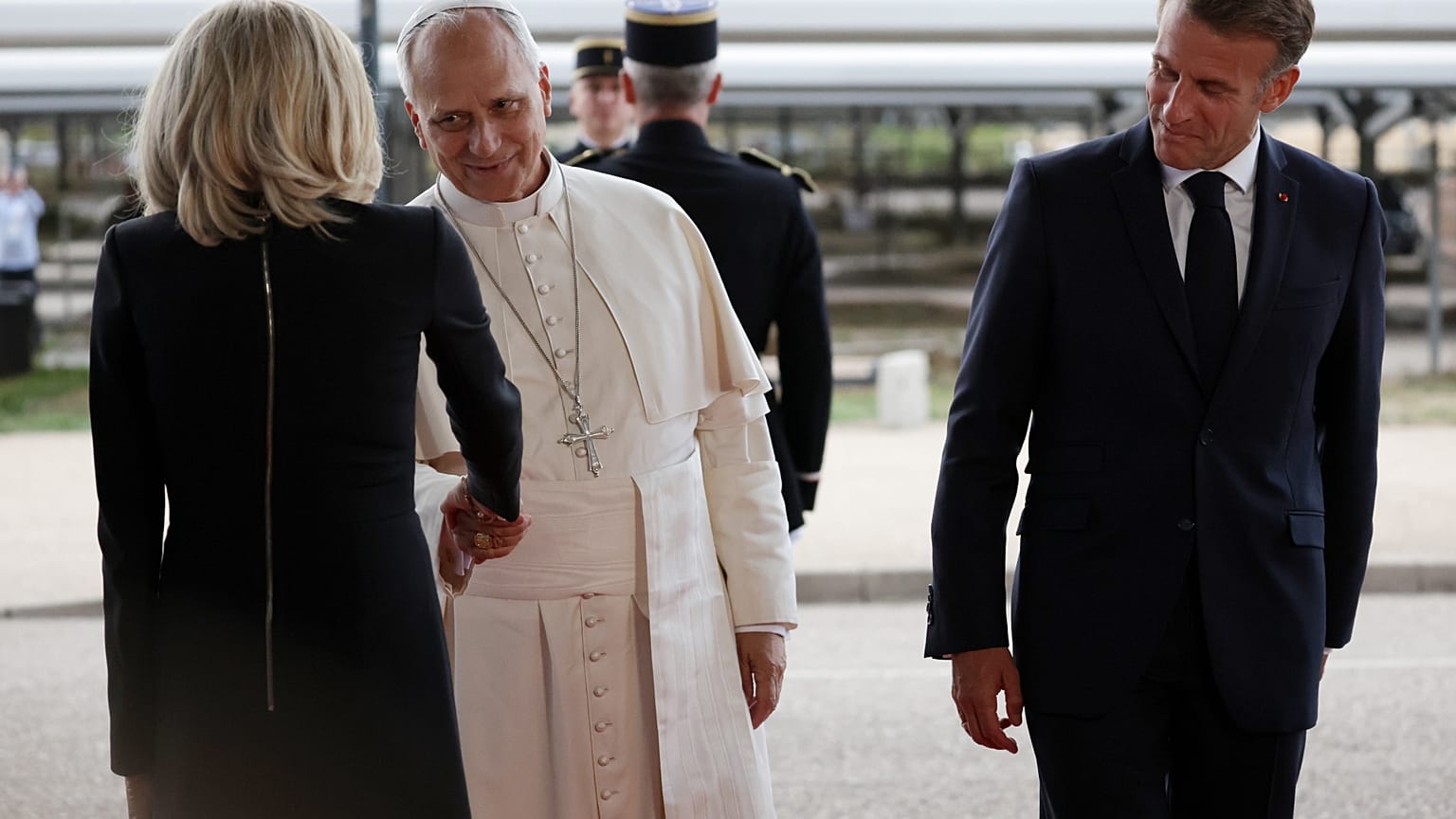
Pope Leo concluded his visit to France in Metz, a city whose history has been shaped by changing European borders and conflicts. The choice of Metz highlighted Robert Schuman, the French Catholic statesman regarded as one of the architects of European integration after the Second World War. At an event called “At the Roots of Europe for Peace and Unity,” Leo met European political and public figures, including Luxembourg Prime Minister Luc Frieden, Prince Albert II of Monaco, Grand Duke Guillaume of Luxembourg and former European Commission president Jean-Claude Juncker. French President Emmanuel Macron, who had initially been expected to attend only the pope’s morning speech, changed his schedule to join the Mass at Saint-Étienne Cathedral and the farewell at the airport. Crowds gathered outside the cathedral hours before the service, where banners and rosaries were visible. Families welcomed Leo in a scene described as both festive and devotional. The Metz stop brought the trip to a close after large gatherings elsewhere in France. According to the Vatican, about 800,000 people attended Leo’s outdoor Mass in Paris, while tens of thousands joined the candlelit procession at Lourdes. Leo departed France following a farewell ceremony with Macron at Metz-Nancy-Lorraine airport. The article presents the final stop as a moment connecting the pope’s visit with Schuman’s legacy and the themes of European unity and peace.
Entities: Pope Leo, Robert Schuman, Metz, France, European integration • Tone: neutral • Sentiment: positive • Intent: inform
28-09-2026
Pope Leo XIV met privately with seven adult survivors of child abuse by French Catholic clergy in Lourdes on September 27, during a four-day visit to France. The Vatican said he thanked them for their painful testimony and reaffirmed his commitment to ending abuse. Survivors described the nearly two-hour meeting as emotional and said Leo listened with compassion and showed familiarity with their individual cases. Jean-Marie Delbos, who was abused at the Notre-Dame de Betharram boarding school, recalled the pope embracing him. Jerome Guillement said Leo recognized that abuse was enabled not only by individual perpetrators but also by systemic problems within the Church. The survivors welcomed the encounter but emphasized that words must lead to concrete action and lasting change.
The meeting took place amid continuing efforts to address the scale of abuse in France. An independent inquiry published in 2021 estimated that about 330,000 children had been abused by Catholic clergy and lay leaders over seven decades. Earlier on Sunday, Leo told an estimated 150,000 people at a Mass in Lourdes that the Church must have the courage to face its past. Survivor Veronique Garnier found his remarks at the Mass troubling because he referred to abuse without directly apologizing, but said the private meeting gave her hope that survivors would be listened to more deeply and that words could be followed by action. Leo also discussed abuse scandals with French bishops.
During the visit, Leo condemned France’s legalization of medically assisted death in July, calling it “false compassion” and saying that legality does not necessarily make an action moral. He urged compassion for people in severe pain while maintaining the Catholic Church’s teaching that human life must be protected from conception until natural death.
Entities: Pope Leo XIV, Jean-Marie Delbos, Jerome Guillement, Veronique Garnier, Lourdes, France • Tone: analytical • Sentiment: neutral • Intent: inform
28-09-2026
Pope Leo XIV’s visit to France drew enormous crowds, prompting questions about whether Catholicism is experiencing a revival in one of Europe’s most secular countries. According to the Vatican, about 800,000 people attended an outdoor Mass in Paris, while roughly 80,000 young people gathered for a prayer vigil at the Stade de France. In Lourdes, more than 150,000 attended Sunday Mass, and crowds of pilgrims lined the streets to see the pope. The scale of the gatherings was especially striking given France’s history of conflict with the Catholic Church, including the execution of hundreds of clergy during the French Revolution.
The article describes evidence that Catholic interest may be growing among some younger people. France’s bishops conference counted 21,386 adult and adolescent baptisms at Easter, including 13,234 adults. Adult baptisms were up 28% from the previous year and more than three times the level a decade earlier. French Ambassador to the Holy See Charles Personnaz characterized the visit as a lively exchange and said it offered young people an appeal to work for peace and face the future without fear.
However, the crowds do not necessarily show a broad or lasting return to Catholicism. A national survey found that 51% of people aged 18 to 59 reported no religion, while 29% identified as Catholic. Non-Catholic Christians and Muslims had both grown as shares of younger age groups over the previous decade. France’s public policies, including constitutional protection for abortion access and a law permitting assisted dying in specified circumstances, also contrast with Catholic teaching; Pope Leo criticized both during his visit. The article places the French figures within a wider Western decline in Catholic identification, noting a decrease in the United States. It concludes that the visit visibly inspired the pope and clergy, but whether it will produce lasting changes in religious affiliation or church attendance remains uncertain.
Entities: Pope Leo XIV, France, Paris, Lourdes, Stade de France • Tone: analytical • Sentiment: neutral • Intent: analyze
28-09-2026
During his four-day visit to France, Pope Leo addressed large crowds at Lourdes and met with French Catholic bishops amid continued scrutiny of clergy sexual abuse. About 150,000 people attended Sunday Mass at the shrine, a site associated with healing that has also drawn abuse survivors seeking recovery. In his homily, Leo spoke of the dignity of sick and frail people and described life as a gift from God. He also said that causing death could not be treated as normal and that legality does not necessarily make an act moral—remarks interpreted as criticism of euthanasia and abortion, including France’s recently enacted euthanasia and assisted-suicide law.
The pope met seven adult survivors of sexual abuse. A 2021 report estimated that approximately 330,000 children were abused by Catholic priests and lay leaders in France between 1950 and 2020. Although Leo did not directly address abuse during the Lourdes Mass, he called for clergy to acknowledge mistakes and urged humility as the Church seeks to heal its wounds. Survivor association co-leader Michele Le Reun-Gaigne cautioned that change would take time, saying progress was slow and would not happen overnight.
Earlier, Leo praised French bishops for their response to abuse, including efforts to listen, pursue truth and justice, make amends, and build a culture of prevention and protection. He urged them to remain vigilant.
On Monday, in Metz, the pope criticized what he described as increasingly uncivilized relations between nations and the boasting of lies and deceit. He called on Europe to help break that cycle through respect for others. The visit to Metz honored Robert Schuman, the French Catholic statesman considered one of the founders of European unity. Leo’s comments were presented as contrasting with views on Europe voiced by members of the Trump administration, and as an implicit criticism of its political practices.
Entities: Pope Leo, Michele Le Reun-Gaigne, Lourdes, Metz, France • Tone: analytical • Sentiment: negative • Intent: inform
28-09-2026
Pope Leo XIV urged European leaders to defend multilateralism and the international rules-based order during a speech in Metz, France, the birthplace of European integration figure Robert Schuman. He described multilateralism as “the best defence against the desire for dominance” and warned of a world increasingly marked by conflict, hunger, deteriorating relations, and distrust between citizens and governments, which he said was fuelled by “lies and deception.” Leo argued that Europe could help counter this climate by reaffirming the rule of law, respect for others, and dialogue. He called for patient negotiations and compromise in pursuit of peace, condemning what he described as a new “pointless massacre” on European soil without explicitly naming Russia’s war against Ukraine.
The Pope also invoked Europe’s Christian roots, describing the continent as a cultural and historical reality rather than merely a geographical one. He argued that Christianity should be part of discussions about Europe’s identity and said the continent has advanced by drawing on its past while adapting through encounters with others.
Metz’s history gave the address added symbolism. Situated in Lorraine near the German border, the city is associated with Schuman and European reconciliation, but it has also changed hands between France and Germany and was annexed by Nazi Germany in 1940. The French presidency said the programme was intended to highlight Lorraine’s cross-border European character and its history of conflict. French President Emmanuel Macron attended the address, with a Mass alongside the Pope planned for later that Tuesday. EU leaders and representatives of European institutions were invited, though only a handful attended alongside Macron, including representatives from Monaco, Andorra, and Luxembourg. Representatives of different faiths, including France’s chief rabbi and the rector of the Grand Mosque of Paris, also took part.
Entities: Pope Leo XIV, Multilateralism, International rules-based order, Metz, Robert Schuman • Tone: analytical • Sentiment: neutral • Intent: inform
28-09-2026
French President Emmanuel Macron urged Europeans to resist what he called a “return of nationalisms” and to renew the courage shown by Europe’s founding fathers. He made the remarks in Metz during Pope Leo XIV’s visit to France. Macron said Europe should continue to serve as a force for peace, independence and democracy, and warned against the continent turning inward or giving in to hatred of others. He called on Europeans to defend a united and democratic Europe. The meeting focused on European integration and peace. The report presents Macron’s statements but does not provide further detail about the meeting, the Pope’s response, or specific policies proposed to address the concerns Macron raised.
Entities: Emmanuel Macron, Pope Leo XIV, Metz, France, Europe • Tone: analytical • Sentiment: neutral • Intent: inform
28-09-2026
Pope Leo XIV concluded a four-day visit to France in Metz on Monday, urging Europeans to draw on the continent’s Christian heritage and tradition of dialogue. He warned against the “desire for domination” that he said lies behind many current wars. Metz was chosen as a fitting setting because its history has been shaped by changing European borders and conflict. The visit also honoured Robert Schuman, the French Catholic statesman regarded as one of the architects of European integration after the Second World War.
At an event called “At the Roots of Europe for Peace and Unity”, Leo met European political figures, including Luxembourg Prime Minister Luc Frieden, Monaco’s Prince Albert II, Luxembourg’s Grand Duke Guillaume and former European Commission president Jean-Claude Juncker. French President Emmanuel Macron, who had initially been expected to attend only the pope’s morning speech, also attended Mass at Saint-Étienne Cathedral and the farewell ceremony after changing his schedule.
Crowds gathered outside the cathedral hours before the service. Families welcomed Leo in a setting described as both festive and devotional. The Metz events concluded a trip that drew large crowds elsewhere in France: the Vatican estimated that about 800,000 people attended the pope’s outdoor Mass in Paris, while tens of thousands joined the candlelit procession in Lourdes. Leo departed France after a farewell ceremony with Macron at Metz-Nancy-Lorraine airport.
Entities: Pope Leo XIV, Metz, France, Robert Schuman, European integration • Tone: neutral • Sentiment: positive • Intent: inform
28-09-2026
Pope Leo XIV left France for Rome on Monday evening, concluding a four-day visit that included stops in Paris, Lourdes and Metz. The article describes the trip as historic and says it generated huge enthusiasm. President Emmanuel Macron accompanied the pope to the airport in Metz and said people were sad to see him leave but glad that the visit had gone well. Macron had not attended any of the Masses earlier in the trip, but changed his decision and attended the pope’s final Mass at Metz Cathedral on Sunday evening. His attendance drew attention because France’s principle of laïcité establishes a strict separation between Church and state, and the role of the head of state at a papal Mass has previously been debated.
The report also focuses on the response of worshippers in Metz. Inès travelled five hours from Rouen to see the pope and described being moved by seeing him in his popemobile and by the shared feeling of community among those gathered. Sisters Antonia and Marie, who came from the surrounding area to watch the papal parade, said his remarks about the importance of peace in Europe resonated with them. They said his message made them feel heard and gave them hope amid difficult circumstances in the world.
Overall, the article presents the conclusion of the visit through both its public and personal dimensions: Macron’s presence at the send-off and final Mass, the French debate around secularism, and the emotional response of attendees. It reports the trip’s itinerary and departure while highlighting the pope’s peace-focused message and the sense of connection and encouragement expressed by people who came to see him.
Entities: Pope Leo XIV, Emmanuel Macron, Metz, France, Rome • Tone: neutral • Sentiment: positive • Intent: inform
28-09-2026
France 24’s debate program examines Pope Leo XIV’s visit to France and asks whether his public defense of European values makes him a moderate counterpoint to the nationalist and eurosceptic right. The program focuses on his concluding stop in Metz, described as the hometown of Maurice Schumann, a founding figure in present-day European federalism. Leo affirmed Europe’s Christian roots, tracing them back to Roman times, while also praising a European Union model that, in the program’s account, moves beyond an “us versus them” outlook and favors human rights and international law over “might is right.”
The discussion is framed around the contrast between this vision and the politics of French National Rally figures Marine Le Pen and Jordan Bardella, as well as the wider electoral gains of the eurosceptic far right in France and neighboring Germany. It poses questions about how sharply Leo’s Catholicism conflicts with those political currents and whether the Pope and the Church can still claim moral authority in 2026.
The program also places the visit in the context of the Church’s history of systemic abuse. During his four-day tour, Leo met privately with victims and acknowledged the harm caused by abuse within the institution. The segment contrasts that difficult reckoning with the large crowds who came to see him, asking how the trip—and this moment for the Church—will be remembered. The article presents these issues as questions for debate rather than reaching a stated conclusion.
Entities: Pope Leo XIV, Emmanuel Macron, Marine Le Pen, Jordan Bardella, Maurice Schumann • Tone: analytical • Sentiment: neutral • Intent: analyze
28-09-2026
The France 24 item, published on 28 September 2026, is a 3-minute-45-second video report about Pope Leo’s speech in Metz during a four-day visit to France. Its headline frames the speech as touching on war and migration, but the supplied article text gives no specific remarks or examples about either subject. The reported focus is instead on Europe’s history and founding principles. Speaking in French in Metz—the hometown of Robert Schuman, described as a founding father of the European Union—the pope urged Europeans to remember their Christian history and the values on which the EU was founded. The article identifies the rule of law and the equality of all people as examples, specifying equality without distinctions of race, colour, class, or profession. The report thus presents the speech as an appeal to recall a shared European heritage and uphold principles of equal treatment. Beyond these points, the supplied text does not provide further detail about the pope’s argument, audience response, or his treatment of war and migration. The page also contains video-player notices, related-story links, and a page-unavailable message; these are website elements rather than additional reporting on the speech.
Entities: Pope Leo, Metz, France, Robert Schuman, European Union (EU) • Tone: neutral • Sentiment: neutral • Intent: inform
28-09-2026
The available France 24 text reports that Pope Leo XIV concluded a visit to France with a message addressed to Europe that was more explicitly political than his other remarks during the trip. Speaking on Monday, he urged Europeans to draw on the continent’s Christian roots and traditions of dialogue as a way to counter what he called the “desire for domination” behind contemporary wars. The report links his appeal to Europe’s history of peaceful integration, recalling forces that helped bring countries together and sustain peace on the continent.
The supplied material is only a short introductory passage, not a full article transcript. It does not give further details about the pope’s speech, identify particular wars or political leaders, or explain the specific historical forces he invoked. The page also lists related stories, including coverage of his remarks on war and migration in Metz and a report describing his France visit as “hugely successful,” but these headlines are not part of the article text itself. Accordingly, the available account supports a limited conclusion: the pope used the close of his France visit to connect Europe’s religious and diplomatic traditions with a call to resist domination and pursue peace. Further context or detail about the speech cannot be established from the provided text.
Entities: Pope Leo XIV, France, Europe, Christian roots, Traditions of dialogue • Tone: analytical • Sentiment: neutral • Intent: inform
28-09-2026
The France 24 report says Pope Leo concluded his visit to France on Monday with a speech in Metz. In remarks quoted in the article, he warned that relations between nations were becoming “increasingly uncivilised” and criticized people who boast of “lies and deceit.” He urged Europe to help “break this cycle,” framing the deterioration in international conduct as a challenge that requires a response from European countries. The report characterizes the visit as “hugely successful,” a description attributed to France 24 correspondent Angela Diffley. It does not provide further details about the pope’s itinerary, the audience for the Metz speech, or the specific measures he proposed. The page also links to a replay described as showing the pope urging peace and unity in Europe on the final day of his visit, but the supplied text contains no additional transcript from that video. Overall, the available article presents the closing speech as both the final event of the France visit and a broader appeal for improved relations among nations. Its emphasis is on the pope’s warning about dishonesty and uncivilized conduct in international relations, alongside his call for Europe to help reverse that pattern. The source excerpt is brief, so it supports only a limited account of the visit and speech.
Entities: Pope Leo, Angela Diffley, France 24, France, Metz • Tone: analytical • Sentiment: neutral • Intent: inform
28-09-2026
France 24 presents a replay of French President Emmanuel Macron speaking about the European Union during Pope Leo XIV’s visit to Metz, France. The brief accompanying description says Macron delivered an address alongside the pope on the final day of the pontiff’s visit to the country. Macron argued that Europe must rediscover the “courage of its founders” and resist what he called a “resurgence of nationalism.” His remarks frame European unity as something that requires renewed resolve in the face of nationalist politics.
The supplied page text does not include a transcript or further details about the speech, the pope’s remarks, or the event beyond its setting and timing. It identifies the video as a replay, gives a runtime of 10 minutes and 14 seconds, and lists the issue date as September 28, 2026. Accordingly, the available material supports a summary of the stated theme and context, but not a fuller account of the leaders’ speeches or reactions. The page also contains video-player notices and links to other news stories, which are not part of the report itself.
Entities: Emmanuel Macron, Pope Leo XIV, France 24, France, Metz • Tone: analytical • Sentiment: neutral • Intent: inform
28-09-2026
France 24’s report covers remarks by Pope Leo XIV on Monday, September 28, 2026, in Metz, northeastern France, on the fourth and final day of his visit to the country. In a speech focused on Europe, the pope urged the continent to remember its Christian history and called for peace and unity.
Leo XIV described relations between individuals and states as becoming increasingly “uncivilised.” He criticized the erosion of trust, saying that keeping one’s word was being dismissed while lies and deceit were being celebrated. He then argued that Europe could help reverse this pattern by drawing on its learned and preserved respect for others.
The report presents the address as an appeal for Europe to use its historical and cultural experience to encourage more respectful relations. Its central themes are peace, unity, trust, honesty, and mutual respect. The supplied article text is a brief written introduction to a 22-minute, 35-second video replay; it does not provide a full transcript or further details about the speech, the pope’s visit, or reactions to his remarks.
Entities: Pope Leo XIV, France 24, Metz, France, Europe • Tone: analytical • Sentiment: neutral • Intent: inform
28-09-2026
French President Emmanuel Macron said Europe was built on a “Greco-Roman and Judeo-Christian foundation” during a speech with Pope Leo in Metz on Monday. The remarks were notable because France is constitutionally secular and has a long-running public debate over national identity, religion and the role of faith in public life. Macron described Europe not merely as a political arrangement but as a civilisation shaped by its cities, villages, educational institutions and public spaces. He said that heritage had helped establish the “primacy of the person” and the idea of the “free and rational individual.”
Macron also warned that European peace, truth and democracy faced threats from both armed conflict and forces that divide societies. He cited Russia’s war in Ukraine as a source of renewed concern about the continent’s security, while arguing that social fragmentation and online manipulation were also dangers. He praised the European Union as a distinctive political project founded on peace and equality among its member states, and urged Europeans to resist divisive nationalism and disinformation.
Calling for action against what he described as an epidemic of disinformation, Macron said algorithms can amplify negative emotions and deepen division. He cautioned that democracy can be weakened not only by military attacks, but also when loneliness spreads and citizens stop listening to one another. Pope Leo’s four-day apostolic journey to France had received an enthusiastic public reception. Macron attended the Pope’s final Mass in Metz, although he had skipped other religious services during the visit.
Entities: Emmanuel Macron, Pope Leo, France, Metz, Robert Schuman convention centre • Tone: analytical • Sentiment: neutral • Intent: inform
28-09-2026
Pope Leo XIV urged European leaders to make compromises in pursuit of peace in Ukraine, saying they should be willing to give up some positions for the greater good. Speaking in French at the end of a four-day tour of France, he described the impact of Russia’s 2022 full-scale invasion as devastating and marked by “senseless slaughter.” He stressed that peace efforts should involve patient dialogue and courageous negotiation, while cautioning that peace-seeking should not be confused with naive pacifism.
The Pope also questioned whether Europe was making creative efforts to advance peace or merely preparing for future wars. His remarks came as European governments, including France, have supported Ukraine financially and expressed concern about further Russian attacks. French President Emmanuel Macron, who attended the final Mass in Metz, had recently approved a €6.5 billion increase in defence spending over two years. Talks between Russia and Ukraine remained stalled, with neither side apparently willing to concede territory; a recent meeting between Ukrainian President Volodymyr Zelenskyy and US President Donald Trump had not changed that impasse.
Migration was another focus of Leo’s speech. As Europe tightens rules for migrants and asylum seekers, he called for people arriving from elsewhere to be welcomed and integrated “as if they were part of one’s own family.” He described migration as an unprecedented encounter between peoples and cultures that should prompt Europeans to reconsider their roots while listening to others.
Leo further argued that Europe should champion multilateralism and respect in international relations, warning that relations between individuals and states were becoming less civilised and that lies and deceit were being celebrated. His visit offered a rare moment of national unity in politically divided France, according to Macron. The speech took place in Metz, a city associated with Franco-German reconciliation, before a limited group of European leaders and dignitaries.
Entities: Pope Leo XIV, Emmanuel Macron, Volodymyr Zelenskyy, Donald Trump, Russia–Ukraine war • Tone: analytical • Sentiment: neutral • Intent: inform
28-09-2026
The available article text describes Pope Leo XIV’s four-day visit to France, which concluded in Metz, a place the article identifies as the intellectual birthplace of the European Union. During the visit, Leo praised the EU’s historical achievement of “tearing down walls that were dividing it.” The headline frames the trip as part of a broader shift in the pope’s public role: alongside leading the world’s 1.4 billion Catholics, he is increasingly acting as an influential statesman and urging peace amid renewed war. The excerpt thus presents his remarks as both an affirmation of European integration and a call for peace in a period of conflict.
The supplied material is only a headline and the opening sentence, followed by a website sign-up prompt. It does not provide details about the wars or conflicts referenced, the specific policy proposals Leo may have made, reactions to his remarks, or the rest of his itinerary. Accordingly, those aspects cannot be established from the text provided. The article’s apparent focus is the intersection of religious leadership, diplomacy, European unity, and appeals for peace, but the available excerpt supports only a limited account of its reporting. The tone is measured and analytical, describing Leo’s evolving statesman role while emphasizing his favorable characterization of European cooperation. Its primary purpose appears to be informing readers about his trip and public message, rather than arguing for a specific policy.
Entities: Pope Leo XIV, Anthony Faiola, Metz, France, European Union • Tone: analytical • Sentiment: neutral • Intent: inform
28-09-2026
Pope Leo took part in a candlelit Rosary procession at the sanctuary in Lourdes, France, joining the crowds as a “pilgrim among pilgrims.” Carrying a candle and rosary, he walked behind a statue of the Virgin Mary. The procession began at the Grotto of Massabielle, associated with Bernadette Soubirous’s reported visions of the Virgin Mary in 1858.
The article explains that the Rosary is a sequence of Catholic prayers traditionally arranged in five decades, during which worshippers reflect on events in the lives of Jesus and Mary. At Lourdes, prayers were spoken in several languages, including French, English, Italian and Spanish, and accompanied by the “Ave Maria” of Lourdes. More than 150,000 candles illuminated the sanctuary, forming the setting for one of the site’s best-known evening ceremonies.
The procession followed a day of other events. Leo had celebrated an outdoor Mass attended by about 150,000 people, met with French bishops, and visited sick and disabled pilgrims. He also held private meetings with survivors of clergy sexual abuse. The visit was described as the first official papal state visit to France in 18 years.
Overall, the report focuses on both the public religious observances and the Pope’s other engagements during his visit. It provides context about the Rosary and Lourdes’s religious significance, while noting the large attendance and the private meetings with abuse survivors. The article presents these events in a factual, descriptive manner without offering explicit commentary on their significance or outcomes.
Entities: Pope Leo, Bernadette Soubirous, Virgin Mary, Lourdes, Grotto of Massabielle • Tone: neutral • Sentiment: neutral • Intent: inform
28-09-2026
Pope Leo XIV used a visit to medical facilities and the Shrine of Our Lady of Lourdes in France to condemn medically assisted suicide. After celebrating Mass, he told a crowd that human dignity requires rejecting what he called the “false compassion” of causing death. He argued that legality does not make the practice moral and urged healthcare workers to care for people who are suffering rather than end their lives. He also cautioned against allowing medical decisions about embryos or older people to be made on the basis of laboratory algorithms, saying medicine must not serve “programmed death.”
The article notes that assisted suicide is legal in France and other Western countries, and says the practice has drawn criticism in Canada. It recounts the case of Brigitte Stegemann, an 83-year-old Canadian woman who died through Canada’s Medical Assistance in Dying (MAID) program. According to a report by the Daily Mail, Stegemann’s granddaughter and primary caregiver, Brigitte Kranendonk, questioned whether her grandmother understood or freely consented to the procedure.
Kranendonk said Stegemann had physical and mental decline and stomach cancer, but still had an appetite and had rejected MAID when it was first presented as an option. She alleged that a doctor described the procedure without clearly saying it would result in death. Kranendonk said that when she later asked her grandmother whether she understood she would die, Stegemann cried and said she had “made a mistake.” The article reports that the family was told she could decline the procedure on the day it was scheduled, but Kranendonk was uncertain whether her grandmother had truly consented and did not want to cause her additional stress. The article presents the case alongside the pope’s broader moral objection to assisted suicide.
Entities: Pope Leo XIV, Lourdes, France, Shrine of Our Lady of Lourdes, medically assisted suicide, false compassion • Tone: analytical • Sentiment: negative • Intent: inform