26-09-2026
The article profiles Nvidia founder and chief executive Jensen Huang, focusing on his close relationship with US President Donald Trump and the consequences that relationship could have for AI policy and competition with China. A call from Trump during a live AI summit—where he endorsed Huang’s position and dismissed AI safety warnings as “a hoax”—illustrated their alignment. Analysts say Huang has deliberately cultivated Trump’s regard, while Trump is drawn to business success and perceived winners.
Huang argues that the United States should compete vigorously in global markets and avoid excessive safety regulation. He has also urged Washington to permit more Nvidia chip sales to China, contending that excluding the company may speed China’s development of domestic alternatives. The article lays out the opposing concern: advanced chips could strengthen Chinese surveillance, censorship, military capabilities, and AI laboratories. Experts disagree about the scale of AI’s long-term risks, with Huang described as unusually dismissive of the possibility of catastrophic harm.
The profile also traces Huang’s personal history, from his childhood in Taiwan and Thailand to immigrating to the United States at age 10, working at Denny’s, and studying engineering. He attributes resilience and a demanding leadership style to his strict upbringing, and says he still works seven days a week. Nvidia, which designs chips manufactured by partners including Taiwan Semiconductor Manufacturing Company, is valued at about $5.4 trillion and dominates the AI-chip market.
The article frames chip exports as part of a wider US-China negotiation. Washington seeks to restrict China’s access to the most advanced technology while preserving Nvidia’s position in the Chinese market, and must also consider China’s leverage over rare earths. Experts characterize this approach as managed technological interdependence, with potential implications for US national security, trade, Taiwan, and the global AI race.
Entities: Jensen Huang, Nvidia, Donald Trump, Xi Jinping, United States-China AI competition • Tone: analytical • Sentiment: neutral • Intent: analyze
26-09-2026
Following Chinese President Xi Jinping’s three-day visit to Washington, the United States and China announced steps to ease trade tensions and expand communication on artificial intelligence. The White House said the countries had reached recommendations for more favourable tariff treatment on $30 billion US of non-sensitive goods in each direction. The goods include U.S. exports such as agricultural products, wood and cosmetics, and U.S. imports such as small appliances, toys and decorations. The countries also agreed to establish a trade council and extend outcomes from earlier discussions in Kuala Lumpur, according to China’s Foreign Ministry.
The announcements come as the two governments extend their existing trade truce by two months beyond its scheduled Nov. 10 expiry, leaving more time to negotiate a potentially broader agreement. The summit ended with an emphasis on personal diplomacy, but without major public breakthroughs. Xi returned to Beijing after the visit. Chinese Foreign Minister Wang Yi described the trip as strengthening and stabilizing the bilateral relationship, and said it could have a far-reaching impact on world peace and development.
The countries also agreed to hold a dialogue about AI’s benefits and risks, with another round planned for November, and to create a channel for communicating about AI-related incidents. The White House said the leaders agreed to use “super intelligence” in place of “artificial intelligence”; China’s Foreign Ministry said Beijing valued Washington’s use of the new term and called for more exchanges and consensus as the technology develops.
Other commitments included supporting each other’s hosting of the Asia-Pacific Economic Cooperation leaders’ meeting and the Group of 20 summit, with both leaders planning to attend the other’s gathering. On foreign policy, the two sides said Iran should honour its commitment not to develop nuclear weapons and that no country or entity should impose transit tolls on international waterways.
Entities: Xi Jinping, Donald Trump, Scott Bessent, Wang Yi, United States • Tone: neutral • Sentiment: neutral • Intent: inform
26-09-2026
Following a three-day summit in Washington, President Donald Trump and Chinese President Xi Jinping agreed to establish a communication channel for AI-related incidents and accelerate work on military crisis communications. The agreements did not resolve the countries’ underlying differences, but analysts described the new working groups and crisis-management mechanisms as meaningful steps that could help keep disputes from escalating. The two governments also agreed to hold a dedicated AI dialogue in November and to sign a memorandum of understanding on military crisis prevention. Trump said the U.S. would maintain its AI lead and would not put the brakes on development or broadly share its technology with China. The White House said the leaders preferred the term “super intelligence” to “artificial intelligence.” On trade, the countries agreed to continue a pledge to reduce reciprocal tariffs on about $30 billion in goods, and extended their trade truce by two months. China also agreed to buy at least 10 million metric tons of U.S. coal in 2027 and 2028. The White House announced a Board of Investment to address investment opportunities and commercial obstacles, while both sides continued discussions about U.S. concerns over Chinese restrictions on rare-earth exports. Other topics included fentanyl precursor chemicals, Iran’s nuclear commitments, and tolls on international waterways, apparently referring to the Strait of Hormuz. The leaders are expected to meet again at the Asia-Pacific Economic Cooperation summit in Shenzhen in November and later at the G20 in Florida. Xi returned to Beijing after the summit. Although Trump showed unusual warmth toward Xi, the article notes the backdrop of a prior trade war with global consequences. An analyst said that personal diplomacy, combined with working-level and military dialogue, could make stability more durable and institutionalized.
Entities: Donald Trump, Xi Jinping, United States, China, AI incident communication channel • Tone: analytical • Sentiment: neutral • Intent: inform
26-09-2026
Chinese President Xi Jinping used the idea of the “Thucydides Trap” at his meeting with U.S. President Donald Trump to argue that competition between the two countries need not end in conflict. His statement that “The Thucydides Trap can be overcome” marked a shift from his framing at a May summit, when he posed the question of whether the U.S. and China could avoid the trap. The concept, popularized by Harvard scholar Graham Allison, describes the historical danger that tensions between a rising power and an established power can lead to war. It draws on Thucydides’ account of the Peloponnesian War, in which Athens’ rise alarmed Sparta.
Xi has invoked the idea before, including in a 2014 interview, when he called for countries to work together to avoid destructive tensions. Chinese commentary on his 2015 U.S. visit likewise emphasized that conflict was not inevitable: mutual suspicion among major powers, rather than the power transition itself, could bring it about. Allison has met Xi and visited China several times, and previously held senior academic and U.S. government roles.
At the latest summit, Xi paired his claim that the trap could be overcome with calls for peaceful coexistence and “healthy” competition without confrontation. He characterized competition as a race in which each side catches up with the other, rather than a winner-take-all struggle. He also called for stronger military crisis communications and prevention. Renmin University professor Cui Shoujun described establishing a boundary against military conflict as the summit’s most significant political outcome, saying it brought greater certainty to a volatile relationship.
Trump’s public remarks on Xi’s arrival focused broadly on collaboration. The article notes that Trump had not commented on Taiwan at the time, even though Beijing’s account said Xi urged the U.S. to oppose Taiwan independence. The meeting was Xi’s first state visit to the U.S. in 11 years.
Entities: Xi Jinping, Donald Trump, Graham Allison, Cui Shoujun, United States • Tone: analytical • Sentiment: neutral • Intent: analyze
26-09-2026
China and the United States agreed to expand communication on artificial-intelligence safety and military crisis management following a three-day summit between US President Donald Trump and Chinese President Xi Jinping. A key commitment is to establish a channel for communicating about AI incidents, alongside a new round of AI-focused talks scheduled for November. China’s Foreign Ministry said the countries could exchange views and seek common ground as AI technologies develop. Beijing also said the two sides would accelerate work on military crisis communications, though it provided no details.
The governments agreed to reduce tariffs on approximately $30 billion in goods described by China as “non-essential” and by the US as “non-sensitive,” including agricultural products and holiday decorations. They also extended a trade truce that had been due to expire on November 10; US Treasury Secretary Scott Bessent said it would remain in effect until January. Under the earlier truce, China suspended rare-earth export controls while the US reduced some tariffs. The White House said the leaders discussed US concerns about rare-earth supplies and sought to restore shipments to appropriate levels. The Trump administration also said China would buy at least 10 million metric tons of US coal in 2027 and 2028.
The summit addressed the Iran war, but produced no reported major breakthrough. China said both sides agreed that Iran should not possess nuclear weapons and that no country should impose transit tolls on international waterways, a reference to the Strait of Hormuz. Trump characterized the summit positively, while Xi described the relationship in terms of strategic stability, respect, fairness, and reciprocity. The leaders are expected to meet twice more before year’s end: Trump at the APEC summit in China in November, and Xi at a G20 summit in Miami in December.
Entities: Donald Trump, Xi Jinping, United States, China, Beijing • Tone: analytical • Sentiment: neutral • Intent: inform
26-09-2026
NPR examines what President Donald Trump’s nearly two-day state visit with Chinese President Xi Jinping achieved, separating the warm public pageantry from the unresolved policy issues. Reporters Emily Feng and Rob Schmitz describe the leaders as notably congenial during events including a visit to the National Archives and a state dinner. The visit’s clearest practical outcome was a two-month extension of a temporary trade truce concerning rare earth elements, which China dominates and could otherwise restrict access to. The extension runs until January, shorter than either side reportedly wanted, with mutual distrust preventing a longer arrangement. Possible joint tariff reductions on roughly $30 billion of goods were expected to be announced, while Trump said Iran was also discussed without providing details.
The reporters emphasize that major disagreements remain, particularly over artificial intelligence and Taiwan. Trump has expressed a preference for little or no additional AI regulation, while Xi has stressed human control and cooperation that ensures AI serves human progress. The presence of leading U.S. technology executives at the state dinner underscored the growing importance of AI and technology to the bilateral relationship.
Schmitz contrasts this visit with Trump’s first term, when his acceptance of a call from Taiwan’s president broke diplomatic protocol and he sharply criticized China. He argues that China is now stronger and has greater leverage in trade. The visit’s imagery, similar across U.S. and Chinese coverage, could convey to Chinese audiences that the United States treats China as an equal, even as China faces a sluggish economy and questions about future growth. The report also begins to explain Xi’s phrases, including “strategic stability” and “Thucydides Trap,” as part of a broader narrative about China’s rise and Western decline; the supplied transcript ends before that discussion is completed.
Entities: Donald Trump, Xi Jinping, Emily Feng, Rob Schmitz, Debbie Elliott • Tone: analytical • Sentiment: neutral • Intent: analyze
26-09-2026
The White House says the United States and China have agreed to reduce tariffs on products worth about $30 billion and to provide more favorable market treatment for selected goods. The arrangement covers US exports such as agricultural products, medical devices, fish, wood and cosmetics, as well as Chinese exports including small appliances, toys, holiday decorations and children’s car seats. The countries also plan to establish a working group on agricultural market access and a dialogue on emerging technology.
A central commitment is for China to buy at least 10 million metric tons of American coal annually in 2027 and 2028. The agreement followed Chinese President Xi Jinping’s three-day state visit and meetings with President Donald Trump. The article also notes that the leaders agreed to use the term “super intelligence” for applicable emerging technologies and to establish a US-China dialogue on the subject.
The announcements come after a sharp tariff conflict: US tariffs on Chinese goods rose as high as 145%, while China imposed tariffs of up to 125% on US goods. The two countries later reached a temporary truce, and US tariffs are now reported at 30%. US Trade Representative Jamieson Greer said the countries had reached agreement on several issues, with further details expected.
The article cautions that China has not always fulfilled earlier purchase commitments, including pledges involving US soybeans and $17 billion in agricultural products. It also places the trade talks in a wider context: Trump is seeking to increase exports and ease consumer costs amid inflation concerns, while US farmers face high diesel prices. The coal commitment is notable given China’s reliance on coal, and the discussions followed Trump’s objection to China’s support for Iran.
Entities: China, United States, Donald Trump, Xi Jinping, Wang Yi • Tone: analytical • Sentiment: neutral • Intent: inform
26-09-2026
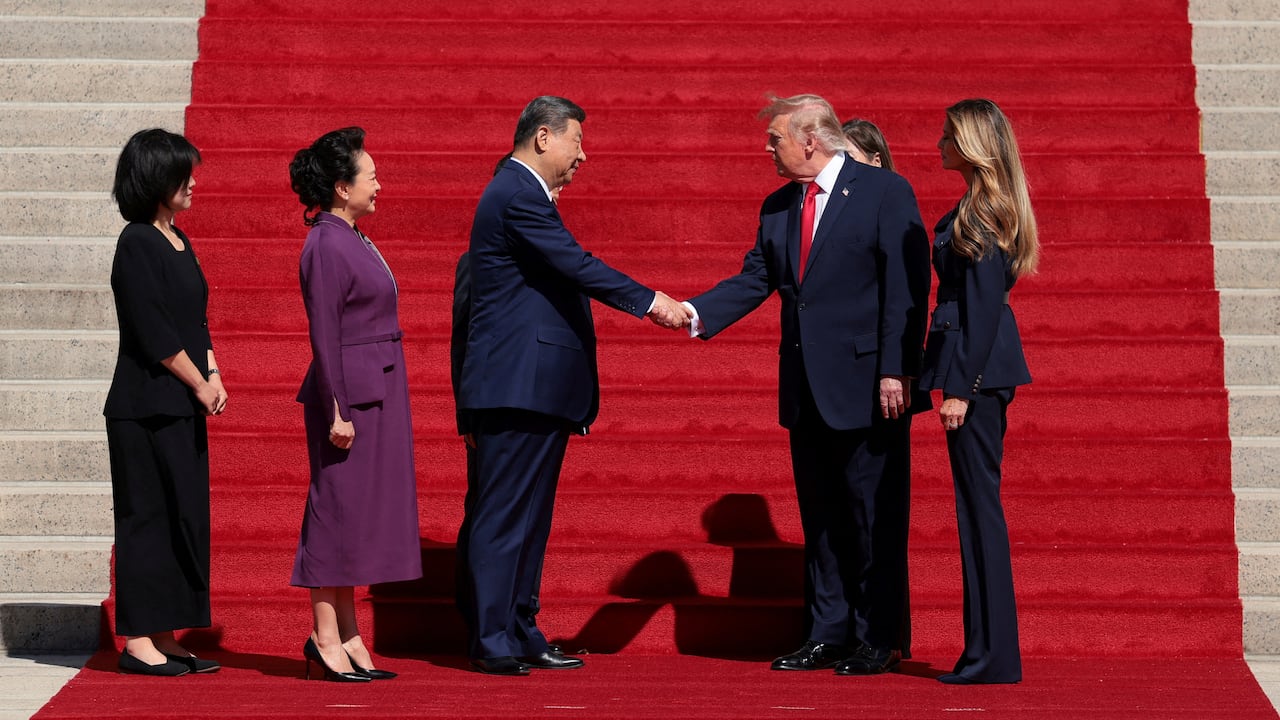
The article describes how Chinese President Xi Jinping and U.S. President Donald Trump appeared with their wives, Peng Liyuan and Melania Trump, during the final day of Xi’s three-day state visit to the United States. Their visit to the National Archives Museum in Washington provided a public setting in which observers could compare the couples’ interactions. According to the article, body-language experts saw a marked contrast in how the two couples held hands, and their joint activities during the trip had attracted close attention.
The article cites body-language expert Patti Wood’s observations of the couples arriving at the museum. Xi and Peng walked up the building’s stairs holding hands. Wood characterized the gesture as appearing natural and noted that they walked closely in sync. The headline and introduction frame these details as revealing differences in the couples’ dynamics, but the supplied excerpt ends before describing Trump and Melania’s behavior or offering further expert commentary. It therefore does not provide enough information to specify the nature of the contrast beyond saying that experts observed one. The article is presented as a brief report about public gestures and expert interpretation, rather than as a detailed account of the state visit’s political outcomes.
Entities: Xi Jinping, Donald Trump, Peng Liyuan, Melania Trump, Patti Wood • Tone: analytical • Sentiment: neutral • Intent: analyze
26-09-2026
China and the United States agreed to establish a bilateral communication channel for incidents involving artificial intelligence, an outcome confirmed by both governments after President Donald Trump and President Xi Jinping met in Washington. The summit produced few major breakthroughs, but both sides presented it as a step toward reducing tensions and maintaining dialogue. The leaders also confirmed plans to meet again at the APEC summit in Shenzhen in November and the G-20 forum in Miami in December.
The White House announced other agreements, including China’s commitment to import at least 10 million metric tons of US coal in 2027 and 2028, and more favorable tariff treatment for US$30 billion of non-sensitive goods in each direction. Two Chinese pandas are also expected to arrive at a US zoo. The visit featured elaborate ceremonial events, including a state banquet, military displays and tours of the White House. Xi described the talks as adding “new substance” to earlier discussions and said the countries had agreed to pursue “strategic stability” based on respect, fairness and reciprocity.
Trump and Xi discussed several contentious issues, including the war in Iran. Trump confirmed the subject had come up but offered little detail about what was said or whether progress was expected on reopening the Strait of Hormuz. The article notes US political pressure on Trump over reports that China supplied Tehran with intelligence used in attacks on US troops.
The leaders’ visit to the National Archives included viewing the Declaration of Independence and the US Constitution. The article contrasts Trump’s presentation of American democratic ideals with recent events: a judge ordered three media outlets readmitted to the White House after Trump had barred them, and rights groups criticize China’s restrictions on press freedom and expression. Trump also mocked former president Joe Biden during a White House tour. Overall, the summit’s clearest result was an agreement to keep communicating, particularly on AI, rather than a resolution of broader disputes.
Entities: Donald Trump, Xi Jinping, China, United States, Bilateral AI communication channel • Tone: analytical • Sentiment: neutral • Intent: inform
26-09-2026
The article interprets Chinese President Xi Jinping’s decision to bring his own state limousine, the Hongqi N701, to Washington as more than a logistical choice. It presents the heavily armoured vehicle as a symbol of China’s growing independence and its ambition to be treated as a global peer of the United States. “Hongqi” means “Red Flag”; the limousine’s exact specifications are classified, but it is believed to weigh more than three tons and to have features including armour, bullet-resistant glass, run-flat tyres, secure communications and protection against contaminated air.
The article contrasts this practice with China’s earlier reliance on host countries for presidential transport, noting that Beijing now reportedly sends a primary and backup car ahead of Xi. The N701 has accompanied him on trips to numerous countries, including Russia, France, Saudi Arabia and India. The article also mentions Russian President Vladimir Putin’s use of the Aurus Senat, suggesting that bringing a leader’s own vehicle is a way for states to avoid depending on a host’s courtesy.
The limousine becomes a metaphor for China’s broader transformation: from a country once associated with building American railroads to one seeking to compete on the global “highway.” The writer acknowledges US advantages, including its military, alliances, technical capabilities and the presidential limousine known as “the Beast,” while emphasizing China’s industrial strength and technological ambitions. The piece ends with a pointed, humorous aside about Donald Trump’s physical familiarity with Xi during the visit, using it to suggest that Trump—not Xi—appeared to be the supplicant.
Entities: Xi Jinping, Donald Trump, Chidanand Rajghatta, China, United States • Tone: analytical • Sentiment: neutral • Intent: analyze