26-05-2026
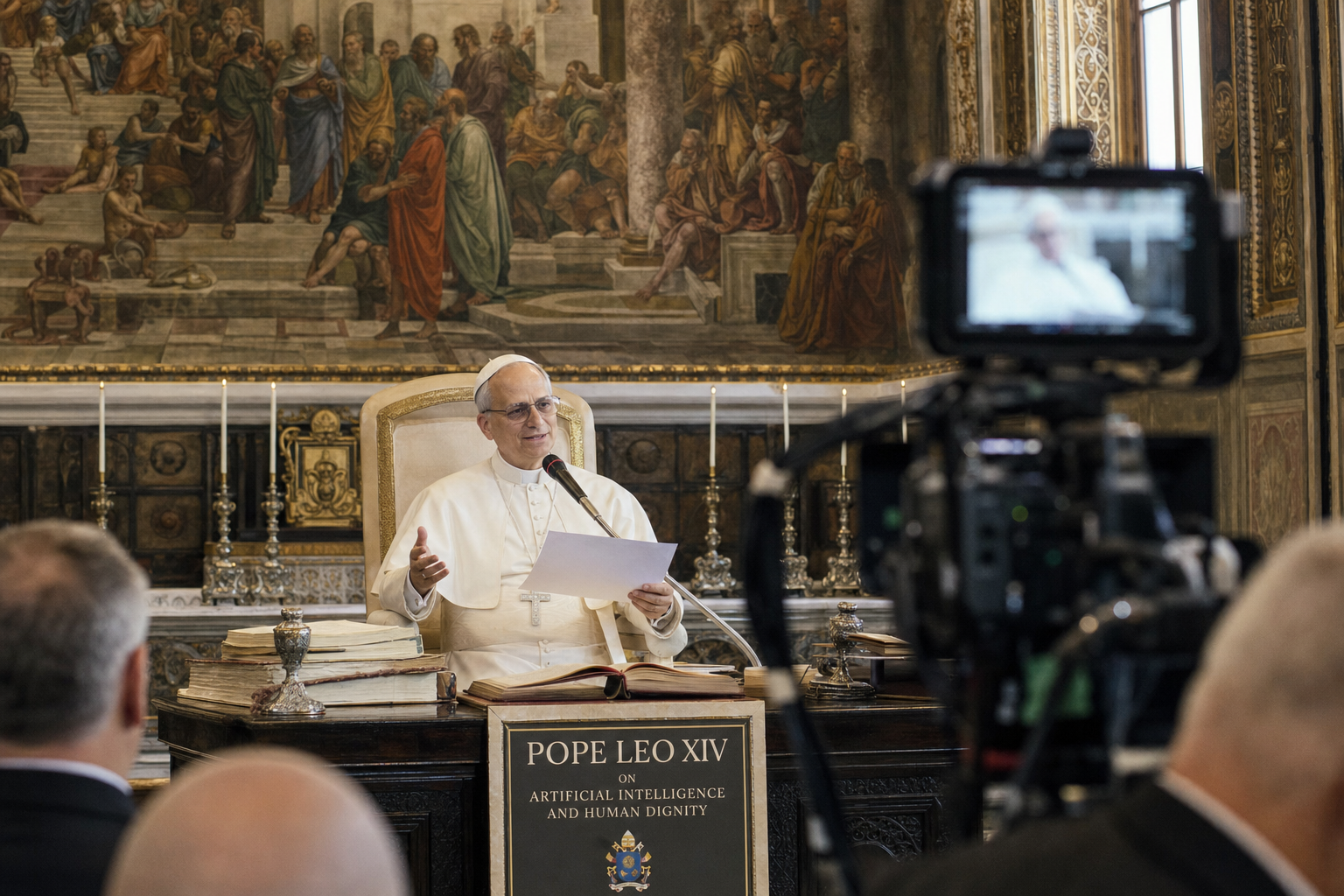
Pope Leo XIV has issued his first major encyclical, Magnifica Humanitas, placing artificial intelligence at the center of a broader reflection on what it means to remain human in a technological age. In the document, the pope warns that AI could make civilization “less human” by hollowing out work, concentrating wealth, deepening inequality, and reducing people to systems governed by data and efficiency instead of dignity and morality. He frames the issue not only as an economic or technical challenge, but as an “anthropological” one that touches the purpose and meaning of humanity itself.
The encyclical calls for the “disarming” of AI and cautions against a global race for ever more powerful algorithms and larger datasets driven by commercial or geopolitical dominance. Leo also extends his critique to the use of AI in warfare, arguing that no algorithm can make war morally acceptable and suggesting that traditional just-war reasoning has become outdated. Vatican officials emphasized that the document is not anti-technology; rather, it insists that human responsibility cannot be surrendered to machines or the companies that build them.
The article also highlights the Vatican’s engagement with tech leaders, including Anthropic co-founder Christopher Olah, who attended the presentation and welcomed broader dialogue with the Church. The pope and his advisers present AI as a profound societal and spiritual challenge, warning that people may be tempted to treat it as a substitute for God. Overall, the piece situates the encyclical as a landmark Catholic response to the AI era, comparable in ambition to Pope Leo XIII’s guidance during the Industrial Revolution.
Entities: Pope Leo XIV, Vatican, Catholic Church, Magnifica Humanitas, artificial intelligence (AI) • Tone: analytical • Sentiment: neutral • Intent: inform
26-05-2026
Pope Leo has released a new Vatican encyclical, "Magnifica Humanitas," positioning the Catholic Church as an active participant in the global debate over artificial intelligence. In the document, he warns that AI could become a tool of "domination, exclusion and death" if it develops without firm moral constraints, especially as governments and companies race ahead with limited regulation. Drawing a historical parallel to Pope Leo XIII’s "Rerum Novarum," which addressed worker exploitation during the Industrial Revolution, the pontiff argues that AI marks a similarly disruptive era with profound implications for human dignity.
The Pope highlights several specific dangers: autonomous weapons that operate beyond meaningful human control, biased algorithms that could restrict access to healthcare, jobs, or security, and a broader erosion of human judgment if society becomes overly reliant on machines. He frames AI governance as comparable to nuclear arms control, insisting that such technology must be directed toward the common good. At the same time, he says “disarming” AI is not sufficient; governments and institutions must actively build systems grounded in trust, moral responsibility, and human dignity.
The encyclical also advances a larger theological claim: that human beings possess freedom, interiority, and a capacity for love and worship that no machine can replace. By entering the AI debate, the Vatican is seeking to inject moral theology into a largely secular technological race and to warn that innovation without ethical limits may deepen inequality and threaten core human values.
Entities: Pope Leo, Vatican, Magnifica Humanitas, artificial intelligence (AI), Pope Leo XIII • Tone: analytical • Sentiment: neutral • Intent: inform
26-05-2026
This opinion piece argues that Pope Leo XIV is right to warn about the moral and social dangers of artificial intelligence, especially the concentration of AI power in the hands of a few large companies. The pope’s encyclical, “Magnifica humanitas,” is praised for stressing that AI must remain accountable to human moral responsibility and public oversight, and for emphasizing transparency about whose values are encoded into AI systems. However, the article strongly criticizes Leo’s proposed political framework for regulating AI, saying it relies too heavily on international bodies like the United Nations and on broad, amorphous coalitions of stakeholders rather than on decisive national governments. The writer contends that AI is moving too quickly for vague multilateral processes and that the U.S. presidency, especially President Trump, is the kind of strong executive authority needed to act quickly and effectively. While acknowledging that the pope and Trump would differ on economics, war, and other issues, the article insists that meaningful AI regulation will require Trump’s backing and support from his voters. Overall, the piece is both a defense of human-centered AI oversight and a partisan argument for national, executive-led regulation over international cooperation.
Entities: Pope Leo XIV, Magnifica humanitas, Vatican, artificial intelligence (AI), United Nations • Tone: analytical • Sentiment: neutral • Intent: critique