25-09-2026
Ethiopian President Taye Atske Selassie accused unnamed “external actors” of interfering in Ethiopia’s internal affairs during a speech to the United Nations General Assembly, as fighting has again flared in the northern Tigray region. His remarks appeared directed at Egypt and Eritrea, countries with which Ethiopia has longstanding disputes. Tensions with Eritrea involve border, security and regional issues; those with Egypt center on the Nile and Ethiopia’s Grand Renaissance Dam.
The renewed clashes have broken the relative calm established by a 2022 peace pact, which ended a devastating two-year war. The current fighting is primarily between Ethiopian federal forces and fighters loyal to the Tigray People’s Liberation Front (TPLF). The TPLF and six other opposition groups recently announced an alliance seeking to overthrow Prime Minister Abiy Ahmed’s government and its Prosperity Party. The party was re-elected in June elections that major opposition groups boycotted.
Selassie said Ethiopia had shown “immense restraint” despite what he described as continued outside interference. He also reiterated the country’s ambition to become one of Africa’s most prosperous and dynamic development engines, and urged forces he characterized as destructive to respect the Horn of Africa’s right to peace and prosperity.
The United Nations and European Union called for restraint and urged the parties to return to the African Union-brokered peace process. The article underscores the risk that renewed internal conflict, opposition efforts to unseat the government, and regional tensions could further undermine the peace agreement and stability in the Horn of Africa.
Entities: Taye Atske Selassie, Abiy Ahmed, Ethiopia, Tigray, Egypt • Tone: neutral • Sentiment: negative • Intent: inform
25-09-2026
Ethiopian federal forces fought overnight to repel an attack by Tigray rebels near Abala in the Afar region, as reports emerged of an internet disruption in northern Ethiopia. The Tigray People’s Liberation Front (TPLF) said it was again in a “full-blown war” with the federal government after seizing local airports and launching attacks into Afar and Amhara earlier in the week. Residents fear a repeat of the telecommunications blackout and blockade that accompanied the 2020–2022 civil war, which killed an estimated 600,000 people.
A humanitarian source reported heavy fighting near Abala, where federal forces reportedly stopped rebels from entering the town, with the army using a drone. Clashes were also reported in Amhara’s North Wollo Zone, including around Lalibela, a UNESCO World Heritage site known for its rock-hewn churches. Analysts say the TPLF may be repeating its previous strategy of advancing south through Amhara toward Addis Ababa. They also suggest the offensive in Afar could target supply routes from Djibouti, a crucial channel for Ethiopia’s international trade and fuel.
The TPLF has allied with six other armed groups in an effort to overthrow Prime Minister Abiy Ahmed’s government. An analyst said the alliance may seek control of settlements along infrastructure routes to disrupt federal supplies. The government, however, is described as having a substantial military advantage, including a large drone arsenal, an army of about 500,000, and support from external partners such as the United Arab Emirates.
The renewed conflict comes shortly after the United States lifted sanctions on Ethiopia and Eritrea linked to atrocities in the previous war. The US embassy criticized the TPLF’s latest offensive. The fighting could also involve Eritrea, which is concerned that Ethiopia may seek to invade it to secure access to the Red Sea.
Entities: Tigray People's Liberation Front (TPLF), Abiy Ahmed, Edward Bach, Ethiopia, Tigray • Tone: analytical • Sentiment: negative • Intent: inform
25-09-2026
The article reports that fighting has intensified in Ethiopia’s Tigray region between Ethiopia’s military and a newly formed rebel alliance. It links the escalation to an announcement by the Tigray People’s Liberation Front (TPLF), which said there was a “full-blown war” against the government. The headline similarly describes fighting as having erupted between the rebel alliance and Ethiopia’s military, indicating a renewed or worsening conflict.
The available article text does not provide further details about where the clashes occurred, when they began, the composition of the alliance, casualties, displacement, or the response of Ethiopian authorities. It also offers no statements from officials or residents and no background on the political or military developments behind the latest fighting. Consequently, the report establishes the central development—the intensification of conflict and the TPLF’s declaration—but does not explain its immediate causes or assess its effects.
The item is presented as a short Al Jazeera video-news report, published on September 25, 2026. Its focus is the renewed confrontation in Tigray and the announcement framing it as a full-scale war against the Ethiopian government. No additional claims or evidence are included in the supplied text, so the report’s scope is limited to identifying the parties and describing the escalation. The information provided supports the conclusion that the situation is worsening, but does not establish the scale or broader consequences of the fighting.
Entities: Tigray, Ethiopia, Tigray People’s Liberation Front (TPLF), Ethiopian military, Ethiopian government • Tone: neutral • Sentiment: negative • Intent: inform
25-09-2026
Fighting in northern Ethiopia has intensified between federal forces and forces from Tigray, raising fears that the region could again face a communications blackout and restrictions on supplies. Telecom and internet services were reported to have stopped working on Friday. NetBlocks detected an internet disruption, while Reuters reported that the Tigray People’s Liberation Front (TPLF) had ordered Safaricom and state-owned Ethio telecom to cut network access. A source suggested the shutdown could be intended to reduce the advantage of government forces’ battlefield drones.
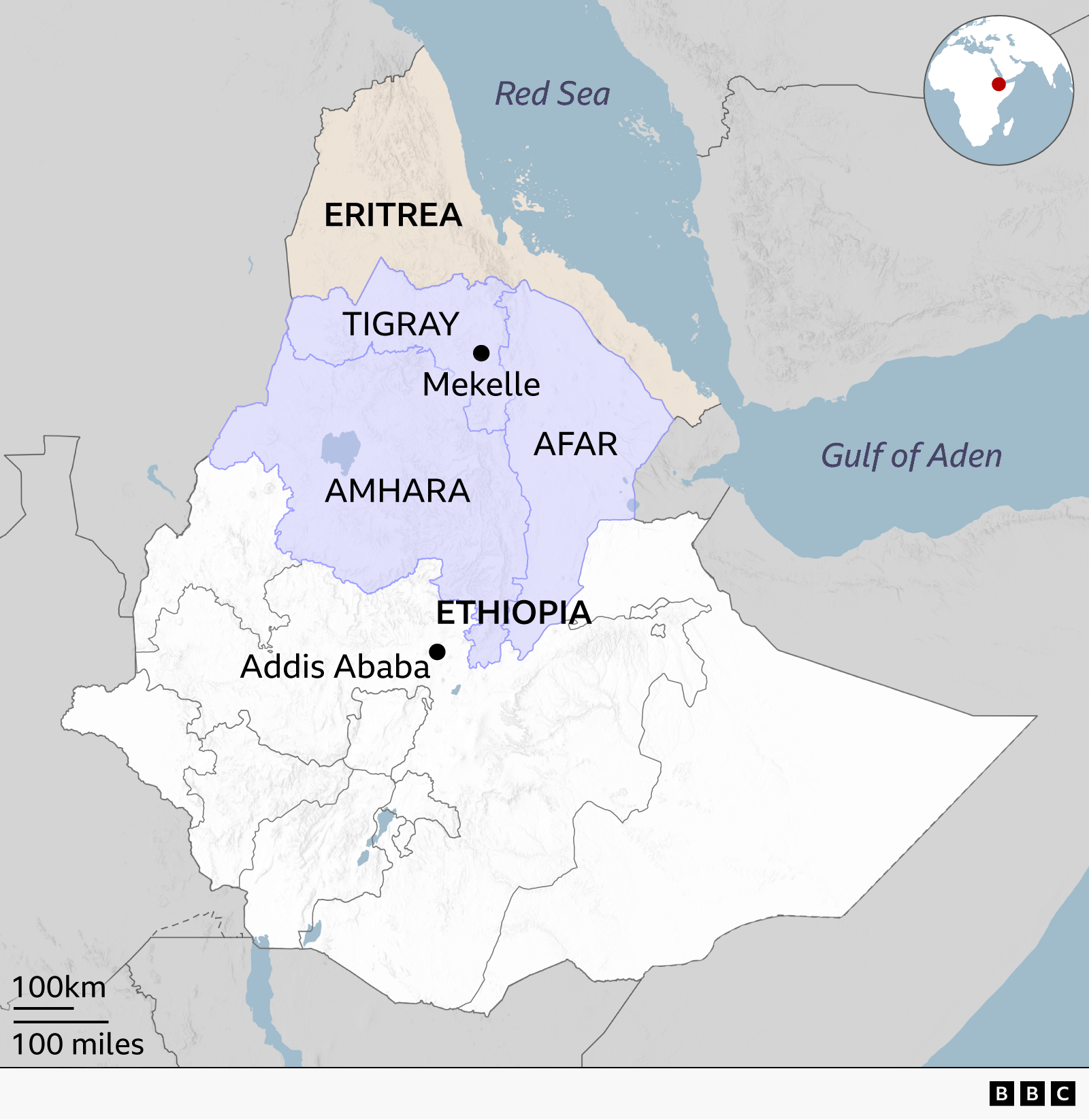
Clashes that had been occurring at a lower level escalated this week across Tigray and spread to neighbouring Afar and Amhara. The expansion followed the formation of a seven-group armed alliance, the Ethiopian Peoples’ Forces Alliance for Survival, which says it seeks to remove Prime Minister Abiy Ahmed’s government. The Tigray Army described the federal operation as a “full-scale offensive” involving infantry, mechanised units and drones, and said it had begun a defensive war. Alliance forces have reportedly seized three airports and attacked federal troops. TPLF central committee member Abdisalam Balema told Al Jazeera the situation had become a “full war.”
The escalation is the most serious since Ethiopia’s 2020–2022 civil war, which killed an estimated 600,000 people. During that conflict, a communications blackout and blockade of supplies isolated Tigray and contributed to famine-like conditions for hundreds of thousands. Residents are now reportedly stocking up on essentials and withdrawing cash. The federal government has accused Eritrea of funding the TPLF and its allies, an allegation Eritrean leaders deny. The renewed conflict also raises the risk of Eritrea becoming involved, amid its concerns that landlocked Ethiopia may seek access to the Red Sea by invading it. The fighting comes shortly after the United States lifted sanctions on Ethiopia and Eritrea related to atrocities in the previous war.
Entities: Tigray, Ethiopia, Mekelle, Afar, Amhara • Tone: analytical • Sentiment: negative • Intent: inform
25-09-2026
Internet and telephone services have been disrupted in Ethiopia’s northern Tigray region following renewed fighting between Tigrayan forces and Ethiopia’s national army. State-owned Ethio Telecom has been completely cut off, while the smaller Safaricom network is still operating. NetBlocks reported evidence of a regional internet shutdown, and humanitarian worker Duke Burbridge told the BBC that telecommunications went down the previous night. The BBC says it has asked Ethiopian authorities for comment but cannot report from Tigray or nearby areas.
The outage could have serious consequences for residents already facing a shortage of cash. Burbridge said people had struggled to access cash for eight months, and warned the loss of internet would be devastating. Many rely on mobile banking and money-transfer applications, most of which they access through the two operators’ networks.
The disruption comes amid escalating clashes. Fighting between Tigrayan forces and their allies and federal troops began on Wednesday, raising fears of a return to full-scale civil war and prompting reports of panic buying. During the previous two-year war, which ended in 2022, Tigray was cut off from the outside world. Restricted access to cash, food and medicine contributed to famine-like conditions; estimates suggest about 600,000 people died.
The Tigray People’s Liberation Front (TPLF), the party controlling the region, announced an alliance with six other armed groups on Sunday, saying they would seek to oust the government. On Wednesday, the TPLF took control of three airports from federal police. Reports that TPLF forces have attacked the neighbouring regions of Afar and Amhara remain unconfirmed. Ethiopian Airlines has cancelled all flights to Tigray.
Entities: Tigray, Ethiopia, Mekelle, Duke Burbridge, Kaleb Moges • Tone: analytical • Sentiment: negative • Intent: inform
25-09-2026
The article examines how renewed fighting in Ethiopia’s Tigray region could draw Eritrea into a wider Horn of Africa crisis, at a time when the United States has ended its Ethiopia-related sanctions regime and removed Eritrean individuals and entities from its sanctions list. The timing has prompted speculation about Washington’s strategic calculations, particularly the importance of securing the Red Sea and the Bab el-Mandeb Strait amid regional conflict and Houthi attacks. The article notes, however, that the US has not presented the sanctions decision as an endorsement of Eritrea or publicly confirmed a deal with President Isaias Afwerki.
Eritrea’s coastline and the port of Assab give it strategic importance, but its authoritarian government and record of military involvement in the previous Tigray war make closer engagement risky. Analysts also caution that sanctions relief may have limited practical economic impact because Eritrea is a closed country with few established trading relationships.
The renewed violence follows the formation of an alliance of seven Ethiopian armed and political groups opposed to Prime Minister Abiy Ahmed. Tigrayan forces seized local airports as fighting spread beyond Tigray, with the TPLF and the Ethiopian government blaming each other for starting the clashes. The 2022 Pretoria peace agreement is now under pressure. Eritrea denies accusations that it supports armed groups, and there is no public evidence that sanctions relief was intended to encourage intervention. Still, deteriorating Eritrea-Ethiopia relations—including disagreement over Ethiopia’s desire for Red Sea access—could give Asmara reasons to become involved if fighting worsens.
The article places these risks within a volatile regional landscape that includes wars and rivalries in Sudan, Somalia, Yemen, and the Nile basin, as well as competing Gulf-state interests. A broader war is not inevitable, but interconnected conflicts and alliances could cause escalation to spread.
Entities: Eritrea, Ethiopia, Tigray, Isaias Afwerki, Abiy Ahmed • Tone: analytical • Sentiment: negative • Intent: analyze
25-09-2026
Internet access has been disrupted in Ethiopia’s northern Tigray region amid renewed fighting between the Tigray People’s Liberation Front (TPLF) and the Ethiopian government, according to internet monitor NetBlocks. The disruption was reported on Friday, but its cause was not immediately known. NetBlocks said network data showed a localized outage consistent with reports of a telecommunications blackout in Tigray.
The renewed hostilities have heightened fears among residents that the region could again be cut off from essential services and supplies. During the 2020–2022 Tigray war, the region was largely isolated from the outside world, and hundreds of thousands of people faced famine-like conditions. Residents told Reuters and AFP that panic buying had emptied shop shelves, while one resident expressed concern that banks, telecommunications, electricity and basic goods could once again become unavailable.
The TPLF took control of regional airports earlier in the week and clashed with Ethiopian government forces in neighboring Afar and Amhara. The group described its conflict with Addis Ababa as “full-blown war.” It has also formed an alliance against the government with the Fano militia in Amhara and five other armed groups. Fano had fought alongside federal forces against Tigrayan rebels in the 2022–2023 war.
The article places the escalation in the context of the TPLF’s political history: the party ruled Ethiopia from 1991 to 2018, before being sidelined as Prime Minister Abiy Ahmed rose to power. The renewed fighting has broken the 2022 peace deal and raised concerns about a return to wider conflict.
Entities: Tigray, Ethiopia, Tigray People’s Liberation Front (TPLF), NetBlocks, Addis Ababa • Tone: neutral • Sentiment: negative • Intent: inform
25-09-2026
Renewed fighting in Ethiopia’s northern Tigray region has raised concerns that the conflict could spread beyond the country and intersect with instability across the Horn of Africa and the Red Sea. Tigrayan forces launched an offensive on September 23, with fighting also reported in Afar and Amhara. The escalation threatens the Pretoria peace agreement, which ended large-scale fighting in 2022 but left political and territorial disputes unresolved.
Experts interviewed by DW warn that regional conflicts and shifting relationships could compound the danger. Martin Plaut says a confrontation involving Ethiopia and Eritrea could draw in Sudanese forces. ACLED analyst Jalale Getachew Birru likewise says Ethiopia’s conflict cannot be viewed in isolation from events in neighboring countries. The African Union has urged restraint, renewed talks under the Pretoria agreement, and diplomatic engagement led by its Horn of Africa representative, Olusegun Obasanjo.
Within Ethiopia, the TPLF has joined six other armed groups, including the Amhara Fano movement, in an alliance seeking to remove Prime Minister Abiy Ahmed’s government. The coalition is not a unified military force, but it could create pressure on several fronts. Fighting in Afar is particularly consequential because the region contains a major transport corridor to Djibouti, Ethiopia’s key route for international trade.
Relations between Ethiopia and Eritrea have worsened since the two countries fought on the same side against the TPLF in the previous war. Ethiopia’s pursuit of Red Sea access has heightened Eritrean security concerns, though the extent of any Eritrean involvement in current events is uncertain.
Sudan’s civil war adds another point of potential connection. Plaut describes alleged indirect support by Ethiopia and Eritrea for opposing Sudanese factions, while acknowledging that DW has not independently verified a claim about a base supplying RSF fighters. The article stresses that regional war is not inevitable: there is no single alliance or command linking all parties, and each actor has separate interests. Still, conflicts can interact through borders, supply routes, and outside powers’ competing interests, risking a wider and more severe humanitarian crisis.
Entities: Tigray conflict, Pretoria peace agreement, Tigray People's Liberation Front (TPLF), Martin Plaut, Jalale Getachew Birru • Tone: analytical • Sentiment: negative • Intent: analyze
25-09-2026
The France 24 article reports growing concern that Ethiopia may be moving back toward civil war as fighting intensifies in the north. It says the Ethiopian army claimed to have killed 272 Tigray People’s Liberation Front (TPLF) fighters in the Amhara region. The TPLF, meanwhile, characterized the conflict as a “full-blown war,” signaling a sharply more serious assessment of the escalation. The article also links the heightened risk to the TPLF’s entry into a new alliance with six other armed groups.
The report presents these developments as grounds for mounting fears of a broader conflict, but the supplied article text is brief. It does not provide further details about the fighting, the identities of the allied groups, the circumstances behind the army’s reported toll, or responses from other parties. Nor does it describe the alliance’s aims or offer independent verification of the competing claims. The piece is introduced as a report from France 24 journalist Tom Canetti, who is described as having the latest from the ground. Overall, the article alerts readers to an escalation and its potential implications, while the available text leaves important questions about the scale, causes, and likely course of the violence unanswered.
Entities: Ethiopia, Tigray, Amhara, Tigray People’s Liberation Front (TPLF), Ethiopian army • Tone: urgent • Sentiment: negative • Intent: inform
25-09-2026
The France 24 report says the Tigray People’s Liberation Front (TPLF) has described its confrontation with Ethiopia’s federal government as a “full-blown war.” According to the article, TPLF forces seized key airports and launched attacks into the neighboring regions of Amhara and Afar, marking a serious escalation in the fighting. The report links this development to the TPLF’s recent decision to join six other armed groups in a new alliance opposed to the federal government.
The article presents the escalation as raising fears that Ethiopia could return to the devastating conflict fought from 2020 to 2022. It states that the earlier war killed at least 600,000 people, underscoring the potential human cost of renewed hostilities. However, the supplied report is brief: it gives no details about which airports were seized, the scale or consequences of the attacks, or a response from the federal government. It also does not independently verify the TPLF’s description of the situation or provide further information about the newly formed alliance.
Overall, the report focuses on the conflict’s escalation and the danger of a return to large-scale war. Its central message is that the TPLF’s claims of fighting, territorial actions, and alliance-building have heightened concern about renewed violence in Ethiopia.
Entities: Tigray People’s Liberation Front (TPLF), Ethiopia, Tigray, Ethiopia’s federal government, Amhara region • Tone: urgent • Sentiment: negative • Intent: inform
25-09-2026
The France 24 page introduces a video report about renewed violence in northern Ethiopia. It says Tigray’s rebel authorities describe the conflict with the Ethiopian government as a “full-blown war,” and reports that fighting has spread beyond Tigray into the neighboring regions of Amhara and Afar. The Ethiopian federal army, according to the page, says that 272 rebels were killed and 260 wounded in the north. These casualty figures are presented as the army’s claim, not as independently verified figures in the available text.
The report’s stated purpose is to assess how serious the escalation is and explain what is driving the renewed fighting. For that analysis, France 24 speaks with Jervin Naidoo, identified as a political analyst at Oxford Economics Africa. However, the supplied page content contains only the video’s introduction and does not include Naidoo’s answers, a transcript, or further details about the causes of the renewed violence. It therefore establishes the conflict’s reported scope, the opposing authorities’ framing, and the questions the segment intends to examine, but does not provide enough information to explain the underlying drivers or reach a conclusion about the escalation. The page is dated 25 September 2026.
Entities: Ethiopia, Tigray, Amhara region, Afar region, Tigray rebel authorities • Tone: analytical • Sentiment: negative • Intent: analyze
25-09-2026
Internet and phone services were disrupted across Ethiopia’s northern Tigray region on Friday, amid the sharpest escalation in violence since the 2020–2022 war. Four people familiar with the situation, including a diplomatic source, told Reuters that the Tigray People’s Liberation Front (TPLF) had ordered Safaricom and state-owned Ethio telecom to cut access. One source suggested the restrictions could hinder federal forces’ use of mobile networks to support battlefield drones. The TPLF did not comment, while a source close to the group denied its responsibility and blamed the government. Reuters reporters encountered failed calls on Ethio telecom and limited Safaricom connectivity, and outage monitor NetBlocks confirmed disruption.
The blackout has raised concerns that people could again be deprived of food, cash and medicine, as during the previous war, when communications were severed and hundreds of thousands faced famine-like conditions. Residents reported panic-buying basic supplies and withdrawing cash; the outage also affected mobile money services. One resident said Safaricom worked only intermittently, while another said TPLF fighters were searching homes for young people to join the war effort.
Tigrayan forces and allies have seized three local airports and attacked federal troops in Afar and Amhara, describing their actions as defensive. Ethiopia’s government accused Eritrea of financially supporting the TPLF, an allegation Eritrea denies. The renewed conflict risks worsening regional instability, already compounded by Ethiopia-Eritrea tensions, Sudan’s civil war, disputes over Red Sea access and spillover from Middle Eastern conflicts. The UN and EU urged restraint and a return to the African Union-brokered peace process.
A diplomatic risk note reviewed by Reuters said the TPLF had taken steps to disrupt telecommunications, including removing Ethio telecom transformers. Ethiopian military drones are a significant battlefield advantage, and the military has used them to strike targets in Tigray, according to ACLED. Fighting also prompted flight suspensions near Lalibela, raising concerns about the UNESCO-listed rock-hewn churches there.
Entities: Tigray, Ethiopia, Tigray People’s Liberation Front (TPLF), Ethio telecom, Safaricom • Tone: analytical • Sentiment: negative • Intent: inform