24-06-2026
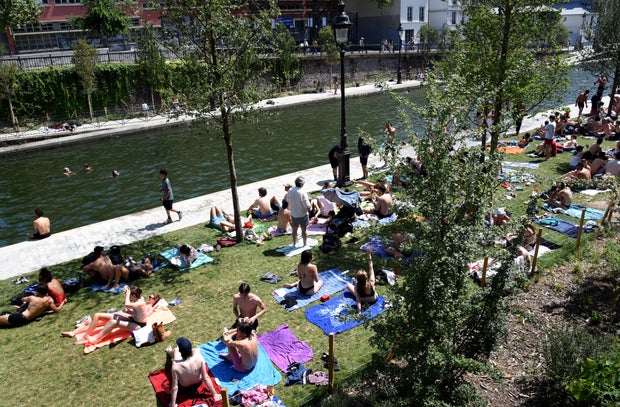
Europe is in the grip of a severe late-June heatwave, with France, Spain and Italy experiencing record or near-record temperatures and mounting public health risks. In France, officials said 40 people have drowned in heatwave-related incidents since Thursday, prompting warnings about swimming in unsupervised rivers, reservoirs and canals. The country recorded its hottest June day on record, and more than half of metropolitan France was placed on red alert. Italy declared red heat alerts in 15 cities, while Spain faced temperatures above 40C in several regions, with forecasters warning of even higher peaks in parts of Andalusia and the Ebro valley. The heat has already caused disruption beyond health impacts: the Eiffel Tower closed early, the Louvre shortened opening hours, and France’s Golfech nuclear plant was shut down because river water became too warm for safe reactor cooling. Authorities in Germany, the Netherlands and Belgium also issued warnings as the heatwave spread northwards. The article frames the event as part of a broader climate trend, noting that Europe is warming faster than the global average and that heatwaves, water stress and wildfire risks are intensifying.
Entities: Europe, France, Spain, Italy, Germany • Tone: urgent • Sentiment: negative • Intent: inform
24-06-2026
France and much of Europe are enduring an intense, early-summer heat wave that has pushed temperatures to dangerous levels, disrupted daily life, and raised serious public-health concerns. In France, officials reported 40 drowning deaths in the past week, many involving young people who went swimming in unsupervised areas to escape the extreme heat. Authorities warned that swimming in unsafe conditions during a heat wave can be deadly, while the national weather service said the country had entered a "plateau of severity" with relentless day-and-night heat and the possibility of additional record-breaking temperatures.
The heat wave has affected schools, transportation, sporting events, and major landmarks such as the Eiffel Tower and the Louvre Museum, which adjusted hours because of the weather. France’s temperatures have already produced record highs for June, and officials compared the event to the devastating 2003 heat wave that caused an estimated 15,000 deaths. The article places the episode in the broader context of climate change, citing European and global agencies that warn heat waves are becoming more frequent, longer, and more intense. Other countries, including the United Kingdom, Spain, and Italy, are also dealing with dangerous heat, with red alerts, school closures, train cancellations, and warnings of possible record-breaking temperatures. The article emphasizes that Europe is warming faster than the global average and that many heat-related deaths are preventable.
Entities: France, Europe, Sébastien Lecornu, Marina Ferrari, Météo-France • Tone: urgent • Sentiment: negative • Intent: inform
24-06-2026
France’s latest heatwave is presented as a stark reminder that the country is poorly prepared for the realities of climate change. In an interview with France 24, climate scientist François Gemenne says the extreme temperatures currently affecting France are not exceptional anomalies but part of a pattern scientists have predicted for decades: hotter, longer, and more frequent heatwaves will become the norm. He argues that political leaders have been too slow to act, particularly on adapting buildings, schools, and cities to rising temperatures.
The article details the heatwave’s immediate effects, including record temperatures, red weather alerts across much of mainland France, more than 800 school closures, and train disruptions in the Paris region. Gemenne stresses that the social consequences are unequal, with elderly people and residents of small top-floor apartments especially vulnerable. He calls for urgent renovation of public buildings and schools, the creation of cooling centres, and broader urban adaptation measures such as more green space.
A major portion of the interview focuses on air conditioning. Gemenne rejects the idea that AC should be dismissed outright, arguing that European rules have eliminated the most harmful refrigerant gases and that France’s low-carbon electricity means AC’s climate impact is now limited. He says the public-health benefits, especially for vulnerable people, outweigh the local downsides, though he emphasizes that access is unequal and that collective solutions are needed. The conversation ends by broadening into the political challenge of maintaining momentum on decarbonisation and adaptation, even when the immediate crisis fades as temperatures fall.
Entities: France, François Gemenne, Météo France, European Union, UN Intergovernmental Panel on Climate Change (IPCC) • Tone: analytical • Sentiment: negative • Intent: analyze