23-10-2026
Nigeria’s health minister, Muhammad Ali Pate, says the country’s first confirmed Ebola case remains contained, with no evidence the virus has spread into the wider community. The patient is a 42-year-old Ugandan-born woman, married to a diplomat based in Abuja. She had spent two weeks on holiday in Kampala before returning to Nigeria. Pate said on Thursday that she was in stable condition and recovering. He reported that her laboratory results were showing significant improvement and that recovery was possible.
The minister urged the public to remain calm while health officials conduct extensive contact tracing. People who had contact with the patient are in isolation, and none are known to have developed symptoms. Pate said there was currently no reason to change plans for large public gatherings, although authorities could introduce additional measures if circumstances change. He expressed hope that the case would remain isolated.
Nigeria has also increased Ebola surveillance at its international airports following confirmation of the case. The article places the situation in the context of a wider outbreak that began in the Democratic Republic of Congo in May and has since been detected in three other African countries.
Entities: Muhammad Ali Pate, Nigeria, Abuja, Kampala, Uganda • Tone: neutral • Sentiment: neutral • Intent: inform
23-10-2026
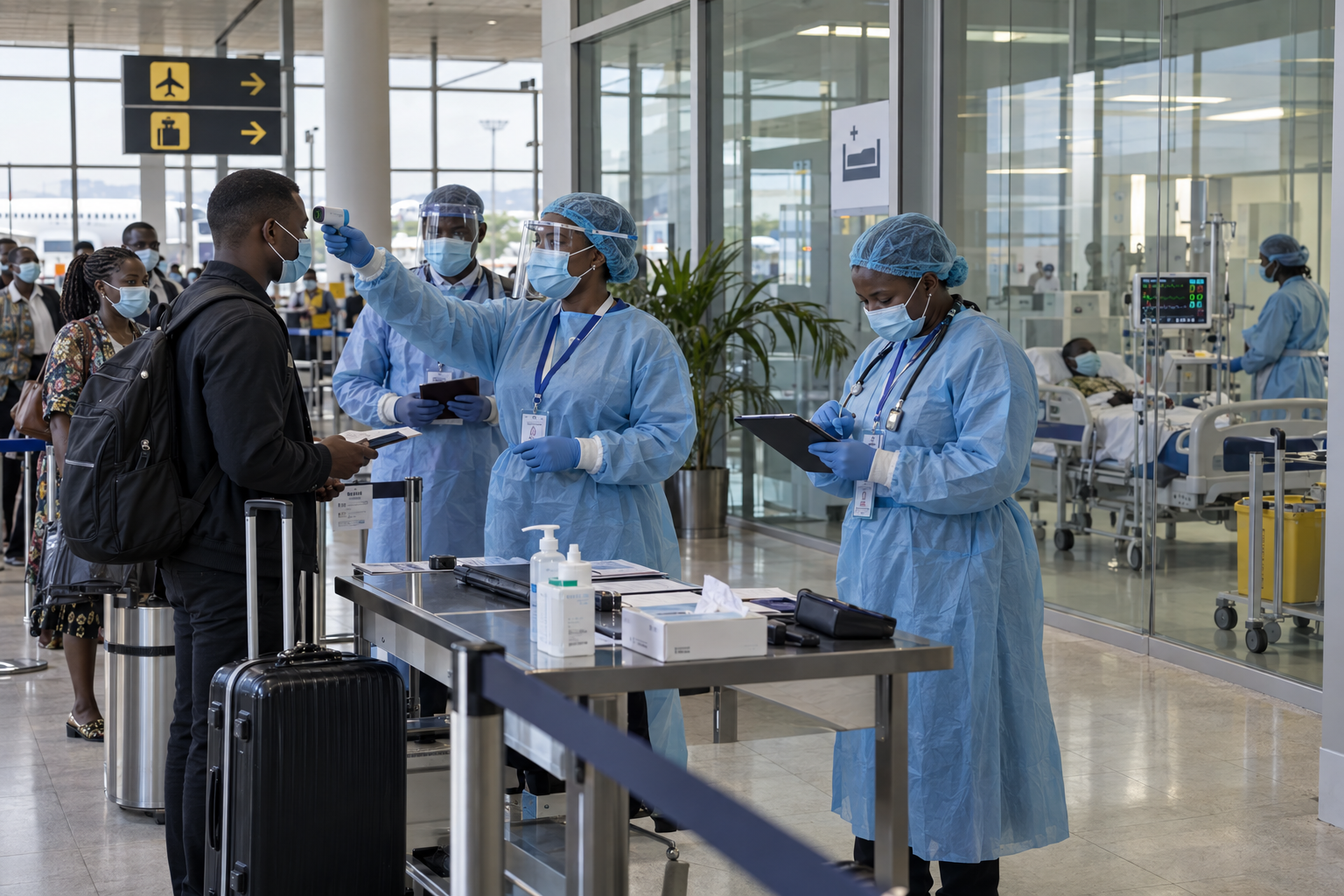
Nigeria has increased health screening for international arrivals at Lagos airport after confirming its first case of the Bundibugyo strain of Ebola. The patient, who returned from Uganda via Addis Ababa, is being isolated and is reported to be in stable condition. Health authorities have identified 44 contacts and are working to find others who may have been exposed. Passengers arriving in Nigeria described differing levels of concern. Patrick Akwongu, returning from Italy via Addis Ababa, said he feared the consequences of an outbreak in Nigeria, which he described as a crowded country. Bezalel Mfashingabo, arriving from Nairobi, said he was not especially worried but was taking precautions and believed infected people were being quarantined in Kenya. The report places Nigeria’s case in the context of a wider outbreak: the Democratic Republic of the Congo has faced its worst-ever Ebola outbreak since May, and cases have also recently been confirmed in Kenya. Uganda, which reported 20 cases, was declared Ebola-free in August. Experts express confidence that Nigeria can contain the current threat, in part because it successfully contained an Ebola outbreak in 2014. However, concern has been raised that the patient was not tested for Ebola until 13 days after symptoms began. The World Health Organization has described the spread of the virus from east to west as evidence of a “complex” Ebola outbreak across Africa. Overall, the article reports stepped-up screening and containment measures while noting both the country’s previous experience and potential delays in detecting the case.
Entities: Nigeria, Lagos airport, Patrick Akwongu, Bezalel Mfashingabo, Bundibugyo strain of Ebola • Tone: analytical • Sentiment: neutral • Intent: inform
23-10-2026
The World Health Organization’s Africa regional director, Mohamed Janabi, warned that the continent is facing a more complex Ebola outbreak after Nigeria confirmed its first case in the current outbreak. The case, announced Tuesday, is an imported infection with the Bundibugyo strain, which is associated with a major outbreak in the Democratic Republic of the Congo. The patient is a woman and diplomat who had travelled to Uganda. Nigeria is the fourth African country affected, while Kenya has reported nine cases since October 6, extending the outbreak across eastern and western parts of the continent.
The new case has revived memories of the 2014 Ebola outbreak, which affected several West African countries and killed more than 11,000 people between late 2013 and 2016. However, Nigeria successfully contained Ebola during that earlier crisis, a record that has bolstered confidence in its ability to respond to new public-health threats.
The article also describes the scale of the outbreak in the DRC, where health authorities report more than 9,000 confirmed cases and 4,381 deaths since mid-May. A trial is underway in eastern Congo to determine whether Ervebo, a vaccine approved for the Zaire strain, can protect against the Bundibugyo strain driving the current outbreak. The WHO said in August that 70,000 doses had been approved for use in the country: 50,000 for frontline and health workers, and 20,000 for the clinical trial. Bundibugyo currently has no licensed vaccine or treatment.
Entities: World Health Organization (WHO), Mohamed Janabi, Nigeria, Democratic Republic of the Congo (DRC), Uganda • Tone: neutral • Sentiment: negative • Intent: inform
23-10-2026
Switzerland’s foreign ministry has confirmed that the woman who tested positive for Ebola in Nigeria is the wife of a Swiss diplomat. The 42-year-old Ugandan-born woman lives in Abuja and tested positive on 20 October, marking Nigeria’s first confirmed Ebola case in more than a decade. She and her husband had travelled to Uganda earlier in October. Her husband is in isolation without symptoms; the Swiss embassy’s 25 staff members remain healthy and were not required to isolate. The woman is receiving treatment in isolation and is improving.
The source of her infection remains uncertain. She returned to Nigeria on 3 October after spending about two and a half weeks in Uganda, but investigators have not verified reports that she visited the Democratic Republic of Congo. She developed symptoms four days after arriving in Abuja and sought care at two private health facilities before her diagnosis. Authorities are examining a possible connection to a Kenyan man who travelled through Uganda and later died of Ebola, as well as whether shared equipment or other contact could have exposed the woman. No link has been established. Kenya has reported nine cases, all linked to that first patient, with no evidence of wider community transmission.
The woman has the Bundibugyo species of Ebola, also identified in the DR Congo outbreak. Nigeria’s Centre for Disease Control and Prevention is conducting genomic sequencing to investigate possible links. Nigerian authorities are expanding contact tracing beyond 44 initially identified contacts. The WHO says it is too early to determine where she was infected, and says limited opportunities to interview her have complicated reconstruction of her movements.
The article places the case in a wider regional context: cross-border travel, trade and unofficial crossings make screening difficult, especially along the porous DR Congo–Uganda border. WHO officials are urging regional vigilance, stronger surveillance and protection for frontline health workers. Ebola spreads through direct contact with infected bodily fluids or contaminated objects, not through the air; rapid contact tracing, isolation and early treatment are central to containing transmission.
Entities: Ebola, Bundibugyo species, Abuja, Nigeria, Uganda, Democratic Republic of Congo • Tone: analytical • Sentiment: neutral • Intent: inform
23-10-2026
Kenya has reported a second death from Ebola, according to its Health Ministry. The patient was a 65-year-old woman and close relative of the country’s first known case, a 40-year-old Kenyan man who had been living in the Democratic Republic of Congo (DRC). The woman developed symptoms while in quarantine about 10 days earlier and received supportive care at an infectious disease unit in Nairobi. The ministry said she died on Friday, that medical staff had made every effort to save her, and that it would arrange a safe and dignified burial with her family. Seven people remain under treatment in Kenya.
Kenya announced its first case on October 6. The man had travelled from the DRC through Uganda, arriving in Kenya on October 3; he tested positive and died on October 5. Of approximately 135 people identified as his contacts, 118 were quarantined and eight tested positive. The ministry said the seven remaining cases belong to one cluster, with no evidence of community transmission.
The article also reports concerns about a related case in Nigeria. Genomic testing indicated that the virus in Kenya’s first patient closely resembles the virus in Nigeria’s first reported case, a woman who returned to Abuja from Uganda. The Swiss Foreign Ministry disputed Ugandan reports that she had visited the DRC. African health authorities are tracing the infection’s source, including whether she may have encountered Kenya’s first patient at an airport; both travelled from Uganda on the same day. Nigeria’s health minister said the viruses appeared related.
The outbreak began in the DRC in May and has spread to Uganda, Kenya and Nigeria. The article notes that the Bundibugyo species has no approved vaccine or specific treatment. World Health Organization figures cited in the report recorded more than 9,700 confirmed cases and 4,690 deaths as of October 20.
Entities: Ebola, Bundibugyo virus species, Kenya, Democratic Republic of Congo (DRC), Uganda • Tone: analytical • Sentiment: negative • Intent: inform
23-10-2026
Uganda says it has no confirmed active Ebola cases, but investigations into infections in Kenya and Nigeria have focused attention on the country and its travel links. According to Africa CDC official Wessam Mankoula, the first confirmed patients in both countries passed through Uganda’s Entebbe International Airport on October 3. Investigators are checking whether they were there at the same time or had any contact; no airport transmission has been established.
Nigeria confirmed Ebola in a woman who had recently traveled in East Africa. She developed symptoms on October 7, was seen at a health facility on October 11, and was isolated after laboratory tests confirmed infection. Officials said she was stable and had identified 44 contacts. Her travel history is disputed: Uganda said preliminary information suggested she had traveled to eastern Democratic Republic of Congo (DRC), while Switzerland’s foreign ministry said she and her husband had not visited the DRC. Swiss officials said she may have contracted Ebola while traveling in Uganda, but that assessment has not been independently confirmed. WHO and Africa CDC likewise said they had no confirmed information that she had been to the DRC.
Kenya’s first confirmed patient, who died in Nairobi on October 5, had traveled from the DRC through Uganda. Kenyan authorities have reported further infections linked to the case and are seeking a Ugandan national identified as a contact, but not yet located. The article stresses that an untraced contact is not necessarily infected, while finding potentially exposed people is important for limiting transmission.
The report describes the difficulty of tracing Ebola across borders, given regional movement and the disease’s two-to-21-day incubation period. Uganda says it is strengthening entry-point screening, while Nigeria is expanding contact tracing and infection-control measures. In Abuja, the case has prompted public anxiety, alongside concerns about economic hardship and the ability of health services to respond. Key questions remain about whether the two patients crossed paths at Entebbe and where the Nigerian patient was exposed.
Entities: Uganda, Kenya, Nigeria, Democratic Republic of Congo (DRC), Entebbe International Airport • Tone: analytical • Sentiment: negative • Intent: inform
23-10-2026
Health officials are investigating whether Nigeria’s first Ebola patient in the current outbreak encountered Kenya’s first patient at Entebbe International Airport in Uganda. The two people were reportedly at the airport on the same day. The Africa Centers for Disease Control and Prevention is examining whether they interacted, but the source of the Nigerian patient’s infection has not yet been established.
Nigeria reported its first Ebola case in more than a decade on Tuesday. The patient is the Ugandan-born wife of a diplomat based in Abuja. She had vacationed in Uganda in September and returned to Nigeria earlier in October. She is receiving treatment, and 44 people who had close contact with her have been quarantined, according to Dr. Wessam Mankoula, the Africa CDC’s head of emergency preparedness and response.
The outbreak began in May in eastern Democratic Republic of Congo and has spread to multiple African countries. Nigeria is the fourth country to report a case in the current outbreak, the first in West Africa, and the farthest from the outbreak’s epicenter. Congo has recorded about 9,700 infections and at least 4,600 deaths, making this its fastest-spreading Ebola outbreak on record. Uganda reported about 20 cases before being declared Ebola-free in August.
Kenya recorded its first case in early October, followed by eight more. Its first patient, who has since died, travelled from Congo to Kenya through Uganda. Officials are investigating whether that patient and the Nigerian patient crossed paths at the airport. Ebola spreads through direct contact with an infected person’s bodily fluids or contaminated items. It can cause severe fever and be fatal, though people are generally not considered infectious until symptoms begin.
Entities: Kate Bartlett, Dr. Wessam Mankoula, Africa Centers for Disease Control and Prevention (Africa CDC), Nigeria, Kenya • Tone: analytical • Sentiment: neutral • Intent: inform
23-10-2026
Health officials are investigating how Nigeria’s first Ebola case in more than a decade became infected, as the outbreak has spread to a fourth African country. The patient is the Ugandan-born wife of a Swiss diplomat based in Abuja. Switzerland’s foreign ministry said she had not travelled to the Democratic Republic of the Congo, where the outbreak was first detected, and was believed to have contracted the virus while travelling in Uganda. This contradicts earlier Ugandan accounts that she had visited eastern DR Congo, adding uncertainty about the outbreak’s transmission routes and the effectiveness of containment.
The World Health Organization says its investigation into the likely source is ongoing. Africa CDC is examining whether the patient could have encountered an Ebola patient in Kenya: both travelled from Entebbe airport on 3 October. WHO officials say this is possible but that symptom timing and other evidence are needed to determine where transmission occurred. Virologist Marion Koopmans cautioned that merely being in the same large airport does not establish an epidemiological link without evidence of meaningful shared exposure.
Nigeria’s health minister, Muhammad Ali Pate, said the case remains contained and contact-tracing is under way to prevent spread into communities. Aid and health-response representatives stressed the importance of rapid cross-border information-sharing and adequately resourcing frontline workers and local organisations.
The outbreak is caused by the rare Bundibugyo virus, for which there is no approved treatment or vaccine. The article reports more than 9,500 infections and nearly half that number in deaths, describing the outbreak as the largest and deadliest in DR Congo’s history and the second largest globally after West Africa’s 2014–16 Ebola outbreak. Ebola spreads through bodily fluids or contaminated materials and can cause severe illness, organ damage and bleeding.
Entities: Ebola outbreak, Bundibugyo virus, Nigeria, Democratic Republic of the Congo, Uganda • Tone: analytical • Sentiment: negative • Intent: inform