22-05-2026
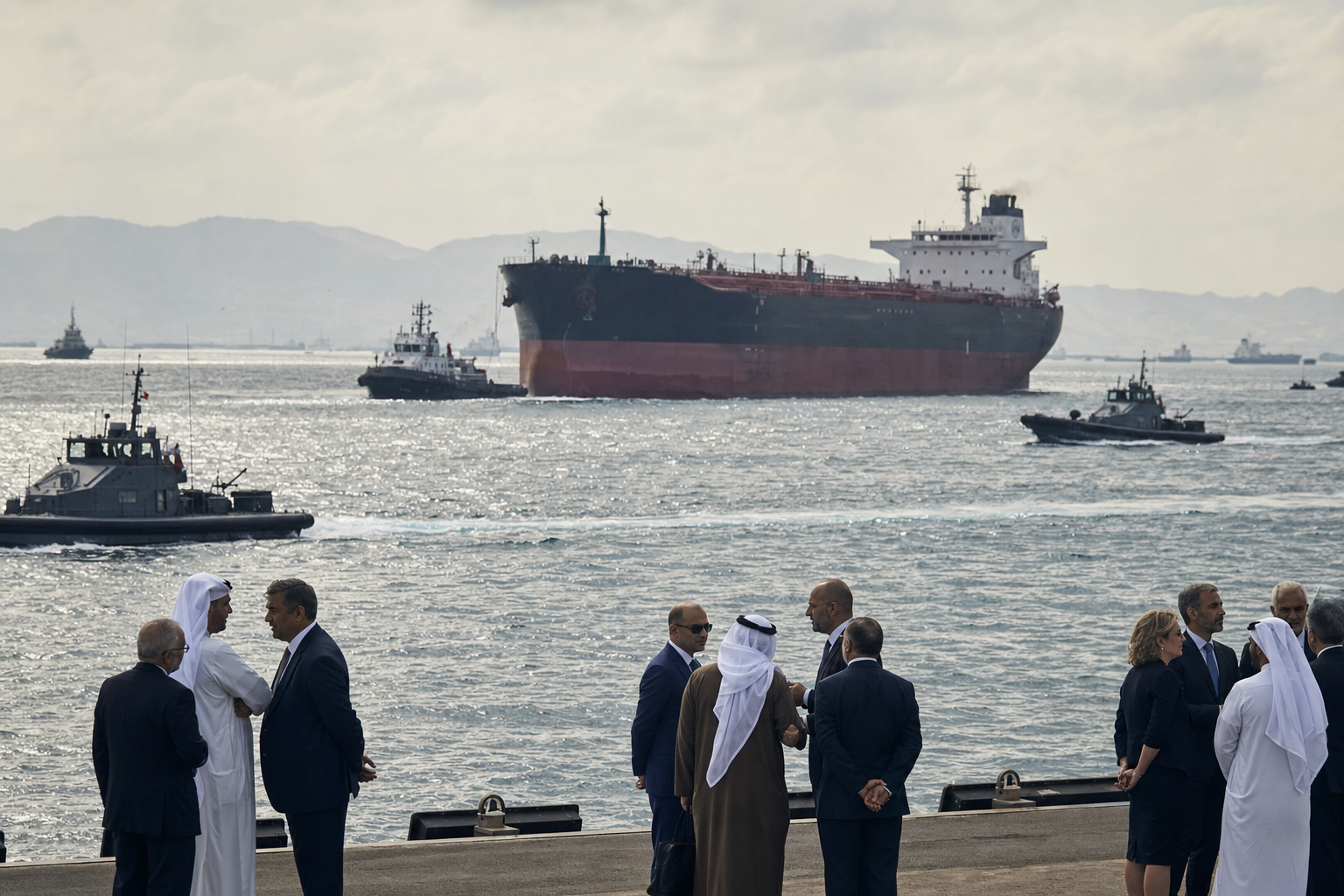
Iran is widening its claimed military control around the Strait of Hormuz, the narrow and strategically vital waterway through which a large share of global oil shipments pass. A newly created Iranian body, the “Persian Gulf Strait Authority,” published a map asserting Iranian armed forces oversight over an area of more than 22,000 sq km, including waters extending into Oman and the UAE. The move prompted a sharp rejection from the UAE, which called Iran’s claims “nothing but fragments of dreams,” while the US and its Gulf allies reiterated that they do not recognize Iranian authority over the strait and have told ships not to comply with Iran’s rules.
The article places this development in the context of rising US-Iran maritime tensions. BBC Verify says footage from IRGC-linked media appears to show an attack on a tanker in the strait, matching a Liberian-flagged vessel called Barakah that reported being struck in early May. Separately, US forces boarded an Iran-bound tanker in the Gulf of Oman, which Centcom said was suspected of violating the American blockade of Iranian ports; the vessel was later released after being searched and redirected. Centcom also said it has redirected dozens of commercial ships and disabled several vessels since the blockade began on 13 April.
The piece also notes broader diplomatic maneuvering: Donald Trump said he delayed a planned strike on Iran after requests from Gulf states, while Pakistan’s military chief was reportedly visiting Tehran for mediation. Overall, the article frames the Strait of Hormuz as a flashpoint where claims of sovereignty, military actions, sanctions enforcement, and backchannel diplomacy are all intensifying at once.
Entities: Strait of Hormuz, Iran, United Arab Emirates (UAE), Oman, Persian Gulf Strait Authority • Tone: urgent • Sentiment: negative • Intent: inform
22-05-2026
The Asian Infrastructure Investment Bank (AIIB) has announced a new US$10 billion facility designed to support member countries affected by the fallout from the US-Israel war on Iran. The facility, called the Energy, Food Security and Economic Resilience Facility, is intended to provide rapid financial assistance over a two-year period to help countries cope with urgent pressures in energy supply, food availability, and broader economic stability. According to the Beijing-based lender, the program is meant to address immediate development disruptions caused by external shocks while also helping countries build longer-term resilience.
AIIB President Zou Jiayi said the initiative will allow members to respond to the development impacts of the conflict while strengthening resilience. She emphasized that the bank aims to support both short-term needs, such as access to energy and food, and longer-term priorities including infrastructure development, green transition, and sustainable growth. The facility will operate alongside the bank’s existing financing tools and will deliver support through fast-disbursing budget support, financing for critical imports, and liquidity assistance.
The bank also said the facility can support government response programs and help affected countries stabilize their economies during the crisis. In addition, infrastructure companies and financial intermediaries may access short-term working capital and business continuity support. Overall, the article presents the facility as a targeted emergency response that also aligns with AIIB’s broader development agenda.
Entities: Asian Infrastructure Investment Bank (AIIB), US$10 billion facility, Energy, Food Security and Economic Resilience Facility, US-Israel war on Iran, Iran • Tone: analytical • Sentiment: neutral • Intent: inform
22-05-2026
The article reports that Iran has been discussing with Oman a possible system of fees for ships passing through the Strait of Hormuz, a critical global shipping lane. The proposal comes after Iran, following attacks by American and Israeli forces in late February, sharply reduced traffic through the strait and gained leverage over international energy markets. Iranian officials have created a new authority and announced that passage would require permission, while state media has described the plan as a system for charging for “specialized services.”
The Trump administration has strongly rejected any payment scheme, calling the strait an international waterway that must remain free. President Trump said the United States wants passage to be “free,” and Secretary of State Marco Rubio warned that any such system would be unacceptable and could make a diplomatic deal impossible. The article notes that Iran and Oman are trying to frame the plan as fees for services rather than a toll, because tolls on an international strait would likely violate international law.
Legal experts cited in the article say that vessels have a widely recognized right to transit international straits without being charged for passage, though reasonable fees for actual services may be permissible. The article suggests that Iran is attempting to push the boundaries of international maritime law by relabeling what could effectively be a toll as a service fee. Oman’s participation is significant because it is an American ally and could help Iran seek broader regional support for the arrangement.
Entities: Iran, Oman, Strait of Hormuz, Gulf of Oman, United States • Tone: analytical • Sentiment: neutral • Intent: inform