21-08-2026
The article examines how President Donald Trump’s effort to improve relations with North Korean leader Kim Jong Un could undermine South Korea’s security. The United States and South Korea are abruptly ending the Ulchi Freedom Shield military exercise after Trump ordered the Pentagon to substantially reduce it, describing the drills as hostile and too expensive. The decision surprised Seoul, which regards the exercises as a central demonstration of the US commitment to defend South Korea, and also concerned regional allies such as Japan and Taiwan.
Although South Korean President Lee Jae Myung publicly praised Trump’s decision and promised to increase domestic defence spending, the move has shaken confidence in the US alliance. South Korean officials fear Trump could eventually reduce the roughly 27,000 US troops stationed in the country or abandon the longstanding goal of denuclearising North Korea without consulting Seoul. These concerns are heightened because the Trump administration increasingly links security issues with trade and burden-sharing disputes, including South Korea’s spending on hosting US troops, its investment commitments and its refusal to support US action against Iran.
The article also highlights North Korea’s strengthened position. Pyongyang continues to develop nuclear weapons and long-range missiles, has rejected denuclearisation and has expanded ties with Russia and China. Its involvement in the war in Ukraine has reportedly provided battlefield experience, including in drone warfare. Kim Yo Jong dismissed Trump’s claims of recent contact and said reducing the military exercises did not change their hostile nature.
Some South Korean experts argue that Seoul may need to develop its own nuclear deterrent if the US retreats further from Asia, although the government warns this could damage the country’s alliances. The article concludes that Trump’s concessions may offer a diplomatic opening but could also encourage further North Korean demands while leaving South Korea more exposed.
Entities: Donald Trump, Kim Jong Un, Kim Yo Jong, Lee Jae Myung, South Korea • Tone: analytical • Sentiment: negative • Intent: analyze
21-08-2026
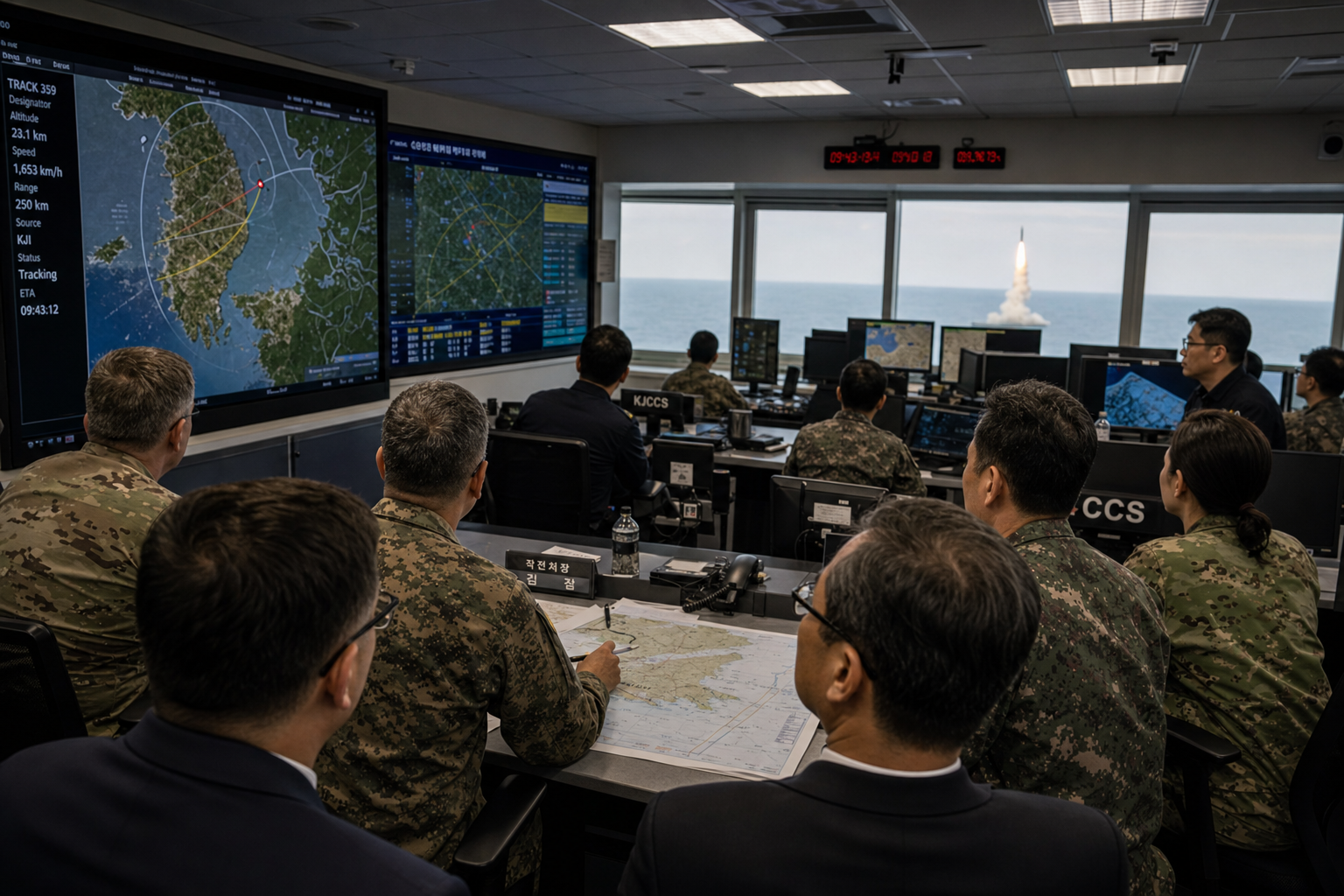
North Korea launched more than 10 short-range ballistic missiles from the Pyongyang area toward the sea east of the Korean Peninsula, according to South Korea. The missiles travelled approximately 300 kilometres. South Korea’s presidential office condemned the launch as a violation of United Nations Security Council resolutions and ordered its military to maintain full readiness while joint exercises with the United States continued.
The launches occurred shortly after U.S. President Donald Trump ordered the Pentagon to substantially reduce the 11-day Ulchi Freedom Shield exercises. Trump said the drills were costly and sent an inappropriate or hostile signal to North Korea. He also cited his reportedly good relationship with North Korean leader Kim Jong Un and South Korea’s refusal to support U.S. military action in Iran. Trump said he expected to meet Kim again and claimed North Korea possessed 57 nuclear weapons, while South Korean officials estimate the country has between 80 and 120 nuclear warheads.
Kim Yo Jong, Kim Jong Un’s sister and a prominent regime spokesperson, dismissed the reduced exercises as insufficient and warned that Washington would not receive the response it wanted by presenting the change as a goodwill gesture. She said relations between her brother and Trump remained excellent but denied that Kim had responded to Trump’s request for talks.
Yang Moo-jin of the University of North Korean Studies said the missile launch likely reinforced Kim Yo Jong’s warning, protested the U.S.-South Korean exercises, objected to discussion of North Korea’s nuclear arsenal and possibly tested improved missile systems. The article also places the launch in the broader context of Trump’s previous meetings with Kim, continuing disputes over the cost of U.S. troops stationed in South Korea, and closer China-North Korea ties. Japan reported a missile had fallen outside its exclusive economic zone, while Chinese Foreign Minister Wang Yi urged Seoul and Washington to move toward peaceful coexistence rather than confrontation.
Entities: North Korea, South Korea, Pyongyang, Korean Peninsula, Donald Trump • Tone: analytical • Sentiment: negative • Intent: inform
21-08-2026
North Korea fired approximately 10 short-range ballistic missiles from the Pyongyang area, according to South Korean officials, shortly after President Donald Trump said he expected to meet North Korean leader Kim Jong Un again later this year. Japan also reported that a suspected North Korean ballistic missile had fallen. The launches occurred as the United States and South Korea shortened their Ulchi Freedom Shield military exercises by about a week, with the drills now scheduled to end Friday at Washington’s direction.
Trump said he ordered the reduction because of his “very good relationship” with Kim and argued that the exercises sent an “inappropriate and hostile signal” to Pyongyang. He also cited South Korea’s limited assistance in the war with Iran as a factor. His renewed focus on Kim and the scaled-back military exercises have unsettled Asian allies, who suspect Trump may be seeking a foreign-policy achievement while the Iran war remains in a costly stalemate.
North Korea has consistently described U.S.-South Korean military exercises as preparations for an invasion and frequently conducts missile tests around the drills. Kim’s sister, Kim Yo Jong, said her brother retained “good memories and feelings” about Trump and that their relationship remained excellent, while adding that she was unaware of any current communication between them.
Trump met Kim three times during his first term, but those meetings produced no firm commitments to limit North Korea’s nuclear weapons program. Trump said North Korea now possessed 57 powerful nuclear weapons, while South Korean officials estimated that it had between 80 and 120 nuclear warheads. Seoul’s defense minister said South Korea still opposed recognizing North Korea as a nuclear-weapon state and did not believe Washington had abandoned denuclearization. South Korean President Lee Jae Myung said he would support Trump’s efforts to pursue peace. The United States maintains approximately 28,500 troops in South Korea under the security arrangement created after the Korean War, which ended in an armistice rather than a peace treaty.
Entities: North Korea, Kim Jong Un, Donald Trump, South Korea, United States • Tone: analytical • Sentiment: negative • Intent: inform
21-08-2026
President Donald Trump said he expects to meet North Korean leader Kim Jong Un again later this year, though neither the White House nor Pyongyang has confirmed plans for a summit. His comments followed a Wall Street Journal report that the administration was seeking to organize a meeting, potentially around the November APEC summit in Shenzhen, China. Trump has reportedly directed aides to contact North Korea in an effort to restart negotiations focused on the country’s nuclear weapons program.
Trump and Kim met three times during Trump’s first term to discuss denuclearization, but those summits produced little progress. Since then, North Korea has continued expanding its nuclear capabilities. Trump said the country now possesses 57 nuclear weapons, while analysts estimate that it has dozens of warheads. Kim has shown no indication that he intends to surrender the program and has instead sought international recognition of North Korea as a nuclear state. He has also ruled out negotiations based on denuclearization.
Trump said he has a good relationship with Kim and expressed confidence that matters with North Korea would be resolved. His administration’s renewed outreach comes after he ordered a reduction in U.S. participation in the Ulchi Freedom Shield military exercise with South Korea. Trump said the drills sent a hostile and inappropriate signal to North Korea and that his decision was based partly on his relationship with Kim. He also cited South Korea’s limited assistance in the war with Iran.
The shortened drills have unsettled U.S. allies, particularly South Korea and Japan, raising questions about the reliability of the American security commitment in the region. South Korean President Lee Jae Myung has called for greater military independence from the United States and is pursuing faster acquisition of nuclear-powered submarines. During a visit to Seoul, Chinese Foreign Minister Wang Yi discussed regional issues with South Korean officials, who sought China’s help in pursuing denuclearization of the Korean Peninsula.
Entities: Donald Trump, Kim Jong Un, North Korea, South Korea, China • Tone: analytical • Sentiment: neutral • Intent: inform