19-06-2026
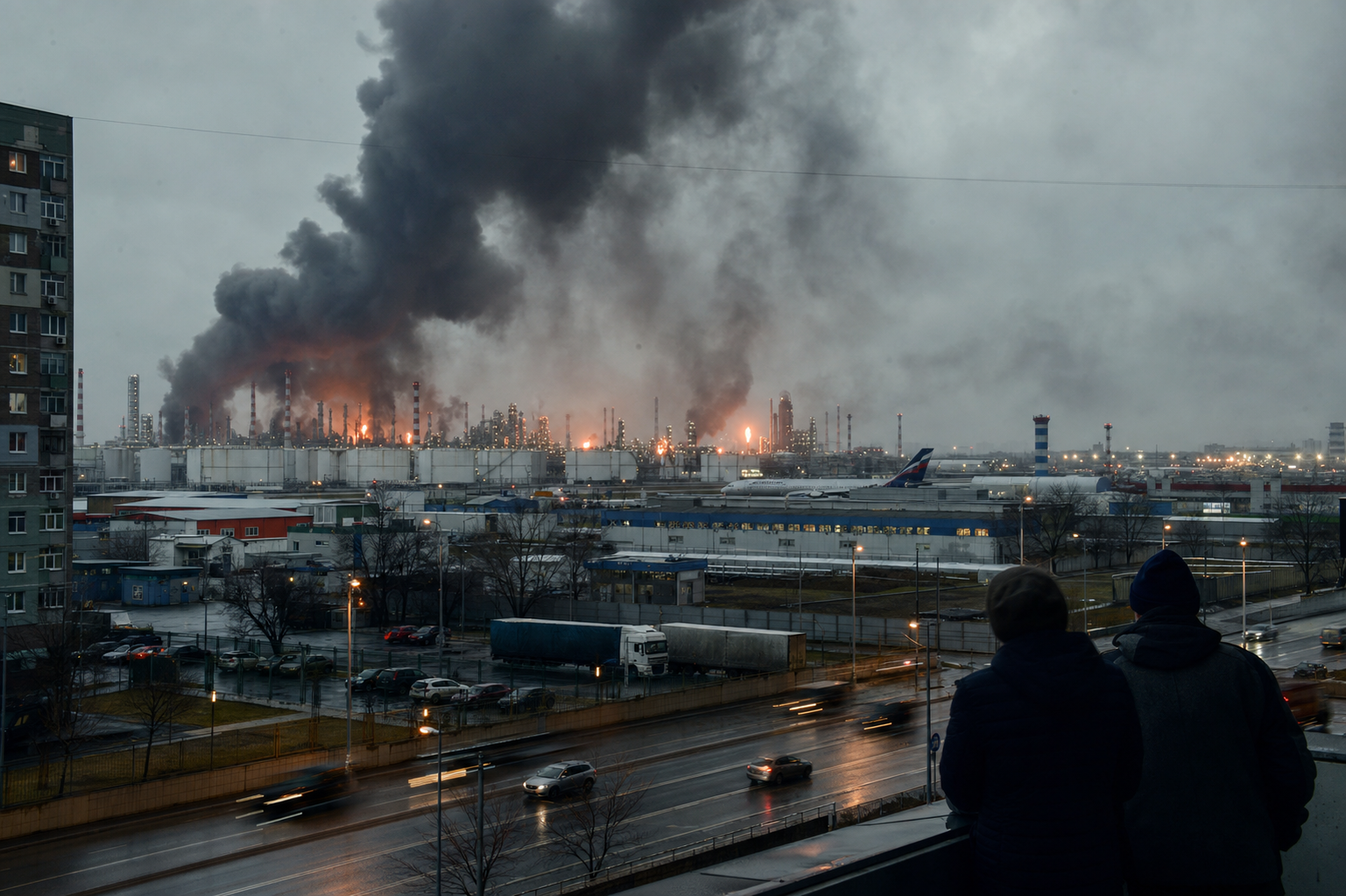
Residents in Moscow reported black specks and oily drizzle after a major Ukrainian drone attack struck the Kapotnya oil refinery in south-east Moscow, part of what Russia said was the largest Ukrainian aerial assault since the start of the full-scale war. The attack triggered fires, thick smoke over the capital, temporary closure of Moscow’s airports, and widespread disruption, while regional officials said 17 people were wounded. The BBC reported that local witnesses described black spots on clothing and a burning smell near the refinery, even as Moscow authorities denied that “oil rain” had fallen. Videos verified by the BBC showed a drone hitting a high-rise building, debris scattering, and an oily residue coating the ground in one area.
The article places the strike within the broader escalation of the war in Ukraine, noting that Russia’s defence ministry said nearly 1,000 drones and four cruise missiles were intercepted across the country, while Ukraine said Russia launched more than 200 drones and ballistic missiles overnight. Ukrainian President Volodymyr Zelensky framed the attack as retaliation for Russia’s recent strike on Kyiv, and Russian Foreign Minister Sergei Lavrov threatened large-scale strikes in response. The piece also explains that Kyiv has increasingly used long-range drone attacks to bring the war home to Russian cities, while Moscow’s air defences—despite being extensive—cannot fully prevent mass drone attacks. Overall, the story emphasizes the growing reach of the conflict, the psychological impact on Moscow residents, and the escalating cycle of retaliatory strikes.
Entities: Moscow, Kapotnya refinery, Andrei Vorobyov, Volodymyr Zelensky, Sergei Lavrov • Tone: urgent • Sentiment: negative • Intent: inform
19-06-2026
Ukraine carried out a large drone strike that hit a major oil refinery in Moscow for the second time in a week, disrupted commercial flights at several Moscow airports, and caused damage in the surrounding region, according to Russian officials. The attack was one of Ukraine’s biggest drone assaults since Russia’s full-scale invasion began more than four years ago. Ukrainian President Volodymyr Zelenskyy framed the strike as retaliation for Russian attacks on Ukrainian sites, including damage to a historic monastery in Kyiv, and warned that “Moscow will burn” if Russia continues its war. He said ordinary Russians should feel the cost of the conflict because, in his view, Vladimir Putin is the one driving it.
The article says the Moscow Oil Refinery, a major facility close to the Kremlin, was set ablaze in images and video released by Russian media. Ukraine has increasingly targeted Russian energy infrastructure in an effort to reduce war revenue and strain Moscow’s military logistics. CBS News also cites Ukrainian officials and Western analysts saying Ukraine’s drone capabilities have improved significantly, contributing to more frequent and effective attacks. Russian air defenses reportedly shot down 555 Ukrainian drones overnight across multiple regions.
The story places the strike in a wider diplomatic context, noting Zelenskyy’s recent coordination call with President Trump and French President Emmanuel Macron and support pledged at the G7 summit in France. It also describes ongoing tensions in U.S.-Ukraine relations under Trump, while Macron emphasized continued Western backing for Ukraine’s defense and counterattack capabilities.
Entities: Ukraine, Russia, Moscow Oil Refinery, Volodymyr Zelenskyy, Vladimir Putin • Tone: urgent • Sentiment: negative • Intent: inform
19-06-2026
CBS News reports that Russia may be facing a shortage of S-300 missile interceptors, a development that Ukrainian officials and analysts say could be weakening Moscow’s air defenses and helping Ukraine carry out deeper strikes inside Russian territory. According to Ukrainian intelligence estimates cited in the report, Russia’s stockpile of S-300 surface-to-air missiles has been declining, in part because Russia has been using some of them offensively against Ukraine by converting them into surface-to-surface weapons. At the same time, Ukraine’s increasingly capable drone attacks are forcing Russia to spend interceptors at a rapid pace, including to defend against newer, faster drones that fly farther than older models.
The article says Ukraine has also deliberately targeted Russian air defense systems in occupied territories and Crimea, further straining Moscow’s defensive network. Analysts quoted in the story say Russia may be consuming air defense missiles at an “unsustainable rate,” while sanctions and supply constraints may make it difficult for Russia to replenish key components needed to produce new interceptors. However, Ukrainian officials caution that Russia still retains more modern air defense systems and continues prioritizing production for those systems.
The piece also places Russia’s shortages in a broader wartime context, noting that Ukraine itself faces shortages of PAC-3 interceptors needed to defend against Russian ballistic missiles. The article concludes by pointing to signs of a possible battlefield shift in Ukraine’s favor, highlighted by a drone strike on an oil refinery deep inside Russia and President Volodymyr Zelenskyy’s remarks that long-range weapons are crucial to forcing Russia to end the war.
Entities: Russia, Ukraine, Kyiv, Moscow, S-300 missile interceptors • Tone: analytical • Sentiment: neutral • Intent: inform
19-06-2026
Ukraine launched one of its largest drone assaults on Moscow since Russia’s full-scale invasion, hitting the Moscow Oil Refinery in Kapotnya and triggering fires, smoke, airport disruptions, and heightened security across the capital. Russian officials said air defenses intercepted more than 130 drones near Moscow and claimed over 550 were shot down nationwide, though those figures could not be independently verified. The refinery strike was especially significant because the facility is a major fuel supplier for Moscow and the surrounding region; reports cited in the article say it supplies a large share of the city’s fuel market and aviation fuel needs. The attack marked the second reported hit on the refinery in three days and appeared to expose weaknesses in Moscow’s air defenses. The article frames the strike as part of Ukraine’s broader strategy to target Russian energy infrastructure and bring the war’s costs closer to ordinary Russians, a campaign Kyiv has described as “long-range sanctions.” It also notes the political context: the strike came as President Volodymyr Zelenskyy was pressing Ukraine’s case with President Donald Trump and G7 leaders, and as President Vladimir Putin hosted ASEAN leaders in Russia. The article includes reactions from Moscow residents describing fear and confusion, plus Ukrainian Foreign Minister Andrii Sybiha’s taunt that Russia started the war and should ask Putin when it will end.
Entities: Ukraine, Moscow, Moscow Oil Refinery (Kapotnya), Russia, Volodymyr Zelenskyy • Tone: analytical • Sentiment: negative • Intent: inform