19-06-2026
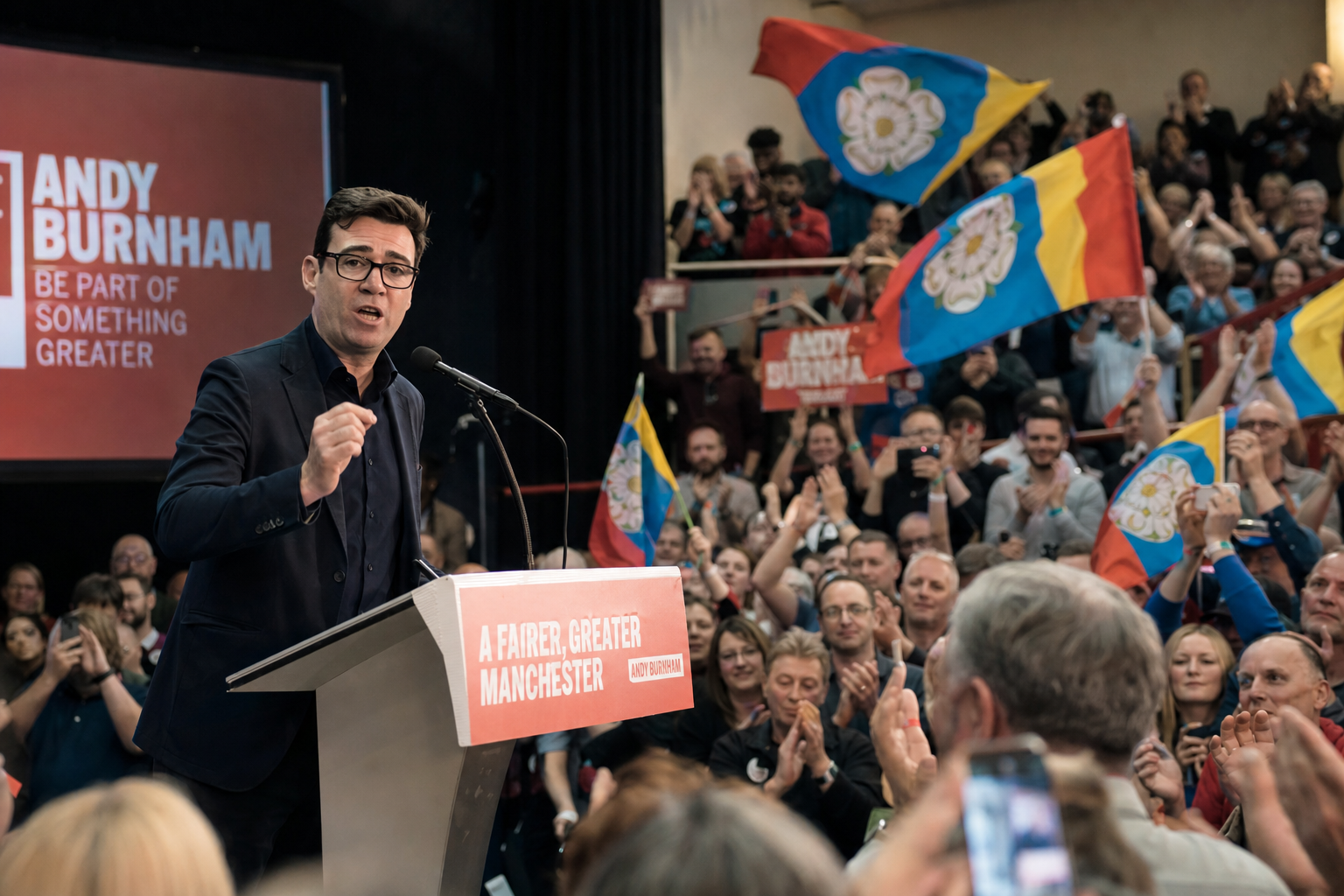
Andy Burnham, Labour’s former Greater Manchester mayor and a prominent figure on the party’s left, has won a special election in Makerfield, north-west England, giving him a route back into Parliament and potentially setting up a leadership challenge to Prime Minister Keir Starmer. Burnham defeated Reform U.K. by more than 9,000 votes and secured nearly 55% of the vote, a result that had been widely anticipated but still carries significant political implications. Because he is now positioned to re-enter Westminster, Burnham could formally mount a challenge to Starmer as soon as next week after being sworn in as an MP.
In his victory speech, Burnham framed the result as more than a local win, describing Makerfield as a “touchstone” rather than a “stepping stone,” and promising to focus on neglected communities. He also used the speech to outline a broader political message centered on “unity and hope,” and to distance himself from what he called the “divided, dark politics” seen in the United States. His remarks were widely interpreted as laying the groundwork for a future bid to lead Labour.
The article also focuses on the possible financial-market consequences of a Burnham leadership challenge or government. Kallum Pickering of Peel Hunt said investors will closely watch whether Burnham would maintain Labour’s fiscal rules and whether his policy agenda could add inflationary pressure. Although Pickering does not expect a major break from current borrowing and debt rules, he warned that markets may demand a higher inflation premium on U.K. government bonds, or Gilts. The speed and orderliness of any leadership contest may matter for investor confidence, as a prolonged battle could create uncertainty over taxation, spending, and borrowing. Pickering also highlighted a major unknown: who would become finance minister in a Burnham cabinet and how that would shape economic policy.
Entities: Andy Burnham, Keir Starmer, Labour Party, Reform U.K., Makerfield • Tone: analytical • Sentiment: neutral • Intent: inform
19-06-2026
Andy Burnham won a UK parliamentary by-election in Makerfield, a result that positions him to mount a challenge to Prime Minister Keir Starmer for the leadership of the Labour Party. The vote was deliberately engineered to give Burnham, the popular mayor of Greater Manchester, a route back into Parliament because party rules and convention require a serving MP to become party leader and, by extension, prime minister. Burnham won decisively with 55% of the vote, defeating Reform UK candidate Robert Kenyon, who secured 35%.
The article frames the result as a major moment of uncertainty for British politics. Burnham returned to Parliament at a time when Labour’s popularity has fallen sharply since its landslide 2024 victory, with Starmer facing growing criticism from party MPs after poor local election results and surging support for Reform UK. The Makerfield constituency, historically Labour and shaped by deindustrialization, economic hardship, and immigration anxieties, became a symbolic battleground for the broader struggle over the direction of UK politics.
Burnham tried to downplay his leadership ambitions during the campaign, presenting himself instead as a local-focused insurgent and emphasizing that Makerfield would be a “touchstone” rather than a “stepping stone.” Reform UK attempted to capitalize on local grievances and anger over immigration, with its candidate arguing that Burnham was using the seat for national ambitions. Analysts quoted in the article say Burnham successfully framed himself as an outsider and avoided letting national leadership politics dominate the contest. The piece suggests that his victory could intensify pressure on Starmer and deepen the instability surrounding Labour’s future leadership.
Entities: Andy Burnham, Keir Starmer, Labour Party, Reform UK, Robert Kenyon • Tone: analytical • Sentiment: neutral • Intent: inform
19-06-2026
Andy Burnham, the mayor of Greater Manchester, won a parliamentary seat in the Makerfield by-election, a result that significantly strengthens his potential challenge to Prime Minister Keir Starmer for the Labour Party leadership and, ultimately, the premiership. Burnham won decisively with 24,937 votes, or about 55 percent, far ahead of Reform U.K.’s candidate Rob Kenyon, who finished second with 15,696 votes, about 34 percent. Burnham framed the victory as a mandate for change, greater power for the north of England, and a more hopeful political direction, while warning Labour that it now has a “final chance” to change course. He also cast his win as a rejection of divisive politics and an opportunity to bring people back together.
The article places the result in the context of Britain’s unstable political climate and Labour’s internal tensions. Reform U.K., led by Nigel Farage, had hoped to capitalize on recent local election gains, but failed to block Burnham’s path. A far-right Restore Britain candidate split some of the anti-Burnham/right-wing vote, though not enough to alter the outcome. The win is likely to energize Burnham supporters who view him as Labour’s strongest answer to Reform’s rise. At the same time, it raises the prospect of a direct leadership confrontation with Starmer, whose popularity has fallen sharply. The article notes that the timing and mechanics of any challenge remain unclear, but several Labour lawmakers are already urging Starmer to step aside if Burnham moves against him.
Entities: Andy Burnham, Keir Starmer, Greater Manchester, Makerfield, Labour Party • Tone: analytical • Sentiment: neutral • Intent: inform
19-06-2026
Andy Burnham, the mayor of Greater Manchester and a two-time former Labour leadership contender, has emerged as a possible future challenger to Britain’s embattled prime minister, Keir Starmer, after winning a special parliamentary election in Makerfield. The article profiles Burnham as a fluent, optimistic communicator with strong appeal in northern England and a record of local governance that supporters say could make him a national savior for Labour against the rise of Reform U.K. led by Nigel Farage. It also presents the obstacles he would face: he would need broad backing from Labour lawmakers, and critics argue that his political flexibility, while useful, could also suggest a lack of firm conviction. The piece traces Burnham’s background from Liverpool and Cambridge to his early work in Labour politics, his Cabinet roles under Tony Blair and Gordon Brown, and his later move to local politics in Manchester. His handling of the Hillsborough campaign, bus regulation, and the pandemic helped build his reputation as an effective and empathetic regional leader. At the same time, the article emphasizes lingering doubts about whether his mayoral style can translate to the national stage, especially amid economic constraints and a demanding political environment in Downing Street.
Entities: Andy Burnham, Keir Starmer, Labour Party, Greater Manchester, Makerfield • Tone: analytical • Sentiment: neutral • Intent: inform