Articles in this Cluster
03-08-2026
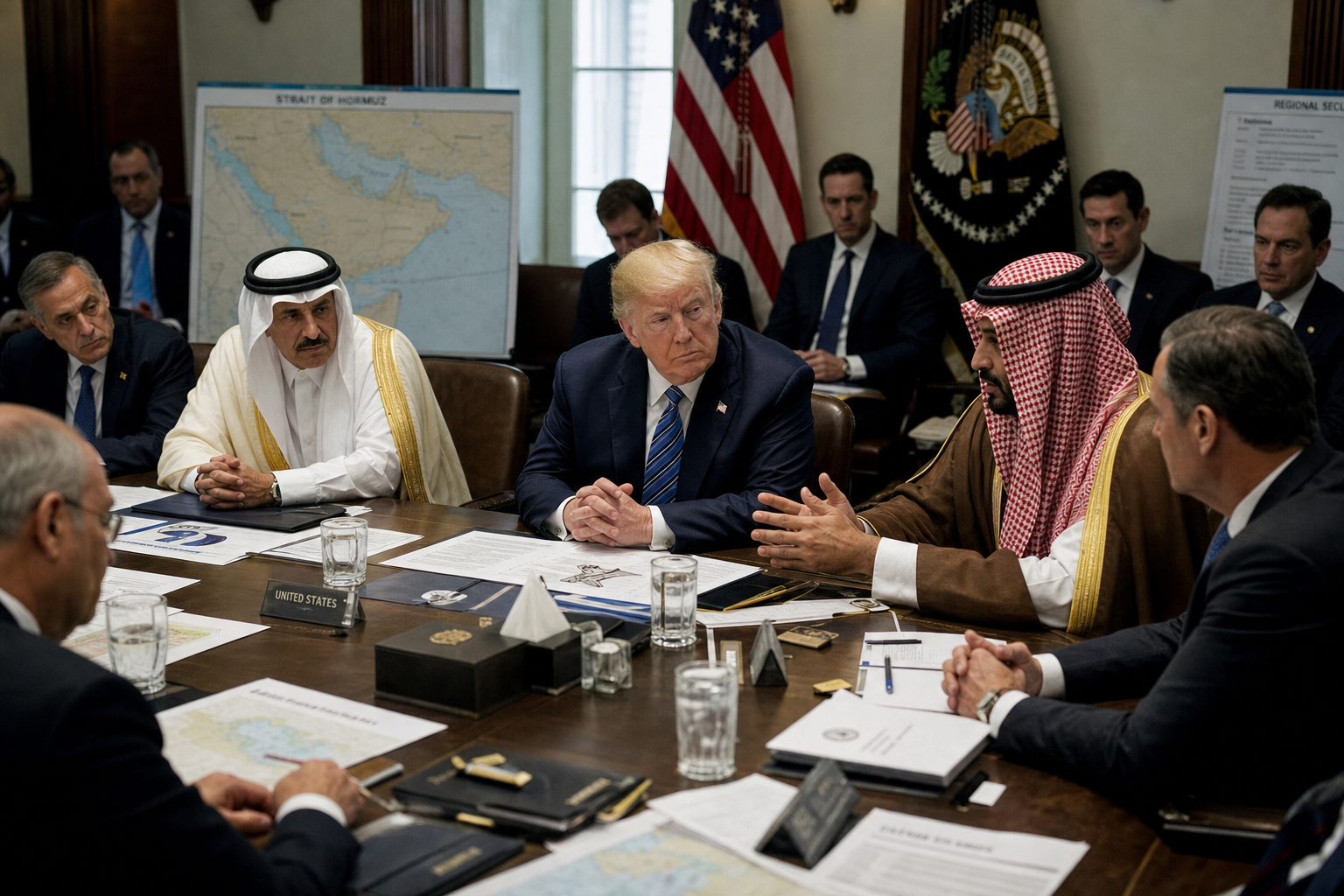
President Donald Trump said new talks with Iran are scheduled to begin on Monday, shortly after he announced he had called off what he described as imminent and “massive” U.S. strikes on the country. Speaking aboard Air Force One, Trump said Iran had seen the attack coming and that negotiations were still underway, with the possibility of a broader deal involving the Strait of Hormuz and Iran’s nuclear program. He also said regional partners, including Saudi Arabia, the UAE and Qatar, had urged restraint because they believed a deal could be reached.
The article places Trump’s comments in the context of a volatile and ongoing conflict, marked by repeated threats, tit-for-tat attacks, and uncertainty over whether diplomacy can avert escalation. Iran has not confirmed Trump’s claims and its semi-official Mehr news agency denied that Tehran had asked the U.S. to hold off, calling the statement a lie. Iranian officials separately said talks with Oman over the Strait of Hormuz were nearing completion.
Markets reacted quickly to the prospect of reduced escalation, with oil prices falling in Asian trading after Trump’s announcement. The piece also notes that Trump has repeatedly issued dramatic warnings about Iran, including threats of devastating military action, while later suggesting diplomacy was still possible. It further highlights concerns among some U.S. conservatives about the war’s unpopularity and its potential political impact ahead of the November midterms.
Entities: Donald Trump, Iran, United States, Air Force One, Truth Social • Tone: analytical • Sentiment: neutral • Intent: inform
03-08-2026
The article argues that the Trump administration, which pledged exceptional transparency, has provided relatively little public information about the American-led war against Iran even as the conflict deepens, costs rise, and casualties mount. Defense Secretary Pete Hegseth and the Pentagon have largely replaced regular briefings with curated battlefield videos and sporadic online updates, leaving reporters, lawmakers, and the public to piece together the war from fragmentary statements by President Trump and scattered official posts. The piece notes that the administration’s messaging has been inconsistent: Trump has alternated between describing decisive military success, temporary ceasefires, and renewed attacks, while also considering—and then canceling—major escalation against Iranian energy infrastructure after talks with Saudi Arabia.
The article highlights bipartisan frustration in Congress over the lack of detailed briefings, including criticism from Republicans such as Rep. Mike Turner and Sen. John Kennedy, who publicly pressed for more direct answers about strategy, casualties, and the rationale for continued involvement. It also describes how Pentagon rules now require prior approval for many congressional communications, further limiting informal access to military leaders. A CBS News poll is used to show public unease: many Americans want the war to end, though substantial numbers support key stated objectives like reopening the Strait of Hormuz and stopping Iran’s nuclear program. Finally, the article places the administration’s secrecy in a broader historical context, comparing it to optimistic war messaging in previous U.S. conflicts, and notes that information-sharing problems extend beyond the Pentagon to the State Department and senior officials like Marco Rubio.
Entities: Pete Hegseth, Donald Trump, Iran, U.S. Central Command, Pentagon • Tone: analytical • Sentiment: negative • Intent: analyze
03-08-2026
President Trump said Saturday that the United States would halt an imminent attack on Iran after indications that a deal to end the war could be close. In a Truth Social post, he said Iran and other Middle Eastern countries asked the U.S. to hold off because the outline of a deal had been agreed to, and he described the prospective agreement as including the immediate reopening of the Strait of Hormuz and the end of Iran’s nuclear threat. Trump said he had agreed to cancel the attack, contingent on quickly reaching a formal deal, and added that Israel was aligned with that commitment.
The report says the U.S. and Israel had been preparing a severe bombing campaign against Iranian energy infrastructure, possibly within days, while Trump had warned publicly that Iran would soon face major damage if it continued. The article also notes that Saudi Crown Prince Mohammed bin Salman urged Trump not to carry out new strikes, citing concern about the targets. Meanwhile, U.S. embassies across the Middle East issued security alerts because of rising tensions, and the State Department warned Americans in the region to exercise caution due to possible flight cancellations, airspace closures, and travel disruptions.
The piece places the announcement in the context of an escalating regional conflict involving U.S., Israeli, Saudi, and Iranian forces. It recounts recent joint U.S.-Saudi strikes against Iran-backed militants in Iraq, Iranian missile attacks on U.S. forces, and prior U.S. strikes on Iranian military facilities. The article frames Trump’s statement as a possible pivot away from further escalation toward a negotiated settlement, though the situation remained fluid and dependent on the success of a rapid deal.
Entities: Donald Trump, Iran, Israel, United States, Saudi Arabia • Tone: urgent • Sentiment: negative • Intent: inform
03-08-2026
Oil prices fell sharply in Asian trading after U.S. President Donald Trump said he had called off a planned strike on Iran, reducing the geopolitical risk premium that had been supporting crude. West Texas Intermediate (WTI) futures for September delivery dropped nearly 6% to $79.57 per barrel, while Brent crude for October delivery fell 4.88% to $83.64 a barrel. Trump said in a Truth Social post that the U.S. had been asked by Iran and other Middle Eastern countries to hold off on any attack because the “perimeters of a deal” had supposedly been agreed to. He said the proposed deal would involve the “Immediate, Complete, and Total OPENING OF THE HORMUZ STRAIT” and an end to Iran’s nuclear threat. However, Tehran responded cautiously and did not endorse Trump’s framing of the situation. Iran’s acting defense minister said the country viewed the remarks as psychological warfare but would take the threat seriously. Iran-linked media further dismissed Trump’s proposal as a “wish list.” The article highlights how oil markets are reacting to shifting rhetoric around conflict, diplomacy, and the strategic importance of the Strait of Hormuz, a critical global shipping chokepoint.
Entities: Donald Trump, Iran, Tehran, Middle East, West Texas Intermediate (WTI) • Tone: analytical • Sentiment: neutral • Intent: inform
03-08-2026
President Donald Trump said the United States will resume negotiations with Iran on Monday after he decided to hold off on further strikes, marking a sharp shift toward diplomacy after a period of escalating tensions in the Gulf. Trump said the decision followed appeals from Saudi Arabia, the United Arab Emirates, Qatar, and Iran, and he suggested a deal involving the Strait of Hormuz and Iran’s denuclearization could be imminent. The announcement helped push oil prices lower, as markets reacted to the possibility of reduced disruption to a waterway that carries a major share of global crude shipments.
Despite the diplomatic opening, the article stresses that risks remain high. A U.K. maritime agency reported an incident near the mouth of the Strait of Hormuz, where a tanker master reported an explosion close to the vessel, though the crew was safe. Analysts cited by BMI said a broader diplomatic understanding on reopening the strait remains possible, but warned that military flare-ups and miscalculation could still trigger renewed escalation. The article also describes a parallel Oman-mediated track, with Iranian and Omani officials reportedly nearing an agreement on how shipping through the strait could be managed after the conflict, potentially with support from Gulf states, China, and the U.S. Taken together, the piece portrays a fragile but meaningful diplomatic thaw amid continuing military and shipping dangers.
Entities: Donald Trump, Iran, United States, Saudi Arabia, United Arab Emirates • Tone: analytical • Sentiment: neutral • Intent: inform
03-08-2026
President Trump said the United States will begin new talks with Iran on Monday after he canceled a planned "massive" military strike that had been scheduled for the weekend. Speaking aboard Air Force One, Trump said the decision to stand down came after appeals from several Gulf allies, including Saudi Arabia, the United Arab Emirates, Qatar, and Iran itself. He said Saudi Crown Prince Mohammed bin Salman privately urged restraint and indicated that Iran was ready to make a deal. Trump framed the move as a choice between negotiation and military action, emphasizing that the U.S. remains prepared to strike if needed.
The article says the proposed diplomatic effort would focus on two major issues: keeping the Strait of Hormuz open to free international trade and oil shipments, and preventing Iran from obtaining nuclear weapons. Trump described the situation as fluid and expressed skepticism about whether a lasting agreement is achievable, noting that internal divisions within Iran have historically undermined talks. At the same time, administration officials said any renewed negotiations would require a cease-fire first. The piece also notes that the canceled attack followed reports that U.S. and Israeli officials had been considering strikes on Iran’s energy infrastructure, while Tehran had warned such attacks could prompt retaliation against Gulf and Israeli energy targets.
Entities: Donald Trump, Tehran, Iran, Saudi Arabia, United Arab Emirates • Tone: analytical • Sentiment: neutral • Intent: inform
03-08-2026
The article describes President Trump’s latest reversal in his approach to Iran, escalating military threats over the weekend and then abruptly pulling back in favor of possible negotiations. Trump said U.S. forces were ready to strike Iran again but claimed he canceled the attack after requests from Saudi Arabia, the United Arab Emirates, Qatar, and Iran itself, because talks might produce a deal to reopen the Strait of Hormuz and address Iran’s nuclear program. The reporting frames this as part of a recurring pattern over the past five months: Trump threatens overwhelming force, then shifts back toward diplomacy, often without explaining clearly what changed.
The article highlights uncertainty inside the U.S. government and among lawmakers about whether the administration has a coherent strategy or is simply cycling through bad options. Analysts and experts quoted in the piece argue that Trump appears to be reacting to the last person he spoke with, especially Crown Prince Mohammed bin Salman and Prime Minister Benjamin Netanyahu, both of whom have influenced his decisions on the conflict. The White House and Pentagon provided little detail about what prompted the renewed possibility of talks.
Republican senators and representatives expressed frustration over the lack of information and concern over the consequences of another bombing campaign, including higher energy prices and inflation. Democrats criticized Trump for relying on inexperienced advisers and personal allies such as Steve Witkoff and Jared Kushner to manage negotiations. Overall, the article presents a portrait of a volatile and unclear U.S. policy toward Iran, with major implications for the wider Middle East, global shipping, and U.S. domestic politics.
Entities: Donald Trump, Iran, Saudi Arabia, United Arab Emirates, Qatar • Tone: analytical • Sentiment: neutral • Intent: inform
03-08-2026
US President Donald Trump said new negotiations with Iran are set to begin on Aug. 3 after he decided to hold off on planned US strikes, framing the move as an effort to pursue a deal that could end the conflict now in its sixth month. The talks, Trump said, will focus on two central issues: the Strait of Hormuz and the broader goal of denuclearising Iran. The article places the announcement against a backdrop of heightened regional tension, including previous US and Israeli strikes, fears of renewed escalation in July, and threats against Iranian energy infrastructure.
The piece explains that the Strait of Hormuz remains the core dispute because it is a critical route for global energy shipments. Iran said it is nearing a separate understanding with Oman over a new route through the strait, while insisting that such an arrangement would not mean reopening the waterway in the old way. Iranian officials and lawmakers described ongoing mediation and an exchange of views, suggesting that talks may revive an earlier June memorandum of understanding. At the same time, maritime volatility persisted: a tanker near Oman reported an explosion, though the crew was safe.
The announcement had immediate market impact, with oil prices falling at the opening of Asian trade. Overall, the article presents a tense but potentially de-escalatory moment in the US-Iran conflict, with diplomacy temporarily replacing threats of military action.
Entities: Donald Trump, Iran, United States, Strait of Hormuz, Oman • Tone: analytical • Sentiment: neutral • Intent: inform
03-08-2026
This article is a transcript of a Face the Nation interview between CBS’s Margaret Brennan and Ohio Republican Rep. Mike Turner. The discussion centers first on U.S. policy toward Iran, including the status of diplomatic negotiations, the conflict involving Iran’s nuclear ambitions, the Strait of Hormuz, and whether Congress is being adequately briefed by the administration. Turner argues that the administration should share more information with Congress but says the situation is dynamic and that Iran will ultimately be forced to negotiate because of declining military, economic, and infrastructure capacity. Brennan also raises concerns about alleged cyberattacks on U.S. water utilities and whether Iran is responsible; Turner says Congress has not been informed but agrees that adversaries such as Iran, Russia, China, and North Korea view critical infrastructure as legitimate targets and that U.S. systems must be hardened.
The final portion shifts to domestic Ohio politics and allegations of domestic abuse against Turner’s colleague Max Miller. Brennan asks whether Republican leadership should open an ethics probe. Turner repeatedly refuses to comment on the allegations, saying the matter belongs in court and not on television, and declines to treat it as a political issue. Overall, the interview reflects a mix of foreign policy tension, cybersecurity concerns, and evasive handling of a sensitive internal party scandal.
Entities: Mike Turner, Margaret Brennan, CBS News, Face the Nation, Ohio • Tone: analytical • Sentiment: neutral • Intent: inform
03-08-2026
CNBC’s Daily Open frames a market week shaped by geopolitics, energy shocks, and policy intervention. The lead story is U.S. President Donald Trump’s announcement that negotiations with Iran will begin Monday after he paused further military strikes, reviving hopes for diplomacy after a weekend of heightened threats. The article notes that markets are reacting to a conflict that has already disrupted global energy supplies and boosted volatility in crude oil, while analysts warn that even if talks proceed, the situation could still be interrupted by renewed flare-ups or miscalculation.
The piece also highlights other major global developments. A United Kingdom maritime agency reported an explosion near a vessel off Khasab, Oman, close to the Strait of Hormuz, underscoring continued risk in the region. In Ukraine, officials are bracing for a difficult winter as they fear Russia may intensify attacks on energy infrastructure, with reports of Ukrainian drone strikes and Russian claims of intercepting hundreds of drones overnight. In foreign exchange, Japan and the United States conducted their first coordinated yen intervention in 28 years to support the currency after it fell to fresh 40-year lows, reflecting broader inflation and political pressures in Japan.
The article briefly turns to corporate dealmaking, reporting that AstraZeneca may be considering a megamerger with Bristol Myers Squibb that could create a roughly $400 billion pharmaceutical giant, though the outcome remains uncertain. It concludes with a separate commentary on India’s youth unemployment crisis, using an exam leak and subsequent protests as a window into deeper frustrations among young graduates struggling to find secure, well-paid work. Overall, the article presents a world economy and political landscape where diplomacy, war risk, central-bank-like intervention, and structural social problems are all converging.
Entities: Donald Trump, Iran, United Kingdom Maritime Trade Operations, Khasab, Oman, Strait of Hormuz • Tone: analytical • Sentiment: neutral • Intent: inform
03-08-2026
CNBC’s Daily Open reports a broad repricing in global markets after signs of de-escalation in geopolitical tensions. President Trump said he canceled a planned attack on Iran and suggested a deal could be close, including the reopening of the Strait of Hormuz and an end to Iran’s nuclear threat. That shift, combined with an OPEC+ decision to raise September output by about 188,000 barrels a day, sent oil prices sharply lower as investors unwound some of the risk premium built up over months of conflict fears.
The article says the decline in crude helped lift U.S. stock futures as markets looked ahead to a key jobs report and a heavy earnings week. It also notes that Asian markets were mixed to lower, while Japan and the U.S. confirmed a coordinated currency intervention to support the yen — the first such action since 2011, according to an MUFG report, and the first coordinated intervention in decades per the correction. The yen had recently weakened to near a 40-year low before recovering.
Beyond the market-moving headlines, the article highlights Berkshire Hathaway’s share performance and notes that AstraZeneca is reportedly exploring a massive merger with Bristol Myers Squibb that could value the combined company at about $400 billion. The piece closes with a separate feature on India’s youth unemployment crisis, framing a leaked medical exam and ensuing protests as evidence of deeper economic frustrations among young graduates.
Entities: Trump, Iran, Israel, Strait of Hormuz, OPEC+ • Tone: analytical • Sentiment: neutral • Intent: inform