03-08-2026
Italy is facing an intense new heatwave that has pushed nearly all of its major cities onto the highest red heat alert, with Rome, Milan, Venice and Naples already included among the 19 cities currently under warning. By Monday, the Italian health ministry expects 25 of the country’s 27 major cities to be on red alert, leaving only Reggio Calabria and Messina at the slightly lower amber level. Authorities are warning that the heat poses risks not only to vulnerable groups such as the elderly, young children and people with chronic illnesses, but also to healthy adults, especially during the hottest hours of the day. Residents are being urged to stay indoors, avoid direct sunlight between 11:00 and 18:00, and drink plenty of fluids.
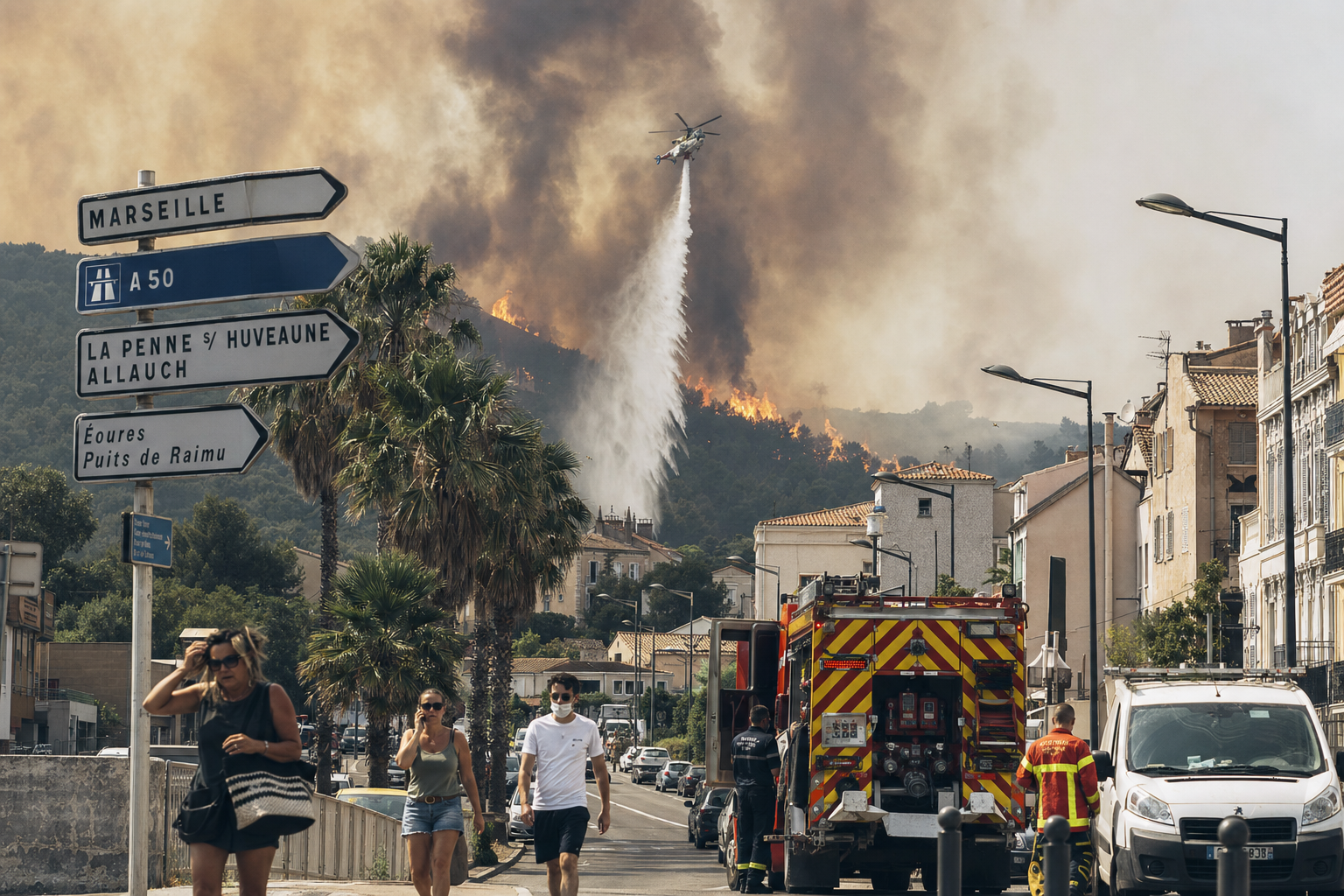
The heatwave is being driven by a subtropical anticyclone from North Africa strengthening over the Mediterranean, and it comes amid a broader European crisis marked by severe wildfires. Firefighters in Greece, France, Portugal and Spain are battling large blazes, with evacuations continuing in several places. In France, thousands were evacuated after a fire reignited in the Var region, while a major blaze in Gironde has been brought under control. In Greece, people were evacuated by sea from a coastal town threatened by fires, and in Spain and Portugal the extent of burned land is far above normal. The article links these events to climate change, noting that Europe is warming twice as fast as the global average, which is increasing the frequency and severity of heatwaves and wildfires across the continent.
Entities: Italy, Rome, Milan, Venice, Naples • Tone: urgent • Sentiment: negative • Intent: inform
03-08-2026
Two crew members were killed and two others injured when two firefighting helicopters collided in mid-air while battling wildfires in Greece. The crash happened Sunday near the Attica-Boeotia border, about 65 kilometers west of Athens, as crews were responding to a large blaze. Video from the scene shows one Bell helicopter striking the rotors of the other before one aircraft burst into flames and crashed into a ravine; the second helicopter made an emergency landing in low vegetation. The dead were identified as a Danish pilot and a Greek fire service liaison officer. The survivors were a British pilot and another Greek coordinator, both of whom sustained minor injuries and were admitted to hospital for observation. Greek authorities grounded all Bell helicopters nationwide pending protocol and investigation. Prime Minister Kyriakos Mitsotakis expressed deep sorrow and condolences, while McDermott Aviation, which leased the helicopters, said it was cooperating with investigators. The article also places the crash in the wider context of severe summer wildfires across Greece and Europe, intensified by prolonged heatwaves and climate conditions that make fires more likely and harder to control.
Entities: Greece, Athens, Attica-Boeotia border, Kyriakos Mitsotakis, Greek Fire Service • Tone: urgent • Sentiment: negative • Intent: inform
03-08-2026
Two Greek firefighting helicopters collided midair on Sunday while battling a wind-driven wildfire west of Athens, killing two crew members and underscoring the extreme danger faced by responders as Europe’s wildfire crisis intensifies. The aircraft, Bell helicopters with two-person crews, were operating over the Psatha area when the collision occurred. Two survivors were recovered alive, though authorities did not immediately provide details on their condition or clarify whether the fatalities had been aboard the same helicopter.
The crash happened amid a fast-moving fire that began Friday near Agios Vasileios and spread toward Porto Germeno and the forested mountains west of Athens, forcing evacuations and straining firefighting resources. Strong gale-force winds pushed flames through dry forest and hindered water-collection efforts from the sea, even as nearly 500 firefighters and 23 aircraft were deployed. Authorities evacuated residents from several communities, including Kandili, Agia Skepi, and Toutouli, and were especially concerned about Porto Germeno. Prime Minister Kyriakos Mitsotakis was briefed on the operation.
The article places the Greece fires within a broader European crisis. Fires in France and Spain have displaced hundreds of thousands, while Greece has also seen deadly blazes on Crete and in the Peloponnese earlier in the week. The piece links the worsening fire conditions to Europe’s warming climate, noting that Europe is warming faster than any other continent and that climate change has made extreme fire weather more likely. The overall picture is one of simultaneous, large-scale disasters overwhelming emergency services across the continent.
Entities: Greek firefighting helicopters, Psatha, Athens, Agios Vasileios, Porto Germeno • Tone: urgent • Sentiment: negative • Intent: inform
03-08-2026
Europe’s wildfire crisis eased in much of western Europe on Saturday, but the danger shifted east to Greece, where gale-force winds fueled new blazes near Athens and forced evacuations by land and sea. In France, the largest fire in Gironde remained contained but not yet fully fixed, leaving some communities evacuated while crews monitored hot spots and used tactical burns to prevent flare-ups. Another fire in the Var region also remained active after high winds revived embers in dry, overheated terrain. Spain’s major fires had largely stopped advancing, and Portugal’s main blaze was under control, marking a significant improvement after a period when fires across France and Spain displaced roughly 300,000 people.
The article places the crisis in the context of Europe’s accelerating climate risks, noting that the continent is warming faster than the global average and that prolonged heat and drought make vegetation more flammable. In Greece, firefighters and aircraft from several countries battled difficult conditions, including extreme turbulence that hindered water drops. The piece also emphasizes the human cost by describing residents returning to burned-out neighborhoods in France and confronting the destruction of homes, forests, and livelihoods. Overall, it presents a continent in which one phase of emergency was easing while another front intensified, underscoring the recurring and climate-driven nature of Europe’s wildfire season.
Entities: Greece, France, Spain, Portugal, Gironde • Tone: urgent • Sentiment: negative • Intent: inform
03-08-2026
The article examines the record-breaking wildfires ravaging France and Spain in the summer of 2026, framing them as a stark warning that extreme wildfire events are becoming more common and more destructive in Europe. In France, a massive blaze near Bordeaux destroyed 42,000 hectares, forced more than 200,000 evacuations, and remained out of control days after it began. The fires were intensified by repeated heatwaves, very dry conditions, and an unusual fire-driven weather phenomenon, pyrocumulonimbus, which helped ignite new fires. In Spain, fires in Almería, Ávila, Madrid, and Valencia caused fatalities, destroyed even more land than in France, and threatened major landmarks, while a new heatwave raised fears of further spread.
Despite the scale of the disaster, the article notes that both countries mounted significant emergency responses. France relied on its fleet of firefighting aircraft, volunteer firefighters, and aid from the EU and non-EU states, while Spain coordinated regional forces, the army, and volunteers under a national emergency declaration. But the piece argues that the fires also exposed structural weaknesses: insufficient firefighting aircraft, underinvestment in prevention, poor forest management, rural depopulation, and political hesitation about climate adaptation.
The article’s broader argument is that these wildfires are not isolated disasters but signs of a new normal driven by climate change and land-use change. As temperatures rise and summers become hotter and drier, fires are increasingly moving closer to cities and becoming harder to control. The article ends on a sobering note that France and Spain will need to reassess their preparedness because such blazes are becoming less exceptional and more routine.
Entities: France, Spain, Bordeaux, Gironde, Saumos • Tone: analytical • Sentiment: negative • Intent: inform