19-05-2026
US President Donald Trump said he had called off a planned military attack on Iran, originally set for Tuesday, after requests from the leaders of Qatar, Saudi Arabia, and the United Arab Emirates, who feared wider regional escalation. Trump framed the pause as part of active negotiations and said a deal could still be reached that would leave Iran without nuclear weapons. He warned, however, that the United States could launch a “full, large scale assault” if talks fail.
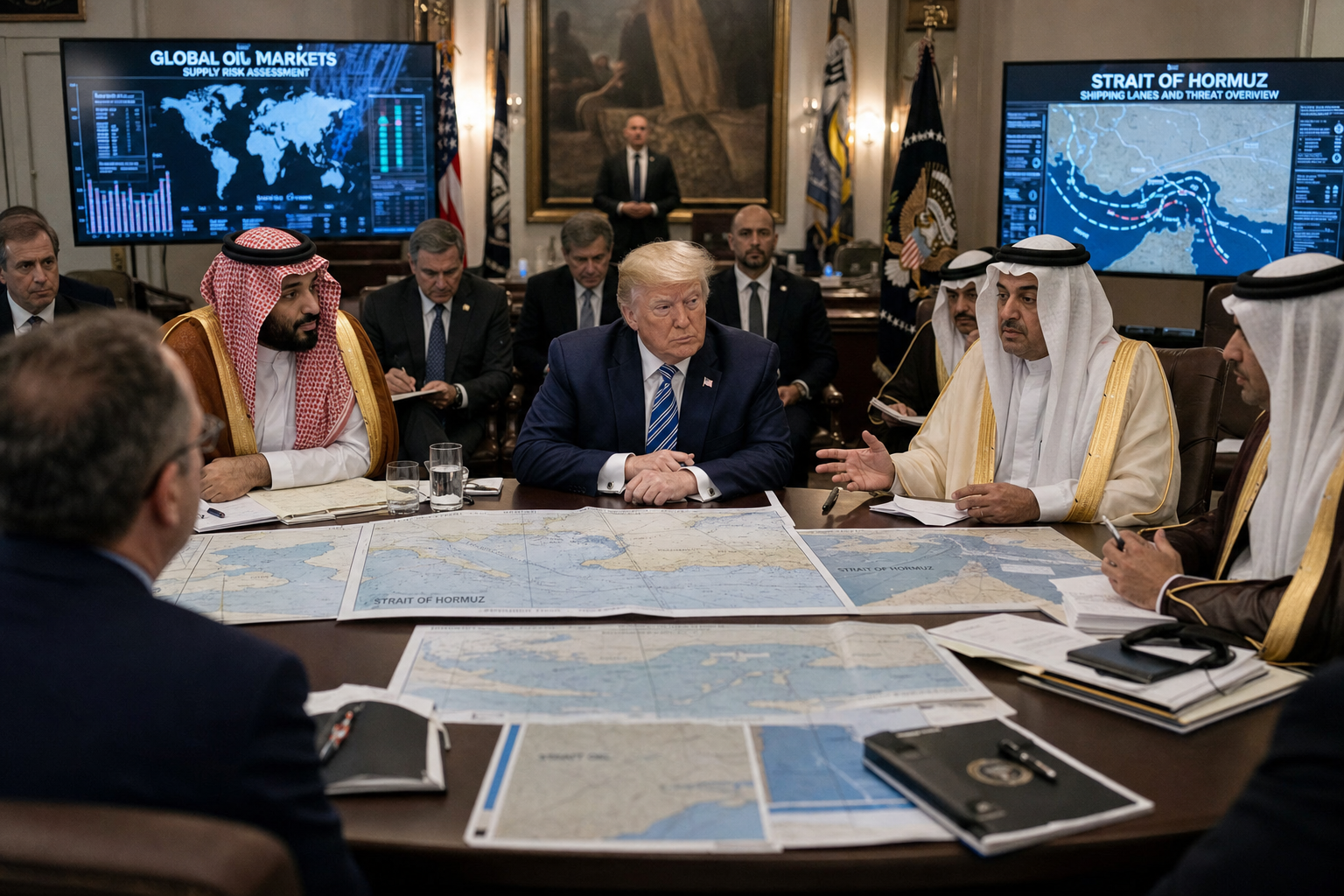
The article places Trump’s announcement in the context of heightened tensions over Iran’s nuclear programme, ongoing US and Israeli strikes, and Iran’s retaliation with drones and missiles against Israel and US targets across the Gulf. It also notes the strategic vulnerability of Gulf states, especially their airports, petrochemical infrastructure, desalination plants, and the Strait of Hormuz, through which a large share of the world’s oil and LNG passes. Oil prices have risen amid the crisis.
Diplomatic efforts continue through back channels, with Iran saying it responded to the latest US proposal via Pakistani mediators. The two sides remain far apart: Iran wants an end to attacks, the blockade of its ports, guarantees against future strikes, and compensation, while reports say Washington wants Iran to sharply limit uranium enrichment and transfer its stockpile abroad. The piece also highlights domestic political pressure on Trump, citing falling approval ratings and public opposition to the war. Overall, the article portrays an unstable mix of military brinkmanship, regional fear, and fragile negotiations.
Entities: Donald Trump, Iran, Qatar, Saudi Arabia, United Arab Emirates • Tone: analytical • Sentiment: negative • Intent: inform
19-05-2026
President Trump said Monday that he had called off a planned U.S. military attack on Iran, which he said had been scheduled for Tuesday, after appeals from key Gulf partners who urged him to allow time for negotiations. In a Truth Social post and later remarks to reporters, Trump said the Emir of Qatar, the crown prince of Saudi Arabia, and the president of the United Arab Emirates asked him to hold off because serious talks were underway and a deal might still be reached. He said any agreement would ensure that Iran does not obtain nuclear weapons, and he instructed the Pentagon and senior military leaders to remain ready for a large-scale assault if talks fail.
The article places this announcement in the context of escalating U.S.-Iran tensions. Trump said the delay could be temporary, potentially lasting only a few days, but he also suggested he hoped it might be longer or permanent if diplomacy succeeds. The report notes that Iran has sent amended terms for a possible deal through Pakistani mediators, and that Trump had earlier extended a ceasefire at Pakistan’s request. It also describes how the Pentagon has continued planning for the possibility of resumed strikes. Meanwhile, Trump has been publicly warning Iran that time is running out, saying the country must move quickly or face severe consequences. The article ends by noting that the Strait of Hormuz remains effectively closed, disrupting oil markets and related sectors.
Entities: Donald Trump, Iran, Qatar, Saudi Arabia, United Arab Emirates • Tone: urgent • Sentiment: negative • Intent: inform
19-05-2026
Asia-Pacific markets were mixed on Tuesday as investors weighed easing oil prices, renewed uncertainty in the Middle East, and a batch of regional economic and corporate developments. Oil prices retreated slightly after news that U.S. President Donald Trump postponed a planned strike on Iran following requests from Qatar, Saudi Arabia, and the United Arab Emirates. Even so, crude remained elevated, and the broader geopolitical backdrop continued to worry markets, especially because the Strait of Hormuz remained closed and the U.S. was still blockading Iranian ports.
Across the region, performance diverged. Japan’s Nikkei 225 erased early gains and slipped 0.45%, though the Topix rose 0.54%. Investors also digested stronger-than-expected Japan first-quarter GDP growth of 2.1% annualized, above the 1.7% Reuters consensus estimate. South Korea’s Kospi fell sharply by 3.12% and the Kosdaq dropped 3.32%, while Australia’s S&P/ASX 200 gained 1.05%. Mainland China’s CSI 300 declined 0.52%, but Hong Kong’s Hang Seng rose 0.41%, boosted in part by Standard Chartered shares after the bank raised its long-term return target and announced job cuts.
India’s Nifty 50 climbed 0.44%, helped by gains in Adani-related stocks after the U.S. dropped fraud charges against Gautam Adani. In the U.S., futures pointed to a modestly positive open, with S&P 500, Nasdaq 100, and Dow futures all slightly higher. The article also notes that major U.S. indices fell in the previous session, extending declines in the S&P 500 and Nasdaq while the Dow finished higher.
Entities: Asia-Pacific markets, Brent crude, West Texas Intermediate (WTI), Donald Trump, Iran • Tone: analytical • Sentiment: neutral • Intent: inform
19-05-2026
Oil prices fell on Tuesday after U.S. President Donald Trump said he would delay a planned military strike on Iran, reducing immediate fears of a broader conflict that could disrupt global crude supplies. Brent crude for July delivery dropped more than 2% to $109.15 per barrel, while West Texas Intermediate fell 1.27% to $107.28 per barrel. Trump said he shelved the attack after requests from the leaders of Qatar, Saudi Arabia, and the United Arab Emirates, and later said he hoped the postponement might last “forever,” though he left open the possibility of action later.
The article explains that before Trump’s comments, there had been little public sign that the U.S. was preparing imminent military action against Iran, despite earlier reporting that he had been considering renewed strikes after Tehran’s latest proposal in peace talks fell short. The proposed strike would have effectively ended a fragile ceasefire reached on April 8. Market analysts said crude prices remain sensitive to ongoing disruptions in the Middle East, with the Strait of Hormuz still partly constrained and only some shipping activity resuming. ING noted that while some tankers and shipments have returned, flows remain well below normal and could worsen quickly, meaning markets are still relying on inventories and alternative supply where possible.
Entities: Oil prices, Brent crude, West Texas Intermediate (WTI), Donald Trump, Iran • Tone: analytical • Sentiment: negative • Intent: inform
19-05-2026
The article describes a volatile global market environment shaped by President Donald Trump’s decision to postpone a military strike on Iran after requests from Gulf leaders, even as the broader conflict and the Strait of Hormuz blockade continue to threaten energy supplies. Oil prices eased on the news, but strategists warn that Europe could face oil shortages within weeks because inventories are falling quickly, while airlines are bracing for severe jet fuel disruptions. The piece highlights how these geopolitical risks are feeding into a broad sell-off in global bond markets, with U.S. and Japanese long-term yields hitting notable highs, reflecting investor anxiety about inflation and supply shocks.
At the same time, U.S. equities are under pressure, especially in technology, with the S&P 500 falling for a second straight session. The article also notes major tech developments: Meta is expected to begin layoffs, and Elon Musk lost a legal battle against OpenAI and Sam Altman over claims related to OpenAI’s corporate structure. On the political front, the article points to Trump’s domestic pivot after his China trip, as he and senior officials begin emphasizing affordability and midterm messaging, including healthcare cost reduction and manufacturing events. The piece closes by situating all of this within a broader geopolitical backdrop, including Putin’s scheduled visit to Beijing.
Entities: Donald Trump, Iran, Saudi Arabia, United Arab Emirates, Qatar • Tone: urgent • Sentiment: negative • Intent: inform
19-05-2026
President Donald Trump said he has delayed a planned U.S. military strike on Iran, citing what he described as ongoing "serious negotiations" and a request from Gulf allies for a short pause because a deal may be close. Speaking Monday night at the White House, Trump said he had intended to authorize "a very major attack" on Tuesday but instead chose to wait "for a little while, hopefully, maybe forever." He framed the decision as a possible opening for diplomacy, while warning that the U.S. could still launch a "full, large scale assault" if no acceptable agreement is reached.
The article places that announcement in the context of an escalating regional conflict. Iran has effectively closed the Strait of Hormuz, the critical passage for oil and gas shipments, and the U.S. has been blocking Iranian ports and redirecting commercial vessels. Gulf states, including Qatar, Saudi Arabia, and the United Arab Emirates, reportedly urged Trump to hold off because they see a chance to keep negotiations alive. Trump has also recently spoken with Israeli Prime Minister Benjamin Netanyahu and Chinese President Xi Jinping about the war.
Markets reacted immediately: oil prices dipped after Trump’s post, reflecting reduced fears of an imminent broader conflict, though prices remained elevated. Iranian state media dismissed Trump’s announcement as a retreat motivated by fear. Meanwhile, diplomats and officials from Turkey and Iran emphasized that major issues remain unresolved, especially the status of the Strait of Hormuz and Iran’s nuclear program. The piece presents the pause as temporary and fragile, with both sides still far apart and the risk of renewed military action still high.
Entities: Donald Trump, Iran, Gulf allies, Qatar, Saudi Arabia • Tone: urgent • Sentiment: negative • Intent: inform
19-05-2026
The article examines how Iran might respond if renewed U.S.-Israeli strikes resume after a fragile cease-fire, and why Iranian leaders are preparing for a shorter but more intense conflict than the last round. According to experts cited in the piece, Iran’s first priority is to preserve the ability to strike back quickly and forcefully, potentially launching tens or hundreds of missiles per day to overwhelm Israeli defenses and alter U.S. calculations. The article emphasizes that Iran’s retaliation options are not limited to direct attacks: it could target Gulf Arab energy infrastructure, particularly oil fields, refineries, and ports in countries such as the United Arab Emirates, Saudi Arabia, and Kuwait, in order to inflict pain on the global economy and pressure President Trump. It also notes the possibility that Iran could use maritime chokepoints as leverage, especially the Bab-al-Mandeb Strait, by restricting traffic and forcing the United States to manage multiple shipping threats at once. Analysts say such threats, even when hyperbolic, reflect serious thinking inside Iran’s security establishment and continue to deter U.S. action. The article also highlights the role of the Houthis in Yemen and the broader regional risk that any renewed war could pull in neighboring states and disrupt global trade.
Entities: Iran, United States, President Trump, Israel, Gulf Arab nations • Tone: analytical • Sentiment: negative • Intent: analyze
19-05-2026
European markets are set to open mixed as investors weigh geopolitical risk, especially developments in the Middle East, along with the broader impact on oil prices and global growth. The article highlights that U.K. futures implied a modest gain for the FTSE 100, while Germany’s DAX and France’s CAC 40 were flat and Italy’s FTSE MIB was slightly lower. Market sentiment is being shaped by U.S. President Donald Trump’s decision to postpone a planned attack on Iran after appeals from regional leaders, while also warning that a large-scale strike could still occur if negotiations fail. The resulting decline in crude oil prices is one of the key immediate market reactions.
The piece also places the market opening in a wider geopolitical context. Russian President Vladimir Putin is due in Beijing for a summit with Chinese President Xi Jinping, occurring shortly after Trump’s visit to China, underscoring the delicate balancing act Beijing faces between Washington and Moscow. Meanwhile, the G7 finance ministers and central bankers meeting in Paris is concluding amid concerns over the Iran conflict and its possible spillovers into the global economy. French Finance Minister Roland Lescure said policymakers need to understand the effects on growth, inflation, and budget deficits before deciding on any response.
On the corporate front, Germany’s plan to re-privatize Uniper stands out as a notable deal story. The company was rescued in the 2022 European energy crisis, and the government now wants to sell its nearly complete stake or list the utility again, potentially making it one of Europe’s biggest transactions of the year. Overall, the article frames a trading day dominated by geopolitics, energy prices, and a significant privatization development.
Entities: European stocks, Stoxx 600, FTSE 100, DAX, CAC 40 • Tone: analytical • Sentiment: neutral • Intent: inform