14-08-2026
The White House has accused more than 40 countries of helping China avoid US tariffs by routing Chinese exports through countries that face lower American import duties. The countries identified in the report include Canada, India, Mexico, Japan and South Korea. US trade adviser Peter Navarro said the alleged practice had cost American jobs and billions of dollars in tariff revenue.
The process, known as transshipping, involves moving cargo through an intermediate country before it reaches its final destination. The White House alleges that Chinese goods have been sent through third countries, sometimes repackaged, to conceal their true origin and secure lower tariffs. It described the alleged system as “fraud cloaked in paperwork” and called it a sophisticated global “Shadow Transshipment Network.” The report estimates that between $30bn and approximately $300bn in goods may have been moved through countries with lower tariff rates.
China rejected the US approach. A Chinese embassy spokesperson said that trade wars have no winners and opposed unilateral US tariff measures and the use of state power against Chinese companies. The spokesperson also warned that agreements concerning transshipped goods should not harm third-party countries. The BBC said it had contacted the governments of the countries named in the report for comment.
The report comes amid continuing tensions between Washington and Beijing and ahead of a planned meeting between US President Donald Trump and Chinese President Xi Jinping in Washington in September. Although the two countries paused most tariffs after talks in May 2025, they have continued imposing sanctions and export restrictions, including measures involving humanoid robots and drones.
Trump’s wider tariff programme, including sweeping levies announced in April 2025, has faced legal challenges. Although the US Supreme Court struck down some of those measures, the administration has continued introducing tariffs through other legal mechanisms.
Entities: Donald Trump, Xi Jinping, Peter Navarro, White House, United States • Tone: analytical • Sentiment: negative • Intent: inform
14-08-2026
The Trump administration says the United States is losing between $19 billion and $26 billion annually in tariff revenue because companies and countries are routing goods through third countries to conceal their origins. White House trade adviser Peter Navarro accused China of using more than 40 countries to “launder” exports and described the practice as a long-running transshipment scheme designed to circumvent US duties.
According to the report, Chinese goods have been sent to countries such as Mexico and Malaysia for repackaging or limited assembly, making it appear that US imports from China had declined. The administration argues that China’s export-focused industrial policies have contributed to instability in the automotive, metals and electronics industries in the US, Europe, Japan and elsewhere.
The report estimates that between $34.2 billion and $303 billion worth of goods may be transshipped annually. Using a central estimate of $75 billion, the White House calculated the resulting tariff-revenue loss. Navarro said the administration’s emerging trade agreements would penalise countries that facilitate tariff evasion, warning that nations such as India could also become involved.
The US Customs and Border Protection agency is testing artificial-intelligence tools to detect transshipments. Importers found to have falsified a product’s country of origin may also face retroactive tariffs covering approximately the previous year.
The claims come as the Trump administration continues to impose broad tariffs intended to protect US manufacturers. However, the duties have also increased domestic inflationary pressure and faced significant legal challenges, with the Supreme Court overturning some tariffs in February. Despite the enforcement concerns, the US trade deficit has narrowed this year: it stood at $371 billion, about $189 billion lower than during the same period last year.
Entities: Donald Trump, Peter Navarro, White House, United States, China • Tone: analytical • Sentiment: negative • Intent: inform
14-08-2026
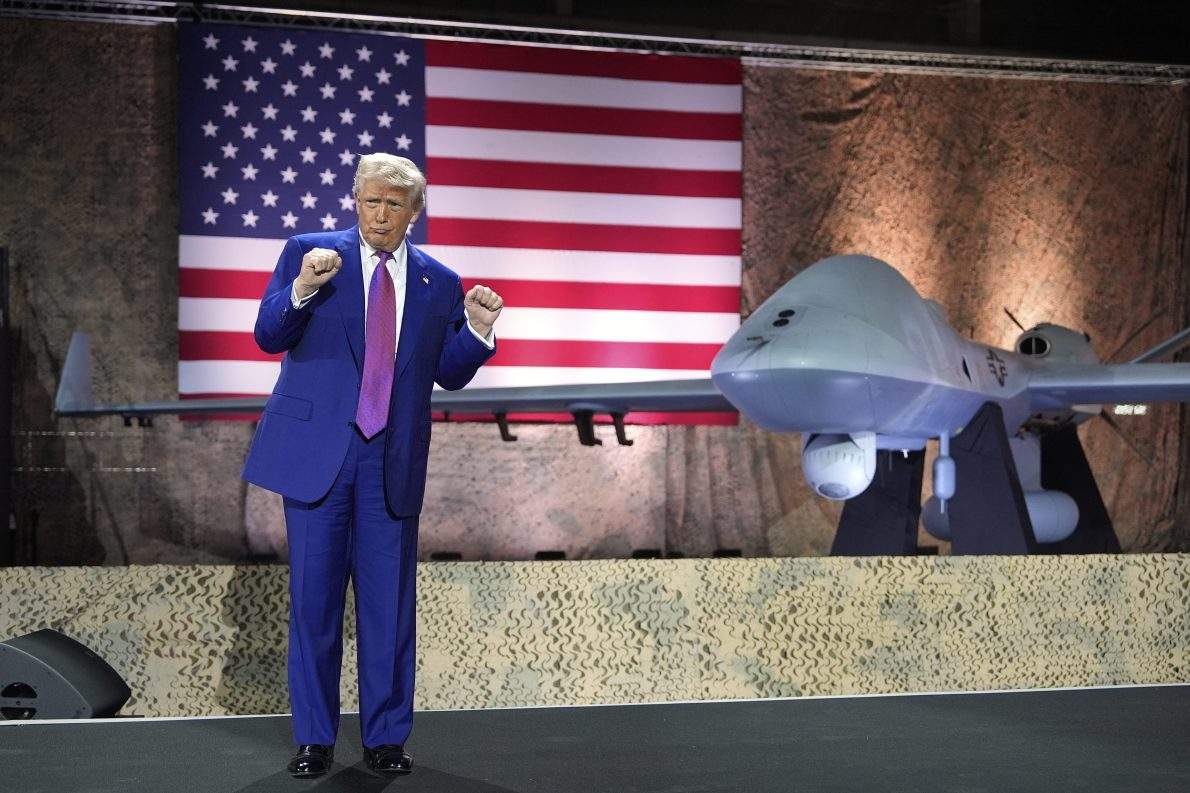
The article reports that US President Donald Trump has ordered new tariffs of up to 100% on imported drones and drone components, including products from several major US allies. The administration says the measures are necessary to address national security concerns, reduce the country’s dependence on foreign suppliers, and strengthen domestic drone manufacturing. The tariffs are scheduled to take effect in 21 days, although some categories of components and exempted products will receive longer implementation periods.
Under the proclamation, a 100% ad valorem tariff will apply to drones of a certain size or with specified capabilities considered particularly sensitive to national security. Smaller drones will face a 25% tariff. Separate country-based tariffs include 15% on drones and components from the European Union, Japan, Liechtenstein, South Korea, Switzerland, and Taiwan, and 10% on drones from the United Kingdom.
Trump said Commerce Secretary Howard Lutnick had investigated imports of unmanned aircraft systems, or UAS, and concluded that foreign producers have a substantial presence in the US market. Lutnick also determined that the United States relies too heavily on foreign sources and that products from certain foreign entities could pose security and safety risks. The administration said US manufacturers currently lack sufficient capacity to meet national security needs.
The proclamation provides delayed implementation for some less-sensitive components, with tariffs taking effect 180 days after signing. Products approved by the Pentagon for exemption from the Federal Communications Commission’s Covered List within 20 days will also receive a 180-day delay. The article notes that tariffs remain a central part of Trump’s trade and foreign policy despite legal challenges and criticism from analysts.
Entities: Donald Trump, Howard Lutnick, White House, United States, France 24 • Tone: neutral • Sentiment: negative • Intent: inform
14-08-2026
U.S. President Donald Trump announced new tariffs on imported drones and drone components, including products from several major U.S. allies. The White House said the measures are intended to reduce the United States’ reliance on foreign-made unmanned aircraft systems and address potential security and safety risks.
Under a proclamation signed by Trump, drones of a certain size or with capabilities considered particularly sensitive to national security will face a 100% ad valorem tariff. Smaller drones will be subject to a 25% tariff. Additional tariffs will apply based on the origin of the products: 15% on drones and components from the European Union, Japan, Liechtenstein, South Korea, Switzerland and Taiwan, and 10% on products from the United Kingdom.
The White House said Commerce Secretary Howard Lutnick examined the effects of drone imports and concluded that foreign producers have substantial market penetration. According to Trump’s proclamation, Lutnick determined that the United States is too dependent on foreign sources for drones and their components, while some foreign entities pose security and safety risks. The proclamation also stated that the U.S. domestic industry currently lacks sufficient capacity to meet national security needs.
The tariffs will generally take effect 21 days after the proclamation is signed. However, tariffs on less-sensitive drone components will take effect after 180 days. The same 180-day delay applies to products that the Pentagon approves for an exemption from the Federal Communications Commission’s Covered List within 20 days of the proclamation.
The measures add to Trump’s broader use of tariffs as a central element of his foreign and trade policies, despite legal setbacks and criticism from some analysts. The announcement could affect drone supply chains involving allied countries as well as U.S. manufacturers that rely on imported components.
Entities: Donald Trump, Howard Lutnick, White House, U.S. Department of Commerce, United States • Tone: analytical • Sentiment: neutral • Intent: inform
14-08-2026
The supplied material identifies a Global News article titled “U.S. says Canada among China’s ‘biggest enablers’ in avoiding Trump tariffs.” The headline indicates that U.S. officials or a U.S. report have accused Canada of helping Chinese goods avoid or circumvent tariffs imposed during the Trump administration, likely through transshipment or related trade practices. However, the article’s body is not included in the provided text, so the specific report, officials, evidence, trade routes, companies, and Canadian government responses cannot be verified or summarized accurately.
Most of the supplied content consists of Global News navigation, sharing tools, commenting instructions, and a long series of user comments. The comments are highly polarized and discuss alleged Chinese influence in Canada, Chinese electric vehicles, Canada–China investment and trade agreements, Mark Carney, Pierre Poilievre, Justin Trudeau, Donald Trump, and the effects of tariffs on consumers and businesses. Some commenters support the U.S. accusation, while others criticize Trump’s tariff policies, defend Canada, question the report’s credibility, or argue that American companies themselves rely heavily on Chinese manufacturing. Several comments call for an investigation, while others make unsupported allegations about political corruption or foreign interference.
Because the actual article text is absent, the headline supports only a limited, neutral characterization: the story reports a U.S. allegation about Canada’s role in helping China avoid tariffs. The comments should not be treated as verified facts or as the position of Global News. The article’s definitive tone, evidence, conclusions, and official responses cannot be determined from the supplied extract.
Entities: United States, Canada, China, Donald Trump, Global News • Tone: analytical • Sentiment: neutral • Intent: inform