14-08-2026
This CBC photo gallery captures how people across Europe and the Arctic experienced a total solar eclipse on Wednesday. The path of totality—where the moon completely blocks the sun—passed over parts of the Arctic, Greenland, Spain and Portugal. Viewers outside that narrow path saw a partial eclipse instead.
The gallery presents photographs from numerous locations, showing both the astronomical event and the public response to it. In Spain, spectators watched from the port of Tarragona, a beach near Valencia, the city of A Coruña, and locations near Teruel and Amposta. One image from Arija shows the moon fully covering the sun, while another taken near the Riet Vell Nature Reserve records the total eclipse over the Spanish landscape.
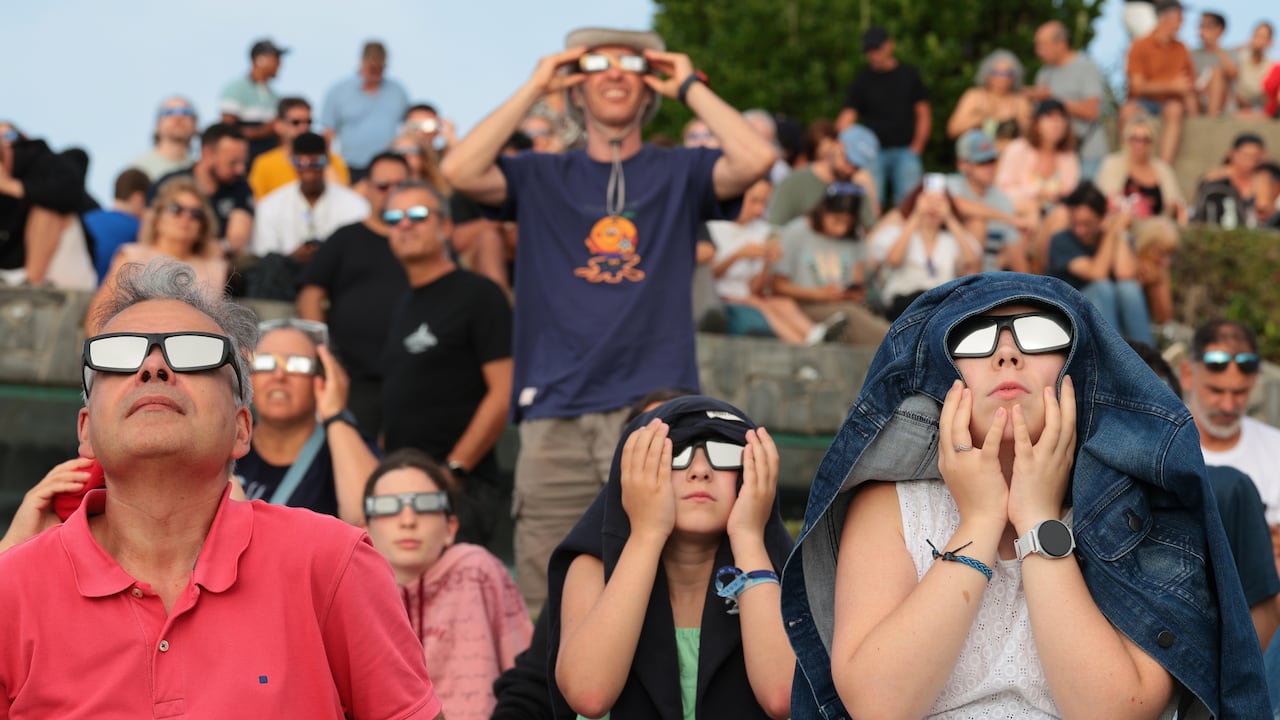
The eclipse was also observed in Berlin and western Germany, where people used eclipse glasses and gathered at Halde Hoheward park. In Warsaw, a woman viewed the sun through a welder’s mask at the Copernicus Science Centre. Crowds in Reykjavík watched through cloudy skies, and an aircraft was photographed passing through the scene near Geneva, Switzerland. The event was even displayed at a stadium in Salzburg, Austria, before a UEFA Super Cup soccer match between Paris Saint-Germain and Aston Villa.
Together, the photographs show the eclipse as both a rare celestial event and a widespread public spectacle, with viewers using specialized equipment, gathering in public spaces and adapting to local weather conditions.
Entities: Total solar eclipse, Partial eclipse, Path of totality, Moon, Arctic • Tone: neutral • Sentiment: positive • Intent: inform
14-08-2026
Millions of people gathered across Spain, Iceland and other parts of Europe to watch a rare total solar eclipse, while parts of Canada experienced only a partial eclipse. Spain held its first total solar eclipse in more than a century under hot, clear skies. Authorities deployed more than 33,000 law-enforcement officers and urged the public to avoid activities that could trigger wildfires during the event.
The eclipse’s path of totality began near the North Pole and crossed Russia, Greenland, Iceland, Spain and Portugal. In Iceland’s remote Westfjords, hotels and campgrounds filled with visitors, including as many as 2,000 people at one campground. Hotel owner Birna Mjöll Atladóttir described preparing for years, with help from her family, to feed and accommodate the crowds. A Canadian visitor photographed totality from a cruise ship in the Mediterranean Sea, about 60 kilometres south of Mallorca.
The article also places the event within an unusual period for eclipse tourism. Three total solar eclipses will occur across three continents over roughly 700 days. The next, on Aug. 2, 2027, is expected to produce more than six minutes of totality near Luxor, Egypt, while a July 22, 2028, eclipse will cross Australia and New Zealand. Both future eclipses will also be visible from parts of Spain.
Canadians will not see another total eclipse at home until Aug. 22, 2044, when totality will cross parts of Alberta, the Northwest Territories, Nunavut, British Columbia and Saskatchewan, including Edmonton and Calgary. The current eclipse coincided with the annual Perseids meteor shower, offering viewers another opportunity to observe the night sky. The article concludes its available live updates by noting that totality had ended worldwide.
Entities: Total solar eclipse, Spain, Canada, Iceland’s Westfjords, Russia • Tone: neutral • Sentiment: positive • Intent: inform
14-08-2026
The only total solar eclipse of 2026 crossed parts of the Northern Hemisphere on Wednesday, bringing a brief period of daytime darkness to locations along a relatively narrow path of totality. The eclipse was especially visible in western Iceland and northern Spain, with northern Spain serving as a major viewing destination. Spain had not experienced a total solar eclipse since 1905. Northern Greenland and extreme northern Russia were also included in the path, although many areas were uninhabited or difficult to access.
A partial eclipse was visible across a much wider region. Approximately 230 million people lived in areas that experienced at least 90% coverage, including major European cities such as Madrid, London and Paris. London reached a maximum of 91% coverage, while parts of North America also saw the moon partially obscure the sun. Fairbanks, Alaska, experienced the greatest coverage in the United States at 37%, followed by Boston at 16%, New York City at 9%, Toronto at 8% and Philadelphia at 7%.
The eclipse began reaching totality in northern Russia at 1 p.m. Eastern time, moved through Greenland and Iceland, crossed the northern Atlantic, and reached northern Spain at approximately 2:30 p.m. Eastern time. The overall passage of totality lasted about an hour and 45 minutes, while total darkness at any individual location lasted roughly two minutes.
Viewers across Europe gathered with protective eclipse glasses, which are essential during partial phases. Glasses can be removed only during the brief period of totality. The next total solar eclipse visible from the United States will occur in 2044 across Montana, North Dakota and South Dakota. Another, in 2045, will cross much of the country from Northern California to Florida, while the northeastern United States will not see totality again until 2079.
Entities: 2026 total solar eclipse, Moon, Sun, Northern Hemisphere, Path of totality • Tone: neutral • Sentiment: neutral • Intent: inform
14-08-2026
The article offers practical guidance for Canadians hoping to observe two major celestial events occurring within hours of one another: a partial solar eclipse on Wednesday and the annual Perseid meteor shower, which peaks Wednesday and Thursday evenings. The eclipse will be visible across parts of northern and western Canada, with Newfoundland and Labrador expected to have the clearest Canadian view, although it will still be only a partial eclipse. Local peak viewing times are listed as 8:54 a.m. in Prince George, 10:02 a.m. in Edmonton, 12:55 p.m. in Toronto and 2:28 p.m. in St. John’s.
The article emphasizes that proper solar-eclipse eye protection is required at all times. Eclipse glasses from the April 2024 total eclipse may still be suitable, and people without glasses can construct a simple pinhole projector using a cardboard box, aluminum foil and white paper. The next total solar eclipse visible in Canada is not expected until Aug. 22, 2044, while Spain and Iceland will receive the most complete view of this event.
The Perseid meteor shower is caused by Earth passing through debris left by Comet Swift-Tuttle. The particles enter the atmosphere at approximately 59 kilometres per second, vaporize at an altitude of about 80 to 90 kilometres and create visible streaks of light. For the best viewing experience, the Canadian Space Agency recommends leaving urban areas and avoiding light pollution. Viewers should allow their eyes at least 30 minutes to adjust to darkness, avoid looking at bright phone screens and lie on their backs while looking directly upward, since meteors can appear anywhere in the sky. A red filter should be used on any necessary flashlight. The article ends while giving additional advice about the best late-evening viewing window.
Entities: Partial solar eclipse, Perseid meteor shower, Canada, Newfoundland and Labrador, Canadian Space Agency (CSA) • Tone: analytical • Sentiment: neutral • Intent: inform
14-08-2026
Spain is preparing for a rare total solar eclipse expected to attract millions of skywatchers across northern and central parts of the country. The eclipse will begin around sunset as the sun, moon and Earth align, briefly plunging parts of the Iberian Peninsula, along with areas of Greenland and Iceland, into darkness. Totality will last less than two and a half minutes at its maximum, but only about a minute in Spain before the event ends over the Mediterranean.
The spectacle is expected to bring at least 500,000 additional visitors, sharply increasing demand for accommodation in cities along the eclipse’s path, including A Coruña, Bilbao and Santiago de Compostela. Viewing sites have also filled early in smaller towns such as Medinaceli.
However, the event is occurring during a period of extreme heat, dry vegetation and ongoing wildfire danger. Spain’s Interior Ministry established 350 official viewing sites but restricted access to 123 others because of environmental risks or difficulties that could hinder evacuations. More than 33,500 law-enforcement officers will be deployed to viewing areas and access points.
The precautions follow a devastating wildfire in Ávila that recently burned 500 square kilometres and forced tens of thousands of people to evacuate. Other fires remain active in southern and central Spain. With temperatures forecast to exceed 35 C across much of the eclipse’s viewing zone, authorities are urging visitors not to light fires, litter or park on dry vegetation, emphasizing that even one spark could trigger a new blaze.
Demand for certified eclipse glasses has also surged. Officials and astronomy experts warn that viewers must use specialized glasses with solar filters, even when only a small portion of the sun remains visible. Supermarkets, museums, pharmacies and planetariums distributed the glasses, but many pharmacies had already run out ahead of the event.
Entities: Spain, Total solar eclipse, Wildfires, Extreme heat and dry vegetation, Spanish Interior Ministry • Tone: urgent • Sentiment: negative • Intent: inform