12-09-2026
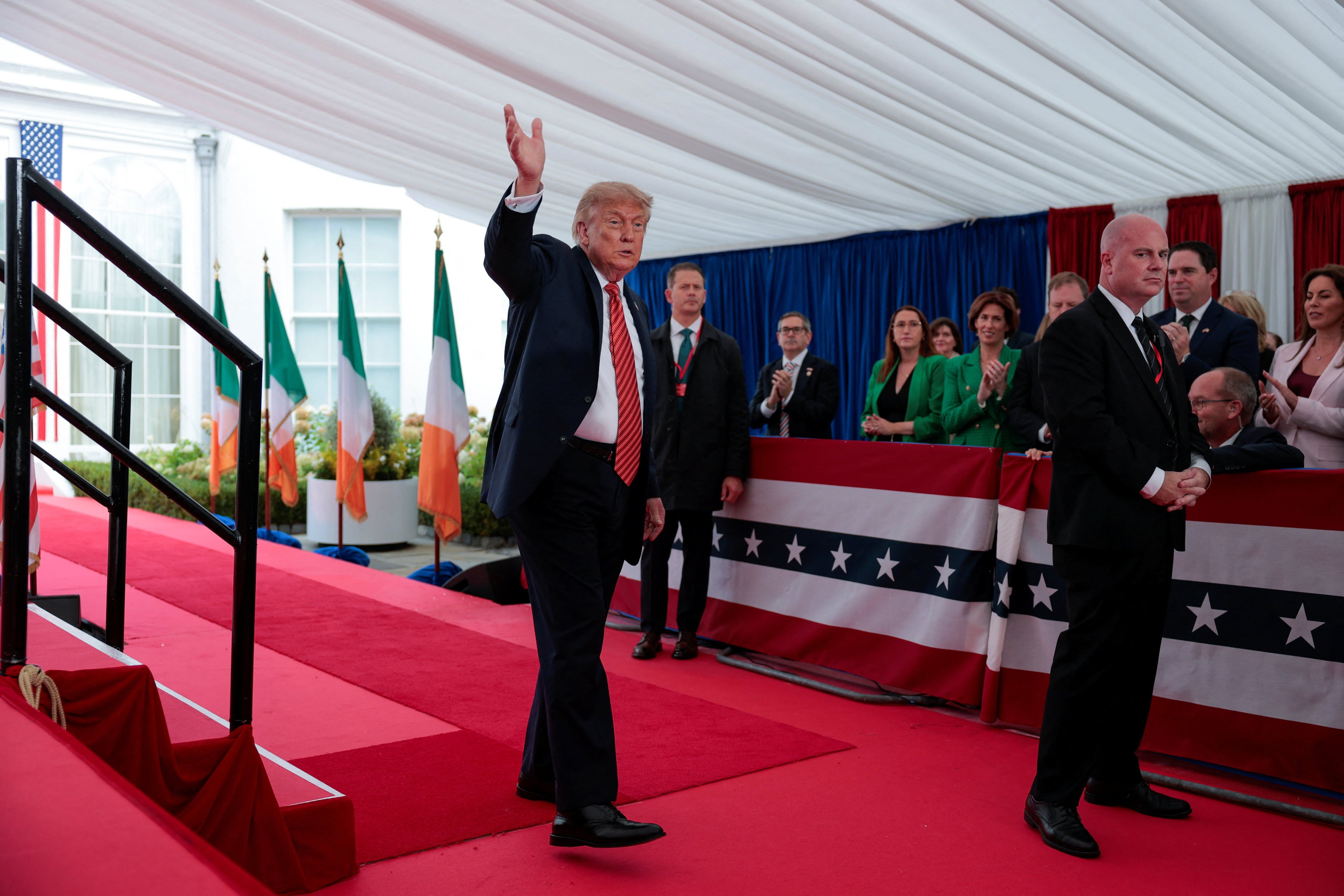
US President Donald Trump said he would welcome a united Ireland during a two-day visit to the Republic of Ireland. Meeting Taoiseach Micheál Martin at Farmleigh House in Dublin, Trump described Irish reunification as a “fantastic thing” and said he believed it would happen eventually. He acknowledged that the UK would have a view on the issue but suggested Martin was the right person to advance it. Later, Trump gave a less definitive response, saying there was “no good answer” to a question about a united Ireland.
The remarks prompted contrasting reactions from political leaders in Ireland and Northern Ireland. Sinn Féin leader Mary Lou McDonald said the Taoiseach should begin planning for reunification. Nationalist SDLP leader Claire Hanna welcomed Trump’s comments, arguing that they reflected how far discussion of Irish unity had shifted. Unionist politicians, including DUP leader Gavin Robinson, UUP leader Jon Burrows and TUV leader Jim Allister, stressed that Northern Ireland’s constitutional future must be decided by its people under the principle of consent established by the Belfast Agreement. Former DUP MP Ian Paisley dismissed Trump’s view as a personal opinion. Foreign Minister Helen McEntee also emphasised that any constitutional change would require consent.
Trump also met Irish President Catherine Connolly, who said she raised the conflicts in Gaza and the wider issue of war and genocide. She highlighted Ireland’s historical experience of famine, colonisation and the Troubles, as well as its perspective on peacebuilding.
The visit involved extensive security arrangements and included Trump’s attendance at the Amgen Irish Open golf tournament in County Clare. More than 10,000 people protested in Dublin, largely over Trump’s policies and US involvement in the Israel-Gaza conflict. Protesters also gathered near Trump’s hotel in Doonbeg, where he was accompanied by his sons Eric Trump and Donald Trump Jr.
Entities: Donald Trump, Micheál Martin, Catherine Connolly, Mary Lou McDonald, Gavin Robinson • Tone: analytical • Sentiment: neutral • Intent: inform
12-09-2026
President Donald Trump began a visit to Ireland by expressing support for a united Ireland, saying he would “love” to see the Republic of Ireland and Northern Ireland unified. Speaking during a meeting in Dublin with Irish Prime Minister Micheál Martin, Trump acknowledged that the United Kingdom would have a role in any such development but suggested that unification “may as well happen now.” His remarks touched on a longstanding and highly sensitive constitutional issue. Northern Ireland remained part of the United Kingdom when the Republic of Ireland became self-governing a century ago, and disputes between pro-British Protestant unionists and largely Catholic nationalists contributed to three decades of violence. The 1998 peace accord, negotiated with significant U.S. involvement, largely ended the conflict but did not settle Northern Ireland’s ultimate status.
Trump’s comments drew criticism from unionist politicians. Gavin Robinson, leader of the Democratic Unionist Party, said unionists were not interested in what he described as the destruction of their country through Irish unity. The article also notes that U.K. Prime Minister Andy Burnham had recently said a unity referendum was “off the table,” prompting a response from Sinn Féin.
During the visit, Trump met with Irish President Catherine Connolly, addressed American and Irish business leaders, and traveled to his oceanfront golf club in Doonbeg to attend the Irish Open. His combination of official diplomacy and participation in a tournament at one of his own properties attracted criticism from some Irish residents. A taxi driver complained about disruption in Dublin and Trump’s decision to play golf while global crises continue, while a university student condemned his views on women, immigrants, and minority communities. Demonstrations involving left-wing opposition groups, anti-military activists, pro-Palestinian organizations, and environmentalists were also planned.
The article places Trump’s Irish Open appearance within his broader pattern of attending sporting events at businesses owned by his family. His clubs in Florida and New Jersey hosted professional golf tournaments during the year, and the Irish Open was the second European Tour event held at a Trump property, following the Nexo Championship in Scotland.
Entities: Donald Trump, Micheál Martin, Catherine Connolly, Andy Burnham, Gavin Robinson • Tone: analytical • Sentiment: neutral • Intent: inform
12-09-2026
US President Donald Trump said he would “love” to see the Republic of Ireland and Northern Ireland unite, describing eventual unification as a “fantastic thing.” He made the comments after meeting Irish Prime Minister Micheál Martin in Dublin during a weekend visit that was primarily connected to the Irish Open golf tournament, held at a course Trump owns on Ireland’s Atlantic coast. Trump also met with Ireland’s president and received a military welcome.
Trump acknowledged that the United Kingdom would have a role in any change to Northern Ireland’s constitutional status. The British government responded that there was no majority public support for holding another referendum on unification and that one would not be held unless that situation changed. The article notes that previous US presidents generally avoided commenting directly on Irish reunification because Northern Ireland experienced decades of sectarian violence during the 20th century.
During his discussions with reporters, Trump also addressed the war between the United States and Iran, which he said began on February 28. He predicted that the conflict would end “very soon” and argued that oil prices, which had risen during the war, would fall sharply afterward. Trump defended the military operation by saying Iran could not be allowed to obtain a nuclear weapon and claimed the country had been approximately two weeks away from doing so. He warned that Iran might have attacked Israel, the wider Middle East, Europe, and eventually the United States. The article notes that the war lacks majority support among Americans, particularly because Trump had campaigned against prolonged foreign conflicts.
Trump also expressed confidence that the United States and Canada would reach a trade agreement soon. He repeated his criticism of Canadian tariffs, particularly those affecting US farmers, and said Canada wanted a deal “very badly.”
Entities: Donald Trump, Micheál Martin, Andy Burham, Republic of Ireland, Northern Ireland • Tone: neutral • Sentiment: neutral • Intent: inform
12-09-2026
US President Donald Trump is visiting Ireland for 48 hours, with a schedule combining high-level political meetings, trade discussions and attendance at the Irish Open golf tournament hosted at his Trump International Golf Links and Hotel Doonbeg in County Clare. In Dublin, Trump is expected to meet Taoiseach Micheál Martin for approximately an hour in a convivial, “St. Patrick’s Day style” discussion, while also making a courtesy call on President Catherine Connolly at Áras an Uachtaráin and delivering a speech to selected guests at the US ambassador’s residence.
The Irish government is expected to raise EU-US trade relations, support for Ukraine, the conflict involving Iran and the continuing situation in Palestine. Trump may also press Ireland to buy US liquefied natural gas as energy prices rise amid the Iran war. Ireland’s support for sanctions against Israeli settlements in the West Bank could create tension, although Washington has not yet issued the backlash Dublin had anticipated.
Greater political sensitivity surrounds Trump’s meeting with President Connolly, a former left-wing parliamentarian, anti-war activist and vocal critic of Trump’s first term. Connolly previously called him a “bully and a misogynist,” while her sister, Margaret Connolly, was detained by Israeli forces in May 2026 after a Gaza-bound humanitarian aid boat was intercepted. Although the presidency is largely ceremonial and Connolly has said she would fulfil her duty to meet Trump, supporters hope she will challenge him publicly.
US comedian Rosie O’Donnell, who now lives in Ireland, is organizing a protest in Dublin and urged Connolly to “speak truth to power.” Trump will spend much of the trip at his golf resort, where Rory McIlroy and other leading golfers are attending, before presenting the tournament trophy on Sunday evening.
Entities: Donald Trump, Micheál Martin, Catherine Connolly, Dr. Margaret Connolly, Rosie O’Donnell • Tone: analytical • Sentiment: negative • Intent: inform
12-09-2026
The article reports on US President Donald Trump’s two-day official visit to Ireland, during which he said he would like to see the Republic of Ireland and Northern Ireland reunified. Speaking alongside Taoiseach Micheál Martin in Dublin, Trump called unification “fantastic” and suggested it would eventually happen, while acknowledging that the UK would have a say. His comments were notable because previous US presidents have generally avoided directly taking a position on Northern Ireland’s constitutional future.
The article places Trump’s remarks in the context of Northern Ireland’s history. Competing nationalist and unionist visions contributed to the Troubles, a period of approximately three decades of violence that killed around 3,600 people. The 1998 peace accord, which received substantial US diplomatic support, largely ended the violence but left the question of Northern Ireland’s status unresolved. Under the agreement, a referendum on reunification can be held if there appears to be majority support. UK Prime Minister Andy Burnham said there was currently no evident public demand for another vote.
Trump also met Irish President Catherine Connolly, a left-wing politician who had previously criticised him and US foreign policy. The article describes the formal reception and Connolly’s largely ceremonial role as head of state. At a joint press conference, Trump criticised Europe over trade, energy and immigration, and described relations with European allies as disappointing because of their limited support for his Iran war efforts and the resulting disruption around the Strait of Hormuz.
Finally, the article examines the overlap between Trump’s official duties and personal business interests. He planned to attend the Irish Open at his golf resort in Doonbeg, continuing a pattern of visiting sporting events held at Trump-owned properties. The report presents the trip as both a diplomatic engagement and an example of Trump combining presidential travel with activities connected to his family business.
Entities: Donald Trump, Micheál Martin, Catherine Connolly, Andy Burnham, Ireland • Tone: analytical • Sentiment: negative • Intent: inform
12-09-2026
US President Donald Trump said during a visit to Dublin that he would like to see the Republic of Ireland and Northern Ireland reunified, calling such an outcome “fantastic.” Speaking alongside Irish Prime Minister Micheál Martin, Trump said reunification would eventually happen, while acknowledging that the United Kingdom would have a say. His comments entered a highly sensitive political debate concerning Northern Ireland’s constitutional future.
Trump arrived in Dublin on September 12 for a two-day visit that combines official meetings with attendance at the Irish Open golf tournament, being held at his luxury resort in Doonbeg, County Clare. The trip illustrates how the president continues to combine presidential responsibilities with the promotion of his family’s business interests. Trump is expected to travel from Dublin to the resort, where approximately 40,000 spectators are expected and golfer Rory McIlroy is the leading attraction.
Ireland has deployed at least 4,000 police and other security personnel, including snipers, for the visit. The operation is estimated to cost €20 million and is taking place while Ireland is already managing extensive security responsibilities connected with its six-month presidency of the European Union. Thousands of protesters are expected to demonstrate in Dublin.
Trump’s schedule includes meetings with Irish President Catherine Connolly and Taoiseach Micheál Martin. Discussions are expected to cover the Middle East, the war involving Iran, US tariffs on European pharmaceuticals, immigration and Gaza. Ireland and the United States share close historical and ancestral ties, but the Irish government’s positions differ from Trump’s administration on several issues, particularly Palestinian rights and Israeli settlements.
Analysts described the meetings as likely to be brief and courteous, while questioning the ethical and political implications of Trump promoting his golf properties during an official foreign visit.
Entities: Donald Trump, Micheál Martin, Catherine Connolly, Ireland, Northern Ireland • Tone: analytical • Sentiment: neutral • Intent: inform
12-09-2026
The France 24 video report states that U.S. President Donald Trump arrived in Dublin, Ireland, on Saturday, September 12, 2026, at the beginning of a weekend visit. During the visit, Trump is scheduled to meet Ireland’s president and prime minister. The report’s headline adds that he will later travel to Doonbeg, on Ireland’s Atlantic coast, where he owns a golf club and course.
Although the visit includes official diplomatic meetings, the report characterizes the trip as being primarily connected to a major golf tournament taking place at Trump’s course. This framing suggests that the sporting event and Trump’s business interests in Ireland are central features of the weekend itinerary, alongside the formal engagements with Irish leaders.
The brief report does not identify the Irish president or prime minister by name, provide details about the issues expected to be discussed, or describe any agreements, statements, or reactions resulting from the meetings. It also does not explain the tournament’s participants or significance beyond identifying it as a major golf event. The available content is a short video-news introduction rather than a detailed account of Trump’s diplomatic agenda or his movements after arriving in Dublin.
Overall, the item presents Trump’s Ireland visit as a combination of official talks in the capital and a trip to his privately owned golf property in Doonbeg. Its focus is on the itinerary and the unusual balance between state-level meetings and a high-profile sporting event, without offering analysis or commentary about the political relationship between the United States and Ireland.
Entities: Donald Trump, Ireland, Dublin, Doonbeg, Ireland’s president • Tone: neutral • Sentiment: neutral • Intent: inform
12-09-2026
President Donald Trump arrived in Dublin, Ireland, on Saturday for a 48-hour trip combining meetings with Irish leaders and an appearance at the Irish Open golf tournament hosted at his company’s resort in Doonbeg. The visit is not an official state visit and comes as Trump’s attention has focused on the Iran war and his Republican Party’s campaign to retain control of both chambers of Congress in the November midterm elections.
Trump is scheduled to meet Irish President Catherine Connolly and Prime Minister Micheál Martin. Their discussions could address economic concerns, the regional consequences of the Iran conflict, and Irish objections to US military actions. The war has contributed to higher gasoline prices in the United States, increasing economic anxiety among American voters. Martin emphasized the importance of US-Ireland economic ties, noting that American-owned companies employ roughly 10% of Ireland’s workforce and contribute substantially to the country’s corporate tax revenue and public finances.
The visit also highlights political differences between the two countries. Ireland is among the European Union’s most pro-Palestinian states and recently passed legislation restricting trade in goods from Israeli settlements in the occupied West Bank. The measure has drawn criticism from US lawmakers and the American ambassador to Ireland. Connolly, who protested Trump’s policies during his 2019 visit, has faced calls from supporters to challenge US military actions and defend Ireland’s traditional neutrality.
Trump’s trip includes a distinctly personal and business-related element. The Trump Organization has operated the Doonbeg golf course since 2014, and Trump is expected to help present the Irish Open trophy on Sunday. Anti-war and anti-Trump demonstrations are planned in Dublin and near the resort. Trump was greeted at Dublin Airport by Tánaiste and Finance Minister Simon Harris, while members of his family, including Donald Trump Jr. and Bettina Anderson, traveled with him.
Entities: Donald Trump, Catherine Connolly, Micheál Martin, Simon Harris, Ireland • Tone: analytical • Sentiment: neutral • Intent: inform
12-09-2026
US President Donald Trump is visiting Ireland for two days of diplomatic meetings and golf, arriving in Dublin under an unusually large security operation. Irish authorities have deployed at least 4,000 police officers and other personnel, including snipers, in what is described as one of the country’s biggest-ever security operations. The heightened measures come as thousands of anti-Trump protesters prepare to rally in Dublin.
During the Dublin portion of the visit, Trump is scheduled to hold separate meetings with Irish Prime Minister Micheál Martin and President Catherine Connolly. Speaking briefly to reporters before departing for Ireland, Trump said he expected to hold numerous meetings with European leaders and others, describing the trip as an interesting period.
After his diplomatic engagements, Trump is expected to travel to Doonbeg on Ireland’s west coast, where he owns a luxury golf resort. The visit coincides with the Irish Open, which is drawing some of the world’s leading golfers to the area. Trump, an avid golfer, may present the tournament trophy on Sunday.
The article highlights the way the trip combines presidential responsibilities with Trump’s private business interests, particularly his planned stay at Trump International Golf Links Ireland. It also references sports journalist Rick Reilly’s 2019 book “Commander in Cheat,” which documented Trump’s controversial or relaxed approach to golf’s rules. Security checks were carried out by members of the Irish army at the Doonbeg resort before Trump’s arrival.
Overall, the visit is presented as both a diplomatic engagement and a high-profile personal and commercial event, with substantial security requirements and the prospect of public demonstrations adding to the political attention surrounding it.
Entities: Donald Trump, Ireland, Dublin, Doonbeg, Irish police and security personnel • Tone: analytical • Sentiment: negative • Intent: inform
12-09-2026
US President Donald Trump said he would “love to see” Ireland reunified during a two-day visit to Ireland, inserting himself into one of the island’s most politically sensitive issues. Speaking after meeting Irish Prime Minister Micheál Martin in Dublin, Trump described the reunification of the Republic of Ireland and Northern Ireland as “a fantastic thing” and suggested that it would eventually happen, adding that “it may as well happen now.” He acknowledged that the United Kingdom would have a role in the matter.
Trump made the comments while travelling to his luxury resort in Doonbeg on Ireland’s west coast, where he planned to watch the Irish Open golf tournament. The article highlights how the visit blurred the boundaries between Trump’s presidential responsibilities and his personal business interests.
Ireland has been divided since 1921, with the Republic of Ireland forming the independent southern state and Northern Ireland remaining part of the United Kingdom. The issue remains especially sensitive because Northern Ireland experienced three decades of sectarian violence, known as the Troubles, which ended with the 1998 Good Friday Agreement and caused about 3,000 deaths.
Under that agreement, a referendum on Northern Ireland’s constitutional status can be held if the UK government believes a majority there is likely to support joining the Republic of Ireland. A majority in the Republic would also need to approve reunification. Trump’s remarks therefore touch on an outcome governed by an established democratic process, but they also represent a notable intervention by a visiting US president in a matter involving Ireland, Northern Ireland and the UK.
Entities: Donald Trump, Micheál Martin, Ireland, Republic of Ireland, Northern Ireland • Tone: analytical • Sentiment: neutral • Intent: inform
12-09-2026
US President Donald Trump arrived in Ireland on Sept 12 for a two-day visit combining official diplomacy with attendance at the Irish Open golf tournament at his Doonbeg resort. The trip has drawn scrutiny because it places Trump’s presidential responsibilities alongside promotion of a family-owned business. He is scheduled to meet Irish President Catherine Connolly and Taoiseach Micheal Martin in Dublin before travelling to County Clare, where around 40,000 spectators are expected and Rory McIlroy is among the leading competitors.
Ireland has mounted one of its largest-ever security operations for the visit, deploying at least 4,000 police and other personnel, including snipers. The operation is reportedly costing €20 million and is complicated by the tournament’s remote coastal location, the expected crowds and planned anti-Trump demonstrations in Dublin.
Trump’s use of a plane gifted by Qatar and his history of promoting his golf properties have intensified questions about conflicts between his public office and private interests. Analysts cited in the article say the visit reflects his willingness to merge presidential activity with his family’s commercial interests. A government ethics expert also warned that promoting luxury golf resorts could be politically damaging while many Americans face financial difficulties.
Trump’s meetings with Connolly and Martin are expected to cover Middle East conflicts, US tariffs on European Union pharmaceuticals and immigration. Connolly, a left-wing critic of Trump, faces pressure to raise the situation in Gaza while maintaining Ireland’s relationship with the United States. Ireland and the US remain close allies, but Dublin’s support for Palestinians and opposition to Israeli settlements differs sharply from the Trump administration’s position. Analysts expect the meeting with Martin to be cordial and the encounter with Connolly to be brief and restrained.
Entities: Donald Trump, Micheal Martin, Catherine Connolly, Ireland, Dublin • Tone: analytical • Sentiment: neutral • Intent: inform
12-09-2026
The article reports that U.S. President Donald Trump expressed support for the eventual reunification of the island of Ireland, including Northern Ireland, which remains part of the United Kingdom. Trump made the remarks on Saturday, September 12, after meeting Irish Prime Minister Micheál Martin in Dublin.
Speaking to reporters, Trump said he would “love” to see Ireland unified and predicted that this would happen eventually. He described reunification as potentially “a fantastic thing” and “a great thing,” while acknowledging that the United Kingdom would have a say in the matter. Trump prefaced his comments by saying that he did not want to cause problems, suggesting awareness of the political sensitivity surrounding Northern Ireland’s constitutional status.
The issue of Irish reunification is governed by the principle of consent under the 1998 Good Friday Agreement. Any change in Northern Ireland’s status would require majority support there, alongside agreement in the Republic of Ireland. The article does not report any new policy initiative or formal U.S. position resulting from Trump’s comments; it focuses on his personal view and prediction.
Trump’s remarks came during his meeting with Martin in Dublin and directly referenced the role of the UK, which retains sovereignty over Northern Ireland. The comments are notable because they touch on one of the most politically sensitive issues in relations among Ireland, Northern Ireland, the United Kingdom, and the United States. The report, attributed to Reuters, provides no response from the British government or other political leaders.
Entities: Donald Trump, Micheál Martin, Ireland, Northern Ireland, Dublin • Tone: neutral • Sentiment: neutral • Intent: inform
12-09-2026
The Washington Post reports that President Donald Trump expressed support for the possibility of Irish reunification during a visit to Dublin on Saturday. Speaking during a meeting with Irish Prime Minister Micheál Martin, Trump said he “would love to see” Ireland reunified. His comments address one of the most politically sensitive constitutional and political questions involving Ireland and the United Kingdom.
The remarks were made while Trump was traveling to attend the Irish Open golf tournament at his resort, Trump International Golf Links. The article places his statement within the context of the longstanding division on the island of Ireland, though the supplied excerpt does not provide further details about his reasoning, Martin’s response, or the political reactions in Ireland, Northern Ireland, or the United Kingdom.
Trump’s comments are significant because Irish reunification remains a deeply contested issue. Any change to Northern Ireland’s constitutional status would have major political implications and would involve the preferences of communities in Northern Ireland, as well as the governments of Ireland and the United Kingdom. The excerpt characterizes the issue as highly sensitive but does not indicate that Trump proposed a specific policy, timetable, or diplomatic initiative.
The report therefore focuses primarily on Trump’s public statement and the setting in which he made it: a meeting with Ireland’s prime minister during a presidential visit connected partly to a golf event at his own resort. Based on the available text, the article is a brief, factual account of Trump’s position rather than a detailed analysis of the potential consequences of Irish reunification.
Entities: Donald Trump, Micheál Martin, Dublin, Ireland, United Kingdom • Tone: neutral • Sentiment: neutral • Intent: inform