12-09-2026
A new ZDF poll indicates that Germany’s far-right Alternative für Deutschland (AfD) is leading ahead of regional elections in Mecklenburg-Western Pomerania, scheduled for September 20, 2026. The poll also shows a sharp decline for Chancellor Friedrich Merz’s centre-right Christian Democratic Union (CDU), which is backed by only 7% of respondents.
If that result were reflected in the election, it would represent the CDU’s worst-ever performance in a regional election in Germany. The figures highlight a significant shift in the political landscape of the northeastern German state and suggest that the AfD could emerge as the strongest party in the contest. The CDU’s weak polling is particularly notable because it is led nationally by Merz, Germany’s chancellor, making the regional result a potential setback for both the party and his leadership.
The report does not provide the AfD’s precise polling percentage or details about other parties’ standings. It focuses instead on the contrast between the AfD’s lead and the CDU’s historically low level of support. The election is therefore presented as an important test of the strength of Germany’s far right and of the CDU’s ability to maintain support under Merz.
France 24 characterizes the AfD as far right and attributes the findings to a new ZDF poll. The article is brief and primarily reports the polling development without offering broader explanations for the AfD’s lead, analysis of voter preferences, or reactions from the parties involved.
Entities: Alternative für Deutschland (AfD), Germany, Mecklenburg-Western Pomerania, Friedrich Merz, Christian Democratic Union (CDU) • Tone: analytical • Sentiment: negative • Intent: inform
12-09-2026
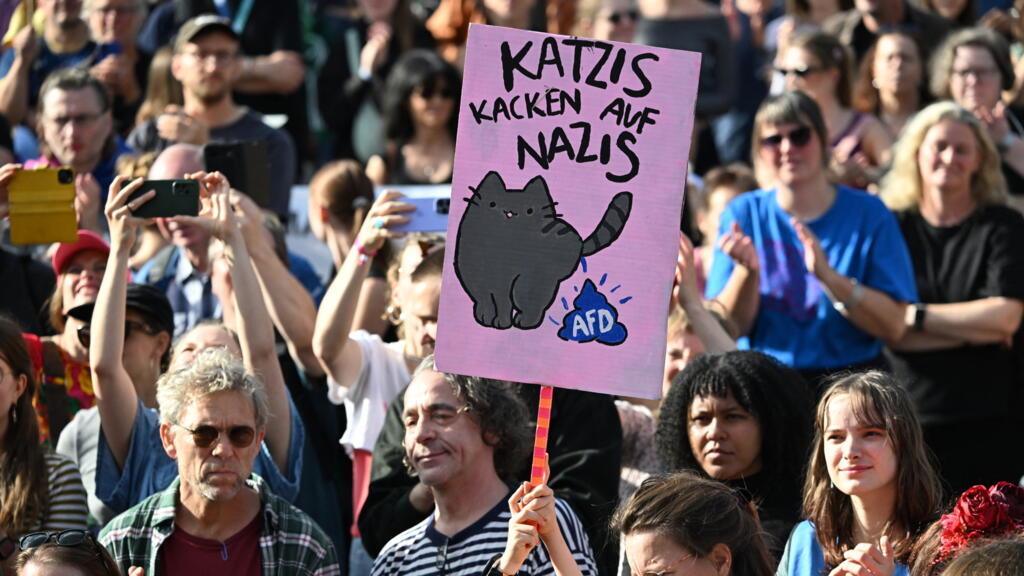
About 150,000 people demonstrated in roughly 20 German cities against the far-right Alternative for Germany (AfD), following the party’s strong performance in a state election in Saxony-Anhalt. The protests, held in cities including Berlin, Hamburg and Munich, were organised by Pruef, a group advocating a ban on the AfD. Demonstrators carried signs such as “Ban the AfD now” and “Democracy needs no alternatives.”
The AfD won nearly 44 percent of the vote in Saxony-Anhalt, far ahead of the centre-right Christian Democratic Union (CDU), which received 17 percent. Although the AfD fell three seats short of an absolute majority, it has begun negotiations with other political groups and lawmakers as it seeks to form the first far-right state government in Germany since World War II.
The party’s rise has alarmed many Germans because of the country’s historical responsibility for the Nazi era. Campact campaign leader Christoph Bautz said the demonstrations represented a broad section of civil society seeking to prevent what he called the “enemies of the constitution” from gaining governmental power in Saxony-Anhalt. Calls for banning the AfD have intensified, but Germany’s legal and constitutional requirements for banning a political party are demanding.
Chancellor Friedrich Merz of the CDU remains doubtful about pursuing a formal ban. Police reported several thousand participants at demonstrations in Berlin, while Campact estimated that around 25,000 people protested in Hamburg and 12,000 in Munich. The AfD held a counter-demonstration in Berlin attended by Kristin Brinker, its lead candidate in the city’s upcoming regional election. The protests underscore the growing political confrontation over the AfD’s electoral breakthrough and its potential access to government power.
Entities: Alternative for Germany (AfD), Germany, Saxony-Anhalt, Berlin, Hamburg • Tone: urgent • Sentiment: negative • Intent: inform
12-09-2026
Tens of thousands of people demonstrated across Germany on Sept 12 against the far-right Alternative for Germany (AfD), following the party’s decisive victory in the Sept 6 election in Saxony-Anhalt. Organisers said approximately 150,000 people participated in protests in about 20 cities, including Berlin, Hamburg and Munich. Demonstrators carried signs such as “Ban the AfD now” and “Democracy needs no alternatives,” expressing opposition to the party’s attempt to gain state-government power.
The AfD won nearly 44 per cent of the vote in Saxony-Anhalt, far ahead of the centre-right Christian Democratic Union (CDU), which received 17 per cent. The result left the AfD three seats short of an absolute majority. The party has begun discussions with other political groups and lawmakers in an effort to form the first far-right state government in Germany since World War II.
The protests were organised by Pruef, which supports banning the AfD, with participation from civil society groups including Campact. Campact leader Christoph Bautz said the demonstrations reflected a broad effort to stop what he described as “enemies of the constitution” from entering government.
The AfD’s rise has alarmed many Germans because of the country’s historical responsibility for the Nazi period. Calls for mainstream parties to pursue a formal ban have increased, but Germany’s legal requirements for banning a political party are demanding. Chancellor Friedrich Merz remains sceptical of such an approach. The AfD also held a counter-demonstration in Berlin, attended by its regional election candidate Kristin Brinker, as it prepared to negotiate over the formation of a government in Saxony-Anhalt.
Entities: Alternative for Germany (AfD), Saxony-Anhalt, Germany, Berlin, Hamburg • Tone: analytical • Sentiment: negative • Intent: inform
12-09-2026
Following the AfD’s strong performance in the Saxony-Anhalt state election, its lead candidate Ulrich Siegmund has faced fierce criticism over comments linking arms production to the party’s plans for “remigration” and deportations. The controversy concerns a proposed production site for the Israeli defence company Elbit Systems in Sangerhausen. At a press conference, Siegmund said the AfD did not fundamentally oppose arms production because it could support domestic security, national stability and defence. He then said military equipment could be needed for future “remigration and deportation offensives.”
After the remarks prompted criticism, Siegmund clarified that arms production included vehicles, protective technology and other equipment used by the Bundeswehr, police and security agencies. He argued that such capabilities should be strengthened to enforce the law, carry out deportations and make a “genuine remigration offensive” possible. He also stressed that the AfD opposed supplying military equipment for foreign wars and wanted to examine what would be produced at the Sangerhausen site and under what conditions.
Elbit Systems’ possible arrival has already generated local protests. The company produces drones, howitzers, rocket launchers, communications equipment and self-protection systems, and already supplies equipment to the Bundeswehr. Sangerhausen’s mayor, Torsten Schweiger, said final assembly of drones, shells or ammunition was not planned, while no final decision on the site has been made. Siegmund said the AfD had not yet adopted a definitive position, noting that economic, security and foreign-policy considerations would all matter.
SPD parliamentary leader Katja Pähle called the comments a political threat and said linking military equipment to mass expulsion amounted to discussing violence as a political tool. BSW co-chair Fabio De Masi accused the AfD of using provocation rather than demonstrating governing intent. The BSW is the only party in the new state parliament willing to discuss possible cooperation with the AfD, although no agreement has been reached. The AfD won 43.8 percent of the vote, fell short of an absolute majority and continues to seek a government.
Entities: Ulrich Siegmund, Alternative für Deutschland (AfD), Saxony-Anhalt state election, Saxony-Anhalt, Sangerhausen • Tone: analytical • Sentiment: negative • Intent: inform