11-05-2026
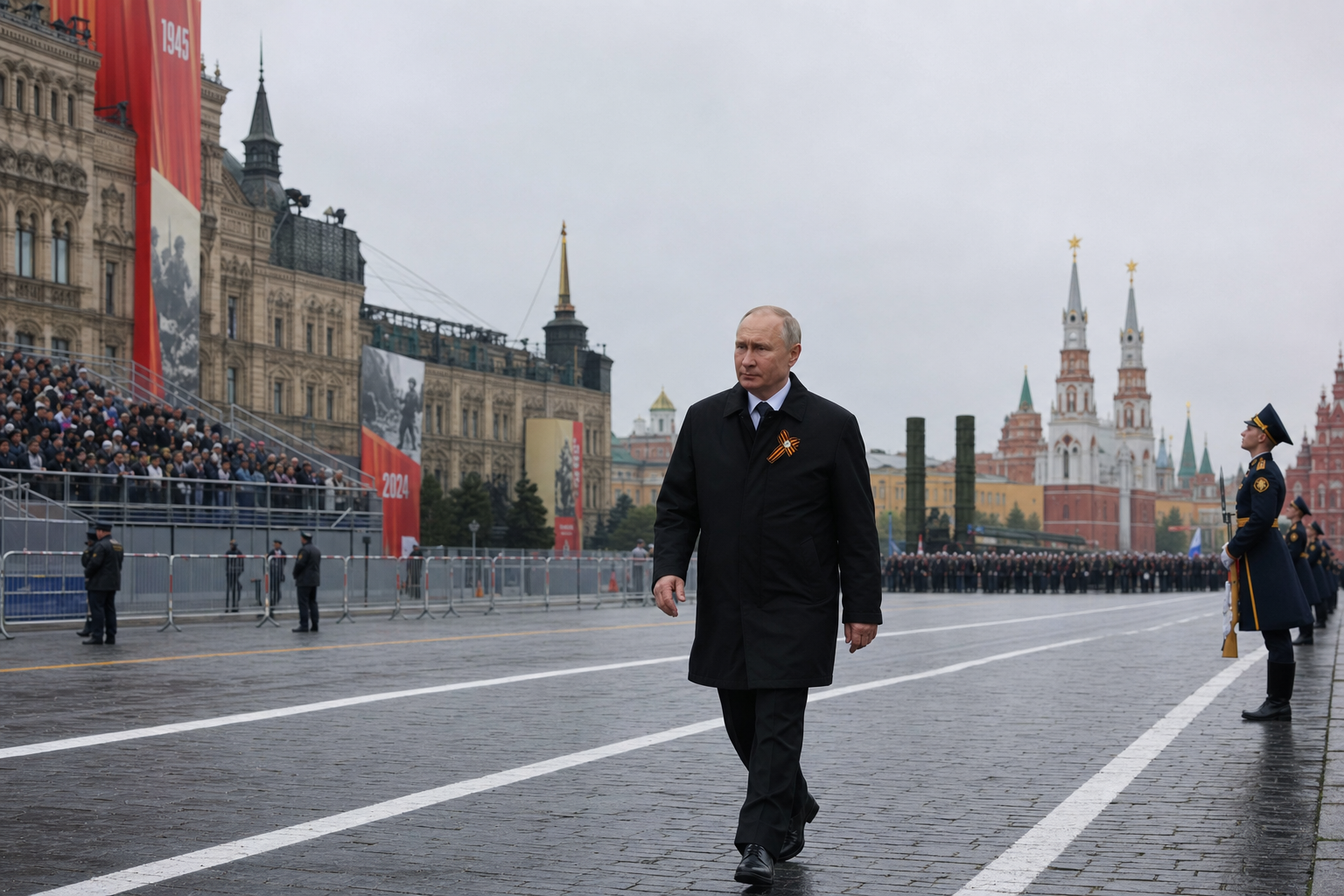
Russian President Vladimir Putin suggested that the war in Ukraine may be nearing its end, making the remark after a scaled-back Victory Day parade in Moscow. In comments to reporters, he said the conflict was “coming to an end,” while also repeating his justification for the invasion and criticizing Western support for Kyiv. His remarks came only hours after his Victory Day speech, in which he framed the war as a “just” struggle against an “aggressive force” backed by NATO.
The article places Putin’s comments in the broader context of the war, which began with Russia’s seizure of Crimea and parts of eastern Ukraine in 2014 and escalated into a full-scale invasion in February 2022. Putin reiterated that he would only meet Ukrainian President Volodymyr Zelensky once a lasting peace treaty had been finalized, though he said a meeting in a third country could be possible at that stage. He also said he was open to discussing new European security arrangements, naming former German Chancellor Gerhard Schröder as a preferred interlocutor.
The piece also highlights the fragile state of the ceasefire surrounding the Victory Day events. A US-brokered three-day truce allowed the Moscow parade to proceed without incident, but both sides later accused each other of violations. Russia alleged thousands of Ukrainian drone strikes and artillery attacks, while Ukraine reported injuries from Russian drone attacks in several regions. The article closes by noting the unusual absence of military hardware from the parade and the reduced access for international journalists, underscoring the tense atmosphere surrounding Russia’s annual showcase of military power.
Entities: Vladimir Putin, Volodymyr Zelensky, Russia, Ukraine, Moscow • Tone: analytical • Sentiment: neutral • Intent: inform
11-05-2026
Russian President Vladimir Putin used Moscow’s scaled-back Victory Day parade to project strength and affirm Russia’s war aims in Ukraine, while also suggesting he believes the conflict may be nearing an end. Speaking after the Red Square ceremony, Putin said he was open to meeting Ukrainian President Volodymyr Zelenskyy in a third country, but only after the terms of a peace agreement were settled. The parade was held under tight security and, for the first time in nearly two decades, omitted heavy weapons such as tanks and missiles, reflecting both the security environment and the strain of the war. The event also featured troops from North Korea for the first time, highlighting Moscow’s growing military ties with Pyongyang.
The article places Putin’s remarks in the context of continuing battlefield gains by Russia and Ukraine’s growing ability to strike targets deep inside Russian territory with long-range drones. It also describes a tense lead-up to the celebrations, including mutual accusations between Russia and Ukraine over ceasefire violations and threats from Moscow to strike Kyiv if Ukraine disrupted the festivities. President Trump’s statement that a ceasefire and prisoner exchange could be the “beginning of the end” of the war is also noted. Beyond the military and diplomatic theater, Victory Day remains a central symbol for Russia, invoking the Soviet victory over Nazi Germany and the immense wartime sacrifices that still shape Russian national identity. The article concludes with details of diplomatic attendance, internet restrictions in Moscow, and criticism in Europe over Slovak Prime Minister Robert Fico’s trip to Moscow.
Entities: Vladimir Putin, Volodymyr Zelenskyy, Donald Trump, Dmitry Peskov, Red Square • Tone: analytical • Sentiment: neutral • Intent: inform
11-05-2026
Russia and Ukraine exchanged accusations on Sunday over alleged violations of a newly announced U.S.-brokered three-day ceasefire, which President Donald Trump said would include a 1,000-prisoner swap. The pause in fighting was meant to coincide with Russia’s Victory Day commemorations, but both sides claimed the other had continued attacks. Ukrainian President Volodymyr Zelenskyy said Russia was not respecting the truce and vowed that Ukraine would respond proportionately to any renewed aggression. Ukrainian officials reported casualties from Russian drone and artillery strikes, while Russia’s Defense Ministry said Ukrainian forces had carried out more than 1,000 violations and attacked civilian and military targets in Russian areas. The article underscores how fragile the ceasefire remains amid deep mistrust between Moscow and Kyiv, despite renewed U.S.-led diplomatic efforts. It also notes that previous ceasefires have failed to produce meaningful results and that Moscow continues to insist on territorial concessions, specifically the withdrawal of Ukrainian troops from the Donbas region, as a condition for progress in negotiations. The piece closes by highlighting the tentative diplomatic momentum, including expected visits to Moscow by U.S. envoy Steve Witkoff and Jared Kushner, but with little sign of a breakthrough.
Entities: Russia, Ukraine, United States, President Donald Trump, Volodymyr Zelenskyy • Tone: analytical • Sentiment: neutral • Intent: inform
11-05-2026
The article argues that Russia is increasingly struggling on the battlefield in Ukraine, and that these military difficulties are beginning to have visible consequences at home. The immediate backdrop is Moscow’s subdued Victory Day parade on May 9, which notably lacked the usual display of tanks and other military vehicles. That absence was not symbolic restraint but a security precaution: Russian authorities feared that concentrated armour and missile carriers would become vulnerable to Ukraine’s expanding drone capabilities. The article says this caution reflected a broader problem for the Kremlin. Mobile internet was shut down in Moscow and St Petersburg for security reasons, and air-defence systems were pulled from distant regions to protect key urban centres, suggesting that Russia is being forced to divert scarce military resources away from other parts of the country.
The article’s central claim is that Ukraine’s battlefield effectiveness is increasingly constraining Russia’s freedom of action. As Ukrainian drones and strikes become more precise and disruptive, they are not only inflicting battlefield costs but also undermining the pageantry and confidence associated with Vladimir Putin’s rule. The muted Victory Day events, a symbolically important national ritual, are presented as evidence that Russia can no longer stage military displays without worrying about vulnerability. This, in turn, hints at a larger strategic and political vulnerability: rising casualties in Ukraine are making Putin look more beleaguered domestically. The overall message is that Russia is stumbling militarily, and those setbacks are feeding into a broader sense of strain and insecurity inside the country.
Entities: Russia, Ukraine, Vladimir Putin, Moscow, St Petersburg • Tone: analytical • Sentiment: negative • Intent: inform
11-05-2026
Russian President Vladimir Putin said on Saturday that he believes the war in Ukraine may be nearing an end, though he offered no concrete timeline or peace terms. His remarks came shortly after Donald Trump announced a surprise three-day ceasefire tied to Russia’s Victory Day commemorations and said it would also include a 1,000-for-1,000 prisoner exchange between Russia and Ukraine. According to the article, the ceasefire began Saturday and would run through Monday, pausing kinetic activity during a period of symbolic importance for Russia and, as Trump noted, for Ukraine as well because of its role in World War II.
The article places Putin’s comments in the context of the long-running conflict, noting that Russia’s full-scale invasion of Ukraine began in February 2022 and has lasted more than four years. It also highlights that Russia has not been able to capture the entire Donbass region, despite early Kremlin expectations of a quick victory. Trump’s role is presented as central to the latest diplomatic movement: he said he personally requested the ceasefire and expressed appreciation for agreements reached by both Putin and Ukrainian President Volodymyr Zelenskyy.
Zelenskyy confirmed on X that Ukraine had agreed to the prisoner exchange through U.S.-mediated negotiations and said Ukraine expected a ceasefire regime on May 9, 10, and 11. He thanked Trump for his involvement and said he hoped the United States would ensure Moscow honors the agreement. Putin, meanwhile, signaled reluctance to engage directly with Zelenskyy until after a lasting peace deal is in place and suggested he would prefer talks with former German Chancellor Gerhard Schroeder instead. Overall, the piece frames the ceasefire and prisoner swap as a cautiously optimistic but fragile step amid an ongoing war.
Entities: Vladimir Putin, Donald Trump, Volodymyr Zelenskyy, Russia, Ukraine • Tone: analytical • Sentiment: neutral • Intent: inform