11-05-2026
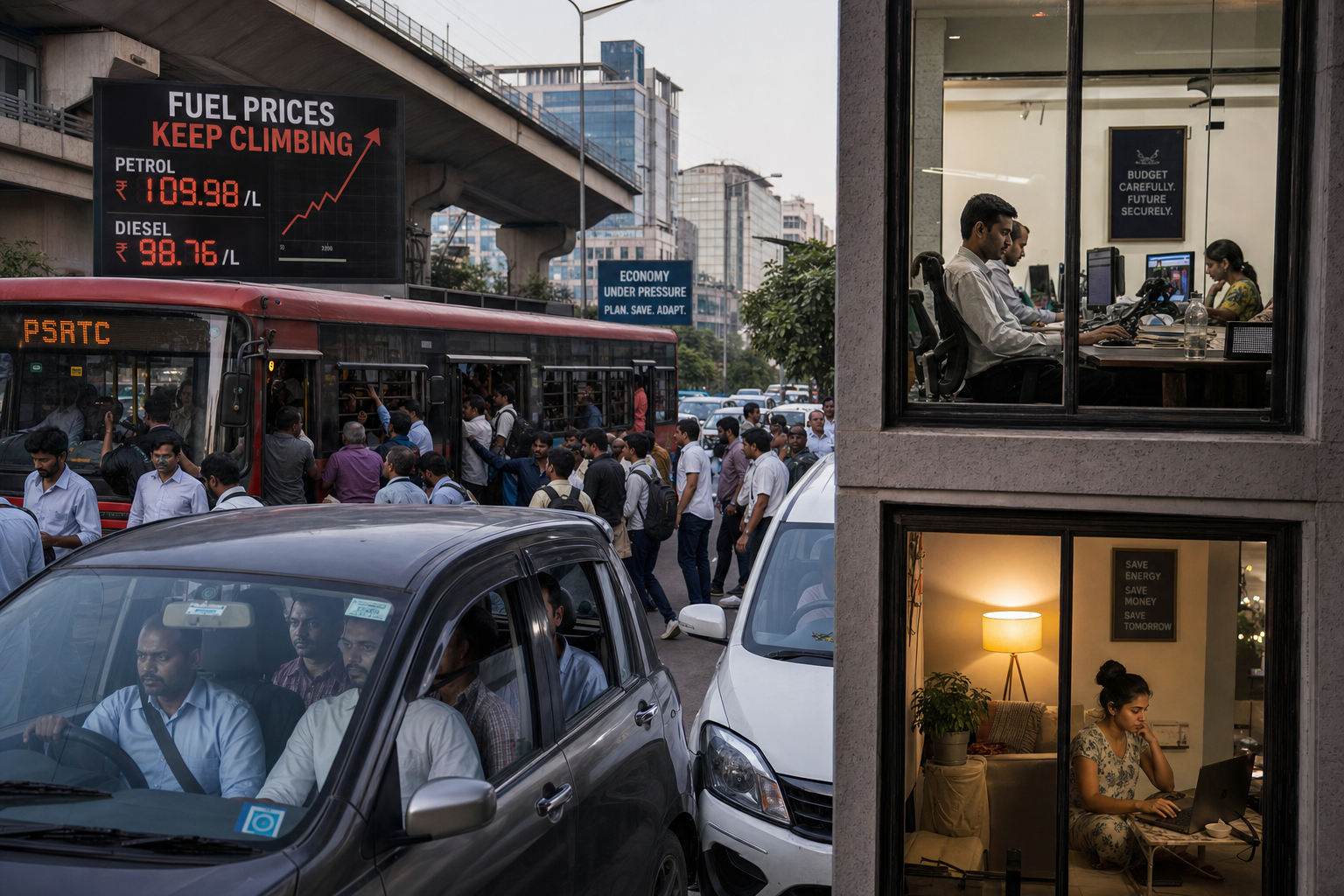
Prime Minister Narendra Modi has urged Indians to adopt austerity measures such as working from home, using public transport, carpooling, buying less gold, limiting foreign travel, and reducing fertilizer use in response to a surge in global energy prices caused by the continuing Middle East crisis. Speaking at a public event in Hyderabad, Modi framed these steps as a matter of national responsibility and foreign exchange conservation, saying patriotism now means living responsibly in everyday life. The appeal comes as India faces pressure from its heavy dependence on imported oil, with crude costs rising sharply after the US and Israel’s war on Iran and the prolonged closure of the Strait of Hormuz, a key shipping chokepoint. The economic impact is already visible: the rupee has fallen to record lows, inflationary pressure is rising, industries linked to glass, plastic, and tiles are under strain, and farmers face concerns over fertiliser shortages and food prices. Modi’s remarks also unsettled markets, contributing to a sharp early drop in the Sensex. Opposition leaders criticized the prime minister, arguing that he was shifting responsibility onto citizens rather than acknowledging policy failures.
Entities: Narendra Modi, Rahul Gandhi, India, Iran, Middle East • Tone: analytical • Sentiment: negative • Intent: inform
11-05-2026
China’s inflation data for April showed both producer and consumer prices rising faster than expected, highlighting how global energy market disruptions are feeding into the domestic economy. According to the National Bureau of Statistics, the producer price index (PPI) rose 2.8% year on year in April, extending its return to growth after more than three years of contraction and beating economists’ forecasts. The consumer price index (CPI), a key measure of inflation, increased 1.2% year on year, also above market expectations and up from March’s 1.0% reading.
The article links the stronger inflation figures to higher energy costs driven by the US-Israel war on Iran, which has pushed up global crude prices and created new inflationary pressure for Chinese producers and consumers. Energy-intensive sectors such as chemicals and fuels were already seeing imported inflationary effects in March, and April’s figures suggest those pressures continued to pass through into domestic prices. A senior statistician at the NBS said domestic energy prices rose 5.7% because of volatility in global crude, contributing 0.39 percentage points to the month-on-month rise in CPI.
Overall, the piece emphasizes that external geopolitical shocks are increasingly shaping China’s inflation outlook, with elevated energy prices posing risks to Beijing’s energy security and complicating price stability for the broader economy.
Entities: China, April inflation, producer price index (PPI), consumer price index (CPI), National Bureau of Statistics (NBS) • Tone: analytical • Sentiment: neutral • Intent: inform
11-05-2026
Indian Prime Minister Narendra Modi warned that the war in Iran and broader Middle East tensions pose serious economic risks for India, and he urged citizens to reduce fuel use, cut back on foreign travel, and pause gold purchases to help conserve foreign currency and ease pressure on the economy. Speaking in Hyderabad, Modi emphasized practical steps such as using public transport, working from home, and carpooling as global fuel prices rise. The article explains that India is especially vulnerable because it imports nearly 85% of its fuel needs and depends heavily on the Strait of Hormuz for crude oil, LNG, and LPG supplies. Rising energy costs are expected to widen India’s trade deficit and current account deficit and put additional strain on the rupee, which is already near an all-time low against the dollar. The piece also notes market reactions, including declines in shares of jewelry companies and IndiGo, and places the issue in a broader macroeconomic context by citing India’s large crude import bill, its status as the world’s second-largest gold buyer, and warnings from economists and officials that the conflict could significantly damage growth and trade balances. Despite the pressure, the government has so far kept retail fuel prices stable through tax cuts rather than passing higher costs directly to consumers.
Entities: Narendra Modi, India, Iran war, Middle East, Strait of Hormuz • Tone: analytical • Sentiment: negative • Intent: inform