10-07-2026
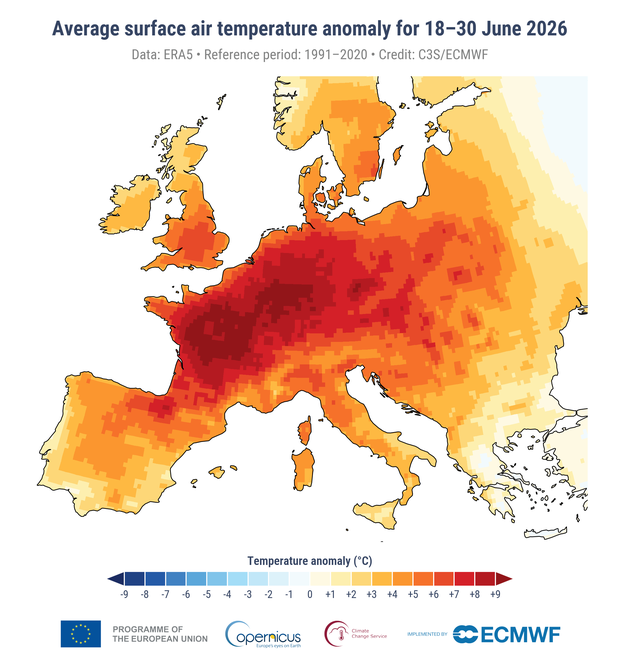
Western Europe experienced its hottest June on record in 2026, while the planet as a whole recorded its second-hottest June ever, according to the European Union’s Copernicus Climate Change Service. The report says a severe heat wave struck Western Europe in the latter half of the month, following an earlier warm spell in May and preceding another developing heat event in July. The heat was not only record-breaking but also deadly and destructive: drought conditions helped fuel major wildfires in southern France, prompting thousands of evacuations, and heat exposure contributed to more than 1,300 reported heat-related deaths across Europe since June 21, with roughly 1,000 excess deaths recorded in France alone, mostly among older adults. The article notes that France and the United Kingdom both set June temperature records, and that continental Europe overall saw its second-highest June on record, around 3.2 degrees Fahrenheit above the 1991–2020 average, while Western Europe was nearly 5.5 degrees above average. Experts cited by the report say these extremes reflect a climate system accumulating heat and increasing the frequency, duration, and intensity of heatwaves. The piece also connects the broader warming trend to exceptionally high sea surface temperatures in the tropical Pacific, where El Niño conditions develop, warning that El Niño could worsen global temperatures and extreme weather in the months ahead. Overall, the article frames the record heat as part of a larger pattern of human-caused climate change with growing risks for public health, ecosystems, and infrastructure.
Entities: Western Europe, Europe, France, United Kingdom, Copernicus Climate Change Service (C3S) • Tone: analytical • Sentiment: negative • Intent: inform
10-07-2026
The article reports on devastating wildfires in southern Spain, where at least 11 people have died as flames spread through Andalusia’s Costa de Almería. The fires have triggered evacuations and prompted a major emergency response involving hundreds of workers battling to contain the blazes. The piece emphasizes the scale and danger of the disaster, framing it as an urgent crisis with significant human cost. Although the page includes several other CNN video teasers, the central news item is the deadly wildfire emergency in Spain and the ongoing efforts to respond to it. The story conveys the severity of the situation through the casualty count, the forced evacuations, and the mobilization of emergency crews, underscoring the destructive impact of the fires on the region.
Entities: Spain, Andalusia, Costa de Almería, wildfires, evacuations • Tone: urgent • Sentiment: negative • Intent: inform
10-07-2026
Wildfires on Spain’s southern coast have killed at least 11 people, making the blaze near Los Gallardos in Almería one of the deadliest in the country’s recent history. Local and regional officials said roughly 150 emergency workers were deployed as firefighters battled to contain the fast-moving fire, while residents were evacuated from nearby towns and a campsite was threatened by shifting winds. Authorities warned that strong gusts could worsen the situation and spread the flames further.
The article places the disaster in the broader context of Europe’s intense summer heat, noting that record temperatures have been set across the continent and that hotter, drier conditions fueled by climate change are increasing wildfire risk. Spain, Portugal, and France are all reported to be fighting major fires. Spain’s meteorological agency had issued additional high-temperature warnings, and local officials described the Almería fire as the region’s most devastating to date. The death toll makes it Spain’s deadliest wildfire since 2005, underscoring the scale of the emergency. Prime Minister Pedro Sánchez offered condolences to the victims’ families as firefighting and evacuation efforts continued.
Entities: Spain, Andalusia, Los Gallardos, Costa de Almería, Almocáizar • Tone: urgent • Sentiment: negative • Intent: inform
10-07-2026
A fast-moving wildfire in southern Spain has killed at least 11 people, making it one of the deadliest fires in the country’s recent history. The blaze struck the province of Almeria, near the Sierra de Los Filabres mountains, and at one point authorities had reported 12 deaths before revising the toll to 11. Several victims were found in burnt-out vehicles, and six other people were injured. The fire prompted the evacuation of about 1,000 residents, road closures, and a large emergency response involving 150 firefighters and 220 soldiers from Spain’s military emergency unit. Officials said they had not yet confirmed the cause, though reports from callers suggested a fallen power line may have ignited the fire, which then spread into nearby forestland.
The article places the disaster in the context of Spain’s escalating climate and wildfire risk. The country has recently experienced severe heatwaves, with June bringing record-setting temperatures and more than 1,000 excess deaths attributed to heat. Western Europe is in its third heatwave in six weeks, and Europe is warming faster than any other continent, according to Copernicus. The story also notes that globally 2025 was the third-hottest year on record. Scientists say climate change, driven in part by fossil fuel use, is increasing the frequency and intensity of heat and dryness, conditions that make wildfires more likely and more dangerous.
Entities: Spain, Almeria, Sierra de Los Filabres, Pedro Sánchez, INFOCA • Tone: urgent • Sentiment: negative • Intent: inform
10-07-2026
At least 11 people died and 19 others were missing after a fast-moving wildfire tore through southern Spain near Los Gallardos in Almería, prompting evacuations and a major emergency response. Authorities said the blaze, among the deadliest in Spain on record, may have been sparked by a downed power line and spread quickly into a wooded area. Four victims were found in a right-hand drive vehicle and were believed to be British, while others were thought to have died after abandoning their cars as they tried to flee along a different route from the official evacuation path. Eight people were injured, four seriously, and about 150 firefighters were battling the fire, with Spain’s military emergency unit also mobilized.
The article places the Spanish disaster in a broader European context of intensifying summer heat and wildfire danger. Officials in France said the country was seeing an exceptionally intense start to the wildfire season, with more than 8,000 fires already burning nearly 100 square miles. Other fires in southern France and Málaga also forced large evacuations. The story further notes that scientists are increasingly confident that heat waves are becoming hotter, more frequent, and longer lasting due to climate change, and cites a recent German heat wave that may have caused roughly 5,100 deaths. Overall, the article emphasizes the deadly convergence of extreme heat, dry vegetation, and widespread wildfire risk across Europe.
Entities: Los Gallardos, Almería, Andalusia, Spain, France • Tone: urgent • Sentiment: negative • Intent: inform
10-07-2026
The article profiles Fernando Sedano and a small team at the European Union’s disaster risk management unit in Ispra, Italy, who use satellite data, weather models, and expert analysis to forecast wildfire risk across Europe. Rather than fighting flames directly, the team helps governments and emergency services decide where to position firefighters, aircraft, and helicopters, and how to coordinate cross-border responses. Their work has become increasingly vital as Europe’s fire seasons grow longer, start earlier, and spread beyond the Mediterranean due to global warming.
The piece explains that 2026 is already shaping up to be a dangerous year, with multiple heat waves and above-average fire activity, including destructive blazes in France, Portugal, and Spain. The European Union is mounting its largest-ever firefighting deployment, placing hundreds of firefighters and dozens of aircraft across high-risk countries. At the same time, Sedano’s team is trying to improve its tools, including near-real-time satellite updates, artificial intelligence, and better vegetation mapping, in order to forecast where fires may spread or intensify.
The article also places the EU’s efforts in a broader global context. Experts say that centralized, data-driven fire management is increasingly necessary as climate change overwhelms national resources and makes extreme fire years more common. Still, the story conveys uncertainty: even with advanced planning and technology, it remains unclear whether Europe can fully keep pace with the growing scale and ferocity of wildfires.
Entities: Fernando Sedano, European Union, European Forest Fire Information System, Ispra, Italy, Lake Maggiore • Tone: analytical • Sentiment: neutral • Intent: inform