10-07-2026
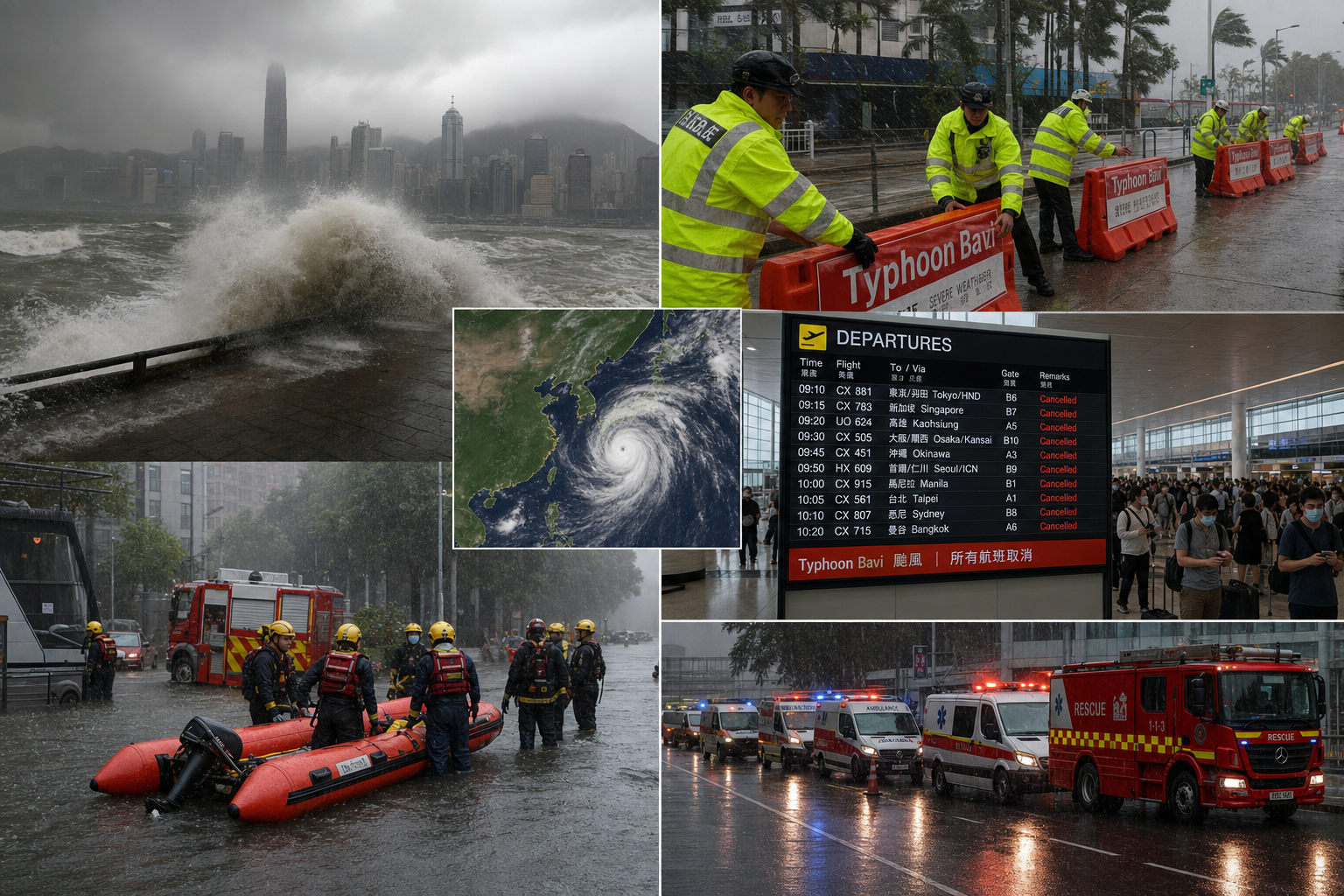
Typhoon Bavi is approaching East Asia, prompting widespread emergency preparations in Taiwan, Japan, and China after severe landslides in the Philippines killed at least 15 people. The storm, described as unusually large and powerful, is moving across the Pacific toward Taiwan and is expected to bring heavy rainfall, strong winds, flight cancellations, school closures, and stockpiling in advance of landfall. Taiwanese authorities have warned of potentially extreme rainfall and placed tens of thousands of soldiers on standby for relief operations. In China, officials have warned of significant impacts, including the possibility that the typhoon’s remnants could travel far inland, while regions less accustomed to typhoons are urged to prepare. Japan’s remote islands are also on alert, with residents securing homes and airlines canceling many flights. The article also places Bavi in the context of another recent destructive storm, Typhoon Maysak, which caused heavy casualties and damage in southern China earlier in the week, underscoring the region’s exposure to back-to-back severe weather events.
Entities: Typhoon Bavi, Taiwan, Japan, China, Philippines • Tone: urgent • Sentiment: negative • Intent: inform
10-07-2026
Authorities in southern China said 39 people were killed after days of heavy rain from Tropical Storm Maysak caused severe flooding in Guangxi region, with the worst damage in Hengzhou, where a partially collapsed reservoir dam sent water into the city and killed 26 people. Nine others remained missing in Guangxi. The storm trapped residents, students, teachers, and animals across the region, prompting a large-scale rescue operation involving drones and thousands of boats. More than 10,000 students and teachers were evacuated from schools in Guigang, while about 130,000 people overall were moved to safety. The flooding also damaged infrastructure, led to road repairs and sanitation work, and restored power to more than 60,000 homes as water levels began to recede. The article also places the disaster in a broader regional weather context, noting that Typhoon Bavi was approaching Taiwan and southeastern China, disrupting transport and prompting warnings, while severe weather elsewhere in China and Bangladesh added to the wider pattern of deadly storms and landslides across Asia.
Entities: Southern China, Guangxi region, Hengzhou, Nanning, Tropical Storm Maysak • Tone: urgent • Sentiment: negative • Intent: inform
10-07-2026
Typhoon Bavi, which had previously reached super typhoon strength, weakened as it approached China’s coast but continued to pose a significant threat because its wind field expanded dramatically. The article reports that the storm had lost its eye, but experts warned that its energy had spread from the compact core into a much larger cloud structure, making it potentially more dangerous in terms of widespread impact. The National Meteorological Centre said Bavi had weakened to severe typhoon status, with maximum winds at the center dropping to 45 meters per second, while still maintaining an orange alert, the second-highest level in China’s four-tier warning system.
The typhoon’s approach disrupted travel across eastern China, with flights cancelled or delayed at multiple airports. Zhoushan airport cancelled 14 flights to and from the island city, and Wenzhou reported 17 inbound cancellations. Airlines including Air China, China Southern Airlines, China Eastern Airlines, and Hainan Airlines activated special customer service channels and offered flexible refund or rebooking options for passengers affected by the storm. Air China specifically allowed travelers booked through cities such as Quanzhou, Hangzhou, and Xiamen to change flights or request refunds without extra fees.
The forecast indicated that Bavi was expected to make landfall between Fuqing in Fujian province and Wenling in Zhejiang province, and to bring heavy rainfall to Taiwan and mainland China over the next 24 hours. The overall tone of the article is factual and weather-disaster oriented, emphasizing both the storm’s weakening intensity and its widening potential impact on transportation and regional safety.
Entities: Typhoon Bavi, super typhoon, severe typhoon, Hong Kong, China’s coast • Tone: urgent • Sentiment: negative • Intent: inform