07-09-2026
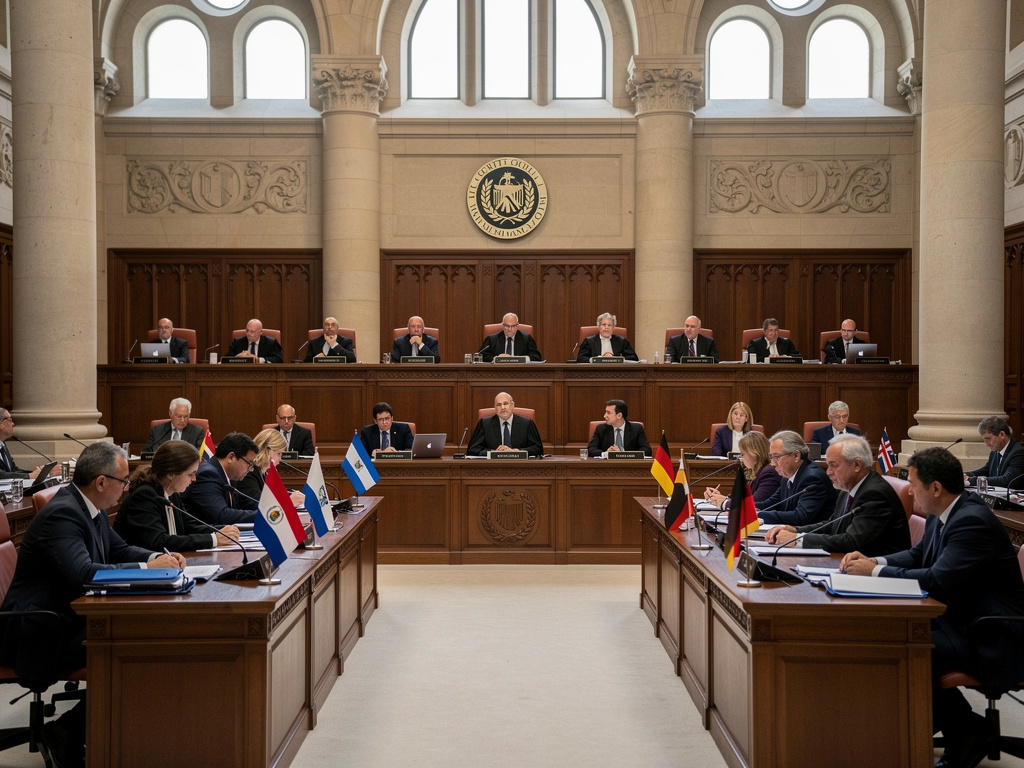
Nicaragua has brought Germany before the International Court of Justice (ICJ), accusing Berlin of violating the 1948 Genocide Convention and international humanitarian law by supplying military equipment to Israel and defunding the UN Relief and Works Agency for Palestine Refugees (UNRWA) during Israel’s war in Gaza. Nicaragua argues that Germany knew there was a risk genocide could be committed and failed to distinguish between Israel’s claimed right of self-defence and actions that could constitute genocide.
Germany rejects the allegations and is asking the court to dismiss the case. It argues that Nicaragua did not complete the required steps before filing its complaint and that some of the claims fall outside the ICJ’s jurisdiction. Germany also says its arms exports to Israel undergo extensive legal scrutiny, noting that most exports since October 7, 2023, consisted of general military equipment such as helmets, body armour and binoculars.
The current hearings concern Germany’s preliminary objections, not whether it ultimately violated international law. The ICJ is expected to decide first whether the case is admissible and within its jurisdiction. Such preliminary rulings generally take about six months. If Nicaragua’s case survives, proceedings on the substance of the allegations could take years.
The case unfolds amid continuing violence in Gaza despite a US-brokered ceasefire. Gaza health authorities report more than 73,000 Palestinian deaths since October 2023, while the UN Satellite Centre says 82 percent of Gaza’s buildings have been damaged or destroyed. The article places Nicaragua’s case alongside South Africa’s separate genocide proceedings against Israel, emphasizing that no final judgment in the Germany case is likely soon.
Entities: Nicaragua, Germany, International Court of Justice (ICJ), The Hague, Netherlands, Israel • Tone: analytical • Sentiment: negative • Intent: inform
07-09-2026
Germany has asked the International Court of Justice (ICJ) to dismiss Nicaragua’s case accusing Berlin of violating the 1948 Genocide Convention by supplying weapons to Israel during its war against Hamas in Gaza. Germany argues that Nicaragua failed to follow required legal procedures before filing the case and that the dispute falls outside the ICJ’s jurisdiction. It also rejects Nicaragua’s allegation that German arms exports amount to aiding and abetting genocide, emphasizing that German weapons exports are subject to strict national review procedures that exceed international standards.
Nicaragua maintains that the case should proceed because both countries are parties to the Genocide Convention. Although neither Nicaragua nor Germany is directly involved in the Israel-Hamas conflict, Nicaragua says Germany could bear responsibility for supplying weapons allegedly used in Gaza. Its earlier request for an emergency order halting German arms exports was rejected in 2024, though Germany’s attempt to have the case dismissed immediately also failed.
Germany suspended weapons exports to Israel for roughly three months in 2025 as casualties increased, but later resumed them after a truce largely reduced the fighting. German authorities approved approximately €167 million in exports between November 2025 and March of the following year, according to information published by the Bundestag.
The case is linked to South Africa’s separate genocide lawsuit against Israel. The ICJ has found it plausible that genocidal acts may have occurred in Gaza and ordered provisional measures, while Israel has rejected those findings. A full hearing in that case is not expected until 2029, meaning Nicaragua’s case could also take years and may depend on the outcome of the broader proceedings. Nicaragua is scheduled to present its arguments next, while a decision on Germany’s request to dismiss the case is tentatively expected later this year.
Entities: Nicaragua, Germany, International Court of Justice (ICJ), The Hague, Israel • Tone: analytical • Sentiment: neutral • Intent: inform
07-09-2026
Germany has urged the International Court of Justice (ICJ) to dismiss Nicaragua’s case accusing Berlin of facilitating genocide in Gaza through its support for Israel. The case focuses particularly on German arms exports and other forms of backing for Israel, which Nicaragua argues violate obligations under the 1948 UN Genocide Convention. The proceedings are taking place at the ICJ in The Hague, where Nicaragua has brought Germany before the court over its alleged role in the Israeli-Palestinian conflict.
During the opening day of four days of hearings, Julia Monar, representing Germany, argued that the court lacks jurisdiction to rule on Nicaragua’s claims. She said the legal conditions required for the ICJ to hear the case had not been met and rejected Nicaragua’s accusations as “inaccurate and distorted.” Germany’s central argument is that the dispute does not constitute a conventional bilateral disagreement between Nicaragua and Germany.
Monar emphasized that neither country is directly involved in the underlying Israeli-Palestinian conflict, which she described as the real subject of the case. Germany therefore maintains that the case is too indirect for the ICJ to adjudicate. The article reports Germany’s preliminary legal objections but does not indicate how the court will rule or address the substance of Nicaragua’s genocide allegations. The hearings represent an effort by Nicaragua to challenge Germany’s relationship with Israel through international legal proceedings, while Germany is seeking dismissal on jurisdictional grounds rather than engaging primarily with the factual allegations.
Entities: Germany, Nicaragua, International Court of Justice (ICJ), United Nations, Julia Monar • Tone: analytical • Sentiment: neutral • Intent: inform