06-09-2026
Germany’s Saxony-Anhalt state election could mark a historic breakthrough for the Alternative for Germany (AfD), which could become the first far-right party to lead a German state since World War II. Polls placed the AfD at 41%, well ahead of Chancellor Friedrich Merz’s Christian Democratic Union at 23%. However, winning the most votes would not necessarily give the party governing power: it would need an absolute majority or a coalition partner, and Germany’s major parties have ruled out cooperation with the AfD. The party’s lead candidate, Ulrich Siegmund, has said he would govern only with a full AfD administration.
The article examines the AfD’s ideological shift from its 2013 origins as a protest movement against the European Union toward far-right nationalism. Saxony-Anhalt’s domestic intelligence agency has classified the state organization as a confirmed far-right extremist group, citing ethnopluralist, anti-Muslim, racist and antisemitic positions. Siegmund rejects the designation and says the agency is being used politically against the party.
The AfD state chapter supports a “deportation and remigration offensive,” including expanded detention facilities and tighter migration limits. The term “remigration” has been associated with proposals to expel not only asylum seekers but also legal residents and German citizens with immigrant backgrounds. Party figures have also criticized Germany’s established approach to remembering Nazi crimes and the Holocaust.
Migration has dominated local debate, particularly after the 2024 Magdeburg Christmas market attack, despite the perpetrator’s legal residency, opposition to Islam and expressed sympathy for the far right. Some residents say the attack strengthened the AfD, while one supporter voiced strongly anti-Syrian and anti-immigration views. The supplied article ends mid-sentence while beginning to discuss Syrians who have successfully adapted to life in Germany.
Entities: Alternative for Germany (AfD), Saxony-Anhalt, Magdeburg, Ulrich Siegmund, Friedrich Merz • Tone: analytical • Sentiment: neutral • Intent: analyze
06-09-2026
Saxony-Anhalt’s state election is attracting national attention because the far-right Alternative for Germany (AfD) leads the polls and could potentially win an absolute majority. Although only about 1.6 million people are eligible to vote, the result could create serious political problems for Chancellor Friedrich Merz and Germany’s federal coalition of the conservative CDU/CSU and the center-left SPD.
Merz has sought to curb the AfD’s popularity through a tougher migration policy, but the strategy has not succeeded. The CDU has instead lost support, prompting criticism within the party. Political scientist Carsten Koschmieder believes Merz is unlikely to resign because he has worked for years to become chancellor and has no obvious successor. However, a strong AfD result could intensify internal disputes over how the CDU should respond to the far right.
A CDU-led government in Saxony-Anhalt might need support from the Left Party if a coalition with the SPD and Greens lacks a parliamentary majority. Merz has ruled out cooperation with both the AfD and the Left Party, creating a difficult situation for regional CDU politicians. Some eastern German conservatives favor working with the AfD, while others warn that doing so would damage the CDU’s democratic identity and its commitment to European and Western institutions.
The election also raises security concerns. Officials warn that an AfD-led state government could gain access to sensitive information, including counterintelligence data. The result may also affect debates over Merz’s proposed pension reforms, which face opposition within his own party.
The article notes that the SPD could gain some relief from a possible strong performance by Manuela Schwesig in Mecklenburg-Western Pomerania, although the AfD also leads there. Overall, the Saxony-Anhalt vote is presented as a test of the CDU’s strategy, the stability of Merz’s coalition and Germany’s broader response to the far right.
Entities: Saxony-Anhalt, Germany, Friedrich Merz, Sven Schulze, Christian Democratic Union (CDU) • Tone: analytical • Sentiment: neutral • Intent: analyze
06-09-2026
Polling stations opened on Sunday in Saxony-Anhalt, Germany, for a state election viewed as an important test of Chancellor Friedrich Merz’s federal coalition. More than 1.7 million eligible voters can cast ballots until 6 p.m. local time. Opinion polls indicate that the far-right, anti-immigration Alternative for Germany (AfD), led by top candidate Ulrich Siegmund, is polling above 40% and has a substantial lead over the Christian Democratic Union (CDU).
A decisive AfD victory could increase pressure on Merz and his coalition, which the article describes as increasingly unpopular. However, the result remains uncertain because a significant share of voters had not yet made up their minds. The ZDF Politbarometer reported that 26% of eligible voters surveyed shortly before the election were undecided.
Siegmund has said he would govern only if the AfD won an absolute majority. Whether the party can achieve that depends partly on how many smaller parties cross the 5% threshold required to enter the state parliament in Magdeburg. The more parties that gain seats, the less likely the AfD is to secure an outright majority of lawmakers. This has prompted calls for tactical voting.
The AfD, CDU, Left, SPD, FDP and BSW have all criticized the tactical voting campaign, while the Greens are the only party identified as supporting it. The CDU has ruled out forming a coalition with the AfD and has also rejected cooperation with the Left through an incompatibility clause adopted at a party conference. Nevertheless, the CDU could potentially work with other parties. Polling stations are open from 8 a.m. to 6 p.m.
Entities: Saxony-Anhalt, Germany, Alternative for Germany (AfD), Ulrich Siegmund, Friedrich Merz • Tone: analytical • Sentiment: neutral • Intent: inform
06-09-2026
The article reports that Ulrich Siegmund, the Alternative for Germany (AfD) candidate in Saxony-Anhalt’s state election, cast his ballot on Sunday, September 6, 2026. Siegmund arrived at a polling station in his hometown of Tangermünde accompanied by his wife, Julia. Supporters gathered outside to welcome him, cheering as he arrived on a motorcycle and later taking selfies with him.
The election has attracted national attention because the AfD is seeking what could be its strongest result yet in a German state election and a possible route to leading a state government. Siegmund has said he would pursue the governor’s post only if the party wins an absolute majority. The report does not provide election results, focusing instead on the candidate’s voting-day appearance and the atmosphere surrounding the vote.
After casting his ballot, Siegmund told supporters that he sensed a “spirit of optimism” around the election. He also called for Germany to overcome its political divisions. His remarks present the election as an opportunity for political change while emphasizing unity, despite the AfD’s status as a far-right party and the controversy surrounding its electoral ambitions.
The video is presented as part of Euronews’ “No Comment” format, with brief factual narration and footage of Siegmund at the polling station. Overall, the report highlights the AfD’s bid for a historic breakthrough, the strong public interest in the Saxony-Anhalt vote, and Siegmund’s stated conditions for seeking leadership of the state.
Entities: Ulrich Siegmund, Julia Siegmund, Alternative for Germany (AfD), Saxony-Anhalt, Tangermünde • Tone: neutral • Sentiment: neutral • Intent: inform
06-09-2026
The article reports that Germany’s far-right Alternative for Germany (AfD) is polling strongly ahead of state elections in Saxony-Anhalt scheduled for September 6, 2026. With support reaching 43% in some state polls, the party could win an outright majority and form a government on its own. Such a result would be unprecedented in postwar Germany: since the Federal Republic was re-established in 1949, no party outside the Social Democratic Party (SPD) or the Christian Democratic Union and its Bavarian sister party, the Christian Social Union (CDU/CSU), has won a single-party governing majority in a German state.
The AfD’s lead candidate, Ulrich Siegmund, is credited with helping the party attract working-class and younger voters. Political experts Daniel Schatz and Janek Treiber argue that an outright victory would have greater symbolic than immediate policy significance. Germany’s federal structure would limit the party’s ability to change national policy, but control of a state would demonstrate that the political establishment’s long-standing “Brandmauer,” or firewall against cooperation with the AfD, had been breached.
The article characterizes the AfD as nationalist, anti-immigration, opposed to much of Germany’s green agenda, and more accommodating toward Russia. It notes that the party won 20.8% in the February 2025 federal election and is now the second-largest party in the Bundestag. AfD co-chair Alice Weidel calls for tighter borders, withdrawal from the Schengen treaty, the deportation of Syrians whose protected status is revoked, and an end to what she describes as the “Islamization” of Germany.
The report also highlights upcoming elections in Mecklenburg-Western Pomerania and Berlin, which are scheduled for September 20, 2026, suggesting that the Saxony-Anhalt contest could have broader national consequences.
Entities: Alternative for Germany (AfD), Saxony-Anhalt, Ulrich Siegmund, Daniel Schatz, Janek Treiber • Tone: urgent • Sentiment: negative • Intent: inform
06-09-2026
France 24 reports on the AfD’s electoral prospects under its 35-year-old lead candidate, Ulrich Siegmund. According to the report, the party has polled above 40% for several months, putting it in a strong position ahead of the relevant German vote. The AfD is described as having a realistic chance of winning an outright—or absolute—majority in parliament, but that outcome depends on the performance of smaller parties.
Germany’s 5% electoral threshold is central to the report’s analysis. Parties that fail to reach this threshold generally do not enter parliament, meaning that votes cast for them would not translate into parliamentary seats. If several smaller parties fall short, the AfD could potentially convert its polling lead into a disproportionately large share of seats, increasing its chances of securing an outright majority.
The report identifies Siegmund as the AfD’s lead candidate but does not provide additional details about his platform, the identity of the smaller parties, or the polling organizations behind the figures. It also does not give a detailed breakdown of regional support or explain the precise seat projections associated with the AfD’s polling position. The concise video report therefore focuses primarily on the relationship between the AfD’s sustained support, the electoral threshold, and the possibility of a parliamentary majority. Its wording presents the majority as a realistic possibility rather than a guaranteed result.
Entities: Germany, Alternative for Germany (AfD), Ulrich Siegmund, German parliament, 5% electoral threshold • Tone: analytical • Sentiment: neutral • Intent: inform
06-09-2026
France 24 reports on voting in Saxony-Anhalt, an eastern German state, in a closely watched election held on September 6, 2026. According to recent surveys cited by the report, the far-right Alternative for Germany (AfD) was leading with just over 40% support, while the Christian Democratic Union (CDU), associated with Friedrich Merz, was polling at 23%. The figures suggest that the AfD could achieve a significant electoral breakthrough in the state.
The video focuses on what might change if the AfD wins. France 24 journalist Shirli Sitbon identifies education as one of the party’s main priorities. The AfD is described as wanting to “reset” the education system, although the short report does not provide detailed proposals or explain how such a reform would be implemented. The article therefore presents education policy as an area likely to be affected by an AfD victory, rather than outlining a complete governing program.
The report places the election within the broader context of the AfD’s popularity in eastern Germany and the national attention directed toward the party’s performance. It does not state the final result, describe coalition negotiations, or assess the likely consequences for other policy areas. Instead, it offers a concise preview of possible changes based on polling and the party’s stated education agenda. The video was produced and presented by Shirli Sitbon and issued by France 24 on September 6, 2026.
Entities: Germany, Saxony-Anhalt, Alternative for Germany (AfD), Christian Democratic Union (CDU), Friedrich Merz • Tone: analytical • Sentiment: neutral • Intent: inform
06-09-2026
The France 24 video examines why the Alternative for Germany (AfD) has become so popular in Saxony-Anhalt, an eastern German state. The report was published on September 6, 2026, as voting began in a closely watched state election. According to the accompanying text, the AfD could become the first far-right party to lead a German state government since World War II, giving the election national significance beyond Saxony-Anhalt itself.
The segment discusses the political situation with Hans Stark, a professor of German studies at Sorbonne University. Although the supplied article text does not provide polling figures, detailed voter demographics, or a definitive explanation for the AfD’s support, its framing indicates that the party’s popularity in eastern Germany is the central issue under examination. The election is presented as a potential turning point in the country’s postwar political history and as an important test of the AfD’s ability to convert electoral strength into governing power.
The report’s wording is factual and focused on the implications of the vote. It highlights both the regional setting and the historical possibility associated with an AfD-led state government. The item therefore functions as a short political analysis rather than a detailed written investigation: it introduces the election, identifies the AfD’s potential breakthrough, and brings in an academic expert to discuss the reasons behind the party’s appeal. The available content does not state the election result or explain whether the AfD ultimately formed a government. It also does not include direct quotations from Stark or additional perspectives from voters, rival parties, or civil society groups.
Entities: Germany, Saxony-Anhalt, Alternative for Germany (AfD), Hans Stark, Sorbonne University • Tone: analytical • Sentiment: neutral • Intent: analyze
06-09-2026
France 24 reports on a closely watched regional election in Saxony-Anhalt, an eastern German state that was part of communist East Germany before reunification. German voters went to the polls on Sunday, September 6, 2026, with the far-right Alternative für Deutschland (AfD) described as the clear frontrunner. The report says the party was expected to secure an easy majority, making the vote an important test of the AfD’s support in eastern Germany.
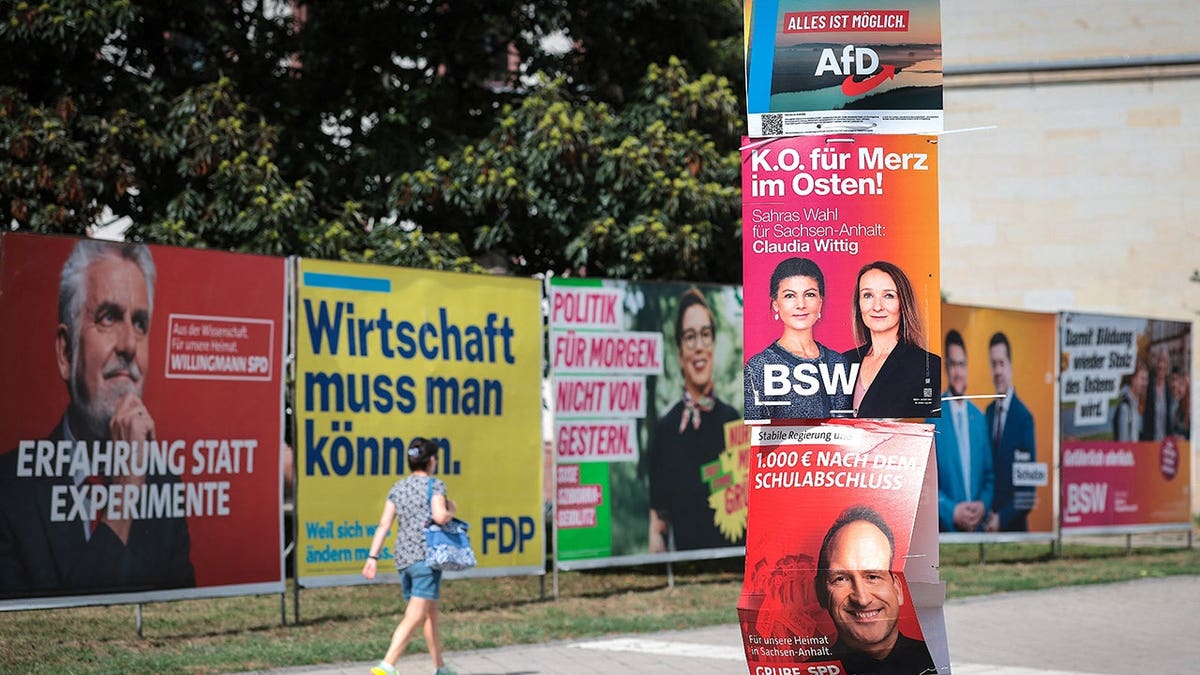
The article characterizes the AfD as far-right and anti-immigrant, while also describing it as friendly toward Moscow and US President Donald Trump. These descriptions frame the election as significant not only for German domestic politics but also for wider debates over immigration and the country’s international orientation. The accompanying image shows pedestrians walking past campaign posters in Magdeburg, the state capital, on the eve of the election.
France 24 correspondent Nick Holdsworth provides further reporting in a short, two-minute video segment. However, the supplied article text contains only a brief introduction to the election and does not include polling figures, statements from party leaders, details about rival parties, voter turnout, or the final result. Its central message is that the AfD entered the regional contest in a strong position and was expected to achieve a decisive victory in a former communist region. The report therefore presents the election as an important indicator of the AfD’s political strength, while leaving the actual outcome and its consequences unresolved.
Entities: Alternative für Deutschland (AfD), Germany, Saxony-Anhalt, Magdeburg, Eastern Germany • Tone: neutral • Sentiment: neutral • Intent: inform
06-09-2026
Voting began on Sept. 6 in Saxony-Anhalt, an eastern German state where the far-right Alternative for Germany (AfD) is seeking a historic breakthrough. If it wins an absolute majority, the AfD would become the first far-right party to lead a German state government since World War Two and could bypass the country’s political “firewall,” under which mainstream parties refuse to govern with it.
The AfD, led by 35-year-old candidate Ulrich Siegmund, has polled above 40% for months and is aiming for at least 45%. Its ability to secure an outright majority will depend partly on how many smaller parties clear Germany’s 5% electoral threshold. Recent surveys put the AfD at just over 40%, ahead of Chancellor Friedrich Merz’s Christian Democrats (CDU) at 23%.
The election is also viewed as a test of Merz’s strategy of countering the AfD by adopting tougher positions on migration and security. Turnout was significantly higher than in the 2021 election, with 34.72% of eligible voters casting ballots by noon, compared with 22.4% previously.
If the AfD falls short of a majority, a CDU-led government under incumbent premier Sven Schulze is considered the most likely outcome. However, coalition negotiations could be complicated because the Free Democratic Party is expected to miss the threshold, the Social Democratic Party is polling below 10%, and the Sahra Wagenknecht Alliance is also at risk of failing to enter parliament. A minority CDU government tolerated by the Left Party is one possible alternative.
For the AfD, the election serves as a trial run for its national ambitions ahead of the 2029 federal election. The party wants to restrict immigration, promote more traditional values in schools and cultural institutions, and overhaul public broadcasting. It has been classified as “far-right extremist” by the state security service, and Siegmund has ruled out coalition talks with other parties.
Entities: Alternative for Germany (AfD), Saxony-Anhalt, Ulrich Siegmund, Friedrich Merz, Christian Democratic Union (CDU) • Tone: analytical • Sentiment: neutral • Intent: inform
06-09-2026
Voters in Germany’s eastern state of Saxony-Anhalt are casting ballots in an election that could mark a major breakthrough for the far-right Alternative for Germany (AfD). If the party wins an absolute majority, it would become the first far-right party to take power at the German state level since World War Two. The AfD, led in the state by 35-year-old Ulrich Siegmund, has polled at just over 40%, well ahead of Chancellor Friedrich Merz’s Christian Democrats (CDU), which stand at about 23%.
The election is also being watched as a test of Merz’s unpopular federal government. His efforts to weaken the AfD’s appeal have included adopting tougher positions on migration and security. An AfD majority would allow the party to bypass the “firewall” maintained by mainstream parties, which have generally refused to cooperate with it. However, Germany’s proportional electoral system makes an outright majority difficult, particularly because parties must win at least 5% of the vote to enter parliament.
If the AfD falls short, a CDU-led administration under incumbent premier Sven Schulze is considered the most likely result. The composition of such a government would depend on which smaller parties clear the electoral threshold. Polls suggest the FDP may fail to enter parliament, while the SPD is polling below 10% and the far-left BSW is also at risk. The CDU has ruled out cooperation with both the AfD and the Left Party, potentially leaving Schulze dependent on a minority government tolerated by the Left.
For the AfD, the election is a step toward its broader goal of gaining national power in the 2029 federal election. Siegmund declared that the party’s rise could no longer be stopped, while acknowledging the significance of the vote regardless of the final result. Initial results were expected shortly after polls closed on Sunday.
Entities: Saxony-Anhalt, Germany, Alternative for Germany (AfD), Ulrich Siegmund, Friedrich Merz • Tone: analytical • Sentiment: neutral • Intent: inform
06-09-2026
The article reports that Germany’s nationalist Alternative for Germany (AfD) party is seeking a major breakthrough in regional elections in the eastern state of Saxony-Anhalt. The party hopes to take control of a regional government for the first time, making the vote an important test of its growing political influence and its prospects for expanding beyond opposition politics.
The report places the AfD’s electoral ambitions alongside the intense controversy surrounding the party. Germany’s domestic intelligence agency has labeled it “right-wing extremist,” while critics have accused it of xenophobia, antisemitism and Islamophobia. These characterizations underscore the political and social tensions surrounding the party as voters prepare to cast ballots.
The election is scheduled for Sunday, and the article frames the contest as a potentially significant moment for both the AfD and German politics more broadly. A victory in Saxony-Anhalt would represent a historic first for the party at the regional-government level and could strengthen its position within Germany’s political system. It could also intensify debates over how established parties and state institutions should respond to the AfD.
The supplied material is only a brief excerpt rather than the complete Washington Post article. It does not provide polling figures, competing parties’ positions, projected results, voter demographics, or reactions from AfD officials. Therefore, the analysis is limited to the article’s headline, byline and opening paragraph, which establish the election’s significance and the controversy surrounding the party without describing the final outcome.
Entities: Alternative for Germany (AfD), Mary Ilyushina, Maegan Vazquez, Berlin, Saxony-Anhalt • Tone: analytical • Sentiment: negative • Intent: inform