06-09-2026
Germany’s far-right Alternative for Germany (AfD) is projected to achieve a major breakthrough in the Saxony-Anhalt regional election, receiving approximately 44 percent of the vote. That result would represent more than double the party’s performance five years earlier and underscore its growing support in the eastern German state. The projected victory raises the possibility that the AfD could lead Germany’s first far-right state government since World War II.
However, winning the largest share of votes does not automatically allow the AfD to govern. Other major political parties have ruled out forming a coalition or otherwise cooperating with the far-right party. As a result, the AfD faces significant political barriers to translating its electoral success into control of the state administration.
The election therefore presents a tension between the AfD’s strong popular support and its isolation from Germany’s established parties. While the projected result signals a substantial shift in the state’s political balance, the party may struggle to secure the parliamentary alliances needed to form a government. The outcome could prompt negotiations among other parties, potentially producing a coalition designed to exclude the AfD despite its leading vote share.
The development is significant nationally because it tests whether the AfD can move from being a powerful opposition force to governing at the state level. It also highlights the broader challenge facing Germany’s political system as the far right gains electoral ground while mainstream parties continue to reject formal cooperation with it.
Entities: Alternative for Germany (AfD), Germany, Saxony-Anhalt, regional election, far-right politics • Tone: analytical • Sentiment: negative • Intent: inform
06-09-2026
The far-right Alternative for Germany (AfD) won a decisive victory in the Saxony-Anhalt state election, but it fell short of securing a majority and therefore cannot govern alone. The result is nevertheless a historic breakthrough: no far-right party has controlled a German state government since the Second World War. The AfD’s victory was accompanied by a poor performance from Chancellor Friedrich Merz’s centre-right Christian Democratic Union (CDU), reflecting widespread dissatisfaction with the federal government. An ARD poll found that 87 per cent of voters in the state were unhappy with the national government, while Merz’s personal approval ratings have declined to historic lows. The AfD’s candidate, Siegmund, claimed the party had received a clear mandate to govern and said the election marked the writing of history. However, Germany’s mainstream parties have maintained a refusal to cooperate with the AfD, which has been classified as right-wing extremist by the local domestic intelligence service. The small Sahra Wagenknecht Alliance (BSW) could enter the state parliament and has suggested a non-partisan premier supported by shifting majorities, potentially including AfD votes. The AfD rejected that approach and said new elections could follow if it cannot implement its agenda. The party’s national platform includes sharply restricting immigration, restoring ties with Russia, ending support for Ukraine, leaving the euro, promoting traditional cultural values, reducing public broadcasting, and stopping new wind-farm construction. The result highlights the AfD’s rapid rise, both in eastern Germany and nationally, where it is polling ahead of the conservatives. It also raises questions about whether Germany’s longstanding political “firewall” against the far right is weakening.
Entities: Alternative for Germany (AfD), Saxony-Anhalt, Friedrich Merz, Christian Democratic Union (CDU), Magdeburg • Tone: analytical • Sentiment: negative • Intent: inform
06-09-2026
Germany’s Saxony-Anhalt state election could mark a historic breakthrough for the Alternative for Germany (AfD), which could become the first far-right party to lead a German state since World War II. Polls placed the AfD at 41%, well ahead of Chancellor Friedrich Merz’s Christian Democratic Union at 23%. However, winning the most votes would not necessarily give the party governing power: it would need an absolute majority or a coalition partner, and Germany’s major parties have ruled out cooperation with the AfD. The party’s lead candidate, Ulrich Siegmund, has said he would govern only with a full AfD administration.
The article examines the AfD’s ideological shift from its 2013 origins as a protest movement against the European Union toward far-right nationalism. Saxony-Anhalt’s domestic intelligence agency has classified the state organization as a confirmed far-right extremist group, citing ethnopluralist, anti-Muslim, racist and antisemitic positions. Siegmund rejects the designation and says the agency is being used politically against the party.
The AfD state chapter supports a “deportation and remigration offensive,” including expanded detention facilities and tighter migration limits. The term “remigration” has been associated with proposals to expel not only asylum seekers but also legal residents and German citizens with immigrant backgrounds. Party figures have also criticized Germany’s established approach to remembering Nazi crimes and the Holocaust.
Migration has dominated local debate, particularly after the 2024 Magdeburg Christmas market attack, despite the perpetrator’s legal residency, opposition to Islam and expressed sympathy for the far right. Some residents say the attack strengthened the AfD, while one supporter voiced strongly anti-Syrian and anti-immigration views. The supplied article ends mid-sentence while beginning to discuss Syrians who have successfully adapted to life in Germany.
Entities: Alternative for Germany (AfD), Saxony-Anhalt, Magdeburg, Ulrich Siegmund, Friedrich Merz • Tone: analytical • Sentiment: neutral • Intent: analyze
06-09-2026
The Alternative for Germany (AfD) won more than 40% of the vote in Saxony-Anhalt, achieving its strongest-ever result in a German state election and emerging as the state’s dominant political force. However, the party did not win enough seats to form a government alone. Its prospects are further complicated by the classification of the state AfD as “confirmed far-right extremist” by Germany’s domestic intelligence agency. The CDU and other parties have ruled out cooperation with the AfD, making a conventional coalition highly unlikely.
AfD lead candidate Ulrich Siegmund said he would reach out to parties willing to support a “fundamental political turnaround,” but also said that implementing the party’s platform was more important than gaining power and that he would not compromise. The AfD’s program calls for a major tightening of asylum and immigration policy, faster deportations, mandatory work requirements for some asylum seekers, and a general “180-degree turnaround” in migration policy. It also proposes cutting support for public broadcasting and democracy projects, creating a vigilante-style organization targeting migrants, and opposing social diversity.
One possible route to power would be an AfD-led minority government that relies on support from other parties on individual votes or through a tolerance agreement. AfD co-leader Alice Weidel said that a coalition or such an agreement remained possible, while the CDU categorically rejected cooperation with both the far left and far right.
The Sahra Wagenknecht Alliance (BSW) could become important if it enters the state parliament. Although it shares some positions with the AfD, particularly a Russia-friendly foreign policy, ideological differences make cooperation uncertain. AfD politicians have also suggested that remaining in opposition could be a deliberate strategy, allowing them to pressure other parties until they secure an outright majority in a future election.
Entities: Alternative for Germany (AfD), Saxony-Anhalt, Ulrich Siegmund, Alice Weidel, Christian Democratic Union (CDU) • Tone: analytical • Sentiment: neutral • Intent: analyze
06-09-2026
The article examines false and misleading allegations of election fraud that circulated online before a consequential state election in Saxony-Anhalt. The far-right Alternative for Germany (AfD) won a decisive lead, raising the possibility that it could help form Germany’s first far-right state government since World War II. Against this backdrop, social media users spread claims alleging that ballots were destroyed, that the Christian Democratic Union (CDU) planned to rig the election, and that officials in Halle began counting postal ballots illegally before polls closed.
DW Fact Check found the video allegedly showing election workers destroying AfD ballots to be staged. The ballots shown had identical names, lacked the required hole punch used for accessible voting templates, and appeared in already-opened envelopes. The Russian disinformation watchdog Gnida Project linked the video to Storm-1516, a campaign controlled by Russia’s military intelligence agency, the GRU.
A second group of videos falsely accused the CDU of using deceased residents’ identities, Nazi soldier databases, or fake postal ballots to manipulate the election. The videos imitated established news outlets, including DW, ARD, WIRED, and the BBC. T-Online journalist Lars Wienand denied being the source of one alleged report, while expert Julia Smirnova identified the material as part of the Russian-linked Matryoshka, or Operation Overload, influence campaign. DW had previously identified more than 180 similar fake posts.
Finally, a widely viewed post misleadingly claimed that Halle had begun counting absentee ballots before the legal deadline. The referenced ZEIT report had described preparatory work, not the official count. Although ZEIT initially worded the entry incorrectly, it corrected the mistake. German regulations prohibit official counting before 6 p.m., but allow ballots to be opened beforehand to prepare for counting.
Entities: Saxony-Anhalt, Alternative for Germany (AfD), Christian Democratic Union (CDU), DW Fact Check, Matryoshka / Operation Overload • Tone: analytical • Sentiment: neutral • Intent: analyze
06-09-2026
Saxony-Anhalt’s state election produced a landmark victory for the far-right Alternative for Germany (AfD), which won more than 40% of the vote in preliminary results. The result was celebrated by AfD leaders Alice Weidel, Tino Chrupalla and leading candidate Ulrich Siegmund, while representing a devastating setback for the governing Christian Democratic Union (CDU). Weidel described the result as a mandate for the AfD to form a government and predicted that Chancellor Friedrich Merz would be replaced before Christmas, although the party is unlikely to govern because all other parties have so far rejected a coalition with it.
The CDU, which had governed Saxony-Anhalt for 24 years, suffered an especially severe defeat. Its result was roughly half that of the previous state election. Incumbent premier Sven Schulze, who had recently succeeded the widely respected Reiner Haseloff, remained in office despite the loss. The CDU’s subdued election gathering reflected the scale of the party’s disappointment.
The next government may depend on the economically left-wing but culturally conservative Sahra Wagenknecht Alliance (BSW), which could narrowly enter the state parliament. The Left Party called the result a “dark day,” citing the AfD’s hardline position on refugees and its promise to deport rejected asylum-seekers on a large scale from the first day in office.
The Social Democratic Party (SPD) expressed hope that all mainstream parties could cooperate to form a majority excluding the AfD. The Greens, relieved to have comfortably crossed the five-percent threshold after earlier polling suggested they might fail, remained deeply concerned about the AfD’s advance. The election therefore left both the future state government and the consequences for Chancellor Merz uncertain. The article presents the vote as a defining moment for Saxony-Anhalt and Germany’s broader struggle over the political “firewall” against the far right.
Entities: Saxony-Anhalt, Alternative for Germany (AfD), Alice Weidel, Ulrich Siegmund, Tino Chrupalla • Tone: analytical • Sentiment: negative • Intent: analyze
06-09-2026
The article examines why the Alternative for Germany (AfD), classified in parts of Saxony-Anhalt as a “confirmed right-wing extremist” organization, has become so popular in the eastern German state. The AfD won the September 6 election by a large margin, while the long-dominant Christian Democratic Union (CDU) lost about half of its support. However, it remained unclear whether the AfD could form a government, as coalition negotiations were expected before the new parliament convened on October 6.
Saxony-Anhalt’s political environment is shaped by its economic and demographic history. The state experienced major job losses after reunification, particularly in lignite mining and the chemical industry, and continues to face structural change, unemployment above the national average, population decline, and an aging population. Many young people have left and not returned. Although the proportion of foreign nationals is lower than the national average, it has more than doubled since 2015, contributing to opposition to further immigration among some voters.
The article places current AfD support in a longer historical context. The far-right German People’s Union won 12.9% of the vote in 1998, demonstrating that extremist parties have maintained a loyal constituency in the state. Analysts argue that many AfD supporters are motivated by general dissatisfaction with Germany’s direction and may back the party regardless of its specific program.
Political scientist Benjamin Höhne warns that an AfD-led government could attempt to weaken liberal-democratic and rule-of-law principles. He compares the party’s ambitions with developments under Donald Trump’s administration in the United States, while noting that implementing such a radical agenda at the state level would be difficult. The article concludes that Saxony-Anhalt’s election will require complex coalition negotiations and could have significance beyond the state itself.
Entities: Saxony-Anhalt, Alternative for Germany (AfD), Ulrich Siegmund, Christian Democratic Union (CDU), Reiner Haseloff • Tone: analytical • Sentiment: negative • Intent: analyze
06-09-2026
The Saxony-Anhalt state election is presented as a significant test for Chancellor Friedrich Merz’s federal coalition and for Germany’s established parties. Although only around 1.6 million people were eligible to vote, the election carried national importance because the far-right Alternative for Germany (AfD) won a substantially larger share of the vote, doubling its support compared with the previous election, while the governing Christian Democratic Union (CDU) lost about half of its support.
The result increased pressure on Merz, who had promised before becoming chancellor to halve the AfD’s support, partly through a tougher migration policy. That strategy failed in Saxony-Anhalt, generating criticism within the CDU. Political scientist Carsten Koschmieder nevertheless argues that Merz is unlikely to resign because he has long sought the chancellorship and has no obvious successor within the CDU/CSU. A strong AfD performance could instead intensify disputes over how conservatives should respond to the party, which German authorities and analysts regard as partly right-wing extremist.
Coalition formation in Saxony-Anhalt could also create difficulties. The CDU might seek a government with the SPD and Greens, but such an alliance could lack a parliamentary majority and require tolerance from the Left Party. Merz has ruled out cooperation with both the AfD and the Left Party, creating a tension between national party policy and the positions of some eastern German CDU politicians, who may be more open to working with the AfD.
Despite internal criticism and public dissatisfaction, Merz intends to continue governing and pursue controversial pension reforms. The article also contrasts the CDU’s difficulties with the SPD’s improved prospects in Mecklenburg-Western Pomerania, where Premier Manuela Schwesig may secure another term and potentially form a government with the Left Party, CDU, or both. The article was originally published before the election and later updated to include its results.
Entities: Saxony-Anhalt state election, Friedrich Merz, Christian Democratic Union (CDU), Christian Social Union (CSU), Social Democratic Party (SPD) • Tone: analytical • Sentiment: negative • Intent: analyze
06-09-2026
The supplied material does not contain the article’s body text. It includes only the label “economist.com,” a URL, and a URL slug that appears to reference an article about the Alternative for Germany (AfD) achieving its best-ever election result in Europe or Germany. Because the content itself is missing, it is not possible to provide a reliable, comprehensive summary of the article’s arguments, evidence, political context, quotations, or conclusions without risking fabrication.
The available metadata suggests that the article likely concerns the electoral performance of the Alternative for Germany, a German political party commonly associated with right-wing or far-right politics. It may discuss the significance of the party’s result, its implications for German politics, the reactions of other political parties, and the broader consequences for European politics. However, none of those details can be confirmed from the supplied text.
The article appears to be dated September 6, 2026, based on the URL, although the date and the reported election result cannot be independently verified here. The publication is identified as The Economist, and the URL places the article in the Europe section. No specific people, polling figures, locations beyond the broad European context, or direct quotations are available in the input.
Accordingly, the feature analysis below distinguishes between entities reasonably inferred from the URL and information that cannot be assessed. Tone, sentiment, intent, and supporting passages cannot be determined from the missing article body. The passages fields are therefore left empty rather than populated with invented quotations.
Entities: The Economist, Europe, Germany, Alternative for Germany (AfD), German politics • Tone: neutral • Sentiment: neutral • Intent: inform
06-09-2026
The Alternative for Germany (AfD) won a decisive victory in Saxony-Anhalt’s regional election, receiving 43.8% of the vote—more than twice its result five years earlier. Despite its strong performance, the party won 39 of the 83 seats in the state parliament, leaving it three seats short of a majority and creating uncertainty over whether it can form a government. The result represents a major advance for the anti-immigration, Russia-friendly party and could lead to Germany’s first far-right state government since World War II.
The governing Christian Democratic Union (CDU), led nationally by Chancellor Friedrich Merz, suffered a significant defeat, winning just 17.2% and 15 seats. The Social Democrats, Greens and Left Party each won eight seats, with vote shares of 9.3%, 8.9% and 8.6%, respectively. Voter turnout reached 77.8%, with the AfD apparently attracting many people who had not voted in the previous election.
AfD candidate Ulrich Siegmund claimed the party had received a clear mandate to govern, while rejecting the idea of a minority administration. However, the divided opposition parties may struggle to form a stable government without the AfD. The outcome is also a setback for Merz’s CDU, which had governed Saxony-Anhalt for 24 years.
The article places the result in the broader context of frustration with Germany’s weak economy and the AfD’s growing support in the former communist east. The party’s regional branch has been classified as a proven right-wing extremist group by Germany’s domestic intelligence agency, a designation the AfD rejects. Its agenda includes mass deportations, restricting migration, opposing support for Ukraine, lifting sanctions on Russia, changing education policy and withdrawing from the regional public broadcasting network. However, several of these proposals fall outside state authority, and Saxony-Anhalt has limited influence at the national level.
Entities: Alternative for Germany (AfD), Saxony-Anhalt, Ulrich Siegmund, Friedrich Merz, Christian Democratic Union (CDU) • Tone: analytical • Sentiment: neutral • Intent: inform
06-09-2026
Polling stations opened on Sunday in Saxony-Anhalt, Germany, for a state election viewed as an important test of Chancellor Friedrich Merz’s federal coalition. More than 1.7 million eligible voters can cast ballots until 6 p.m. local time. Opinion polls indicate that the far-right, anti-immigration Alternative for Germany (AfD), led by top candidate Ulrich Siegmund, is polling above 40% and has a substantial lead over the Christian Democratic Union (CDU).
A decisive AfD victory could increase pressure on Merz and his coalition, which the article describes as increasingly unpopular. However, the result remains uncertain because a significant share of voters had not yet made up their minds. The ZDF Politbarometer reported that 26% of eligible voters surveyed shortly before the election were undecided.
Siegmund has said he would govern only if the AfD won an absolute majority. Whether the party can achieve that depends partly on how many smaller parties cross the 5% threshold required to enter the state parliament in Magdeburg. The more parties that gain seats, the less likely the AfD is to secure an outright majority of lawmakers. This has prompted calls for tactical voting.
The AfD, CDU, Left, SPD, FDP and BSW have all criticized the tactical voting campaign, while the Greens are the only party identified as supporting it. The CDU has ruled out forming a coalition with the AfD and has also rejected cooperation with the Left through an incompatibility clause adopted at a party conference. Nevertheless, the CDU could potentially work with other parties. Polling stations are open from 8 a.m. to 6 p.m.
Entities: Saxony-Anhalt, Germany, Alternative for Germany (AfD), Ulrich Siegmund, Friedrich Merz • Tone: analytical • Sentiment: neutral • Intent: inform
06-09-2026
Alternative for Germany (AfD) candidate Ulrich Siegmund voted on Sunday in the Saxony-Anhalt state election, arriving at a polling station in his hometown of Tangermünde with his wife, Julia. Supporters gathered outside to greet him, cheering as he arrived on a motorcycle and later taking selfies with him. Siegmund’s vote took place in an election receiving significant national attention because the AfD is seeking its strongest-ever result in the eastern German state and a possible route to leading a state government.
Siegmund has said he would pursue the position of state governor only if the AfD secured an absolute majority. After casting his ballot, he told supporters that he sensed a “spirit of optimism” surrounding the election and urged Germany to overcome its political divisions.
The report presents the voting-day scene and Siegmund’s public comments but does not provide election results. Its focus is on the candidate’s arrival, the response from supporters, and the broader political significance of the contest. The article identifies the AfD as a far-right party and frames the election as a potentially historic moment for the organization at the state level. The video report is dated September 6, 2026, and is presented in Euronews’ “No Comment” format, with little additional analysis or commentary.
Entities: Ulrich Siegmund, Julia Siegmund, Alternative for Germany (AfD), Saxony-Anhalt, Tangermünde • Tone: neutral • Sentiment: neutral • Intent: inform
06-09-2026
The article reports that Germany’s far-right Alternative for Germany (AfD) is polling strongly ahead of state elections in Saxony-Anhalt scheduled for September 6, 2026. With support reaching 43% in some state polls, the party could win an outright majority and form a government on its own. Such a result would be unprecedented in postwar Germany: since the Federal Republic was re-established in 1949, no party outside the Social Democratic Party (SPD) or the Christian Democratic Union and its Bavarian sister party, the Christian Social Union (CDU/CSU), has won a single-party governing majority in a German state.
The AfD’s lead candidate, Ulrich Siegmund, is credited with helping the party attract working-class and younger voters. Political experts Daniel Schatz and Janek Treiber argue that an outright victory would have greater symbolic than immediate policy significance. Germany’s federal structure would limit the party’s ability to change national policy, but control of a state would demonstrate that the political establishment’s long-standing “Brandmauer,” or firewall against cooperation with the AfD, had been breached.
The article characterizes the AfD as nationalist, anti-immigration, opposed to much of Germany’s green agenda, and more accommodating toward Russia. It notes that the party won 20.8% in the February 2025 federal election and is now the second-largest party in the Bundestag. AfD co-chair Alice Weidel calls for tighter borders, withdrawal from the Schengen treaty, the deportation of Syrians whose protected status is revoked, and an end to what she describes as the “Islamization” of Germany.
The report also highlights upcoming elections in Mecklenburg-Western Pomerania and Berlin, which are scheduled for September 20, 2026, suggesting that the Saxony-Anhalt contest could have broader national consequences.
Entities: Alternative for Germany (AfD), Saxony-Anhalt, Ulrich Siegmund, Daniel Schatz, Janek Treiber • Tone: urgent • Sentiment: negative • Intent: inform
06-09-2026
France 24 reports on voting in Saxony-Anhalt, an eastern German state, where the far-right Alternative for Germany (AfD) is presented as a potential winner in a closely watched regional election. The report focuses on the historical significance of a possible AfD-led state government. Correspondent Nick Holdsworth explains that, if the party succeeds in forming a government, it would be the first regional government headed by a far-right party in Germany since the end of the Second World War. The report compares this possibility with the “dark days of Nazism,” emphasizing the exceptional political and historical implications of such an outcome.
The short video does not provide final election results or explain which coalition arrangements might allow the AfD to govern. Instead, it describes the situation while voting is underway and highlights the broader significance of the election for Germany. Saxony-Anhalt is portrayed as an important test of the AfD’s growing popularity in eastern Germany and of the country’s established political parties’ ability to prevent the far right from taking executive power at the state level.
The article is primarily informational and contextual. It does not openly advocate for a particular party or predict a definitive result, but its language underscores the seriousness of the possibility. By linking a potential AfD-led government to Germany’s Nazi past, the report frames the election as a major development in the country’s postwar political history. The item is a two-minute, 23-second France 24 video issued on September 6, 2026.
Entities: Alternative for Germany (AfD), Nick Holdsworth, Saxony-Anhalt, Germany, Eastern Germany • Tone: analytical • Sentiment: negative • Intent: inform
06-09-2026
France 24 reports on the AfD’s electoral prospects under its 35-year-old lead candidate, Ulrich Siegmund. According to the report, the party has polled above 40% for several months, putting it in a strong position ahead of the relevant German vote. The AfD is described as having a realistic chance of winning an outright—or absolute—majority in parliament, but that outcome depends on the performance of smaller parties.
Germany’s 5% electoral threshold is central to the report’s analysis. Parties that fail to reach this threshold generally do not enter parliament, meaning that votes cast for them would not translate into parliamentary seats. If several smaller parties fall short, the AfD could potentially convert its polling lead into a disproportionately large share of seats, increasing its chances of securing an outright majority.
The report identifies Siegmund as the AfD’s lead candidate but does not provide additional details about his platform, the identity of the smaller parties, or the polling organizations behind the figures. It also does not give a detailed breakdown of regional support or explain the precise seat projections associated with the AfD’s polling position. The concise video report therefore focuses primarily on the relationship between the AfD’s sustained support, the electoral threshold, and the possibility of a parliamentary majority. Its wording presents the majority as a realistic possibility rather than a guaranteed result.
Entities: Germany, Alternative for Germany (AfD), Ulrich Siegmund, German parliament, 5% electoral threshold • Tone: analytical • Sentiment: neutral • Intent: inform
06-09-2026
France 24 reports on voting in Saxony-Anhalt, an eastern German state, in a closely watched election held on September 6, 2026. According to recent surveys cited by the report, the far-right Alternative for Germany (AfD) was leading with just over 40% support, while the Christian Democratic Union (CDU), associated with Friedrich Merz, was polling at 23%. The figures suggest that the AfD could achieve a significant electoral breakthrough in the state.
The video focuses on what might change if the AfD wins. France 24 journalist Shirli Sitbon identifies education as one of the party’s main priorities. The AfD is described as wanting to “reset” the education system, although the short report does not provide detailed proposals or explain how such a reform would be implemented. The article therefore presents education policy as an area likely to be affected by an AfD victory, rather than outlining a complete governing program.
The report places the election within the broader context of the AfD’s popularity in eastern Germany and the national attention directed toward the party’s performance. It does not state the final result, describe coalition negotiations, or assess the likely consequences for other policy areas. Instead, it offers a concise preview of possible changes based on polling and the party’s stated education agenda. The video was produced and presented by Shirli Sitbon and issued by France 24 on September 6, 2026.
Entities: Germany, Saxony-Anhalt, Alternative for Germany (AfD), Christian Democratic Union (CDU), Friedrich Merz • Tone: analytical • Sentiment: neutral • Intent: inform
06-09-2026
The France 24 video examines why the Alternative for Germany (AfD) has become so popular in Saxony-Anhalt, an eastern German state. The report was published on September 6, 2026, as voting began in a closely watched state election. According to the accompanying text, the AfD could become the first far-right party to lead a German state government since World War II, giving the election national significance beyond Saxony-Anhalt itself.
The segment discusses the political situation with Hans Stark, a professor of German studies at Sorbonne University. Although the supplied article text does not provide polling figures, detailed voter demographics, or a definitive explanation for the AfD’s support, its framing indicates that the party’s popularity in eastern Germany is the central issue under examination. The election is presented as a potential turning point in the country’s postwar political history and as an important test of the AfD’s ability to convert electoral strength into governing power.
The report’s wording is factual and focused on the implications of the vote. It highlights both the regional setting and the historical possibility associated with an AfD-led state government. The item therefore functions as a short political analysis rather than a detailed written investigation: it introduces the election, identifies the AfD’s potential breakthrough, and brings in an academic expert to discuss the reasons behind the party’s appeal. The available content does not state the election result or explain whether the AfD ultimately formed a government. It also does not include direct quotations from Stark or additional perspectives from voters, rival parties, or civil society groups.
Entities: Germany, Saxony-Anhalt, Alternative for Germany (AfD), Hans Stark, Sorbonne University • Tone: analytical • Sentiment: neutral • Intent: analyze
06-09-2026
France 24 reports on a closely watched regional election in Saxony-Anhalt, an eastern German state that was part of communist East Germany before reunification. German voters went to the polls on Sunday, September 6, 2026, with the far-right Alternative für Deutschland (AfD) described as the clear frontrunner. The report says the party was expected to secure an easy majority, making the vote an important test of the AfD’s support in eastern Germany.
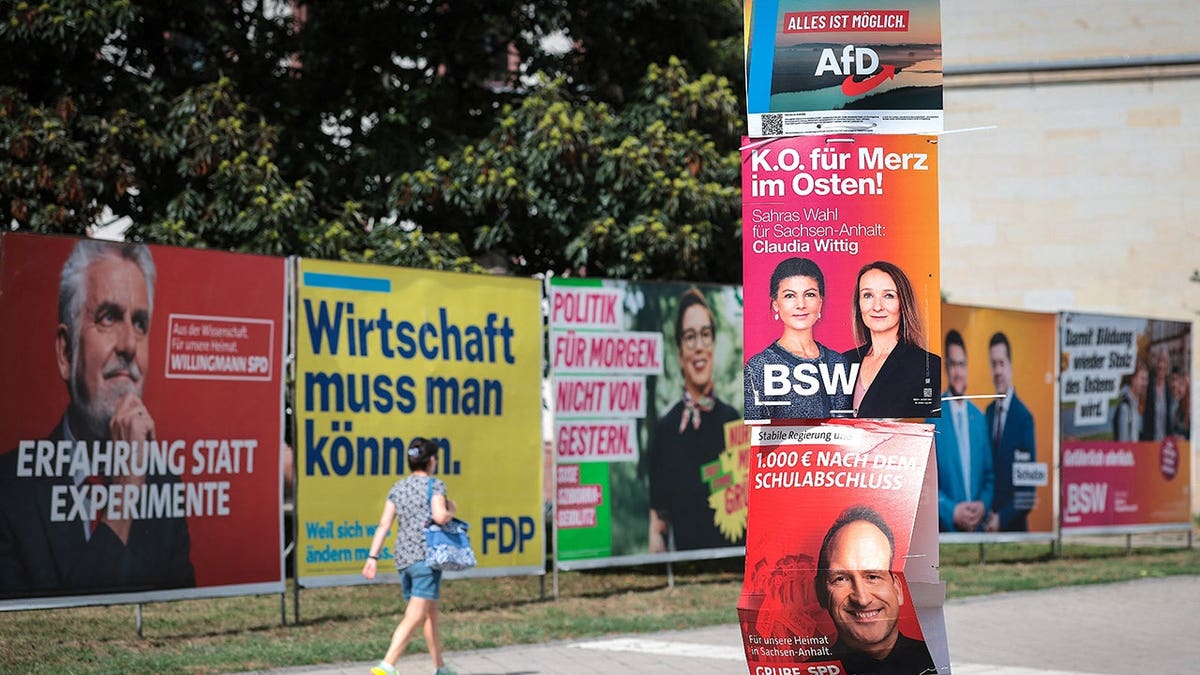
The article characterizes the AfD as far-right and anti-immigrant, while also describing it as friendly toward Moscow and US President Donald Trump. These descriptions frame the election as significant not only for German domestic politics but also for wider debates over immigration and the country’s international orientation. The accompanying image shows pedestrians walking past campaign posters in Magdeburg, the state capital, on the eve of the election.
France 24 correspondent Nick Holdsworth provides further reporting in a short, two-minute video segment. However, the supplied article text contains only a brief introduction to the election and does not include polling figures, statements from party leaders, details about rival parties, voter turnout, or the final result. Its central message is that the AfD entered the regional contest in a strong position and was expected to achieve a decisive victory in a former communist region. The report therefore presents the election as an important indicator of the AfD’s political strength, while leaving the actual outcome and its consequences unresolved.
Entities: Alternative für Deutschland (AfD), Germany, Saxony-Anhalt, Magdeburg, Eastern Germany • Tone: neutral • Sentiment: neutral • Intent: inform
06-09-2026
Germany’s far-right Alternative for Germany (AfD) party appeared headed for a major victory in Saxony-Anhalt’s state election, winning an estimated 44.5 percent of the vote in early results. Chancellor Friedrich Merz’s conservatives were projected to receive 18.5 percent, while the Social Democrats and Greens appeared likely to clear the threshold for parliamentary representation. Despite the AfD’s strong showing, it was not immediately clear whether the party could govern alone or form a coalition.
AfD co-leader Alice Weidel described the result as historic and said it gave the party a mandate to govern. However, the party is being monitored by Germany’s domestic intelligence service over allegations of right-wing extremism, and mainstream parties have generally maintained a political “firewall” to prevent it from entering government. If the AfD cannot rule independently, coalition negotiations among its opponents could be prolonged. The left-wing populist Sahra Wagenknecht Alliance could potentially cross the electoral threshold and emerge as a possible coalition partner, although cooperation with the AfD would remain politically controversial.
The result would represent a major challenge to Germany’s postwar political consensus, shaped by the country’s Nazi past and its reluctance to cooperate with extremist parties. The AfD, led in Saxony-Anhalt by 35-year-old Ulrich Siegmund, has campaigned on strict anti-immigration policies, including deportations and “remigration,” opposition to progressive social policies, and changes to how the Nazi era is taught in schools. It also promotes incentives to encourage German expatriates to return and financial support for families.
The party has drawn support by appealing to eastern German identity, nostalgia for communist-era East Germany, and continuing economic disparities between eastern and western Germany. Critics warn that its immigration policies could damage a state dependent on foreign-born workers, while others fear that an AfD-led security apparatus could expose sensitive information to Russia. The election also deepens pressure on Merz, whose government is struggling with weak economic growth and declining popularity. Analysts said the result would intensify demands for stronger leadership within his conservative bloc.
Entities: Alternative for Germany (AfD), Saxony-Anhalt, Alice Weidel, Ulrich Siegmund, Friedrich Merz • Tone: analytical • Sentiment: negative • Intent: inform
06-09-2026
France 24 reports on the Alternative for Germany (AfD) celebrating a strong performance in the Saxony-Anhalt state election, where the far-right party emerged as the leader after polls closed. The result places the party’s top candidate, Ulrich Siegmund, in a potentially historic position: he has been polling first and could become the leader of Germany’s first far-right state government since the Second World War.
The report presents the election as a significant moment for German politics. The AfD’s campaign slogan, “Everything is possible,” reflects its confidence and ambition. Siegmund and senior party figures Alice Weidel and Tino Chrupalla celebrated the exit-poll results in Magdeburg, while Siegmund suggested that he could be on the verge of making history.
The article also examines the political resistance to the AfD. Other German parties have maintained a “Brandmauer,” or firewall, intended to prevent cooperation with the far right because of concerns about the party’s ideology and Germany’s historical experience. German intelligence agencies have designated some parts of the AfD as right-wing extremist.
At the same time, the report describes how the party has attempted to present a more approachable public image. Aggressive slogans such as “Enough is Enough” have been replaced by a more positive message. Der Spiegel has portrayed Siegmund as a seemingly accessible but dangerous political figure whose persona may conceal a more radical program. Siegmund rejects that characterization as an establishment media tactic and has even signed copies of the magazine cover featuring the description. Overall, the report combines election-night developments with context about the AfD’s growing influence, its efforts at image management, and the continuing controversy surrounding its role in German politics.
Entities: Alternative for Germany (AfD), Ulrich Siegmund, Alice Weidel, Tino Chrupalla, Saxony-Anhalt state election • Tone: analytical • Sentiment: neutral • Intent: inform
06-09-2026
Germany’s far-right Alternative for Germany (AfD) won the largest share of votes in the Saxony-Anhalt state election, according to exit polls from public broadcasters ARD and ZDF. The party was projected to receive between 44.1% and 44.5% of the vote, more than double its 20.8% result in the 2021 election. Chancellor Friedrich Merz’s conservative Christian Democratic Union (CDU) was projected to receive 18.5%, roughly half its previous share.
Although the AfD clearly led the election, it was not immediately certain whether it had won enough seats to govern alone. If it succeeds in forming a state government, it would be the first time a far-right party has controlled a German state government since World War II. The result represents a major advance for a party classified as right-wing extremist by domestic intelligence authorities in several German states. The AfD is also polling strongly at the national level, suggesting that its appeal has expanded beyond eastern Germany.
The party’s leading candidate in Saxony-Anhalt, 35-year-old Ulrich Siegmund, campaigned on mass deportations and hard-line changes to migration and education policy. The AfD also supports altering the regional public broadcaster, closer relations with Russia and the U.S. MAGA movement, ending aid to Ukraine, and revoking refugee protections for Ukrainians.
AfD leader Alice Weidel described the result as evidence of “explosive growth” across eastern Germany and nationally. Siegmund called it a historic signal for the country. Former U.S. President Donald Trump and Elon Musk welcomed the result, while Russian envoy Kirill Dmitriev called it a historic win. Poland’s Prime Minister Donald Tusk and France’s Europe Minister Benjamin Haddad condemned the outcome, with Haddad calling it a grave moment for Europe.
Entities: Alternative für Deutschland (AfD), Saxony-Anhalt, Germany, Christian Democratic Union (CDU), Friedrich Merz, Alice Weidel • Tone: analytical • Sentiment: negative • Intent: inform
06-09-2026
Germany’s far-right Alternative for Germany (AfD) won a decisive victory in the regional election in Saxony-Anhalt, an ex-communist state in eastern Germany. According to projections from public broadcasters ARD and ZDF, the AfD secured 44 per cent of the vote—more than double its previous support and far ahead of the centre-right Christian Democratic Union (CDU), which received about 18 per cent. The result represents a major breakthrough for the party and brings a far-right organization closer to governing at state level than at any point since World War II.
The outcome was also interpreted as a serious setback for Chancellor Friedrich Merz and his CDU. Saxony-Anhalt’s CDU state premier, Sven Schulze, described the result as “a severe blow” but said he would remain caretaker leader while parties attempt to form a new government. Because the AfD was projected to fall short of an outright majority, it will not be able to govern alone.
The party’s path to power is further complicated by an agreement among all major parties not to cooperate with it. This so-called “firewall” reflects the AfD’s classification by Germany’s domestic intelligence agency as “right-wing extremist” in Saxony-Anhalt. The arrangement could lead to difficult and potentially prolonged coalition negotiations, as mainstream parties seek to exclude the AfD from government despite its strong electoral mandate.
AfD lead candidate Ulrich Siegmund celebrated the result, saying the party had made history. National co-leader Alice Weidel called the performance “sensational” and argued that voters had given the AfD a clear mandate to govern. The election highlights the party’s growing strength in eastern Germany and intensifies the national debate over whether established parties can continue isolating it politically.
Entities: Germany, Saxony-Anhalt, Alternative for Germany (AfD), Friedrich Merz, Ulrich Siegmund • Tone: analytical • Sentiment: negative • Intent: inform
06-09-2026
Voting began on Sept. 6 in Saxony-Anhalt, an eastern German state where the far-right Alternative for Germany (AfD) is seeking a historic breakthrough. If it wins an absolute majority, the AfD would become the first far-right party to lead a German state government since World War Two and could bypass the country’s political “firewall,” under which mainstream parties refuse to govern with it.
The AfD, led by 35-year-old candidate Ulrich Siegmund, has polled above 40% for months and is aiming for at least 45%. Its ability to secure an outright majority will depend partly on how many smaller parties clear Germany’s 5% electoral threshold. Recent surveys put the AfD at just over 40%, ahead of Chancellor Friedrich Merz’s Christian Democrats (CDU) at 23%.
The election is also viewed as a test of Merz’s strategy of countering the AfD by adopting tougher positions on migration and security. Turnout was significantly higher than in the 2021 election, with 34.72% of eligible voters casting ballots by noon, compared with 22.4% previously.
If the AfD falls short of a majority, a CDU-led government under incumbent premier Sven Schulze is considered the most likely outcome. However, coalition negotiations could be complicated because the Free Democratic Party is expected to miss the threshold, the Social Democratic Party is polling below 10%, and the Sahra Wagenknecht Alliance is also at risk of failing to enter parliament. A minority CDU government tolerated by the Left Party is one possible alternative.
For the AfD, the election serves as a trial run for its national ambitions ahead of the 2029 federal election. The party wants to restrict immigration, promote more traditional values in schools and cultural institutions, and overhaul public broadcasting. It has been classified as “far-right extremist” by the state security service, and Siegmund has ruled out coalition talks with other parties.
Entities: Alternative for Germany (AfD), Saxony-Anhalt, Ulrich Siegmund, Friedrich Merz, Christian Democratic Union (CDU) • Tone: analytical • Sentiment: neutral • Intent: inform
06-09-2026
Voters in Germany’s eastern state of Saxony-Anhalt are casting ballots in an election that could mark a major breakthrough for the far-right Alternative for Germany (AfD). If the party wins an absolute majority, it would become the first far-right party to take power at the German state level since World War Two. The AfD, led in the state by 35-year-old Ulrich Siegmund, has polled at just over 40%, well ahead of Chancellor Friedrich Merz’s Christian Democrats (CDU), which stand at about 23%.
The election is also being watched as a test of Merz’s unpopular federal government. His efforts to weaken the AfD’s appeal have included adopting tougher positions on migration and security. An AfD majority would allow the party to bypass the “firewall” maintained by mainstream parties, which have generally refused to cooperate with it. However, Germany’s proportional electoral system makes an outright majority difficult, particularly because parties must win at least 5% of the vote to enter parliament.
If the AfD falls short, a CDU-led administration under incumbent premier Sven Schulze is considered the most likely result. The composition of such a government would depend on which smaller parties clear the electoral threshold. Polls suggest the FDP may fail to enter parliament, while the SPD is polling below 10% and the far-left BSW is also at risk. The CDU has ruled out cooperation with both the AfD and the Left Party, potentially leaving Schulze dependent on a minority government tolerated by the Left.
For the AfD, the election is a step toward its broader goal of gaining national power in the 2029 federal election. Siegmund declared that the party’s rise could no longer be stopped, while acknowledging the significance of the vote regardless of the final result. Initial results were expected shortly after polls closed on Sunday.
Entities: Saxony-Anhalt, Germany, Alternative for Germany (AfD), Ulrich Siegmund, Friedrich Merz • Tone: analytical • Sentiment: neutral • Intent: inform
06-09-2026
The article reports that Germany’s nationalist Alternative for Germany (AfD) party is seeking a major breakthrough in regional elections in the eastern state of Saxony-Anhalt. The party hopes to take control of a regional government for the first time, making the vote an important test of its growing political influence and its prospects for expanding beyond opposition politics.
The report places the AfD’s electoral ambitions alongside the intense controversy surrounding the party. Germany’s domestic intelligence agency has labeled it “right-wing extremist,” while critics have accused it of xenophobia, antisemitism and Islamophobia. These characterizations underscore the political and social tensions surrounding the party as voters prepare to cast ballots.
The election is scheduled for Sunday, and the article frames the contest as a potentially significant moment for both the AfD and German politics more broadly. A victory in Saxony-Anhalt would represent a historic first for the party at the regional-government level and could strengthen its position within Germany’s political system. It could also intensify debates over how established parties and state institutions should respond to the AfD.
The supplied material is only a brief excerpt rather than the complete Washington Post article. It does not provide polling figures, competing parties’ positions, projected results, voter demographics, or reactions from AfD officials. Therefore, the analysis is limited to the article’s headline, byline and opening paragraph, which establish the election’s significance and the controversy surrounding the party without describing the final outcome.
Entities: Alternative for Germany (AfD), Mary Ilyushina, Maegan Vazquez, Berlin, Saxony-Anhalt • Tone: analytical • Sentiment: negative • Intent: inform
06-09-2026
The Straits Times’ Sept 7, 2026 “While You Were Sleeping” roundup highlights five major developments in politics, international security, transport and sport. In Germany, the far-right Alternative for Germany (AfD) won a landslide in the Saxony-Anhalt state election, securing about 44 per cent of the vote and more than doubling its previous support. The result was a major setback for Chancellor Friedrich Merz and his centre-right CDU, which received roughly 18 per cent. Although the AfD was not expected to win an outright majority, the outcome could lead to a difficult and prolonged process of forming a state government.
In the United States, an Amazon cargo plane operated by 21 Air overshot a runway at Miami International Airport after arriving from San Juan, Puerto Rico. The Boeing 767-300 struck several vehicles and caught fire, killing at least five people, according to the report. The incident led to the closure of the airport’s runways while emergency crews assessed those affected.
In Ukraine, President Volodymyr Zelensky held renewed talks with US envoys Steve Witkoff and Jared Kushner about possible proposals for ending the war with Russia. A Ukrainian presidential official described the latest discussions as more effective, although Zelensky had warned that the conflict appeared likely to continue into winter.
Iran announced plans to establish a “prohibited zone” near the Strait of Hormuz. Security chief Mohsen Rezaei said ships entering the area could be placed on Iran’s sanctions list, amid escalating tensions and recent clashes involving US forces.
The roundup also reports that Arsenal defeated Chelsea 2-1 in a London derby. Arsenal recovered from Morgan Rogers’ early goal to end Chelsea’s unbeaten start and reinforce its status as a leading contender to retain the Premier League title.
Entities: Alternative for Germany (AfD), Saxony-Anhalt, Friedrich Merz, Ulrich Siegmund, Christian Democratic Union (CDU) • Tone: neutral • Sentiment: neutral • Intent: inform