03-11-2026
In his address to the Euronews EU Enlargement Summit, European Council President António Costa argued that EU enlargement is a strategic investment in peace, security, democracy and shared prosperity—not a burden. He said enlargement helps overcome historical divisions and strengthens Europe’s economic and geopolitical position, while fulfilling the aspirations of people in candidate countries. Costa emphasized that accession must be fair, consistent and based on merit, and that it requires more than adopting EU rules: candidates must build trust, resolve disputes peacefully and uphold democratic values.
Citing the 2004 enlargement, Costa said more than 100 million people have joined the Union since then, the shared economy has grown by over €2 trillion, and the economies of countries from Central and Eastern Europe have more than doubled. New member states have helped create 26 million jobs, including more than six million at home. He also described benefits that begin before formal accession, including Western Balkans investment and gradual integration with the Single Market, improved transport and border links, digital initiatives, and lower roaming costs.
Costa reviewed progress by candidate countries. Montenegro and Albania provisionally closed additional negotiating chapters, while Ukraine and Moldova opened negotiations on new clusters. He expressed confidence that Montenegro could complete its remaining work and become the “28th by 28.” He noted the effects of Russia’s war on Ukraine and praised reforms in Moldova, while stressing that democratic institutions, media freedom, anti-corruption efforts and the rule of law are essential. He also offered EU support to Serbia’s new government and urged progress by North Macedonia, Bosnia and Herzegovina, and Kosovo. Costa concluded that EU membership means sharing the Union’s values and said he looks forward to welcoming future members as equal members of the European family.
Entities: António Costa, European Union (EU), Euronews EU Enlargement Summit, 2004 EU enlargement, Western Balkans • Tone: analytical • Sentiment: positive • Intent: persuade
03-11-2026
EU enlargement is at a pivotal moment as political leaders gather in Brussels for Euronews’ second Enlargement Summit. After years of treating expansion as a key part of its foreign policy, the EU is seeking to turn renewed momentum into concrete progress by setting out the remaining steps for the candidates closest to accession. The European Commission’s planned roadmaps for Montenegro, Albania, Moldova and Ukraine could, however, deepen the divide between these frontrunners and countries whose bids have stalled.
Montenegro is nearest to joining, but bilateral disputes with Croatia—rooted in the legacy of the Yugoslav Wars—are complicating its progress. The EU is also discussing institutional safeguards for future members in connection with Montenegro’s accession treaty, which could become a model for later entrants. Albania, considered the next closest candidate, faces political pressure after protests over preparatory work for a luxury resort in a protected area, a project planned by Jared Kushner, US President Donald Trump’s son-in-law.
Moldova is advancing rapidly, prompting the Commission to reallocate resources to keep pace with its negotiations. Ukraine has begun making formal progress following a change of government in Hungary, and is expected to open all negotiating clusters before year-end, though agriculture could become a contentious issue. Serbia’s recent change of government has raised hopes in Brussels for improved relations and renewed momentum in the Western Balkans. Meanwhile, North Macedonia, Bosnia and Herzegovina, and Kosovo have seen their accession efforts stall and risk losing access to EU regional funding in favour of frontrunners.
Georgia’s accession process has effectively stopped amid democratic backsliding and a shift in its diplomatic orientation towards Russia. Enlargement Commissioner Marta Kos has described Georgia as a candidate “only on paper.” Armenia, which is not formally a candidate, is considering an application as it seeks to reduce its dependence on Russia after conflict with Azerbaijan. The article concludes that Brussels must demonstrate its enlargement ambitions can produce tangible results.
Entities: European Union enlargement, Euronews Enlargement Summit, European Commission, Montenegro, Albania • Tone: analytical • Sentiment: neutral • Intent: analyze
03-11-2026
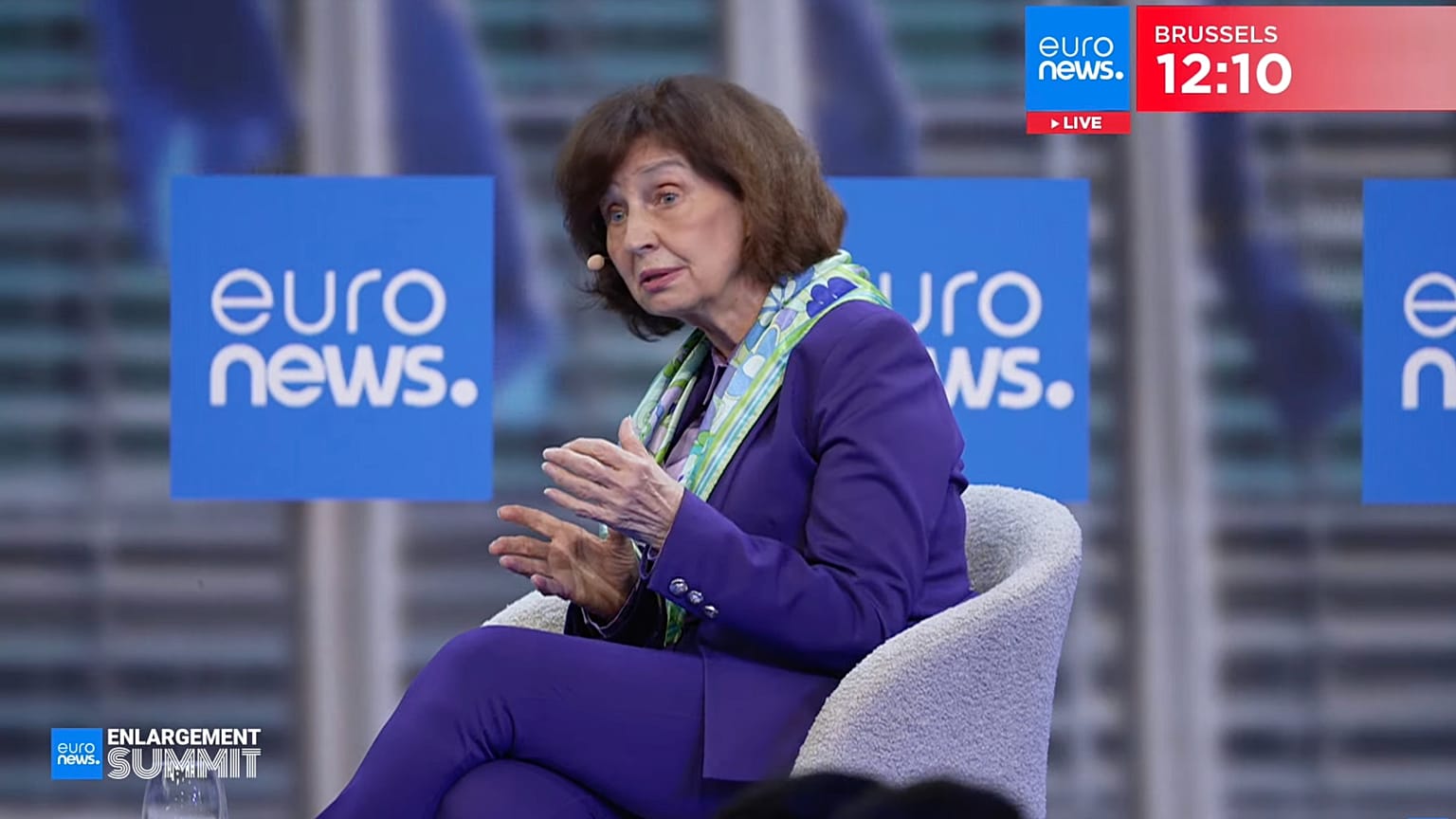
North Macedonia’s President Gordana Siljanovska-Davkova says her country’s bid to join the European Union is being held up by Bulgaria’s demand that Bulgarians be explicitly recognised in North Macedonia’s constitution. Speaking at the Euronews Enlargement Summit, she argued that further constitutional concessions should not be made without public support, noting that the constitution has already been amended 26 times and that most changes were imposed. She said roughly 80% of citizens oppose the proposed amendments, which have not passed the first stage in the parliamentary constitutional commission.
Under a 2022, French-brokered compromise, North Macedonia agreed to include Bulgarians among the communities recognised in its constitution. The change requires a two-thirds parliamentary majority, which the government has not secured. Siljanovska-Davkova said the obstacle to EU integration was not a failure to meet EU requirements, but insufficient political will among neighbouring countries.
North Macedonia applied for EU membership in 2004 and became a candidate in 2005. Its progress has been repeatedly impeded by disputes, including the long-running disagreement with Bulgaria. The president also cited the 2018 agreement with Greece, which led the country to change its name from the Republic of Macedonia to North Macedonia and ended a dispute that had blocked its NATO and EU ambitions. She questioned how far EU candidate countries should be expected to go in making concessions to resolve bilateral disputes.
Although she criticised the effect of Bulgaria’s demands, Siljanovska-Davkova did not directly accuse Sofia of deliberately blocking accession. She said she would continue seeking a resolution through dialogue and called for pragmatism and greater political willingness among neighbouring countries.
Entities: Gordana Siljanovska-Davkova, North Macedonia, Bulgaria, European Union (EU), Euronews Enlargement Summit • Tone: analytical • Sentiment: neutral • Intent: inform
03-11-2026
Albanian Prime Minister Edi Rama said Serbia’s new leadership is unlikely to change the country’s refusal to recognise Kosovo, a position that remains a major obstacle to Serbia’s bid to join the European Union. Speaking at the Euronews Enlargement Summit in Brussels, Rama said the Student List, which won Serbia’s recent election, was “completely closed” to discussing recognition. Kosovo declared independence in 2008 and applied for EU membership in 2022, while Serbia’s student movement and most other Serbian political forces regard Kosovo as an integral part of Serbia. The EU has pressed Belgrade and Pristina to normalise relations to reduce regional tensions. Rama also criticised Serbia’s reluctance to align with EU policies, particularly sanctions against Russia, saying Serbia must meet the conditions for belonging to the European community.
Turning to Albania’s accession bid, Rama declined to give a date for EU membership but said he remained committed to completing negotiations by the end of 2027. Albania has been an EU candidate since 2014 and began formal accession negotiations in 2020. Rama described the accession process as unpredictable, while acknowledging that Albania still has work to do. He defended enlargement as merit-based and called for a decisive moment of expansion, invoking former German Chancellor Helmut Kohl and urging Europe to bring candidate countries into the same “family.” He also reiterated his support for partial integration of candidates as an interim step, using a metaphor about keeping children around the table to warn against leaving them open to Russian or Chinese influence.
Rama added that the United Kingdom should wait before seeking closer relations with Brussels, arguing that Albania and Montenegro had waited long enough and were ahead of Britain in the enlargement queue.
Entities: Edi Rama, Serbia, Kosovo, Albania, European Union (EU) • Tone: analytical • Sentiment: neutral • Intent: inform