03-11-2026
On the eve of the 2026 US midterm elections, Michigan Senate candidates Abdul El-Sayed, a Democrat, and Mike Rogers, a Republican, held competing rallies as their bitter campaign reached its final hours. The race could help determine control of Congress, though polling indicated that El-Sayed had widened his lead despite late developments that appeared to offer Rogers an opening.
At a rally in Rochester Hills, Rogers framed the election as a fight for the country’s “heart and soul” and urged supporters to defeat what he called the “Democrat Socialists of America.” In Detroit, El-Sayed spoke to members of the United Auto Workers and emphasized the cost of living, arguing that voters were more concerned about expensive gas and groceries than the attacks on his name and faith. The article describes a wave of anti-Muslim rhetoric during the campaign. President Donald Trump had claimed El-Sayed would “invite hordes of jihadis” and repeatedly misnamed him. El-Sayed responded that he expected to be called senator after the election.
A major late development was Democratic Representative Haley Stevens’s endorsement of Rogers. Stevens had lost to El-Sayed in the Democratic Senate primary. She said her decision followed concerns about an advertisement linking US support for Israel to grocery costs and her claim that she had been shut out of El-Sayed’s campaign. Stevens acknowledged her disagreements with Rogers but said she believed El-Sayed was not fit to serve. Rogers praised the endorsement, and his rally crowd chanted her name. Stevens also suggested she intended to help shape the Democratic Party after leaving office in January.
A New York Times-Siena poll released Sunday put El-Sayed ahead by 11 percentage points among likely voters, 53 percent to 42 percent, with a margin of error of plus or minus 3.6 points.
Entities: Abdul El-Sayed, Mike Rogers, Haley Stevens, Donald Trump, Michigan • Tone: analytical • Sentiment: neutral • Intent: inform
03-11-2026
The article outlines voting hours, vote-counting expectations and closely watched races in the 2026 US midterm elections. More than 230 million eligible voters can vote on Tuesday, November 3. All 435 seats in the House of Representatives and 35 of the Senate’s 100 seats are contested, and voters in 36 states will elect governors. Republicans currently control both chambers of Congress.
Poll opening and closing times vary by state. Vermont is expected to open first, at 5am Eastern Time (10:00 GMT). Several states begin voting between 6am and 7am, with Michigan opening at 7am. The earliest polls close at 6pm in Indiana and Kentucky. Closures continue in waves, with Alaska last, at around 1am Eastern Time on Wednesday (06:00 GMT).
Initial results may arrive as polls close on Tuesday, but early counts do not necessarily identify winners. Election officials report vote counts as ballots are processed, while news organisations such as the Associated Press assess when races can be called. Close contests may take hours or days to resolve, and control of Congress may not be clear immediately. Mail, provisional and other ballots can be counted after election night, meaning final tallies may take days or weeks.
The article says Senate Democrats need a net gain of four seats to reach a majority, while House Democrats need three. It highlights contests including Abdul El-Sayed versus Mike Rogers in Michigan; Angie Nixon challenging Ashley Moody in Florida; Jon Ossoff versus Mike Collins in Georgia; Susan Collins versus Troy Jackson in Maine; Chris Pappas versus John Sununu in New Hampshire; and Roy Cooper versus Michael Whatley in North Carolina.
Entities: 2026 US midterm elections, United States Congress, US House of Representatives, US Senate, Republican Party • Tone: neutral • Sentiment: neutral • Intent: inform
03-11-2026
Michigan’s closely watched 2026 Senate race is unfolding amid widespread concern over the cost of everyday necessities, including fuel, food and medical care. Detroit resident Crystal Hill, who works long hours delivering packages and driving for Uber, says she cannot afford essential kidney medication. Her experience reflects polling that found more than four in ten Americans had struggled to pay for basic needs in the past year. Economic frustration could help Democrats regain control of Congress, but the Senate outcome remains uncertain, and Michigan is one of several battleground states that could decide it.
Democrat Abdul El-Sayed, a physician advocating more affordable healthcare, is challenging Republican Mike Rogers. The campaign has become bitter, with Rogers portraying El-Sayed’s proposals as socialist and warning of communism. El-Sayed also faces attacks directed at his Muslim identity, including insults from President Donald Trump. El-Sayed argues that his name and faith are unrelated to voters’ financial difficulties. A final New York Times/Siena University poll gave him an 11-point lead, but a late endorsement of Rogers by Haley Stevens, who had lost to El-Sayed in the primary, disrupted the Democratic campaign and prompted staff resignations and criticism from party leaders.
Voters interviewed in Detroit described sharply rising costs and financial strain. Arab American voter Sindus Segmen, who supports El-Sayed, said she relies on her children and cannot afford a car. Terrance Lemmons blamed Trump for high petrol prices. However, economic discontent does not automatically benefit El-Sayed: some voters resist his progressive platform, while others express fears about religious radicalism. Political consultant Lynn Wiggins cautioned that Michigan is not a progressive stronghold. The article presents the race as a collision between pocketbook concerns and divisive political and religious attacks, with implications for congressional control and Trump’s power.
Entities: Abdul El-Sayed, Mike Rogers, Donald Trump, Haley Stevens, Crystal Hill • Tone: analytical • Sentiment: neutral • Intent: analyze
03-11-2026
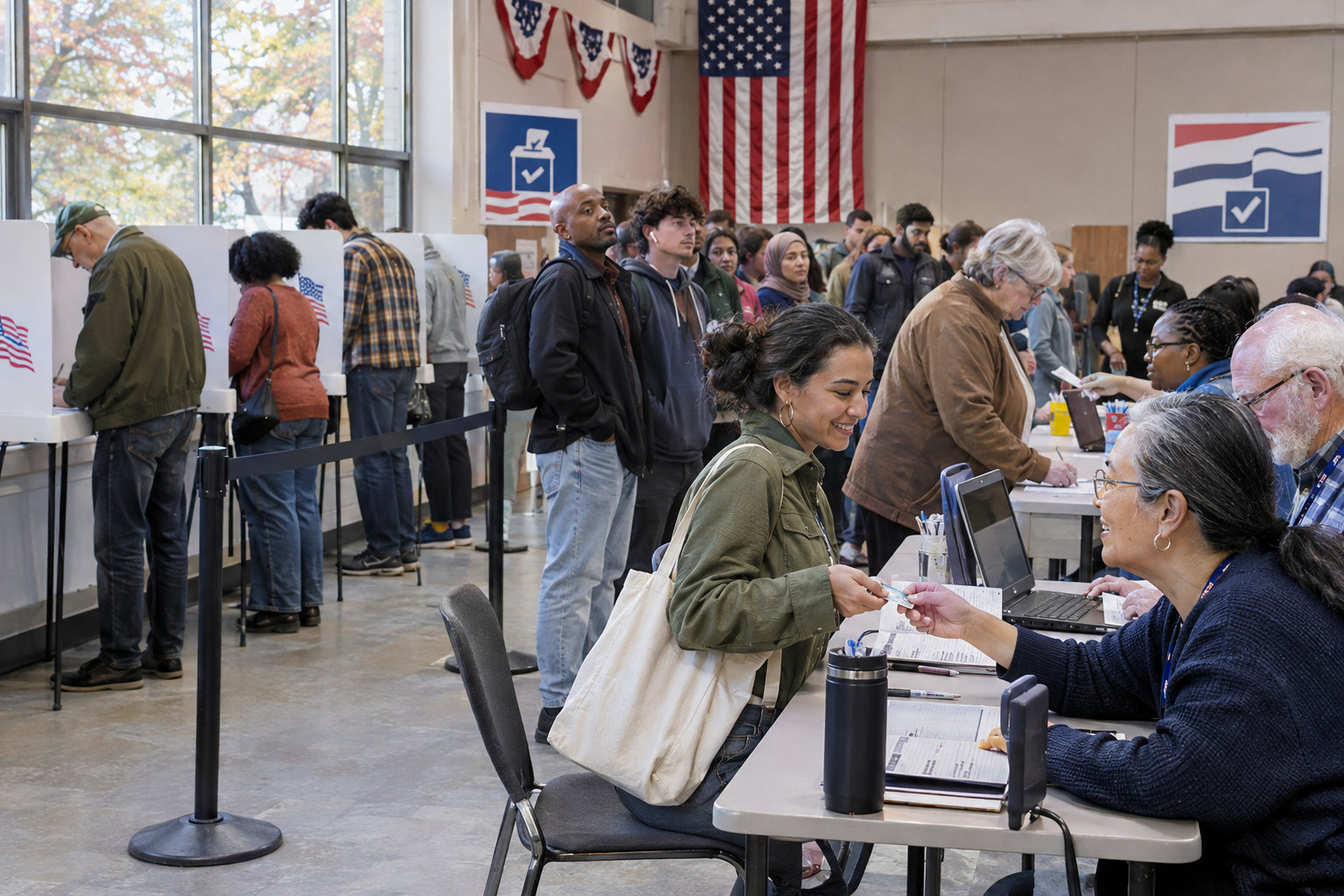
Americans are voting in the 2026 midterm elections to determine the make-up of the next Congress and fill important state-level positions. Most polling stations are scheduled to open at 7am and close at 8pm local time, following early voting that began in some states in mid-September. The elections are taking place amid sharply increased living costs, with petrol, food and other necessities remaining expensive during the Iran war.
Although President Donald Trump is not on the ballot, the results are expected to reflect voters’ views of his first two years back in office. Trump urged Americans to vote as though his presidency itself were at stake. At a Monday rally near the Lincoln Memorial Reflecting Pool, he called the elections the most important midterms in his lifetime and described the country as being in a “Golden Age.” Historically, the party holding the presidency tends to lose seats in midterms; the scale of Republican losses in Congress and governorships may indicate how voters assess Trump’s performance.
The article also describes disputes over election administration. The Trump administration has pursued efforts to address what it calls voter fraud. In Alaska, the Justice Department sued to prevent officials from declaring a winner in the Senate race unless Republican incumbent Dan S Sullivan prevailed. The department argued that voters could be confused by another candidate, Dan J Sullivan, whose name is nearly identical. The article notes that the issue has been widely reported and that the incumbent’s name is clearly marked on the ballot, while the White House has alleged attempted fraud.
In California, the White House sought to have as many as 20,000 mail-in ballots rejected, alleging they were cast by non-citizens. The article places these efforts in the context of Trump’s past challenges to election results: after losing the 2020 presidential election to Joe Biden, he claimed widespread fraud, but election officials and members of his own administration said no widespread fraud had occurred.
Entities: Donald Trump, Joe Biden, Sara Ruthven, United States midterm elections, Iran war • Tone: analytical • Sentiment: neutral • Intent: inform
03-11-2026
The article examines whether Latino voters will help determine the outcome of Texas’s 2026 midterm races and whether Donald Trump’s gains among Hispanic voters in 2024 will endure. In Texas, nearly 6.3 million eligible Latino voters make up about 31.7% of the electorate, giving their preferences potential influence over Senate, gubernatorial and House contests. The implications could extend to competitive districts in California, Arizona, Florida and Pennsylvania, and to control of the House of Representatives.
Polling cited in the article points to a possible shift toward Democrats. A CBS News poll found that 51% of Latino voters planned to support a Democratic House candidate, compared with 24% for a Republican. Other surveys showed Democratic candidates James Talarico and Gina Hinojosa leading among Latino voters in statewide races. However, support varies by geography: rural Latino voters were more favorable to Republicans in one survey, while urban Latino voters leaned toward Democrats. Republicans also question whether polling will translate into votes and argue that economic priorities, social conservatism, religion and immigration policy may sustain support for their party among some Latino voters.
The article describes competing explanations for voter dissatisfaction with Trump: Democratic strategist Chuck Rocha emphasizes prices, fuel costs and affordability, while Representative Joaquin Castro points to immigration enforcement and the effects of ICE operations on Latino communities. It also stresses that Latino voters are not politically uniform and that turnout, not just candidate preference, will matter. Early voting increased sharply in Hidalgo and Cameron counties, but those figures do not reveal party preference. Past ticket-splitting and the limits of primary-turnout data further complicate predictions. Both parties are competing for Latino voters, with Democrats expanding Spanish-language and community-based outreach. The supplied article text ends mid-sentence while beginning to describe Republican efforts.
Entities: Latino voters, Donald Trump, Texas, 2026 US midterm elections, UCLA Latino Policy and Politics Institute • Tone: analytical • Sentiment: neutral • Intent: analyze