02-10-2026
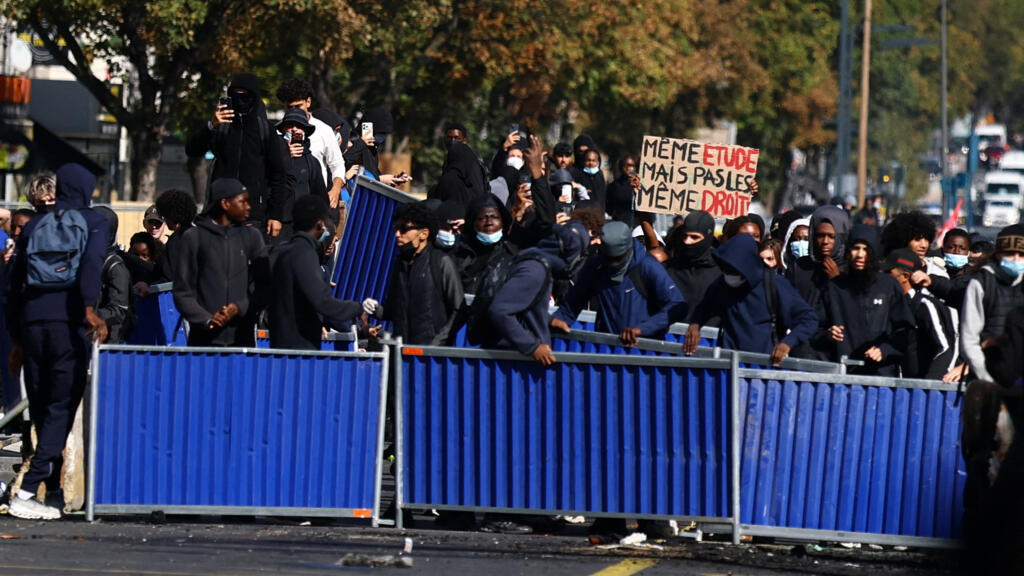
Hundreds of French high schools were closed or disrupted on Friday as student protests over overcrowded classrooms and absent teachers spread nationwide and grew increasingly volatile. The Ministry of National Education reported that at least 400 of the country’s 3,700 high schools were closed, while 560 had experienced protests or other disruption. Demonstrations began in the Paris area the previous week and have since involved school blockades, street fires and clashes with police.
Students described inadequate classroom space and short lunch breaks as sources of frustration. Fires damaged entrances at two Paris high schools, and police used tear gas during protests. Authorities reported significant injuries and damage: Education Minister Edouard Geffray said at least 170 students and 65 school staff members had been wounded, and more than 100 high schools had sustained severe damage. Justice Minister Gerald Darmanin said about 2,000 people had been detained, most of them children. He argued that parents should pay for damage caused by their children, while Geffray urged parents to keep children away from protests because of the danger.
The protests are occurring alongside a public-sector strike against the government’s budget plans, increasing pressure on President Emmanuel Macron ahead of next year’s elections. Amnesty International condemned images of students being assaulted by law enforcement and said minors should be protected. A student in Rennes also denounced police violence. The government accused the left-wing France Unbowed party of taking control of the movement; senior party official Manuel Bompard rejected that claim as a conspiracy theory. Geffray said he would meet education unions and student groups in an effort to open dialogue and ease tensions.
Entities: France, Emmanuel Macron, Edouard Geffray, Gerald Darmanin, Manuel Bompard • Tone: neutral • Sentiment: negative • Intent: inform
02-10-2026
The article reports on continuing protests over learning conditions in France, where many schools remain closed. It describes a situation involving demonstrations across the country, violence, blockades and hundreds of arrests. The account indicates that the protests are disrupting school operations, but the provided article text does not specify which learning conditions are at issue, how the protests began, or the positions of school authorities and government officials.
Al Jazeera correspondent Natacha Butler spoke with students demonstrating in Paris, offering a student perspective from the protests. However, the available text does not include their comments or further detail about what they said. It also does not provide information on the scale or location of individual incidents beyond the mention of demonstrations across France and student protesters in Paris.
The article is presented as a short video news report, published on 2 October 2026. Its central focus is the question of what is behind the school protests, while the accompanying description establishes the immediate context: disputes over learning conditions, school closures, unrest and arrests. The text does not give enough information to explain the protesters’ specific demands or establish the causes of the violence. Accordingly, this summary is limited to the facts stated in the supplied description and does not infer additional causes or outcomes.
Entities: France, Paris, Al Jazeera, Natacha Butler, French schools • Tone: neutral • Sentiment: negative • Intent: inform
02-10-2026
French school protests that began nearly two weeks ago in the low-income Seine-Saint-Denis area have spread across the country, with hundreds of high schools blockaded or closed and university students beginning to join. The unrest has included fires and damage to school buildings, injuries to teachers, school leaders, police and firefighters, and thousands of detentions. Student groups also report injuries caused by police, including serious eye injuries and a teenager who lost many teeth.
The protests include demands for more teachers, smaller classes, better buildings and other education funding. The article notes that these concerns resonate with many people, but that France’s tight finances and Prime Minister Sébastien Lecornu’s proposed €54bn in spending cuts make new public spending unlikely. It argues that the deeper concern for President Emmanuel Macron’s government is whether the unrest is being politically exploited and could signal wider instability ahead of presidential elections.
The political debate centers on France Unbowed (LFI) and its leader Jean-Luc Mélenchon. Politicians on the right and centre accuse LFI of encouraging the protests to mobilise young voters and advance its ideas. A leaked police report cited non-student protesters, unclear demands, political symbols and protest tactics as evidence of far-left influence. LFI rejects the accusation, saying it is simply supporting a legitimate movement; Mélenchon has also urged students to avoid violence.
The article describes Mélenchon’s strong support among young people and in diverse urban suburbs, while noting that young voters often abstain. It concludes that the protests may foreshadow greater political and social tension, especially if Mélenchon loses a presidential run-off against Marine Le Pen, as polls currently suggest. The piece presents the protests as both a dispute over underfunded schools and a potential warning sign for an increasingly polarised France.
Entities: Emmanuel Macron, Sébastien Lecornu, Jean-Luc Mélenchon, Marine Le Pen, Bally Bagayoko • Tone: analytical • Sentiment: negative • Intent: analyze
02-10-2026
Thousands of students have protested across France over what they describe as worsening education standards, including teacher shortages, overcrowded and overheated classrooms, long school hours, and deteriorating buildings. The demonstrations began in Paris and have spread to hundreds of schools in cities including Montpellier, Nantes, Marseille, and Brest. France’s Justice Minister Gérald Darmanin said 735 of the country’s 3,700 schools had been affected, while Interior Minister Laurent Nuñez reported 1,747 arrests on Friday and warned that the unrest was moving towards rioting and urban violence.
Clashes and damage have been reported in several locations. In Belfort, a 17-year-old was arrested on suspicion of attempted homicide after a police officer was targeted; verified video showed the officer being chased, knocked down, and repeatedly kicked and punched. At least 65 education staff have been injured. Police used tear gas in Strasbourg and charged protesters in Pantin, while fires burned in rubbish bins and barricades in several cities. The education ministry reported significant damage to school facilities, including more than €2m in damage at Nelson Mandela high school in Nantes after a fire damaged its entrance and interior.
Education Minister Édouard Geffray said the movement had been taken over by people who were not students. Protesters, however, said police actions had made them angrier. Budget cuts that would affect education funding have further fuelled opposition, while parents fear their children may be caught up in violence. Darmanin said prosecutors had been asked to pursue parents for damage caused by their children. Several trade unions have backed the students’ right to demonstrate. The protests come six months before the next presidential election, at a politically sensitive time for President Emmanuel Macron.
Entities: France, Paris, Brest, Montpellier, Nantes • Tone: neutral • Sentiment: negative • Intent: inform
02-10-2026
Riot police clashed with high school students across France on Friday as demonstrations over education conditions and funding spread beyond the Paris region and became increasingly violent. Reports described tear gas in Strasbourg, fireworks directed at police in Marseille, burning rubbish bins in Rennes, and fires and firecrackers in Pantin. A regional education authority spokesperson said a youth sprayed petrol at a teacher in La Ciotat; Reuters could not independently verify the circumstances shown in a related video. Interior Minister Laurent Nuñez said police had arrested about 5,000 people since Monday, most of them teenagers. Four hundred high schools—around one in 10—were closed on Friday, and Education Minister Édouard Geffray reported injuries to 65 education staff, including 40 headteachers. Teachers’ unions called a strike for Tuesday. The protests began in the Paris region and reflect grievances including overcrowded classrooms, teacher shortages, short timetables, and poorly maintained or overheated buildings. Students and some parents said they supported demands for better learning conditions, while officials urged families to keep children away from demonstrations and characterized the unrest as urban violence. The government’s draft 2027 budget would raise education spending by 1.7 per cent, below inflation, to €65.53 billion, while debt servicing is forecast to reach €74.5 billion. The demonstrations are unfolding six months before a presidential election, amid low opinion-poll ratings for President Emmanuel Macron and his government. Officials alleged that the hard-left France Unbowed party initiated the movement; its lawmakers denied this and accused the government of politicizing the protests. Rights groups criticized police tactics against minors, and authorities have opened investigations into alleged police violence, including the eye injury of a 16-year-old reportedly hit by a rubber bullet.
Entities: Emmanuel Macron, Laurent Nuñez, Édouard Geffray, Gérald Darmanin, France • Tone: analytical • Sentiment: negative • Intent: inform
02-10-2026
Student protests that began in the Paris region have spread across France, disrupting or closing hundreds of high schools. Students cite long school days, poor facilities, overheated classrooms, and a lack of teachers and textbooks. In Paris, students set fires outside schools and clashed with police; fires damaged the entrances of two schools, and police used tear gas in several locations. The education ministry said more than 560 of France’s 3,700 high schools had experienced disruption on Friday, after the Interior Ministry reported that more than 1,000 were affected the previous day. Some schools, including many in Marseille, planned to move classes online.
The government acknowledges that students’ complaints are legitimate but condemns what it describes as urban violence. Education Minister Edouard Geffray said the movement had been taken over by violent fringe groups. He reported that at least 65 staff members, including 40 principals, and about 170 students had been injured since the protests began; more than 100 high schools had sustained severe damage. Justice Minister Gerald Darmanin said he had asked prosecutors to pursue parents for damage caused by their children. Around 2,000 people have been taken into police custody, about 90% of them minors, he said.
Students interviewed in Paris and Rennes said school closures were a success and accused police of excessive force, including the use of tear gas. The unrest has also become a political issue ahead of France’s presidential election. The government accused the hard-left France Unbowed party and its leader, Jean-Luc Melenchon, of involvement in the movement, while party official Manuel Bompard rejected that claim as conspiracy thinking.
Entities: French high school student protests, Paris, France, Edouard Geffray, Gerald Darmanin • Tone: neutral • Sentiment: negative • Intent: inform
02-10-2026
More than 400 schools in France were closed on Friday after student protests over poor school facilities, long days and teacher shortages spread nationwide and became violent. The Interior Ministry said more than 1,000 of the country’s roughly 3,700 high schools were affected on Thursday, including 222 that were blockaded. Reports say clashes, arson and other violence have injured educational staff, police officers and more than 100 students. Education Minister Édouard Geffray initially described the movement’s starting demands as legitimate, while the Interior Ministry later said the unrest had moved beyond legitimate student expression and had taken on characteristics of urban violence. Geffray was due to meet with teachers’ unions, student representatives and parents’ groups.
The protests add pressure as the government begins difficult negotiations over its 2027 budget. Finance Minister Roland Lescure said the proposed budget aims for a €54 billion fiscal adjustment, with planned measures including a freeze on public-sector wages, including teachers’ pay. The government must win support in a politically divided National Assembly, while the Prime Minister’s Office cited intelligence claims that the movement was being organized by La France Insoumise and ultra-left groups. Some LFI members have publicly supported the protests.
France’s fiscal position intensifies the conflict over education spending. The country is subject to the EU’s excessive deficit procedure and has repeatedly exceeded the bloc’s deficit and debt limits. Its deficit reached 5.1% of GDP last year, while debt stood at 119% of GDP at the end of June. Political divisions and the scale of the public finances challenge have unsettled investors. French government bond yields are near multi-decade highs; the benchmark 10-year yield was 4.914%, 139 basis points above its level a year earlier and near a 24-year high. The article presents the student unrest as both an education crisis and a test of the government’s ability to make politically difficult budget cuts.
Entities: France, Édouard Geffray, Roland Lescure, La France Insoumise (LFI), French Interior Ministry • Tone: analytical • Sentiment: negative • Intent: analyze
02-10-2026
More than 400 schools and colleges across France were closed on Friday as student demonstrations over poor education conditions continued and spread nationally. Education Minister Edouard Geffray said 735 institutions had been affected, a 30% decrease from the previous day, and reported fewer emergency-services personnel injured. The protests began last month in the Paris region, with students citing teacher shortages, deteriorating buildings and insufficient learning materials. Although ministers acknowledged young people’s frustration, they also called for calm as presidential elections approach.
The demonstrations have included fires, property damage and clashes with police. A fire at Lycée Mandela in Nantes is expected to keep the school closed until mid-October, while the facade of a Paris high school was also badly damaged. Police have made about 2,000 arrests, and injuries have included 40 high school principals, according to Geffray. Regional authorities estimated substantial damage, including at least €25 million in Auvergne-Rhône-Alpes and around €7 million in the Ile-de-France region. Students, meanwhile, have criticized what they consider a heavy-handed police response, including the use of tear gas.
Geffray said violent individuals were exploiting student groups and urged parents to keep children off the streets. Student representatives and unions, after meeting with him, called for concrete answers to their demands and continued demonstrations, while urging participants to avoid violence and vandalism. The government has also accused the left-wing La France Insoumise (LFI) party of exploiting the movement, an allegation the party denies. LFI leader Jean-Luc Melenchon has backed the protests while urging non-violent action. Student unions have called for a mass protest on October 6 under the slogan “Police out of schools!”
Entities: Edouard Geffray, Jean-Noel Barrot, Sebastien Lecornu, Jean-Luc Melenchon, Nahanael Combary • Tone: analytical • Sentiment: neutral • Intent: inform
02-10-2026
Violent student protests have spread across France, with clashes reported in Strasbourg, Marseille, Rennes, Paris and other cities. Riot police used tear gas as protesters set fires and threw fireworks, while roughly 400 high schools remained closed. Justice Minister Gérald Darmanin said about 2,000 people, most of them teenagers, had been arrested since the demonstrations began. Officials also reported injuries among school staff and students, and serious damage at more than 100 high schools.
The protests began in late September over overcrowded classrooms, teacher shortages, long school days and deteriorating facilities, including classrooms affected by heat. Students have blamed years of underinvestment. The government’s proposed 2027 budget would increase education spending by 1.7% to 65.53 billion euros, excluding teacher pensions—less than the rate of inflation.
As the demonstrations have grown more violent, they have become a political dispute. French intelligence agencies reportedly told a government crisis meeting that politicians from the hard-left France Unbowed party (LFI) initiated the movement. Education Minister Édouard Geffray accused LFI of fueling the initial protests and said the movement had been taken over by ultra-left groups. LFI lawmakers rejected the accusations, saying President Emmanuel Macron’s government was politicizing the unrest ahead of the 2027 presidential election. LFI leader Jean-Luc Mélenchon denied responsibility for the violence.
A Foundation for Defense of Democracies envoy said students’ original complaints were legitimate but argued that attacks on school leaders and firefighters represented extreme violence and a broader confrontation with the government. The supplied article excerpt ends mid-sentence.
Entities: Gérald Darmanin, Édouard Geffray, Emmanuel Macron, Jean-Luc Mélenchon, Simone Rodan-Benzaquen • Tone: urgent • Sentiment: negative • Intent: inform
02-10-2026
France 24 reports on escalating protests over school conditions, focusing on Aubervilliers, a suburb of Paris. Reporter Olivia Bizot describes the aftermath of demonstrations there as “apocalyptic.” The report says the protest movement began the previous week in the Paris region and spread rapidly across France. Teenage pupils have blocked access to school buildings, and some demonstrations have involved clashes with police.
The article frames the unrest as a growing national movement and highlights both disruption at school entrances and confrontations between students and law enforcement. However, the supplied page text provides only a brief description of the video report. It does not specify what school conditions prompted the protests, how many schools or students are involved, whether anyone was injured or arrested, or what responses authorities and school officials have made. Those details therefore cannot be established from the text provided.
The report’s emphasis is on the visible severity of events in Aubervilliers and the rapid spread of the protests, rather than on a detailed explanation of the movement’s demands or background. Its description presents the situation as serious and unsettled, but the term “apocalyptic” is attributed to the reporter’s characterization of the scenes, not elaborated with further examples in the supplied text. Overall, this is a short, news-reporting account of a developing French school protest movement, with limited information beyond its geographic spread, participants, and reported clashes.
Entities: France, France 24, Olivia Bizot, Aubervilliers, Paris region • Tone: urgent • Sentiment: negative • Intent: inform
02-10-2026
The France 24 report describes escalating protests by French high school students on Friday, October 2, 2026. According to the article’s introduction, students lit fires outside schools and faced off with police as a protest movement continued to disrupt education. More than 560 establishments had been closed or affected, and the demonstrations showed no sign of abating. The headline characterizes the situation as “rapidly becoming out of control.”
France 24 correspondent Rochelle Ferguson Bouyahi examines why students are protesting and how the demonstrations escalated into violence. However, the supplied page contains only a short description of the video, not a transcript or further reporting. It does not specify the students’ demands, the events that led to confrontations, the locations of particular protests, or the authorities’ response beyond the reported clashes with police. Those details therefore cannot be established from the text provided.
Overall, the article presents a developing episode of student unrest with significant consequences for schools and education. Its emphasis is on the spread and escalation of demonstrations: fires outside schools, confrontations with police, and disruption or closure across hundreds of establishments. The report’s stated purpose is to explain the reasons behind the protests and how they turned violent, while the available text chiefly establishes the scale and immediate conditions of the unrest.
Entities: France, French high school students, Rochelle Ferguson Bouyahi, France 24, French school protests • Tone: urgent • Sentiment: negative • Intent: inform
02-10-2026
The France 24 Spotlight segment examines whether a wave of protests in French schools could become a new “Yellow Vests” movement. The report says that protests first appeared in isolated cases at high schools in Rennes, Caen and Villeneuve-d’Ascq. Students’ complaints were similar: overloaded timetables, staffing shortages and poor facilities. Within days, demonstrations had spread to Saint-Denis and Créteil, and a student interview circulated widely on TikTok, receiving 1.4 million views. The protests then grew into hundreds of demonstrations across the country, with a mix of peaceful actions and serious violence. The report describes a school set on fire in Nantes, a fire engine set alight in Marseille after firefighters were forced from the vehicle, and a video showing a female police officer being attacked while people shouted at her. The government characterizes the unrest as urban violence and accuses hard-left agitators of exploiting genuine grievances for political purposes ahead of an election. La France Insoumise rejects the implication that it supports violence, saying it does not favor violent methods of action. The segment asks where the protests are heading and what they have become, discussing those questions with Jean-Remi Girard, a teacher and president of the National Union of Lycees and Colleges, which represents education workers serving pupils from primary school through college. The provided text is an introduction to the broadcast rather than a full transcript, so it does not include Girard’s answers or the segment’s conclusions.
Entities: Jean-Remi Girard, Gavin Lee, France, Rennes, Caen • Tone: analytical • Sentiment: negative • Intent: analyze
02-10-2026
The France 24 item reports that riot police clashed with high school students in several French cities on Friday, October 2, 2026. The demonstrations concern classroom conditions and funding, and the article says President Emmanuel Macron’s government is struggling to contain protests that have become increasingly violent. The movement has had a substantial effect on education: more than 560 establishments have been closed or experienced disrupted classes.
The available article text provides only a brief description of the events. It does not specify which cities saw clashes, how many people were injured or arrested, what particular demands students are making, or how the government has responded beyond trying to contain the protests. Although the page lists related coverage—including reports describing the protests as escalating and students seeking respect, dignity, and decent working conditions—those headlines are not part of the article’s main report and do not supply further confirmed details here.
The report presents the protests as both a dispute over school conditions and a challenge for the government, with disruption extending across hundreds of educational institutions. Its emphasis is on clashes, increasing violence, and the scale of the disruption. The supplied page identifies the item as a 2-minute-and-13-second video, but provides no transcript or additional narration. Therefore, the summary is limited to the information in the visible article description and does not infer details about events beyond it.
Entities: France, Emmanuel Macron, France 24, high school students, riot police • Tone: neutral • Sentiment: negative • Intent: inform
02-10-2026
French high school protests over classroom conditions and education funding escalated into clashes with riot police on Friday, October 2, as the demonstrations spread nationwide. Police used tear gas in Strasbourg and protesters set fires and threw fireworks or firecrackers in several cities, including Marseille, Rennes, Pantin and Brest. The government says the protests have shifted toward urban violence; Justice Minister Gerald Darmanin said outsiders had hijacked the movement, while intelligence agencies attributed its initiation to politicians from the hard-left France Unbowed party. LFI lawmakers deny this and accuse the government of politicizing the unrest ahead of next year’s presidential election.
Students’ complaints include overcrowded classes, teacher shortages, poor facilities, difficult timetables and classrooms overheated during heatwaves. The unrest has injured 65 education staff, including 40 headteachers, according to Education Minister Edouard Geffray. Darmanin said police had arrested 2,000 people, mostly teenagers, since the protests began. Around 400 high schools—roughly one in 10—were closed Friday, and Geffray urged parents to keep children away from protests. Some parents nevertheless support the students’ demands. Teachers’ unions have called a strike for Tuesday, following a public-sector walkout the previous week.
The protests are unfolding amid widespread dissatisfaction with President Emmanuel Macron’s government and plans for budget cuts. The draft 2027 budget proposes a 1.7% increase in education spending, below inflation, to €65.53 billion excluding pensions. Debt servicing is expected to exceed education spending next year. Rights groups have criticized police tactics against minors, and the Interior Ministry has opened three investigations into alleged police violence. Student protests have also begun in Liège, Belgium, where high schools were closed Friday.
Entities: Emmanuel Macron, Gerald Darmanin, Edouard Geffray, Sandra Champain-Seller, France • Tone: analytical • Sentiment: negative • Intent: inform
02-10-2026
Hundreds of French high schools have been closed amid a student protest movement that has spread from the Paris region across the country. On Friday, students lit fires outside schools and confronted police, as demonstrations continued despite the closure of about 400 establishments. The movement began the previous week and involves teenage pupils in the final years of their schooling at lycees. Protesters have blocked access to school buildings and clashed with police. They cite several grievances: school days they consider excessively long, inadequate facilities and conditions—including classrooms that become overheated—and frequent staff absences. The French government has acknowledged that the students’ complaints are legitimate, while also condemning the violence, which it has described as “urban violence.” The report presents the demonstrations as ongoing, with no sign that the movement is easing. It does not identify individual protesters, officials, or specific schools, nor does it provide details about injuries, arrests, or the government’s response beyond its statements about the grievances and violence. The central issue is therefore a nationwide disruption to high schools, driven by complaints about the learning environment and staff availability, alongside confrontations that have accompanied the protests.
Entities: French high school students, France, Paris region, French high schools, Lycees • Tone: neutral • Sentiment: negative • Intent: inform
02-10-2026
Students in Paris, Toulouse and Lille have held demonstrations and blockaded schools as part of a protest movement spreading across France. The students are calling for better resources for schools and denouncing what they describe as underfunding, unsafe buildings and teacher shortages. Footage dated 1 October 2026 shows pupils gathering outside Henri IV and Lamartine high schools in Paris. In Toulouse, students burned bins and clashed with police; in Lille, protesters smashed bus shelters and faced tear gas. The demonstrations have taken place amid a heavy police presence. The report says students and staff expect the mobilisation to continue until their demands are met, and students warn that protests will persist nationwide. It does not specify the government’s response, the number of participants, whether anyone was injured or arrested, or the precise resources being sought. The video report, updated on 2 October 2026, presents the events as fresh demonstrations within a broader movement over school conditions. Its focus is on the protests’ spread across three cities, the confrontations shown in the footage and the grievances motivating students. The central issue is the condition and resourcing of French schools, while the immediate events include blockades, property damage and clashes between pupils and police.
Entities: French high school students, Paris, Toulouse, Lille, Henri IV high school • Tone: neutral • Sentiment: negative • Intent: inform
02-10-2026
The France 24 article presents an interview with Éric Fassin, a sociologist and professor at Paris VIII University, about student protests over school conditions in France. Hosted by Alison Sargent, the segment frames the demonstrations not merely as disputes about individual schools, but as a broader demand for equality, dignity, recognition and the basic conditions required to study. Fassin says students from working-class suburbs are seeking the same educational opportunities available to students in more privileged areas. The protests began among students in the Parisian suburbs and have since spread, but he argues that their central meaning has remained consistent.
Fassin characterizes the movement as both social and political, with a democratic dimension. The article also places the protests in a longer French history of the repression of social movements, suggesting that the current demonstrations should be understood within that wider context. The accompanying page references nearby reports about school blockades, clashes with police and demands from students in Saint-Denis, but the main segment does not provide detailed accounts of specific confrontations, policy proposals or government responses. Its focus is instead on interpreting the protests and articulating what students are asking for: respect, dignity, decent working conditions for learning and equal opportunity. Overall, the piece offers an analytical perspective through Fassin’s comments rather than a comprehensive report on the events or their outcomes.
Entities: Éric Fassin, Alison Sargent, Paris VIII University, France, Parisian suburbs • Tone: analytical • Sentiment: neutral • Intent: analyze