01-10-2026
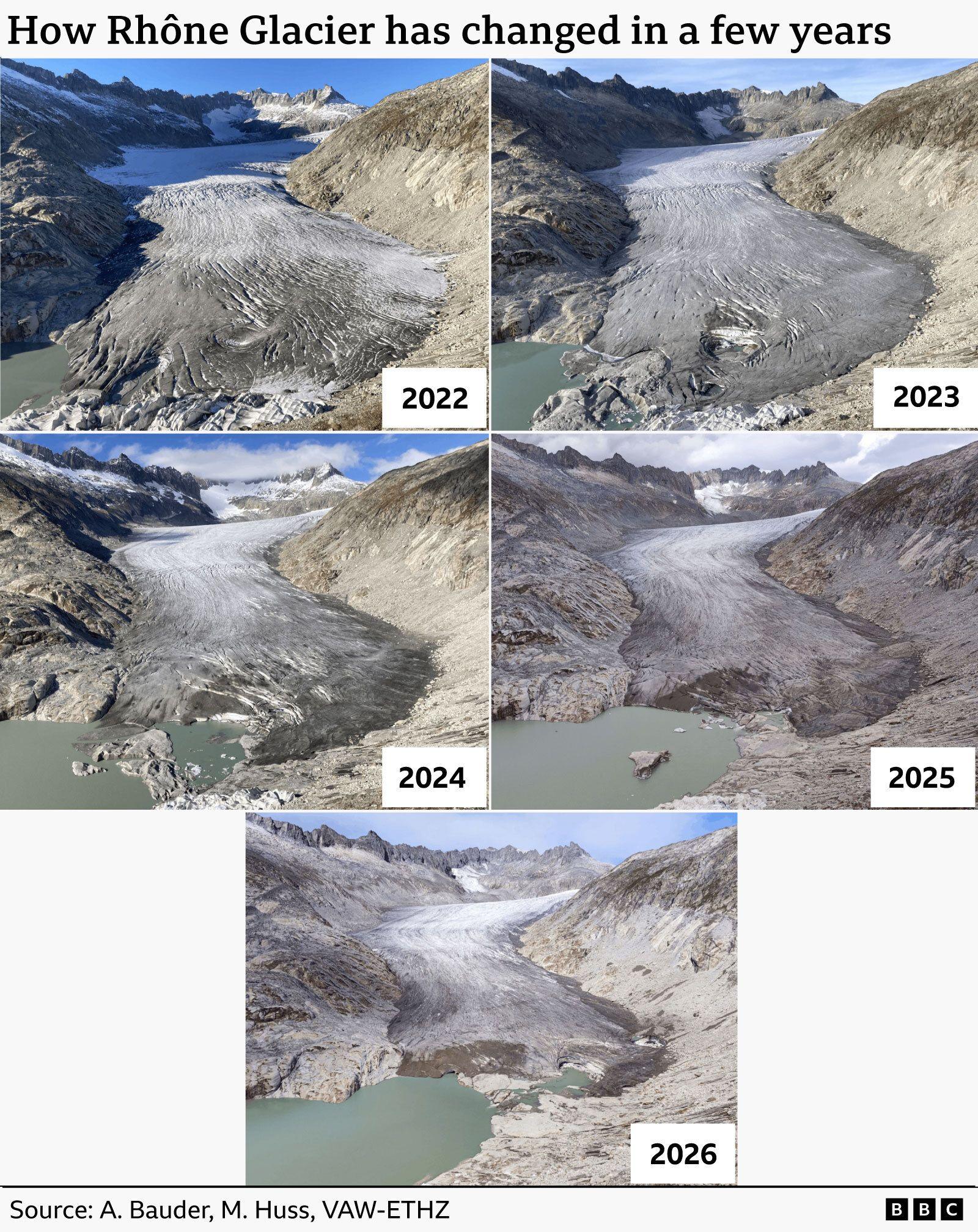
Swiss glaciers lost an estimated 5.5% of their remaining ice in 2026, a near-record decline that scientists describe as extraordinary and disastrous. The loss was driven by intense summer heatwaves following a mild winter that left glaciers with less protective snow than usual. Early heat in May and June stripped away much of what remained, exposing darker ice that absorbs more solar energy and accelerates melting during subsequent heatwaves. Researchers say the pace of loss is especially alarming: until recently, losing 2% of glacier ice in a year was considered extreme.
The melt has immediate benefits and serious long-term costs. Swiss glaciers released an estimated 2.2 trillion litres of water between July and September, helping ease shortages during hot, dry weather. But that water represents ice accumulated over decades or centuries, and dwindling glaciers will be less able to support irrigation, hydropower and transport during future heatwaves. Low water levels in the Rhine already affected shipping and raised transport costs this summer.
Scientists also warn that glacier loss and thawing frozen ground can destabilise mountain slopes, increasing landslide and, in extreme cases, flash-flood risks. This year, even glaciers at elevations around 3,500 metres had lost their seasonal snow cover; some recorded four metres of ice loss at their highest points. Without snow surviving the summer to replenish ice, glaciers shrink and can eventually disappear. Some Alpine glaciers, including Plattalva in eastern Switzerland, are already gone, and scientists say the climate is now too warm for many others to survive.
Researchers stress that cutting carbon emissions can still protect substantial amounts of glacier ice, particularly in the Himalayas and polar regions. Preserving these ice masses could also limit sea-level rise, which threatens billions of people living in coastal areas.
Entities: Swiss glaciers, Switzerland, Dr Matthias Huss, Glacier Monitoring Switzerland, Dr Fabien Maussion • Tone: analytical • Sentiment: negative • Intent: inform
01-10-2026
Swiss glaciers lost 5.5% of their ice volume in 2026, marking the second-largest annual decline on record, according to a new report from the Glacier Monitoring in Switzerland (GLAMOS) network. Experts attribute the exceptional loss to limited snowfall during winter and record summer temperatures, amid unprecedented heat waves in Europe. GLAMOS chief Matthias Huss described 2026 as “a catastrophic year” for the glaciers.
The losses are part of a steep longer-term decline: Switzerland’s glaciers have shed almost one-fifth of their ice over the past five years. The report warns that continued melting could threaten water supplies and raises broader questions about the long-term survival of Europe’s ice fields. Huss said Alpine glaciers cannot survive in the long term under current conditions. He also pointed to individual glaciers that may disappear within 10 to 15 years.
The article connects the melting to human-caused climate change. Huss said current warming is entirely attributable to anthropogenic climate change and argued that without human emissions or fossil fuels there would be no warming at present. The findings underscore the vulnerability of glaciers in Europe, described in the article as the world’s fastest-warming continent, and the consequences that continued ice loss may have for local communities and water resources.
Entities: Swiss glaciers, Switzerland, Europe, Glacier Monitoring in Switzerland (GLAMOS), Matthias Huss • Tone: analytical • Sentiment: negative • Intent: inform
01-10-2026
Swiss glaciers lost 5.5% of their ice in 2026, another year of severe decline linked by scientists to global warming. The loss was slightly below the 6% record set in 2022, largely because more winter snow covered the ice. However, some of Switzerland’s largest glaciers, including the Rhône and Aletsch, experienced record losses. Glacier researcher Matthias Huss, who leads the GLAMOS monitoring network, describes landscapes where ice has vanished and bare rock and alpine plants are appearing. Switzerland has already lost 1,200 smaller glaciers in the past 50 years, and researchers warn that all glaciers could disappear by the end of this century if warming continues at its current pace.
The decline threatens Europe’s water supplies. Glaciers act as “water towers,” storing winter snow and releasing meltwater in spring and summer to feed rivers such as the Rhine and Danube. Their water supports food production, transport and power generation. This summer, low river levels halted freight transport and forced some nuclear power stations to close temporarily. As glaciers shrink, rivers may eventually lose a crucial source of water, raising the risk of drought for farmers.
Ice and alpine permafrost also help stabilize mountain slopes. Their loss can increase the risk of landslides and flooding. The article cites the destruction of the Swiss village of Blatten, where a glacier collapse buried 300 homes; residents had been evacuated but remain in temporary accommodation. It also notes deadly floods on Nepal’s border with Tibet after a glacier collapse. Huss cautions that mountain disasters have multiple causes, but says climate change can act as a catalyst by warming permafrost and removing ice. He argues that the visible glacier losses are clear evidence of climate change and a warning to act.
Entities: Matthias Huss, GLAMOS (Swiss glacier monitoring network), Swiss Academy of Sciences (SCNAT), Switzerland, Swiss Alps • Tone: analytical • Sentiment: negative • Intent: warn
01-10-2026
Swiss glaciers have lost nearly 20 per cent of their mass over the past five years, according to experts cited in a new study by the Glacier Monitoring in Switzerland (GLAMOS) network. The study reports that glaciers lost 5.5 per cent of their volume in 2026, making it the second-biggest annual melt on record. The losses followed a record-hot summer and a winter with little snowfall, conditions that contributed to the severe melt.
GLAMOS chief and glaciologist Matthias Huss described the quantity of ice lost this year as enormous and called 2026 “a catastrophic year”. He warned that there could be no ice left in Switzerland in 10 or 15 years. The article emphasizes that Switzerland’s glaciers are disproportionately affected by climate change, and presents the recent loss as part of a rapid, continuing decline.
The report, published by the GLAMOS monitoring network and relayed by Agence France-Presse, focuses on the scale and pace of the glacier retreat. Its figures point to substantial losses both over the five-year period and in the latest year alone. The article does not provide further details about the study’s methods or discuss specific responses to the decline; its central message is the stark warning that, after another exceptionally destructive melt season, Swiss glacier ice could disappear within a relatively short time.
Entities: Switzerland, Swiss glaciers, Matthias Huss, Glacier Monitoring in Switzerland (GLAMOS), Agence France-Presse • Tone: urgent • Sentiment: negative • Intent: warn
01-10-2026
Swiss glaciers lost more than 5% of their ice in 2026, one of their worst years on record, according to a report from the Swiss Glacier Monitoring Network (GLAMOS) and the Swiss Commission for Cryosphere Observation of the Swiss Academy of Sciences. The losses followed a winter with little snowfall and record summer temperatures during a European heatwave. The report also found that Swiss glaciers have lost nearly a fifth of their ice over the past five years, intensifying concerns about the future of Europe’s ice fields and water supplies.
GLAMOS director Matthias Huss said extreme melting years are now occurring almost annually, describing the situation as worrying. Although this year’s losses did not quite match the record levels of 2022, the effects were severe. Switzerland’s largest glacier, the Aletsch, experienced its greatest melt ever in 2026. Glacier de Tsanfleuron lost more than four metres of average thickness, a change Huss said would have been unthinkable just a few years ago.
Scientists estimated that glaciers in Switzerland lost around 2.2 trillion litres of water between July and September alone—more than four times the annual drinking-water consumption of Swiss households. Meltwater can temporarily help relieve summer water shortages, but Huss cautioned that this benefit is declining as glaciers and ice-covered areas shrink. He also described the visible exposure of bare rock where snow had disappeared, saying the changed mountain colours made him sad. The article presents the scale and consequences of the melt while emphasizing that increasingly frequent extreme years signal accelerating glacier retreat.
Entities: Swiss glaciers, Switzerland, European heatwave, Swiss Glacier Monitoring Network (GLAMOS), Swiss Commission for Cryosphere Observation • Tone: analytical • Sentiment: negative • Intent: inform