01-10-2026
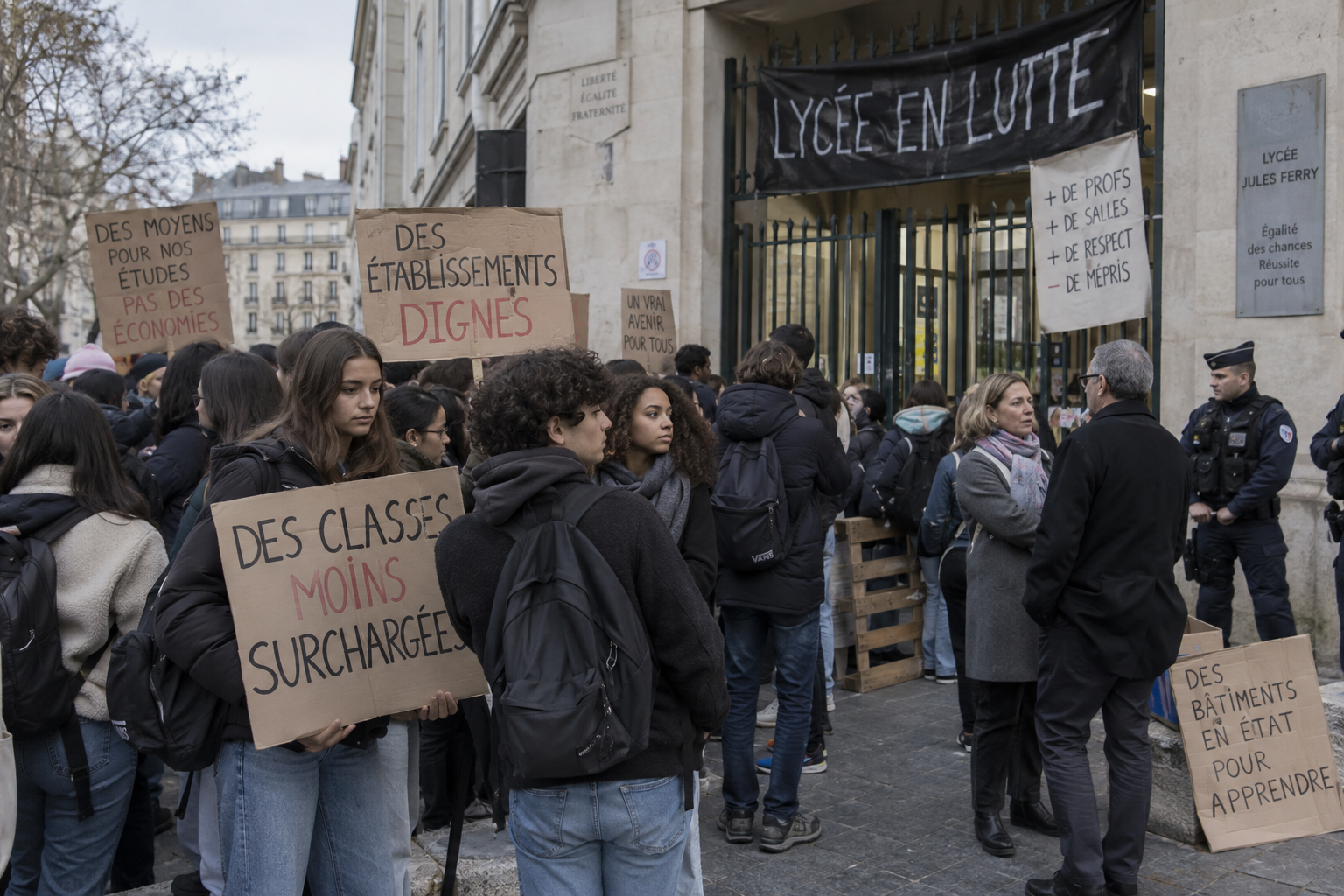
French high school protests over school conditions escalated on Wednesday, leading security forces to detain 625 people and leaving at least 83 police officers and gendarmes wounded, Interior Minister Laurent Nuñez said. Demonstrations have involved school blockades and violent clashes, affecting 356 schools. The unrest began the previous week in the Île-de-France region around Paris and spread to other cities. Students have raised concerns about timetables, large classes, teacher shortages and classrooms overheated during this year’s heatwaves.
Nuñez condemned what he described as an expansion of the movement and an escalation of violence, citing projectiles thrown at law enforcement, verbal abuse, attempted arson and other acts he characterized as urban violence. Education Minister Edouard Geffray said 119 students and staff members had been injured since the unrest began. He urged that students be able to return to class, particularly those prevented from attending because of the blockades.
The most affected cities included Paris, Bordeaux, Lyon and Lille. Police used tear gas during clashes in Lille. Speaking in Madrid, President Emmanuel Macron criticized hard-left politicians whom he accused of legitimizing violence. A student in Lille, Juan, said protesters opposed vandalism and were demonstrating to defend their rights, pointing to long school days from 8 a.m. to 6 p.m. The article presents both the government’s concerns about violence and students’ stated grievances about school resources and schedules.
Entities: French high school protests, Lycées, Laurent Nuñez, Edouard Geffray, Emmanuel Macron • Tone: neutral • Sentiment: negative • Intent: inform
01-10-2026
French school protests escalated on Wednesday, with security forces detaining more than 600 people and dozens of police officers and gendarmes reported wounded, according to the interior minister. The protests have included blockades of high schools and violent clashes. The report does not provide further details about the arrests, the identities of those detained, the severity of the injuries, or the locations of individual clashes.
Students have been protesting outside schools since the previous week. Their grievances concern school conditions, including timetables, class sizes, and a shortage of teachers. They have also raised concerns about classrooms becoming overheated during this year’s heatwaves. The article presents these issues as the context for the demonstrations, while noting that the protests have grown more confrontational.
The item is a France 24 “On the ground” video report from Paris by Caroline Baum, issued on October 1, 2026. Its headline emphasizes the scale of detentions and injuries as the protests intensify. The available text does not include interviews, student or government responses beyond the interior minister’s statement, or additional reporting on how authorities and school communities plan to address the complaints. It therefore offers a concise account of the escalation and the students’ stated concerns, rather than a detailed examination of the causes or consequences.
Entities: France, Paris, France 24, Caroline Baum, French security forces • Tone: neutral • Sentiment: negative • Intent: inform
01-10-2026
France 24 reports that protests over conditions at French high schools escalated on Tuesday, with teenagers setting fire to rubbish bins and throwing projectiles at police. Officers responded with batons and tear gas. The clashes took place amid continuing student blockades and demonstrations at hundreds of high schools, where pupils are demanding better conditions. The article describes the schools as lycées, which serve students aged 15 to 18 during the final three years of secondary education in France. It adds that the movement has angered the French government.
The report is presented as a short video item, credited to France 24 journalist Catherine Viette, and was issued on October 1, 2026. The supplied article text does not specify the particular conditions students are protesting, identify the locations of the clashes, give figures for arrests or injuries, or provide responses from students, police, or government officials. It therefore establishes the broad scale and confrontational nature of the demonstrations but offers limited detail about their causes or the authorities’ position. Related headlines visible on the webpage refer to other stories, including separate coverage of school protests, but they are not part of this article’s reporting. Overall, the item describes a developing confrontation between student demonstrators and police, with blockades continuing across many schools and demands for improved conditions at the center of the protests.
Entities: French teenagers, France, French government, France 24, Catherine Viette • Tone: neutral • Sentiment: negative • Intent: inform
01-10-2026
Violent student protests over staff shortages and deteriorating school buildings escalated across France on Thursday, with attacks and fires reported at schools in Marseille and Nantes. In Marseille, hundreds of young people surrounded a fire truck responding to a blaze at Saint-Exupery high school, forced firefighters out, and set the vehicle on fire. A headteacher at Victor Hugo high school, also in Marseille, was doused in petrol and injured in an attack, according to prosecutors. In Nantes, a fire broke out at Nelson Mandela high school. Officials said it was brought under control, nobody was injured, and the building was evacuated; students arriving for classes were turned away.
The demonstrations and school blockades began the previous week and have left dozens injured. Hundreds of people, most of them teenagers, have been arrested. The unrest has become a political challenge for the government as it announced unpopular spending cuts in its 2027 budget. Prime Minister Sebastien Lecornu’s office held a crisis meeting about the protests on Thursday.
Students have also accused police of using heavy-handed tactics, including teargas. In Saint-Denis, a protester displayed a sign asking whether students could explain themselves without being teargassed. The government condemned violence while acknowledging that problems in high schools need to be addressed. Interior Minister Laurent Nunez said troublemakers were moving between schools to incite violence. Education Minister Edouard Geffray urged schools to hold classes remotely when protesters blocked their premises, saying violence would not deprive students of their right to education. The report describes both the immediate risks to people and school property and the wider dispute over education conditions, policing, and government spending.
Entities: France, Marseille, Nantes, Saint-Denis, Saint-Exupery high school • Tone: neutral • Sentiment: negative • Intent: inform
01-10-2026
The France 24 video report, titled “Why are French students blocking their school entrances?”, describes a continuing wave of high-school blockades across France. On Thursday, students again attempted to establish “blocus” protests at the entrances to their schools. The article presents the actions as protests and poses the central question of what the students are demanding, but the supplied page text does not spell out their specific demands. Instead, it directs viewers to a video in which France 24 journalist Tanishk Saha explains the reasons behind the movement.
The report also gives a figure from French Interior Minister Laurent Nuñez: 625 people, mostly students, were detained during blockade attempts on Wednesday. Nuñez said he had observed “an expansion of the movement.” The page’s related headline about clashes between teenagers and police suggests the blockades had intensified, but the article text provided here offers no further details about those confrontations, the locations involved, or the students’ stated objectives.
The material is therefore a brief news-video introduction rather than a full transcript. Its focus is the spread of school entrance blockades, the number of detentions reported by the interior minister, and the question of what is motivating the student protests. Because the video itself is not transcribed in the supplied content—and the page indicates that the player may not load—the students’ specific demands cannot be confirmed from this text alone.
Entities: France, France 24, Tanishk Saha, Laurent Nuñez, French high school students • Tone: analytical • Sentiment: neutral • Intent: inform
01-10-2026
French security forces detained more than 600 people on Wednesday as student protests at high schools intensified and spread beyond the Paris region. Interior Minister Laurent Nunez said demonstrations affected 356 schools. Clashes, projectile-throwing and arson attempts left 83 police officers and gendarmes wounded, along with 32 teachers and pupils. Nunez condemned what he described as an escalation of violence and acts amounting to urban violence.
Students at French lycées have been blockading schools since the previous week. They say they are protesting overcrowded classrooms, heavy workloads, poor-quality learning materials and shortages of teachers. One 17-year-old student, Fadila, told Reuters that her school had cockroaches and rats, and that classroom temperatures could range from sweltering to below freezing. The movement began in the Ile-de-France region around Paris and spread to other parts of the country. Paris, Bordeaux, Lyon and Lille were among the cities most affected on Wednesday; AFP reported that police again used tear gas during clashes in Lille.
President Emmanuel Macron acknowledged that students’ concerns were legitimate but said they did not justify violence or attacks on police and teachers. He argued that schools should remain open as places for sharing knowledge, rather than being blockaded or having rubbish bins set on fire. Macron and Nunez also accused far-left groups of encouraging violence. Nunez said some individuals had moved between schools to agitate and incite students.
Politicians and officials criticized the left-wing La France Insoumise party and its presidential candidate, Jean-Luc Melenchon, over rhetoric they said was fueling anger. Melenchon accused the government of a crackdown with “obvious racist undertones” and urged supporters to back the protests. Prime Minister Sebastien Lecornu rejected the racism accusation as an insult, saying it divided the debate rather than helping restore calm.
Entities: France, French high schools (lycées), Student protests and school blockades, Ile-de-France, Paris • Tone: analytical • Sentiment: negative • Intent: inform