27-09-2026
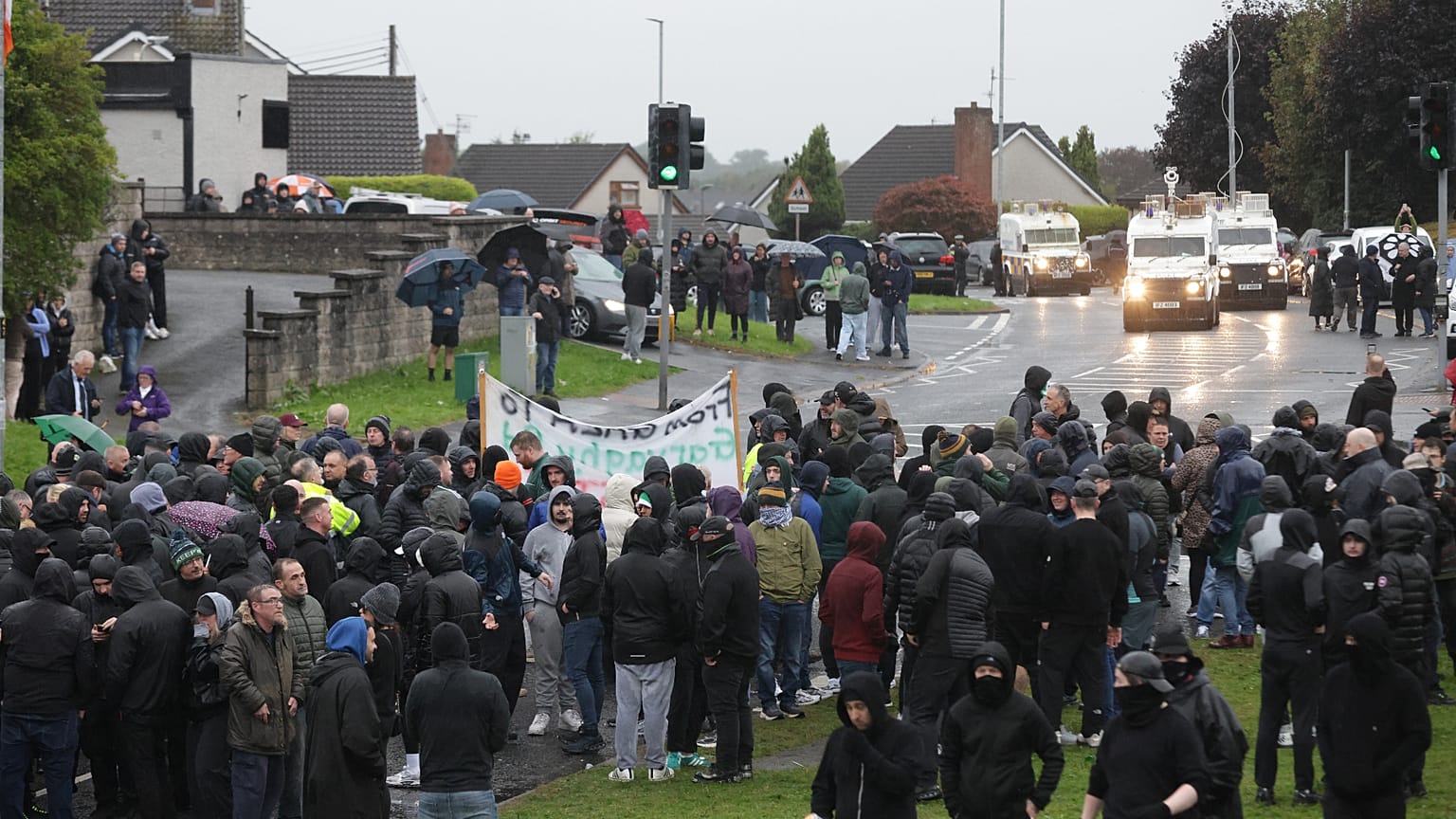
Thousands of protesters blocked an Orange Order parade from proceeding along the Garvaghy Road in Portadown, Northern Ireland, after a High Court ruling in Belfast allowed the march to go ahead. The demonstration followed days of uncertainty and a court hearing that ended at 2:15 a.m. Sunday. Many protesters wore balaclavas, and Sinn Féin President Mary Lou McDonald and Northern Ireland First Minister Michelle O’Neill were among those present. O’Neill urged the crowd to remain until at least midnight.
The parade, which celebrates Northern Ireland’s Protestant heritage and its links with the United Kingdom, was the first permitted to travel along the route in nearly 30 years. The Garvaghy Road was a flashpoint during the years before the 1998 Good Friday Agreement, which largely ended the violence known as the Troubles. About 3,600 people were killed and 50,000 wounded during that conflict.
The dispute reflects Northern Ireland’s competing national identities: Irish nationalists, most of them Catholic, generally seek unity with the Republic of Ireland, while largely Protestant unionists favor remaining in the U.K. Democratic Unionist Party leader Gavin Robinson criticized O’Neill for joining what he called an unlicensed protest and accused her and Sinn Féin of disregarding the courts and police. O’Neill defended her presence, arguing that the parade’s actions and support from political unionists threatened progress made over the past 28 years.
Police Service of Northern Ireland head Jon Boutcher said calls for calm had been heeded and expressed hope that events would conclude peacefully. The article reports that both sides appeared to be responding to appeals from across the political spectrum to avoid escalating tensions. It also explains that the Orange Order is named for William of Orange, the Protestant prince who took the British throne after defeating Catholic King James in the 17th century.
Entities: Portadown, Garvaghy Road, Northern Ireland, Orange Order parade, Good Friday Agreement • Tone: analytical • Sentiment: neutral • Intent: inform
27-09-2026
The Orange Order, a Protestant and pro-British organization, was scheduled to march on Sunday along Garvaghy Road in Portadown, a largely Catholic and Irish nationalist area of Northern Ireland. It was the first time since 1997 that the parade had been permitted to pass through the area. The march was approved after a series of legal challenges, with a court ruling overnight allowing it to proceed. A previous rejection of the Order’s application had been overturned by the High Court because of a procedural error; a new application was subsequently approved.
The parade was limited to 35 Orange Order members walking silently, without bands or other Order supporters. Around 2,000 people gathered in a counterprotest on Sunday morning. UK Prime Minister Andy Burnham urged calm, saying that progress had been made in Northern Ireland and should not be undone. First Minister Michelle O’Neill, of the Irish republican Sinn Fein party, opposed the decision and supported local residents’ right to protest, describing the march as unwanted and sectarian. Democratic Unionist Party MP Carla Lockhart argued that residents had nothing to fear from a small, silent and orderly procession.
Garvaghy Road was a focal point of the Drumcree dispute in the late 1990s, when repeated clashes between residents and marchers caused disorder amid the wider conflict between Irish nationalists and British unionists. The Good Friday Agreement, signed in 1998, largely ended three decades of conflict known as the Troubles and established the Parades Commission to regulate contentious processions. The Commission had repeatedly rejected the Orange Order’s requests to march through the area before the latest legal and application process led to approval.
Entities: Orange Order, Garvaghy Road, Portadown, Northern Ireland, Andy Burnham • Tone: neutral • Sentiment: neutral • Intent: inform
27-09-2026
About 2,000 protesters gathered in heavy rain in Portadown, Northern Ireland, on 27 September, blocking the Garvaghy Road to prevent an Orange Order procession from entering the mainly Catholic and nationalist area. Police monitored the gathering using vehicles and a helicopter. The 35 Orange Order members authorised to participate stayed inside a nearby church while the road remained blocked. The procession was permitted to travel without bands or supporters and would have been the first such march along the route since 1998. It was scheduled to start at 8am and finish by 9.30am, but the Police Service of Northern Ireland said the road was not clear, delaying it.
The impasse followed a series of late-night court rulings. A High Court judge initially stopped the parade on Saturday, citing the potential for the longstanding dispute to escalate. Shortly before midnight, the Court of Appeal reversed that decision. Chief Justice Siobhan Keegan said the High Court judge had “unfortunately erred in law”. A further High Court challenge was dismissed in the early hours of Sunday.
The ruling drew criticism from nationalist leaders. First Minister Michelle O’Neill questioned why the route had been reopened after 28 years, while Sinn Féin president Mary Lou McDonald called on the British government and police to stop the procession. Prime Minister Andy Burnham appealed for calm and warned against undoing progress made since the Good Friday Agreement. The confrontation also revived memories of the Drumcree dispute, during which Garvaghy Road became a major flashpoint during the Troubles.
Entities: Portadown, Northern Ireland, Garvaghy Road, Orange Order, Police Service of Northern Ireland (PSNI) • Tone: neutral • Sentiment: neutral • Intent: inform
27-09-2026
France 24 reports heightened tensions in Northern Ireland after Belfast’s High Court approved a controversial Orange Order parade through a Catholic area. About 2,000 protesters blocked the route where the Protestant march was scheduled to pass. The march is notable because it is the first time in nearly 30 years that the Orange Order has been permitted to use this route, which had been a notorious flashpoint during the Troubles. The article connects the dispute to Northern Ireland’s history of sectarian conflict and notes that the 1998 Good Friday Agreement largely brought an end to the bloodshed. With the parade authorization bringing renewed attention to that history, UK Prime Minister Andy Burnham appealed for calm from all sides. He said he did not want to see Northern Ireland “go backwards.” The report focuses on the court decision, the protest and the risk of heightened tensions around the march. It does not provide further details about the court’s reasoning, the protesters’ identities, or what happened after the report was issued.
Entities: Northern Ireland, Belfast, High Court in Belfast, Orange Order, Andy Burnham • Tone: neutral • Sentiment: neutral • Intent: inform
27-09-2026
Around 2,000 protesters blocked an Orange Order parade from proceeding through Garvaghy Road, a Catholic area of Portadown, Northern Ireland, despite a High Court decision allowing the march. The standoff followed the lifting of a nearly 30-year ban on the contentious route. Northern Ireland First Minister Michelle O’Neill and Sinn Fein leader Mary Lou McDonald joined the protesters, who gathered overnight in the rain after the court rejected residents’ last-minute attempt to stop the parade. The Orange Order members, limited by the Parades Commission to 35 participants, assembled elsewhere in town but did not begin marching while they waited for police clearance. Police in riot gear warned protesters that blocking the route was a criminal offence, while officers and police vehicles remained between the opposing groups.
The route had been banned in 1998 after repeated unrest surrounding the Drumcree dispute. That year, the Good Friday Agreement largely brought an end to the three decades of violence known as the Troubles. The Orange Order describes its marches as part of Protestant cultural tradition, while nationalists say parades through Catholic areas are offensive and intimidating displays of triumphalism. Leaders in both Ireland and Britain called for calm. British Prime Minister Andy Burnham said Northern Ireland should not go backwards, while Irish premier Micheál Martin criticized the Parades Commission’s decision as “incomprehensible” and “wrong.” O’Neill warned that the dispute raised questions about how the peace process operates. Democratic Unionist Party leader Gavin Robinson, by contrast, accused ministers of participating in an unlawful protest and disregarding the police, courts and rule of law. Britain’s minister for Northern Ireland, Chris Bryant, could revoke the commission’s ruling at police request, but he said no such request had been made.
Entities: Portadown, Garvaghy Road, Northern Ireland, Orange Order, Michelle O’Neill • Tone: neutral • Sentiment: negative • Intent: inform