27-08-2026
Japanese avant-garde artist Yayoi Kusama has died at the age of 97. Her studio announced on her official website that she died on August 14, although no cause of death was provided. The statement said Kusama continued painting until her final days and expressed a commitment to carrying forward her message of love, creativity, hope and strength through art.
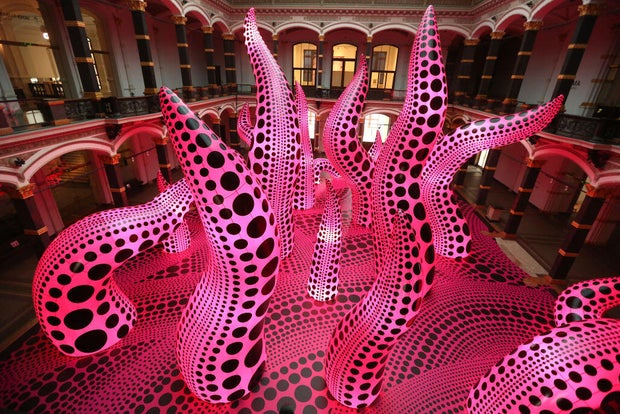
Kusama was internationally known for transforming hallucinations and psychological distress into an expansive artistic practice featuring obsessive polka-dot paintings, pumpkin motifs, mirrored “infinity rooms”, soft sculptures and experimental performances. In 2024, the National Gallery of Victoria in Melbourne mounted a major retrospective containing nearly 200 works, including an unprecedented number of infinity rooms. By April 2025, the exhibition had attracted more than 500,000 visitors, making it the most visited exhibition in Australian history. Her works are also held or displayed by the National Gallery of Australia in Canberra and the Art Gallery of New South Wales in Sydney.
Born in Matsumoto City in 1929, Kusama experienced visual and auditory hallucinations, anxiety and dissociation from childhood. She moved to New York at 27 to pursue art and quickly became part of the avant-garde scene, exhibiting alongside Andy Warhol, James Rosenquist and Claes Oldenburg. Her early installations included phallic soft sculptures and the room-sized work Aggregation: One Thousand Boats Show. During the 1960s, she also staged anti-war “Kusama Happenings”, experimental films, public performances and events associated with the hippie movement.
At the 1966 Venice Biennale, she unofficially presented Narcissus Garden, an installation of 1,500 mirrored balls that she sold to visitors. She later represented Japan at the 1993 biennale, becoming the first solo woman to do so. After returning to Japan, Kusama voluntarily entered a mental hospital around 1977 and continued working daily at a nearby studio. She described art as her method of coping with pain, anxiety and fear, and said in 2017 that she continued to experience hallucinations that inspired her paintings.
Entities: Yayoi Kusama, National Gallery of Victoria, National Gallery of Australia, Art Gallery of New South Wales, Matsumoto City, Japan • Tone: analytical • Sentiment: neutral • Intent: inform
27-08-2026
Yayoi Kusama, the pioneering Japanese contemporary artist celebrated for her vivid polka dots, mirrored environments and repetitive motifs, has died at 97. Her studio said she died Aug. 14 at a hospital in Tokyo and continued painting until her final days. In a statement, the Yayoi Kusama Studio said she remained committed to exploring “forever love and eternal soul” and hoped her art would bring hope and strength to people worldwide.
Kusama was one of Japan’s most internationally respected artists. Her work was exhibited at major institutions including New York’s Museum of Modern Art and the Whitney Museum of American Art. Although dots became her most recognizable trademark, she also used nets, swirls, worms, mirrors, lights and sculptural forms to create immersive works with a psychedelic, repetitive quality.
Kusama said she had experienced hallucinations since childhood and that she painted the world as she saw it—covered in spots. She spent decades in and out of psychiatric institutions, but her mental illness did not prevent her from becoming one of the first Japanese women to travel to New York to pursue art, arriving in 1957. She struggled with poverty and obscurity while working against the prevailing popularity of action painting, yet continued developing her distinctive style.
In New York, Kusama befriended artists including Andy Warhol, Georgia O’Keeffe and Joseph Cornell. Her late-1960s anti-war “happenings,” which involved placing circles on people and a horse, attracted media attention and sometimes led to arrests for obscenity. Her body of work later expanded to films, novels, sculptures and installations such as “Fireflies on the Water,” “Mirrored Corridor” and “Infinity Mirrors.”
As public interest in her work grew, Kusama collaborated with brands such as Louis Vuitton and licensed her designs for products. Her work sold for millions, and she received Japan’s Order of Culture in 2016. Despite being labeled pop, avant-garde or feminist, she resisted categories that she felt failed to capture her art. Until the end of her life, Kusama described herself as both frightened and defiant, insisting that devotion to her art was central to her legacy.
Entities: Yayoi Kusama, Yayoi Kusama Studio, Tokyo, New York, Museum of Modern Art • Tone: emotional • Sentiment: neutral • Intent: inform
27-08-2026
Japanese artist Yayoi Kusama has died at the age of 97. The article traces her career from childhood hallucinations and social pressures in Japan to her emergence as an internationally recognized avant-garde artist. Kusama began seeing dots and net-like patterns around age 10, experiences she later connected to psychological distress and transformed into recurring artistic motifs. She described her art as an expression of her life and mental illness, while treating creative work as both a survival strategy and a form of therapy.
After studying at the Kyoto School of Arts and Crafts, Kusama held exhibitions in Matsumoto before leaving Japan for New York in 1958. Supported initially by her mother and encouraged by Georgia O’Keeffe, she became part of the New York avant-garde. Her repetitive “Infinity Net” paintings, soft sculptures and performances attracted attention, although the article emphasizes that male contemporaries often achieved greater commercial success. Kusama addressed sexism, sexuality and war through works such as “Traveling Life” and through provocative antiwar “happenings” involving self-obliteration, nudity and sexual imagery.
Her 1966 installation “Narcissus Garden,” consisting of 1,500 mirrored spheres displayed at the Venice Biennale, criticized the commercialization of the art world. Kusama later represented Japan at the Biennale in 1993 and eventually achieved enormous global popularity. Exhibitions at The Broad in Los Angeles and Tate Modern in London sold out rapidly, while her works reached multimillion-dollar auction prices.
Kusama returned to Japan in 1973 and lived in a psychiatric clinic in Tokyo while continuing to produce paintings, sculptures and installations. Her immersive “Infinity Rooms,” polka-dot works and themes of infinity made her one of the world’s best-known contemporary artists. Despite lifelong mental-health challenges, she remained productive until late in life and expressed gratitude to her audience, saying she created art for the healing of humanity.
Entities: Yayoi Kusama, Georgia O’Keeffe, Andrew Solomon, Stephan Diederich, Museum Ludwig • Tone: analytical • Sentiment: neutral • Intent: inform
27-08-2026
Yayoi Kusama, the Japanese artist whose vivid paintings, sculptures and immersive installations made her one of the world’s most recognizable contemporary artists, has died aged 97. Her studio said she died in a Tokyo hospital on 14 August and had continued painting until her final days.
Born in Matsumoto in 1929, Kusama endured an abusive childhood and began experiencing hallucinations as a child. She transformed those visions—particularly swarming flowers and repeated patterns—into art, developing lifelong themes of infinity, repetition and “self-obliteration.” After studying traditional Japanese painting in Kyoto, she moved to New York in 1958, where her “infinity net” paintings attracted attention and were acquired by artists including Donald Judd and Frank Stella.
Kusama produced soft sculptures, performances and installations, frequently confronting sexuality, war and social conventions. Her provocative happenings included nude “body festivals,” a same-sex wedding staged in New York, and political protests. Despite her participation in the spheres of pop art and minimalism, she argued that the art world marginalized her and that white male artists appropriated ideas she had developed.
Following the death of artist Joseph Cornell and worsening mental-health problems, Kusama returned to Japan. In 1977 she entered a psychiatric hospital in Tokyo, where she lived permanently while working daily at a nearby studio. Her international recognition grew substantially later in life, particularly after her 1993 Venice Biennale presentation and the expansion of her mirrored-room installations and pumpkin sculptures.
Kusama’s colorful, selfie-friendly “infinity rooms” brought her work to a mass global audience through museums and social media. The article presents her career as a remarkable movement from obscurity and personal suffering to late-life acclaim and superstar status.
Entities: Yayoi Kusama, Infinity Mirror Rooms, Matsumoto, Japan, Tokyo, Japan, New York • Tone: analytical • Sentiment: positive • Intent: inform
27-08-2026
The Washington Post obituary portrays Yayoi Kusama as a pioneering, controversial and ultimately globally celebrated Japanese artist whose work transformed personal hallucinations, psychological distress and anxieties about sex into immersive visual experiences. Kusama died Aug. 14 in a Tokyo hospital at age 97; her website announced her death without giving a cause.
Largely self-taught, Kusama rose from relative obscurity to become one of the world’s most recognizable and commercially successful contemporary artists. Her signature motifs included polka dots, repetitive brushwork, pumpkins, phalluses and mirrored environments. Her “Infinity Nets” paintings began after she moved to New York in 1958, while her “infinity mirror” rooms later used mirrors, LED lights and reflective objects to create seemingly endless, hypnotic spaces. The installations became especially popular with social-media audiences, drawing long lines at museums and broadening her public beyond the traditional art world.
The article also examines Kusama’s experimental career in 1960s New York. Her sexually charged “Accumulations” works and nude happenings challenged patriarchy, conservative conventions and the Vietnam War. Events such as the “Nixon Orgy” and “Grand Orgy to Awaken the Dead” generated considerable publicity, though critics dismissed some of the performances as exhibitionism rather than serious art.
Kusama’s career was interrupted in the early 1970s as her mental health deteriorated. After nervous breakdowns and suicide attempts, she entered a Japanese psychiatric hospital in 1975 and became a permanent resident in 1977, maintaining a nearby studio and continuing to work. Her later fame expanded through museum exhibitions, merchandise, fashion collaborations with Marc Jacobs and Louis Vuitton, and a Macy’s Thanksgiving Day Parade balloon. The obituary concludes its provided excerpt with her childhood in Matsumoto, her family’s troubled marriage and the hallucinations that first shaped her artistic practice.
Entities: Yayoi Kusama, Tokyo, Matsumoto, Japan, New York avant-garde art scene, Infinity Nets • Tone: analytical • Sentiment: neutral • Intent: inform