26-07-2026
President Trump reportedly changed travel plans during and after a NATO summit in Turkey because U.S. officials detected a credible threat from Iran and affiliated proxy groups targeting the presidential aircraft. According to officials cited by CBS News, intelligence indicated a possible missile attack on the plane, prompting the Secret Service to adopt a backup plan and have Trump fly part of the trip on the older Air Force One rather than the newly donated Qatari Boeing 747-8. The article says Trump traveled to Ankara on the newer aircraft, but returned from Ankara to the United Kingdom on the older plane before switching back to the newer jet for the final leg to the United States.
The report notes that the temporary switch raised questions about the security of the Qatari-gifted aircraft, which is still undergoing retrofitting and will receive additional upgrades in the fall. White House press secretary Karoline Leavitt said the newer plane is safe but will be enhanced for about a month, during which Trump will continue using the older aircraft. The piece also places the travel decision in the context of heightened U.S.-Iran tensions, citing Trump's own public statements on Truth Social about possible Iranian assassination threats and his warnings of severe U.S. retaliation if such threats are carried out.
Entities: Donald Trump, Air Force One, Iran, Iranian proxy groups, U.S. Secret Service • Tone: analytical • Sentiment: negative • Intent: inform
26-07-2026
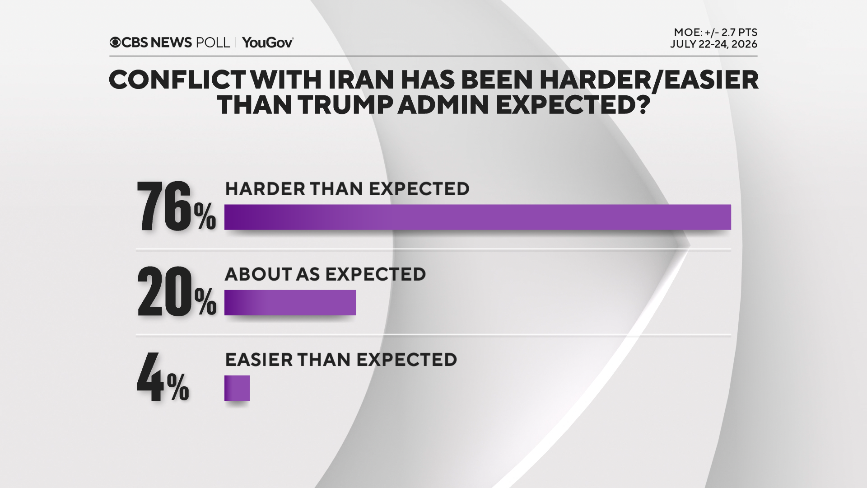
A CBS News/YouGov poll finds that Americans view the Iran conflict with growing uncertainty and frustration, with most saying they do not have a clear sense of what is happening day to day in the Strait of Hormuz. Respondents broadly agree on the conflict’s major U.S. objectives: reopening the strait, stopping Iran’s nuclear program, and preventing Iran from threatening the region. But many also believe the war is not going well and will likely drag on for months or years. The article says a majority still prefer ending the war rather than pushing Iran for more concessions, though that preference has weakened since a ceasefire deal collapsed, especially among Republicans who had previously backed the president’s approach.
The poll suggests Americans think President Trump is not providing clarity about the conflict and often makes the situation sound better than it is. Perceptions of the war’s trajectory have worsened over time, while views of who has the advantage remain mixed. Despite the conflict’s importance, approval of Trump’s handling of Iran is stable but net negative and remains lower than his overall approval rating.
The story also connects the war to domestic concerns, especially rising gas prices, inflation, tariffs, and a general sense that incomes are not keeping up. Those who feel most burdened by the economy are more likely to oppose tariffs and are more negative about the military action. The article concludes with polling methodology details, noting the survey was conducted July 22-24, 2026 among 2,193 U.S. adults with a ±2.7-point margin of error.
Entities: Iran, Strait of Hormuz, United States, Trump administration, President Trump • Tone: analytical • Sentiment: negative • Intent: inform
26-07-2026
The article argues that President Trump, despite his self-image as an unpredictable and forceful leader, has become increasingly constrained by the Iran war he launched with the stated goals of destroying Iran’s nuclear program and weakening its government. Months into the conflict, those goals remain largely unmet, while the war has worsened oil markets, disrupted shipping routes, and strained U.S. military resources. The piece portrays Trump as frustrated and erratic, repeatedly rewriting deals and shifting course on unrelated issues as he searches for a way to claim victory without escalating further.
A central theme is that Trump now faces an unwelcome set of choices: intensify military action, rely more heavily on economic pressure, or declare victory and withdraw. Each path has major downsides. Military escalation could cause civilian casualties, deepen humanitarian catastrophe, and expose dwindling U.S. missile-defense stockpiles. Economic coercion may not force Iranian compliance and could further destabilize the region. Declaring victory risks looking weak and abandoning his own stated objectives. The article also highlights how the war has reverberated beyond Iran, including Trump’s abrupt reversal on a Saudi civil nuclear agreement, new tariffs on Canada, and frustration among Republicans over his refusal to sign a bipartisan housing bill.
Overall, the article depicts a president whose claims of dominance are colliding with the practical limits of military power, diplomatic trust, and political control.
Entities: Donald Trump, Iran, Iranian nuclear program, Strait of Hormuz, Red Sea • Tone: analytical • Sentiment: negative • Intent: analyze