26-06-2026
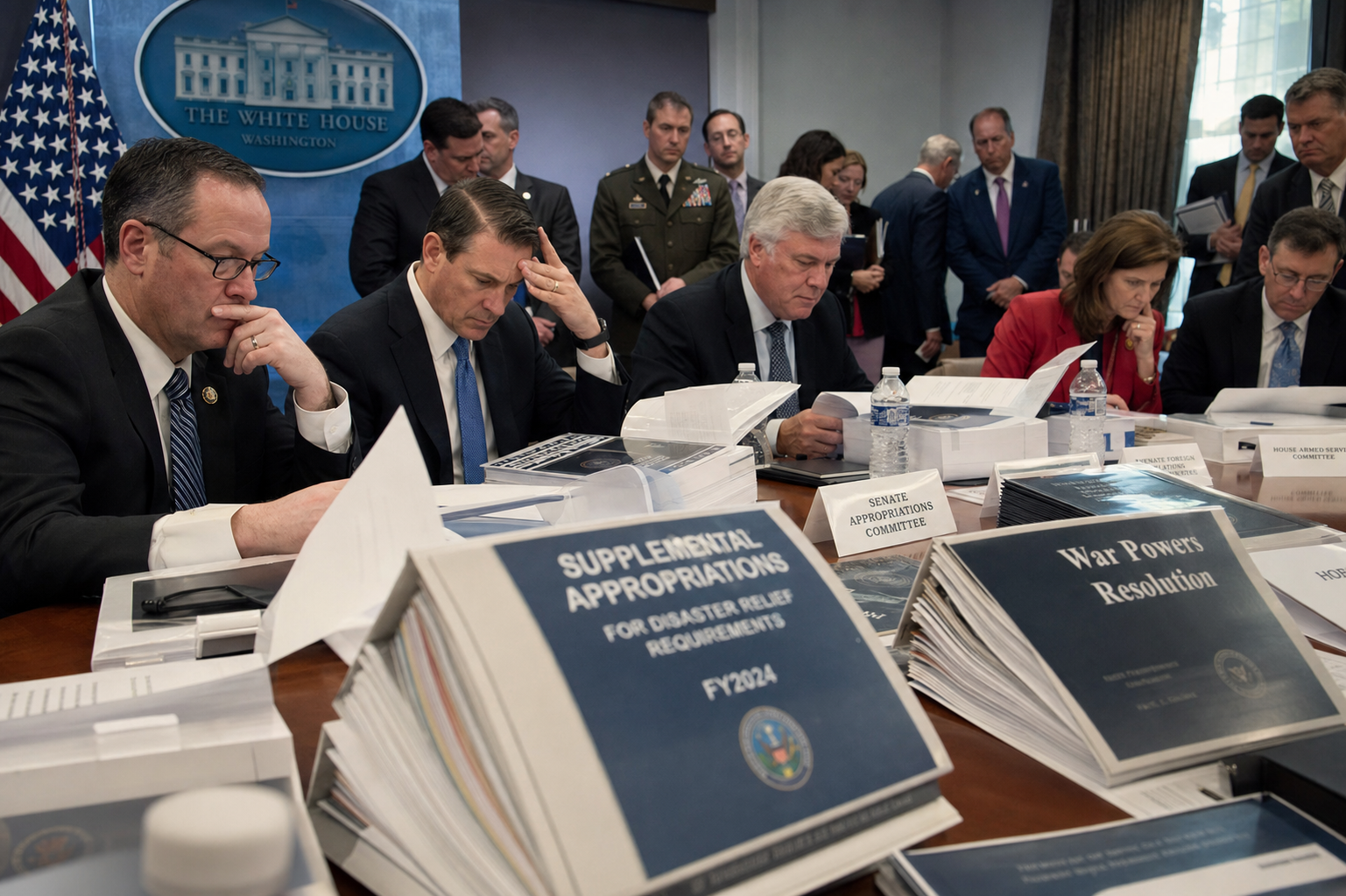
The article reports that the White House has asked Congress to approve $87.6bn in funding, much of it tied to the US war with Iran, even as lawmakers have moved to rein in President Donald Trump’s war powers. The request comes immediately after Congress passed a resolution rebuking the military action, exposing a growing clash between the president and some Republican senators. The largest portion of the request, $67bn, would go to the Department of Defense, with additional money for munitions, operations, classified programs, and embassy security in the Middle East and South Asia. The package also includes funds for unrelated priorities such as farmers and an Ebola response in Central Africa.
The article emphasizes the political difficulty Trump faces. The conflict is unpopular with voters ahead of the midterm elections, the ceasefire with Iran is still in effect, and several Republicans have shown openness to limiting the president’s authority. A tense meeting on Capitol Hill highlighted the divisions, including an alleged shouting match between Trump and Senator Bill Cassidy, who had initially backed a war powers measure. Cassidy later said he had received a briefing from top Trump aides and then changed his vote to help defeat a similar resolution.
The piece also places the funding request in the context of the war’s cost and uncertainty. While the Pentagon has estimated spending at $29bn so far, analysts and lawmakers believe the true financial damage is greater. Overall, the article presents a politically fraught effort by Trump to secure war funding while facing scrutiny from Congress, skepticism within his party, and public unease about the conflict.
Entities: Donald Trump, Bill Cassidy, Mike Johnson, JD Vance, Steve Witkoff • Tone: analytical • Sentiment: neutral • Intent: inform
26-06-2026
GOP Sen. Bill Cassidy of Louisiana says he changed his position on a Democrat-led war powers resolution after a tense exchange with President Donald Trump at a Senate Republican lunch and a subsequent White House briefing. Cassidy had previously supported efforts to restrict Trump’s war powers regarding Iran because, he said, senators were not being briefed adequately on the administration’s objectives and strategy. After Trump confronted Republican senators who backed the measure, Cassidy says he passed a note to Middle East envoy Steve Witkoff requesting a briefing, which was arranged the same evening. Following that briefing, Cassidy voted against the latest Democratic attempt to advance the resolution, helping Republicans defeat it. Cassidy explained that the briefing persuaded him the administration had a plausible plan to meet its stated goals in Iran, including degrading nuclear, ballistic missile, and conventional military capabilities. He also reflected on the heated exchange with Trump, saying he lost his temper, but emphasized that his main concern was obtaining enough information to serve his constituents responsibly. The article highlights both the political tension within the GOP over Iran policy and Cassidy’s claim that access to briefings, rather than loyalty to Trump, drove his vote change.
Entities: Bill Cassidy, Donald Trump, Steve Witkoff, Louisiana, Senate Republican lunch meeting • Tone: analytical • Sentiment: neutral • Intent: inform
26-06-2026
President Donald Trump’s meeting with Senate Republicans on Wednesday became tense and confrontational, especially over questions about Iran, war powers, and Trump’s legislative demands. According to sources familiar with the meeting, Trump and Louisiana Sen. Bill Cassidy got into a heated exchange after Cassidy pushed back on the president and at one point told him to sit down, prompting Trump to sternly tell Cassidy to do the same. Cassidy later said he raised his voice to match Trump’s and defended his willingness to stand up for the American people.
The meeting centered largely on the Senate’s recent actions related to limiting Trump’s ability to take further military action against Iran. Senate Democrats had advanced a resolution on Tuesday, with four Republicans joining them, while a separate Tim Kaine-led measure failed later on Wednesday. Trump reportedly expressed frustration with Republicans who supported the Iran resolution, including Cassidy, and also criticized Alaska Sen. Lisa Murkowski, who arrived late and later questioned Trump’s decision not to sign a housing bill.
Trump also used the meeting to push Senate Republicans to back the SAVE America Act, a voter citizenship verification bill that GOP leaders say lacks the votes to pass. He canceled plans to sign a bipartisan housing bill unless Congress first passed the SAVE America Act, and he suggested eliminating the Senate filibuster to get it through. Senators described the lunch as lively and spirited, though several acknowledged Trump’s disappointment and the awkwardness of the exchange. The article portrays both the personal friction between Trump and senators and the broader intraparty conflict over Iran policy, legislative priorities, and Senate procedure.
Entities: Donald Trump, Bill Cassidy, Lisa Murkowski, John Cornyn, Tommy Tuberville • Tone: analytical • Sentiment: neutral • Intent: inform
26-06-2026
The article reports that the Trump administration submitted an $87.6 billion supplemental funding request to Congress to cover costs related to the Iran war, while also seeking money for Ebola response, farm aid, and a policy change to allow year-round sales of E15 gasoline. Most of the request—$67 billion—would go to the Pentagon for munitions, operational costs, and classified programs, with additional funds requested for the Department of Energy and the State Department. The proposal is expected to face serious resistance in Congress, particularly from Democrats, and could put vulnerable Republicans in a difficult political position because support may be viewed as endorsement of the unpopular war. The article notes that some Republicans have already moved to limit Trump’s military actions in Iran, including support for a war powers resolution this month. Democratic leaders Chuck Schumer and Patty Murray sharply criticized the request as an attempt to funnel money to unrelated Pentagon priorities and to bail out what they called a disastrous war. In contrast, GOP Sen. Roger Wicker defended the funding as essential and argued it would accelerate production of key weapons and defense capabilities. The request also includes $11.1 billion in farm aid, $1.4 billion for Ebola response in Central Africa, and a proposal to permanently authorize E15 sales to help lower gas prices and support domestic fuel production.
Entities: Trump administration, Congress, Iran war, Pentagon, Ebola outbreak • Tone: analytical • Sentiment: negative • Intent: inform