24-08-2026
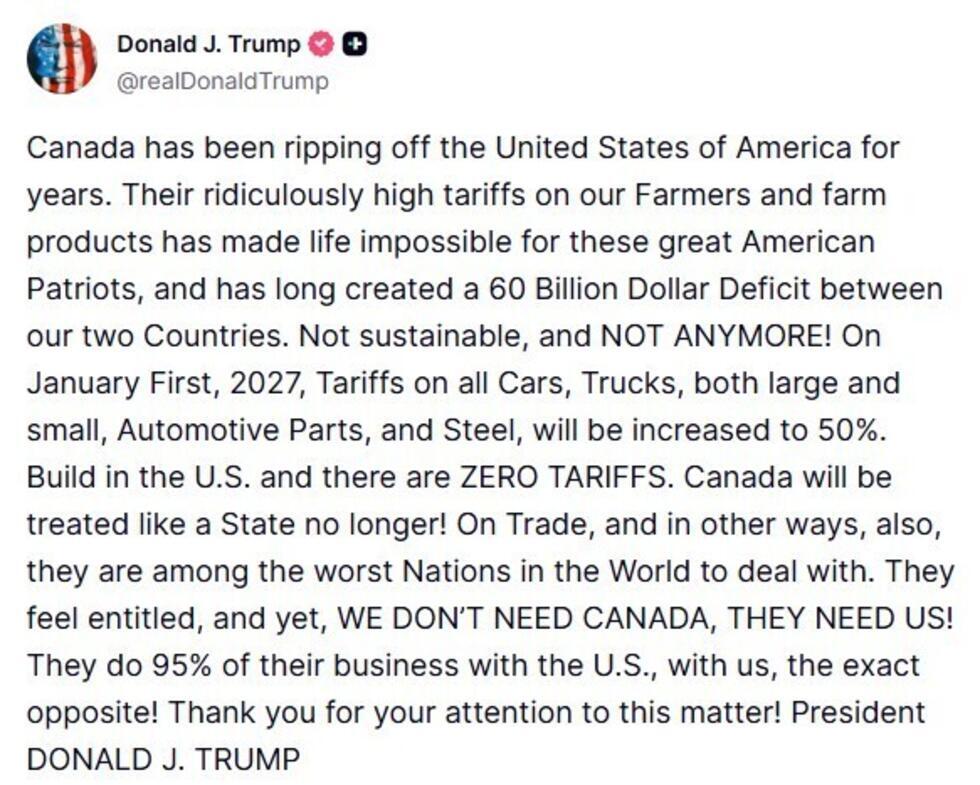
US President Donald Trump announced that the United States will impose 50% tariffs on Canadian automobiles, car parts and steel beginning January 1, 2027. The announcement escalates a trade dispute between the two neighboring countries after negotiations collapsed late the previous week. The current US tariff on Canadian automobiles is 25%, meaning the proposed measure would represent a substantial increase for the Canadian auto industry.
Trump said on social media that Canadian goods built in the United States would face no tariffs and accused Canada of taking advantage of the US. He also wrote that Canada would be treated like a US state, while arguing that the United States does not need Canadian trade. His announcement followed the implementation of 50% US tariffs on approximately $20 billion worth of other Canadian products, including hockey sticks, fishing rods, wine and dairy goods. The affected goods represent about 5% of Canada’s annual exports to the United States.
Canadian Prime Minister Mark Carney said Ottawa would impose retaliatory tariffs starting September 8 on US steel, dairy products, appliances, agricultural equipment, pulp and paper, and electronics. Because roughly 70% of Canadian exports go to the United States, Canada may be more economically vulnerable in the confrontation.
The two governments have offered conflicting explanations for the breakdown in negotiations. Carney accused Washington of weaponizing economic integration and said Canada had been attacked by the new tariffs. US chief trade negotiator Jamieson Greer argued that the United States was responding to a year of Canadian retaliation and said the measures were intended to protect American workers and supply chains. Canada had not yet responded to Trump’s latest tariff announcement, and no additional negotiations were scheduled.
Entities: Donald Trump, Mark Carney, Jamieson Greer, Canada, United States • Tone: urgent • Sentiment: negative • Intent: inform
24-08-2026
US President Donald Trump announced that tariffs on Canadian cars, trucks, automotive parts and steel will rise to 50% from 25% on 1 January 2027. He accused Canada of having “ripped off” the United States for years and criticized what he called high Canadian tariffs on US farmers. The announcement followed the collapse of negotiations between Washington and Ottawa aimed at avoiding new 50% duties on certain Canadian goods.
Canadian Prime Minister Mark Carney said Canada had rejected a “bad” deal because it could not accept the US offer or meet its demands. The tariffs that took effect on Saturday affect approximately $20 billion worth of Canadian goods. Carney warned that Canada would respond dollar for dollar, targeting sectors including steel, dairy, appliances, agricultural equipment, pulp and paper, and electronics in order to protect Canadian workers and businesses.
The Office of the United States Trade Representative described the breakdown as a missed opportunity and accused Canada of maintaining prolonged retaliation against the US. It claimed that Canadian demands and reversals had disrupted a balance reached during earlier negotiations.
The dispute is part of Trump’s broader tariff strategy during his second presidential term. His administration argues that tariffs will strengthen US manufacturing, create domestic jobs and address unfair trade practices. Critics say higher duties increase costs for American consumers and companies while creating uncertainty for investment, supply chains and cross-border commerce. Trump has also repeatedly suggested that Canada should become the 51st US state, intensifying tensions between the two longtime trading partners.
Entities: Donald Trump, Mark Carney, United States, Canada, Office of the United States Trade Representative • Tone: analytical • Sentiment: negative • Intent: inform
24-08-2026
US President Donald Trump has threatened to raise US tariffs on Canadian cars, trucks, automotive parts and steel to 50% from January 1, 2027, doubling the current 25% tariff on non-US automotive content. The announcement followed the collapse of trade negotiations between Washington and Ottawa over measures aimed at avoiding new US tariffs on selected Canadian goods.
Canadian Prime Minister Mark Carney said Canada had negotiated patiently and pragmatically but would not accept an agreement “at any price.” He said the United States had made excessive last-minute demands, including limits on Canada’s ability to negotiate trade agreements with other countries, reduced tariff relief for Canadian-made vehicles, and weaker protections for Canadian language, culture and sovereignty. Canada has announced retaliatory tariffs and accused Washington of weaponising the two countries’ economic integration.
US Trade Representative Jamieson Greer defended the measures, saying they were necessary to protect American workers and supply chains after a year of Canadian retaliation. He argued that the United States had offered Canada better terms on sensitive products, but that Ottawa had rejected the proposal. Ontario Premier Doug Ford backed Carney’s decision, warning that the agreement would have harmed the province’s auto, steel and manufacturing sectors.
The dispute threatens to deepen an already escalating trade war and casts doubt on the future of the North American trade agreement involving the United States, Canada and Mexico. The countries exchanged $880 billion in goods and services last year, while their largely undefended border supports extensive daily movement of people and trade. The confrontation represents a major break from the traditionally cooperative US-Canadian relationship, with Carney saying the countries will not return to their previous economic partnership.
Entities: Donald Trump, Mark Carney, Jamieson Greer, Doug Ford, United States • Tone: analytical • Sentiment: negative • Intent: inform
24-08-2026
NPR examines the reaction in Canada after Prime Minister Mark Carney rejected a proposed trade agreement with the United States, despite President Donald Trump’s earlier claim that the two countries had reached a deal. The agreement was not final, and Canada withdrew from negotiations three days after Trump’s announcement. In response, the United States imposed new 50% tariffs on a broad range of Canadian imports and threatened additional tariffs on Canadian automobiles. Carney said Canada would respond by matching U.S. tariffs “dollar for dollar.”
Speaking with NPR’s Adrian Florido, Globe and Mail columnist Andrew Coyne says Carney’s decision was not entirely surprising, but that many Canadians were puzzled by how close the government had come to accepting terms that appeared to offer Canada little in return. According to Coyne, the negotiations involved more than tariffs: U.S. demands reportedly would have restricted Canada’s ability to sign trade agreements and trade freely with other countries. Such conditions were viewed as unacceptable because they threatened Canadian sovereignty and conflicted with Canada’s strategy of reducing its dependence on the United States.
Coyne says Carney’s decision has received broad support across Canada, even though businesses are deeply concerned about the consequences of a trade war. He identifies the auto industry, particularly in Ontario, as especially vulnerable. Coyne also argues that the dispute is changing Carney’s political identity. Although Carney has a business background and is generally inclined toward dealmaking, he is now presenting himself as a leader confronting what many Canadians see as an existential threat.
The crisis is prompting a broader Canadian debate about the risks of relying too heavily on the United States. Coyne says there is growing determination to diversify Canada’s economy and ensure the country is never again so exposed to U.S. trade policy.
Entities: Canada, United States, Mark Carney, Donald Trump, Andrew Coyne • Tone: analytical • Sentiment: negative • Intent: inform
24-08-2026
Canadian Prime Minister Mark Carney has rejected a proposed trade agreement with the United States because, according to his government, it would have weakened protections for the French language and Quebec’s Francophone culture. Carney said American negotiators viewed French-language rules as an “irritant,” but emphasized that language rights in Quebec are fundamental and not bargaining chips. He instructed Canadian negotiators to abandon the talks, declaring that Canada would not accept the US demands.
The breakdown has intensified an already serious trade conflict. New US tariffs on a range of Canadian products began over the weekend, affecting approximately 5% of Canada’s exports to the United States. Canada says it will retaliate in early September. US President Donald Trump has threatened further tariffs on Canadian cars, trucks, auto parts and steel, accusing Canada of exploiting the United States and insisting that Canada needs the US more than the reverse.
Quebec Premier Christine Fréchette supported Carney’s decision, saying the province’s language and culture were central to its identity. The article explains that Quebec laws requiring French descriptions on products and promoting French-language content have long frustrated US negotiators. US trade representative Jamieson Greer denied that French-language protections were being negotiated, arguing instead that Washington objected to Canadian policies requiring US streaming companies to help fund Canadian content. Carney rejected that characterization.
The dispute has produced strong political reactions across Canada. Quebec businesses have described the tariffs as a worst-case scenario, while anti-Trump sentiment has risen sharply in the province. Support for Quebec independence has declined amid the economic uncertainty, and sovereigntist politician Paul St-Pierre Plamondon said a possible referendum should be delayed until Trump leaves office. Ontario Premier Doug Ford responded to Trump with an aggressive warning, reflecting the increasingly confrontational atmosphere between the two countries.
Entities: Mark Carney, Donald Trump, Dominic LeBlanc, Canada, United States • Tone: analytical • Sentiment: negative • Intent: inform
24-08-2026
US President Donald Trump has announced a new 50% tariff on Canadian automobiles, trucks, automobile parts and steel, with the measures scheduled to begin on 1 January 2027. The announcement marks another deterioration in the historically close economic relationship between the United States and Canada.
Trump criticized Canada’s trade policies toward American farmers and claimed on Truth Social that Canada had been taking advantage of the US for years. He argued that Canada depends heavily on the American market because it conducts 95% of its business with the United States, while insisting that the US does not need Canada.
Canadian Prime Minister Mark Carney said the move was largely expected after the US imposed earlier tariffs. He described the American measures as unjustified and questioned their impact on workers in US states such as Michigan, Ohio, Kentucky and Alabama. Carney emphasized that Canada is the largest customer for American automobiles, buying more than the European Union, Japan, South Korea and the United Kingdom combined.
The tariff announcement followed the collapse of negotiations over a possible agreement to reduce duties on cars and other materials. Trump had recently imposed another 50% tariff on $20bn in Canadian exports, including hockey equipment and electronics. Carney rejected the latest proposed deal, saying the US had demanded too much while offering too little, and pledged to respond with equivalent tariffs.
The two countries trade approximately $909bn annually, but Carney has said Trump’s second term and his aggressive tariff agenda have ended an era of deep bilateral economic ties. He said Canada remained prepared to negotiate, but only if the US returned to the table with a more constructive attitude and a genuine partnership.
Entities: Donald Trump, Mark Carney, Canada, United States, Quebec • Tone: analytical • Sentiment: negative • Intent: inform
24-08-2026
The supplied content does not contain the body of the AP News article. It consists almost entirely of AP News navigation menus, section labels, newsletters, and unrelated headlines. The only article-specific information available is the title, “Canada will announce retaliatory tariffs on US Tuesday,” and a related headline stating that Canada would announce retaliatory tariffs as President Donald Trump told Canadian and other leaders to “fall in line.”
Based on that limited material, the article concerns an escalating trade dispute between Canada and the United States. Canada was expected to announce retaliatory tariffs on Tuesday in response to U.S. trade actions or threatened measures. The wording suggests that Trump was applying pressure on Canada and framing compliance with U.S. demands as necessary. Canada’s planned response would represent an effort to counter that pressure through reciprocal trade penalties.
The dispute appears to involve broader bilateral economic relations and the use of tariffs as a political and negotiating tool. However, the supplied text does not provide the tariff rates, affected products, implementation schedule, legal authority, statements from Canadian officials, or details about the U.S. measures that prompted the response. It also does not include the article’s reporting, context, quotations, or analysis. Ontario is referenced in the URL and surrounding AP navigation, but the available text does not explain the province’s role. Consequently, this summary is limited to the headline-level information provided and should not be treated as a complete summary of the original article.
Entities: Canada, United States, Donald Trump, Ontario, AP News • Tone: urgent • Sentiment: negative • Intent: inform
24-08-2026
CNBC’s Daily Open highlights a widening use of U.S. economic power against both allies and adversaries, alongside renewed pressure in financial markets. U.S.-Canada trade talks collapsed over the weekend, leading Washington to impose 50% tariffs on certain Canadian imports. Canadian Prime Minister Mark Carney said Ottawa would respond with dollar-for-dollar retaliatory tariffs beginning Sept. 8, while President Donald Trump accused Canada of seeking the benefits of U.S. statehood without formally joining the country.
The article also focuses on Treasury Secretary Scott Bessent’s expected announcement of sweeping sanctions against Iran. Bessent has described the planned measures as potentially the “single greatest financial offensive ever marshalled against an adversary” and said the administration’s goal is to pressure Iran’s economy sufficiently to avoid major military operations. The United States is urging allies and other countries to stop doing business with Iran, a demand Tehran has condemned as an assertion of extraterritorial sovereignty.
Markets are also under pressure as longer-term U.S. Treasury yields resume their rise. The 30-year yield reached 5.273%, while the 10-year yield rose to approximately 4.734%, weighing on U.S. stock futures. Asian markets were mixed, with Japan’s Nikkei 225 higher and South Korea’s Kospi lower.
In technology, Anthropic is preparing for a possible initial public offering amid growing public resistance to artificial intelligence and the data centers needed to support it. That opposition is expected to appear as a risk factor in the company’s IPO prospectus, alongside competition, margin pressure from open-source models, and the possibility of slower data-center construction.
The article concludes with Meta’s antitrust trial, which could force changes to features such as infinite scrolling, autoplay videos, disappearing content, beauty filters, and algorithmic feeds. Analysts warn that the case could make social media substantially different if the states prevail.
Entities: Donald Trump, Scott Bessent, Mark Carney, United States, Canada • Tone: analytical • Sentiment: negative • Intent: inform