24-07-2026
CNN’s live updates describe an escalating U.S.-Iran conflict entering its 13th consecutive night of strikes, with no immediate ceasefire in sight. The U.S. military says it carried out another wave of attacks on Iranian military targets, while Iranian state media reported at least four deaths and claimed Iran responded by targeting U.S. assets in Bahrain and Jordan. President Donald Trump indicated he is not ready to negotiate, saying the U.S. needs “more of the same,” and he also asserted that damage caused by Houthi attacks on ships in the Red Sea would be paid for using frozen Iranian assets. Iran’s foreign minister Abbas Araghchi condemned that idea as an “incendiary precedent.” The article also reports that Iran rejected a ceasefire proposal reportedly relayed by the Iraqi prime minister because it did not resolve the status of the Strait of Hormuz. Separately, oil prices surged above $100 per barrel amid the regional violence, and the UK said its forces were prepared to defend against any Iranian retaliation after Tehran threatened RAF Fairford over the use of UK bases by U.S. bombers. The live blog includes additional context on a new U.S.-Saudi civilian nuclear agreement, with Trump adding a condition that Saudi Arabia join the Abraham Accords and denying that the deal would permit uranium enrichment. Overall, the story frames a fast-moving regional war with military escalation, diplomatic rejection, energy-market shock, and widening international implications.
Entities: United States, Iran, President Donald Trump, Abbas Araghchi, Houthi rebels • Tone: urgent • Sentiment: negative • Intent: inform
24-07-2026
The article reports that debate inside the Trump administration has resurfaced over whether U.S. policy toward Iran should remain limited to military pressure aimed at protecting maritime traffic or expand into a broader effort to weaken or even help bring down the Islamic Republic. The discussion, according to a Financial Times column cited by Fox News, includes possible support for an internal uprising and renewed backing for armed Iranian opposition groups such as Kurdish factions. That debate is unfolding as the U.S. continues strikes on Iranian military targets in response to attacks on American personnel and threats to shipping in the region.
At the same time, President Donald Trump is portraying diplomacy as still possible. He told reporters that Iran is seeking secret talks and is desperate to negotiate because it is being "decimated." Trump said the administration has not ruled out discussions, though he emphasized that Iran has not yet come to the table in a meaningful way. Secretary of State Marco Rubio also framed the mission narrowly, saying U.S. strikes are aimed at assets used to attack global commercial shipping, not regime change.
The article contrasts that official position with the broader strategic question now being debated: whether continued strikes and sanctions are simply part of a maritime-security mission centered on the Strait of Hormuz, or whether they could evolve into a campaign to destabilize Iran’s leadership. Experts quoted in the piece say formal regime collapse is not currently the declared military objective, even if weakening the regime remains a longer-term aspiration and some targets, such as suspected nuclear facilities, could be treated differently.
Entities: Donald Trump, Iran, United States, U.S. Central Command (CENTCOM), Marco Rubio • Tone: analytical • Sentiment: neutral • Intent: analyze
24-07-2026
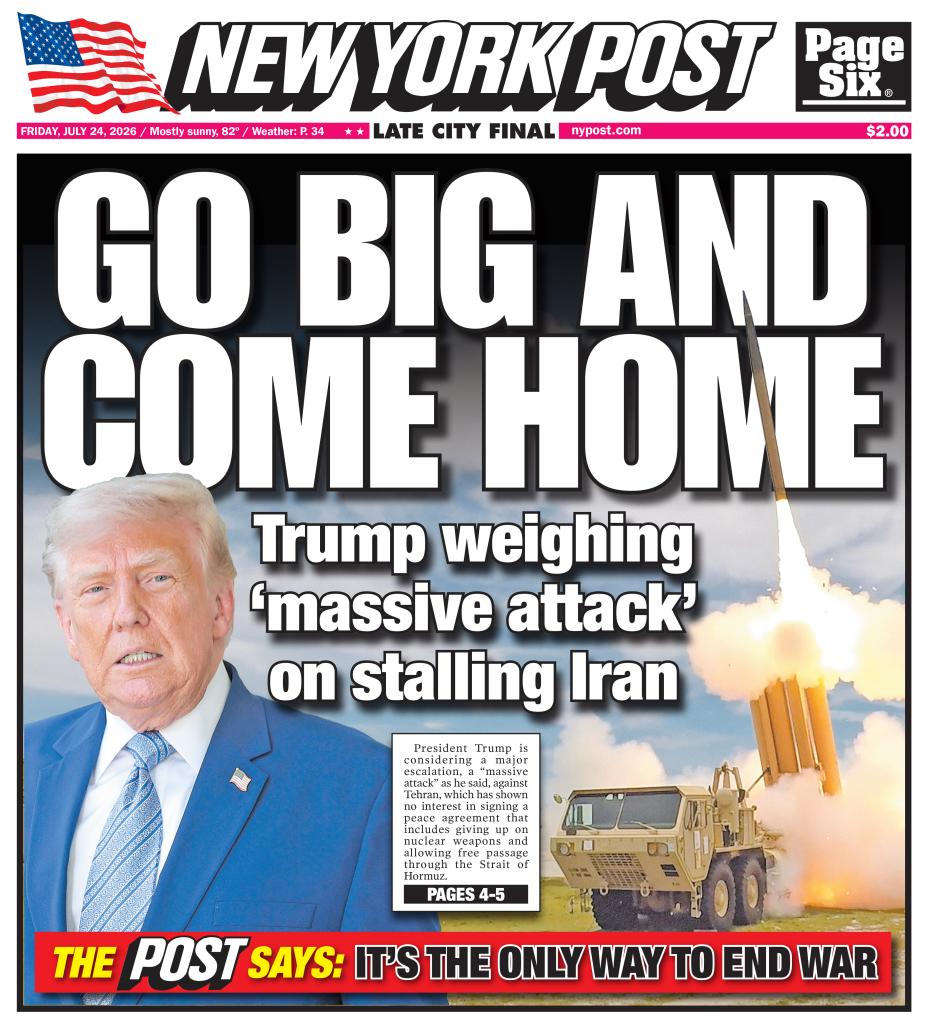
This opinion piece argues that the Trump administration should respond to Iran’s continued aggression with a major military strike in order to force Tehran back to serious negotiations. The author claims that Iran’s leaders are not genuinely interested in peace, pointing to attacks on U.S. servicemembers, anti-American propaganda, and efforts to exert control over strategic waterways such as the Strait of Hormuz and the Red Sea chokepoints via the Houthis. In the writer’s view, Iranian negotiators are merely stalling while the real decision-makers exploit American restraint. The article contends that only a credible threat of overwhelming force — described by President Trump as a “massive attack” — will convince Iran’s leadership that the United States is serious. It explicitly rejects a ground invasion, but supports heavy, targeted strikes and sustained pressure until a real agreement is reached. The overall message is that deterrence through force, not diplomacy alone, is necessary because Iran interprets restraint as weakness.
Entities: Donald Trump, Iran, Tehran, Revolutionary Guard, Houthis • Tone: urgent • Sentiment: negative • Intent: persuade
24-07-2026
According to a Reuters report cited in the article, Iran allegedly sent Islamic Revolutionary Guard Corps (IRGC) commanders, military advisers, missile and drone equipment, and even gold to Yemen to bolster Houthi rebels before the group’s attacks on commercial shipping in the Red Sea. The article frames the move as part of a widening regional confrontation that threatens vital maritime trade routes, especially the Bab-el-Mandeb strait (called the “Gate of Tears”) and, indirectly, the Strait of Hormuz. It says the Houthis’ attacks on Saudi oil tankers helped push Brent crude above $100 a barrel and intensified fears that the rebels could attempt to shut down the Bab-el-Mandeb entirely. President Trump is quoted warning that the U.S. would hold Iran responsible for future Houthi attacks, calling the Houthis a surrogate or proxy of Iran and threatening major military punishment. The piece also notes that the Houthis claimed responsibility for attacking the Saudi tankers ENCELIA and LAYLA with missiles and drones in retaliation for a blockade decision. Overall, the article presents the reported Iranian support for the Houthis as part of a broader effort to pressure shipping lanes and energy markets, while highlighting the potential consequences for global oil supply and regional security.
Entities: Iran, Islamic Revolutionary Guard Corps (IRGC), Houthis, Yemen, Red Sea • Tone: urgent • Sentiment: negative • Intent: inform
24-07-2026
Iran has rejected a cease-fire proposal delivered by Iraqi Prime Minister Ali al-Zaidi, who recently visited the White House and met with President Trump. According to the report, al-Zaidi brought a proposed temporary deal to Tehran on Trump’s behalf, but Iranian officials refused to consider it. The terms of the proposal were not fully disclosed, but Iranian leaders reportedly objected that it did not settle the core dispute over control of the Strait of Hormuz. Iranian Foreign Minister Abbas Araghchi said the issue was not simply about message delivery or intermediaries, but about what he described as America’s “illogical, greedy and controlling” outlook.
The rejection comes amid a sharp escalation in U.S.-Iran hostilities. The article says U.S. forces carried out a 13th straight night of airstrikes against Iran, targeting military command centers, drone storage facilities, communication networks, coastal surveillance sites, and maritime capabilities. U.S. Central Command said the strikes were aimed at reducing the threat to civilian and commercial shipping in the Strait of Hormuz, while asserting that the waterway remains open and that commercial vessels are still moving with U.S. military support.
At the same time, Trump is considering what he described as a “massive attack” to pressure Iran back to negotiations, saying the U.S. is close to making a decision and fully prepared. He also said Israel could join the operation quickly if asked, though he emphasized that the U.S. does not need help to proceed. Overall, the article depicts rising military pressure, failed diplomacy, and the possibility of a broader regional escalation.
Entities: Iran, Iraqi Prime Minister Ali al-Zaidi, President Trump, White House, Tehran • Tone: urgent • Sentiment: negative • Intent: inform