23-08-2026
Former Ukrainian defence minister Mykhailo Fedorov has told the BBC that President Volodymyr Zelensky should answer questions about what he knew regarding alleged corruption within his inner circle. Fedorov said a recently announced money-laundering investigation raised legitimate questions about the president’s awareness, while stressing that he had never personally seen Zelensky engage in corruption or instruct him to break the law.
Fedorov was dismissed last month after reportedly falling out with the head of Ukraine’s armed forces. He was credited with modernising the defence ministry, expanding Ukraine’s use of drones and helping develop long-range strike capabilities. He said he had removed some corruption from defence procurement but warned that remaining problems continued to affect Ukraine’s military performance.
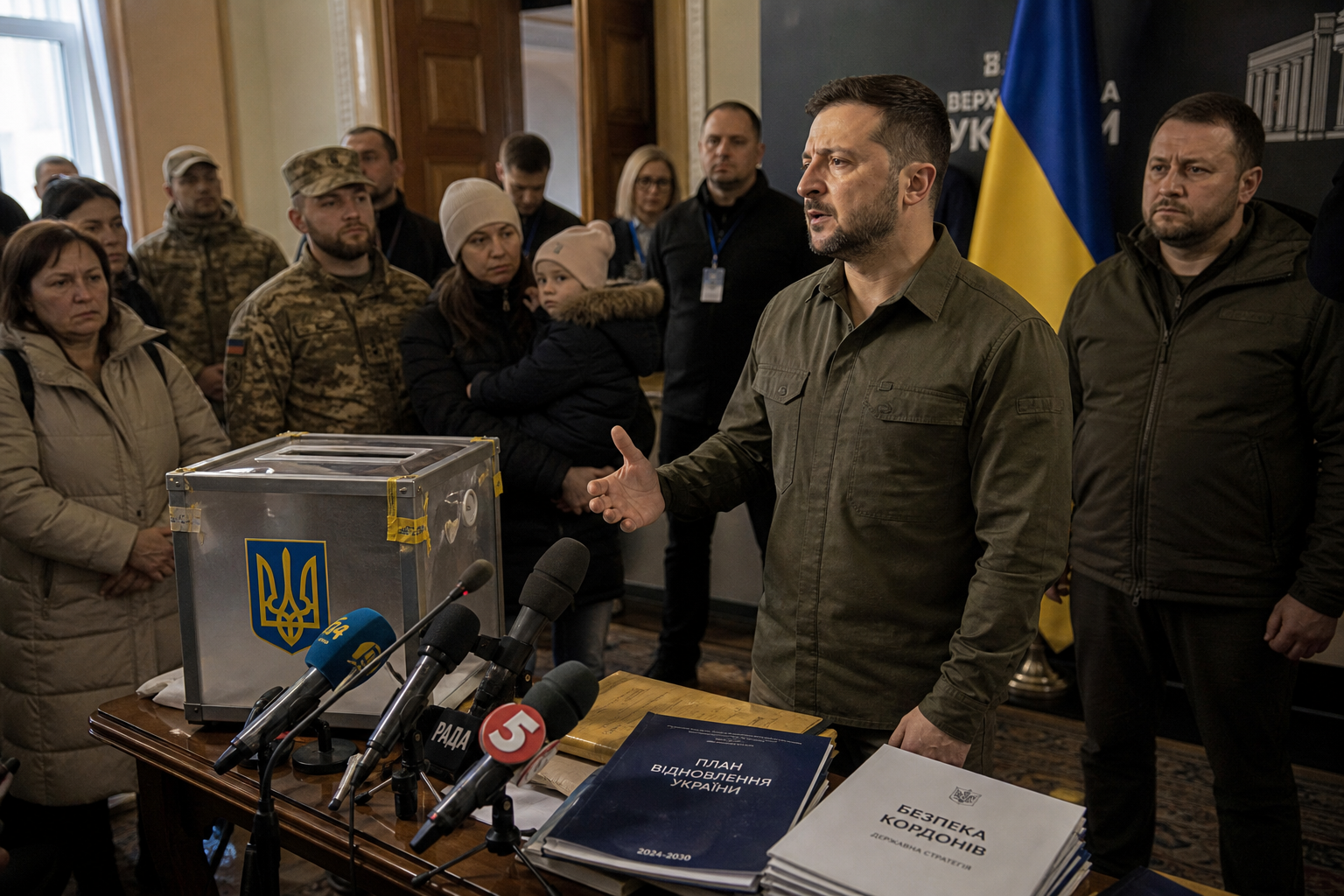
The former minister also renewed his call for presidential elections during wartime, arguing that democracy should not become “the hostage of Putin”. Ukraine has been under martial law since Russia’s full-scale invasion in 2022, and elections are currently suspended. Zelensky has said holding a vote now would be dangerously divisive. Experts also point to practical difficulties involving soldiers, refugees, residents of occupied territories and Russian disinformation.
Fedorov said he had no immediate political ambitions but did not rule out running for president in the future. He also discussed plans to continue working with technology companies, including Elon Musk, whose Starlink system has been important to Ukraine’s war effort. Fedorov criticised delays in Western weapons deliveries, including from the UK, and called for direct investment in Ukraine’s modern drone production rather than outdated equipment.
The article presents Fedorov’s allegations and political arguments alongside responses from Zelensky and his spokesperson, while providing background on the corruption investigation, the election debate and Ukraine’s military technology strategy.
Entities: Volodymyr Zelensky, Mykhailo Fedorov, Ukraine, Russia, BBC News • Tone: analytical • Sentiment: neutral • Intent: inform
23-08-2026
Ukrainian President Volodymyr Zelenskyy has rejected calls for Ukraine to hold presidential elections while the country remains at war with Russia, warning that a wartime vote could “destroy” or split the country. His comments followed a public demand from former Defence Minister Mykhailo Fedorov, whose dismissal last month created political unrest and made him a potential challenger to Zelenskyy.
Zelenskyy argued that elections are prohibited during active conflict under Ukrainian law and would be extremely difficult to organize because of security threats, millions of Ukrainians living abroad or under Russian occupation, and military personnel serving at the front. He said a vote might be possible if Ukraine’s international partners could guarantee security, but claimed no such plan had been proposed. A Kyiv International Institute of Sociology poll found that 57 per cent of Ukrainians preferred elections to be held only after the fighting ends, despite continued public interest in political change.
The president described a wartime election as a “tsunami for the state” and said his priority was to end the war while preserving Ukraine as an independent and sovereign country. He maintained that he still had a positive attitude toward Fedorov, a former ally credited with modernizing Ukraine’s military and advancing drone warfare, but said Fedorov had been drawn into the wrong course of action. Fedorov has not said whether he would run in a future election.
Zelenskyy also discussed tensions surrounding defence spending and a dispute involving Starlink. He said inaccurate information from the Defence Ministry led him to tell U.S. President Donald Trump that Elon Musk had approved the use of Starlink over Russian territory for Ukrainian deep-strike operations. Zelenskyy later learned that Musk had rejected the proposal, viewing it as a dangerous escalation. The president said the episode contributed to his decision to take action involving the defence ministry, although he did not directly accuse Fedorov of lying.
Entities: Volodymyr Zelenskyy, Mykhailo Fedorov, Ukraine, Russia, Ukrainian Defence Ministry • Tone: analytical • Sentiment: negative • Intent: inform
23-08-2026
Ukrainian President Volodymyr Zelenskyy has rejected calls to hold elections while the country remains under martial law and continues fighting Russia’s full-scale invasion. Responding to former Defense Minister Mykhailo Fedorov, Zelenskyy argued that elections during wartime would pose a serious risk of dividing and destabilizing Ukraine, describing them as a potential “tsunami for the country.” Elections are currently suspended under martial law, a policy that enjoys broad public support.
Fedorov made his proposal roughly a month after Zelenskyy dismissed him as defense minister. He retains considerable support among younger Ukrainians, some of whom have called for his return and suggested that he could challenge Zelenskyy in a future presidential contest. However, a recent poll reportedly found that Zelenskyy remains the more popular potential candidate. Zelenskyy criticized Fedorov’s position, saying he was moving, or being pushed, toward harmful decisions.
The Ukrainian president also warned that Russia could mobilize an additional 300,000 troops after parliamentary elections expected in September. He said Moscow might conduct another large-scale mobilization in 2027 as it seeks to seize the remaining Ukrainian-held parts of Donetsk, a major Russian strategic objective.
As Russian missile attacks continue, Zelenskyy announced an agreement with Germany for the delivery of 600 Patriot PAC-2 missile interceptors during 2027 and 2028. The Patriot system is described as Ukraine’s only weapon capable of intercepting Russia’s Iskander-M and Kinzhal ballistic missiles, but Kyiv is running short of ammunition. France has also pledged new interceptor missiles. Norway, meanwhile, plans to provide an additional 85 billion Norwegian crowns in financial support to Ukraine in the 2027 fiscal year, as European countries attempt to compensate for growing US reluctance to assist Kyiv under President Donald Trump.
Entities: Volodymyr Zelenskyy, Mykhailo Fedorov, Ukraine, Russia, Germany • Tone: analytical • Sentiment: negative • Intent: inform
23-08-2026
This France 24 report, issued on August 23, 2026, focuses on Ukrainian President Volodymyr Zelensky’s opposition to holding elections during the ongoing war with Russia. In remarks delivered on Sunday, Zelensky argued that wartime elections would be too dangerous for Ukraine and could split the country. The headline presents his warning in especially forceful terms, saying that elections could “destroy the country.”
The comments followed a public call for a vote from Zelensky’s former defense minister, introducing an element of internal political disagreement into the debate. The supplied report does not identify the former minister, explain the legal framework surrounding elections during wartime, or describe any specific election timetable or proposal. Instead, it concentrates on Zelensky’s assessment that current security conditions make a nationwide vote potentially destabilizing.
The article frames the issue as a tension between holding elections and preserving national security and political unity while Ukraine remains under attack. Zelensky’s concern, as presented by France 24, is that an election campaign during the war could deepen divisions rather than reinforce democratic institutions. The report does not state that elections are permanently ruled out; rather, it conveys the president’s view that conducting them under current circumstances would pose severe risks.
The item is presented as a short video report featuring analysis from France 24 correspondent Emmanuelle Chaze in Kyiv. Its imagery and wording place the political dispute within the broader context of Russia’s invasion and continuing pressure on Ukraine. Overall, the article provides a concise account of Zelensky’s position and the political challenge posed by calls for elections during wartime.
Entities: Volodymyr Zelensky, Ukraine, Kyiv, Russia, Vladimir Putin • Tone: analytical • Sentiment: negative • Intent: inform
23-08-2026
Ukrainian President Volodymyr Zelensky has rejected calls for elections during the war with Russia, warning that a wartime vote would act like a “tsunami” that could split and destroy the country. Ukraine has suspended elections under martial law, and the article says this policy remains broadly supported by the population while the country continues to defend itself against Russia’s invasion.
The debate intensified after Zelensky dismissed popular Defence Minister Mykhailo Fedorov. Fedorov subsequently called for a way to organize elections, prompting speculation that he might seek to challenge Zelensky, although he has not explicitly said so. The dismissal triggered protests and a wider political crisis, including attacks by Fedorov on senior military leadership and the eventual removal of the commander-in-chief.
The article outlines major practical and security barriers to holding a vote. These include enabling soldiers, millions of refugees and residents of occupied territories to participate, while protecting the process from Russian interference and physical attacks. Only 15 percent of Ukrainians reportedly support holding elections before hostilities end, while Zelensky remains largely popular despite growing domestic criticism.
The political dispute comes as the war escalates. Russia has increased its use of ballistic missiles, exposing shortages in Ukraine’s air-defence capabilities. Zelensky said deliveries of interceptor missiles for US Patriot systems had fallen from 675 in 2023 to 364 in 2025, with 264 projected for 2026, while Ukraine is seeking 300 for the coming winter. He also said Russia can produce about 100 ballistic missiles monthly. The article reports that civilian deaths have reached their highest level since the opening months of the invasion, and that Ukraine was preparing to meet European allies to discuss ways to pressure Moscow to end the war.
Entities: Volodymyr Zelensky, Mykhailo Fedorov, Ukraine, Kyiv, Russia • Tone: analytical • Sentiment: negative • Intent: inform
23-08-2026
France 24 reports that Ukrainian President Volodymyr Zelensky has rejected calls to hold elections during the war, arguing that such a vote would pose a “huge risk” and be highly dangerous for Ukraine. The response came after former Defence Minister Mykhailo Fedorov called for elections. According to the report, Fedorov was dismissed by Zelensky the previous month, adding a political dimension to the disagreement over whether Ukraine should organize a vote under wartime conditions.
The report presents the issue as a conflict between democratic electoral processes and the security and political risks created by Russia’s ongoing war against Ukraine. Zelensky’s position, as summarized by France 24, is that wartime elections could destabilize the country and potentially deepen internal divisions. The accompanying headline and related material characterize his concern as the possibility that an election could “split” Ukraine, although the provided excerpt does not include a detailed explanation of his arguments or any legal analysis of election rules during martial law.
The item is identified as an analysis by France 24 international affairs editor Matthew-Mary Caruchet, who is also credited with the video. The available text does not provide Fedorov’s specific reasoning, the government’s formal legal position, reactions from opposition groups, or a proposed election timetable. It therefore establishes the central dispute but does not offer a full account of the political debate. Overall, the report portrays wartime elections as a contentious and potentially destabilizing issue involving Ukraine’s democratic legitimacy, national unity, and security.
Entities: Volodymyr Zelensky, Mykhailo Fedorov, France 24, Ukraine, Kyiv • Tone: analytical • Sentiment: negative • Intent: analyze
23-08-2026
The France 24 report examines Ukrainian President Volodymyr Zelensky’s rejection of calls to hold elections while Ukraine remains at war. Zelensky argues that a wartime vote would endanger the country and could divide or “split” Ukraine, presenting elections under current conditions as a serious national risk rather than a solution to political disagreement.
The report follows a controversial appeal by Zelensky’s former defense minister, who urged authorities to create a path toward holding an election. The article does not identify the former minister or provide further details about the proposal, but it frames the call as a challenge to the government’s position during the ongoing conflict with Russia.
The report also cites a recent opinion poll conducted by the Kyiv Institute of Sociology during the summer. According to the poll, only 15 percent of respondents support holding an election at this time, suggesting that most people surveyed do not consider an immediate vote appropriate under wartime conditions. The article places the debate within the broader context of elections, martial law, and the continuing war in Ukraine.
Presented by journalist Eliza Herbert, the report focuses on the competing concerns of democratic elections and national unity during an active conflict. Zelensky’s position, as described by France 24, is that proceeding with an election now could weaken Ukraine rather than strengthen its political legitimacy. The report’s emphasis is on the potential dangers and public reservations surrounding a wartime vote, rather than on advocating for a specific electoral timetable.
Entities: Volodymyr Zelensky, Ukraine, Russia, Kyiv, Kyiv Institute of Sociology • Tone: analytical • Sentiment: negative • Intent: inform
23-08-2026
Ukrainian President Volodymyr Zelensky has publicly described his dispute with dismissed Defence Minister Mykhailo Fedorov, criticizing Fedorov’s involvement in mass protests and his calls for an election as misguided. The comments represent Zelensky’s first public explanation of the circumstances surrounding Fedorov’s removal and come amid broader political tensions in Ukraine.
Zelensky also blamed inaccurate information from the Defence Ministry for contributing to an awkward exchange with US President Donald Trump concerning the use of Starlink satellite communications in Russia. He suggested that problematic defence-spending decisions were also part of the dispute, although the article does not provide further details.
During a two-hour meeting with reporters, Zelensky outlined Ukraine’s worsening shortage of Patriot air-defence missiles, which are vital for intercepting Russian ballistic missiles. He said deliveries from Western allies have declined over the past three years while Russian missile attacks have intensified, highlighting the pressure on Ukraine’s air-defence capabilities.
Despite these challenges, Zelensky reported battlefield progress, claiming Ukrainian forces have nearly recaptured the Dnipropetrovsk region. According to figures he provided, roughly 10 square kilometres remain under Russian control.
The president’s remarks also addressed peace negotiations, Ukraine’s budget difficulties, ongoing efforts to counter Russian ballistic attacks and the political turmoil surrounding Fedorov’s dismissal. Although the meeting was initially off the record, a transcript was released publicly the following day, allowing Zelensky’s account of the dispute and Ukraine’s military situation to receive wider attention.
Entities: Volodymyr Zelensky, Mykhailo Fedorov, Ukraine, Ukrainian Defence Ministry, Donald Trump • Tone: analytical • Sentiment: negative • Intent: inform
23-08-2026
The supplied material does not include the body of the Associated Press article. Instead, it consists almost entirely of AP News navigation menus, newsletter promotions, section labels, and unrelated headlines. The only article-specific information available is the headline: “Zelenskyy details rift with Ukraine's dismissed Defense Minister Fedorov.”
Based on that headline alone, the article concerns Ukrainian President Volodymyr Zelenskyy describing or explaining a disagreement with Fedorov, who is identified as Ukraine’s dismissed defense minister. The wording indicates an internal political or governmental dispute involving Ukraine’s defense leadership and a recent ministerial dismissal. However, the available text does not explain what caused the rift, when the dismissal occurred, what Zelenskyy said, how Fedorov responded, or what consequences the disagreement may have for Ukraine’s government or its war effort.
The surrounding AP website navigation places the story under World coverage and the Russia-Ukraine war section, suggesting that the dispute may be relevant to Ukraine’s wartime administration. That context is derived from the site’s menu rather than from the article itself. No supporting details, quotations, background information, official statements, or independent reactions are present in the supplied content. Consequently, a fuller summary of the article’s reporting would require the missing article body. The extraction below is therefore limited to information explicitly stated or strongly indicated by the headline and its surrounding metadata, without adding unverified details.
Entities: Zelenskyy, Fedorov, Ukraine, Ukraine’s defense minister, Defense Ministry leadership • Tone: neutral • Sentiment: negative • Intent: inform