23-08-2026
The article reports that a Chinese humanoid robot named “Tianzhuo” completed a 100-metre race in 9.39 seconds at the World Humanoid Robot Games in Beijing. According to the report, that time is faster than Usain Bolt’s officially recognized 100-metre world record of 9.58 seconds. Tianzhuo was developed by the Beijing Innovation Centre of Humanoid Robotics and defeated two other robots made in China in the competition.
The brief report presents the event as a notable milestone in humanoid robotics and robot athletic performance. By comparing the machine’s time with Bolt’s record, it highlights the speed that robotic systems are beginning to achieve in controlled competitive settings. The race took place during an event dedicated to humanoid robots, suggesting that the competition was designed to demonstrate and compare the capabilities of such machines.
The article provides only basic details about the race and does not explain the robot’s design, whether it ran entirely autonomously, the track conditions, or how the result was officially measured and validated. It also does not provide reaction from organizers, robotics researchers, or Usain Bolt. Therefore, the report primarily conveys the claimed result rather than offering a detailed examination of its technical significance or a comparison with human athletic performance under equivalent conditions.
Published on 23 August 2026, the item is a concise news update focused on the result, the robot’s developer, the competing machines, and the location of the games.
Entities: Tianzhuo, Beijing Innovation Centre of Humanoid Robotics, World Humanoid Robot Games, Beijing, China • Tone: neutral • Sentiment: positive • Intent: inform
23-08-2026
At the World Humanoid Robot Games in Beijing, a humanoid robot developed by Beijing-based X-Humanoid reportedly ran 100 meters in 9.39 seconds, surpassing Usain Bolt’s 9.58-second human world record set in 2009. The robot covered the distance in roughly 109 yards, but it had to stop by crashing into a cushion and falling to the ground before being removed on a stretcher. A second X-Humanoid robot also exceeded the human standing high-jump record, reaching 2.88 meters compared with the 2.45-meter mark set by Cuba’s Javier Sotomayor in 1993.
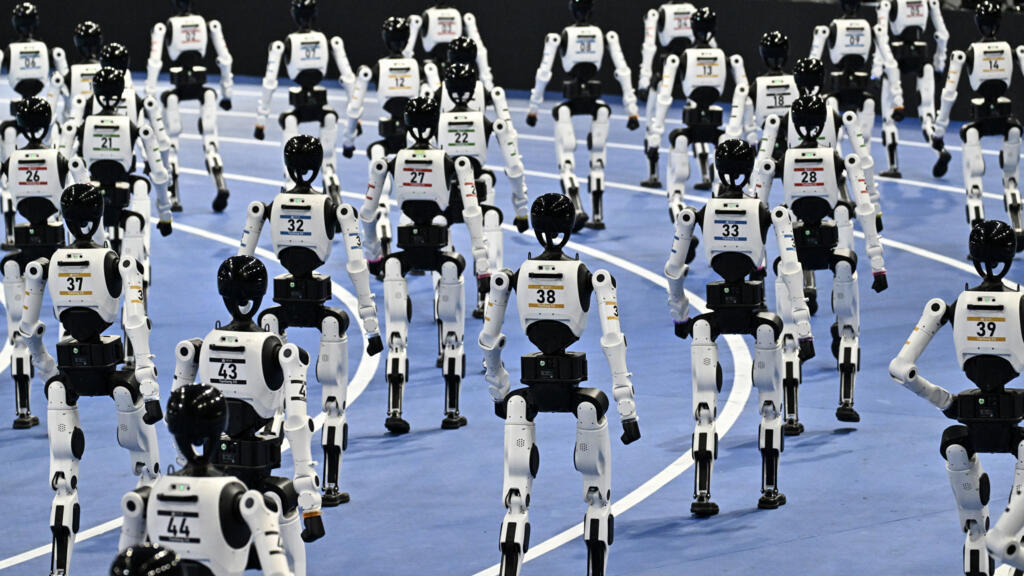
The achievements occurred on the opening day of the second annual, Olympics-style event, which features more than 2,000 humanoid robots competing in activities including running, table tennis and soccer. Organizers and manufacturers presented the event as evidence of China’s rapid progress in advanced robotics, including a large display in which hundreds of robots marched in synchronized formation.
The competition also revealed the technology’s limitations. Several robots tripped, fell apart or caught fire during events, illustrating that impressive demonstrations do not necessarily translate into reliable performance. Experts cited in the article say humanoid robots remain primarily used for demonstrations and performances and may require more time before they can be deployed widely in real-world settings.
The article places the event within growing U.S.-China tensions over robotics. The U.S. Federal Communications Commission recently announced a national-security-based ban on imports of new foreign-made humanoid robots, a measure aimed at China. The Pentagon also added Unitree, a major Chinese robot maker, to a list of companies it says have links to the Chinese military. Beijing rejected those accusations. China currently leads global humanoid-robot production, and manufacturers report substantial orders from government and private-sector customers.
Entities: World Humanoid Robot Games, X-Humanoid, Beijing, China, Usain Bolt, Javier Sotomayor • Tone: neutral • Sentiment: neutral • Intent: inform
23-08-2026
At the World Humanoid Robot Games in Beijing, humanoid robots competed in athletics, boxing, football, and martial arts, drawing cheers and laughter from hundreds of spectators. The event highlighted China’s expanding role in humanoid robotics and featured several headline-making performances. During the opening ceremony, the Chinese-developed Tiangong Ultra humanoid reportedly completed the 100-metre sprint in 9.39 seconds, faster than Usain Bolt’s 9.58-second world record set in 2009. The same robot later completed the 400-metre race in 38.16 seconds, with the time subsequently revised to 38.15 seconds—nearly five seconds faster than the human world record. Tiangong Ultra was developed by a Beijing research centre backed by local government.
The competition also demonstrated the limitations of current robotic technology. Some robots failed to start, while others moved at walking speed, collapsed after the starting gun, or struggled to remain upright. One robot wobbled dramatically during a 400-metre heat but managed to finish, while another fell over the ropes during a boxing match and had to be removed by human handlers. In football, a toddler-sized robot amused spectators by kicking the ball beyond the playing area, and even poorly defended goals received enthusiastic applause.
The event prompted questions about whether robot competitions measure meaningful intelligence or practical usefulness. Hou Yali, a 72-year-old Beijing spectator, said she wanted to see robots compete directly against humans to determine whether they could truly surpass them. She noted that speed alone does not demonstrate intelligence or the ability to perform household or caregiving tasks. Hou said she would welcome robots capable of cleaning homes and preparing meals, suggesting that future public interest may focus less on athletic records and more on robots’ usefulness in everyday life.
Entities: Tiangong Ultra, Usain Bolt, Beijing, China, World Humanoid Robot Games, China’s humanoid robotics industry • Tone: neutral • Sentiment: positive • Intent: inform