23-05-2026
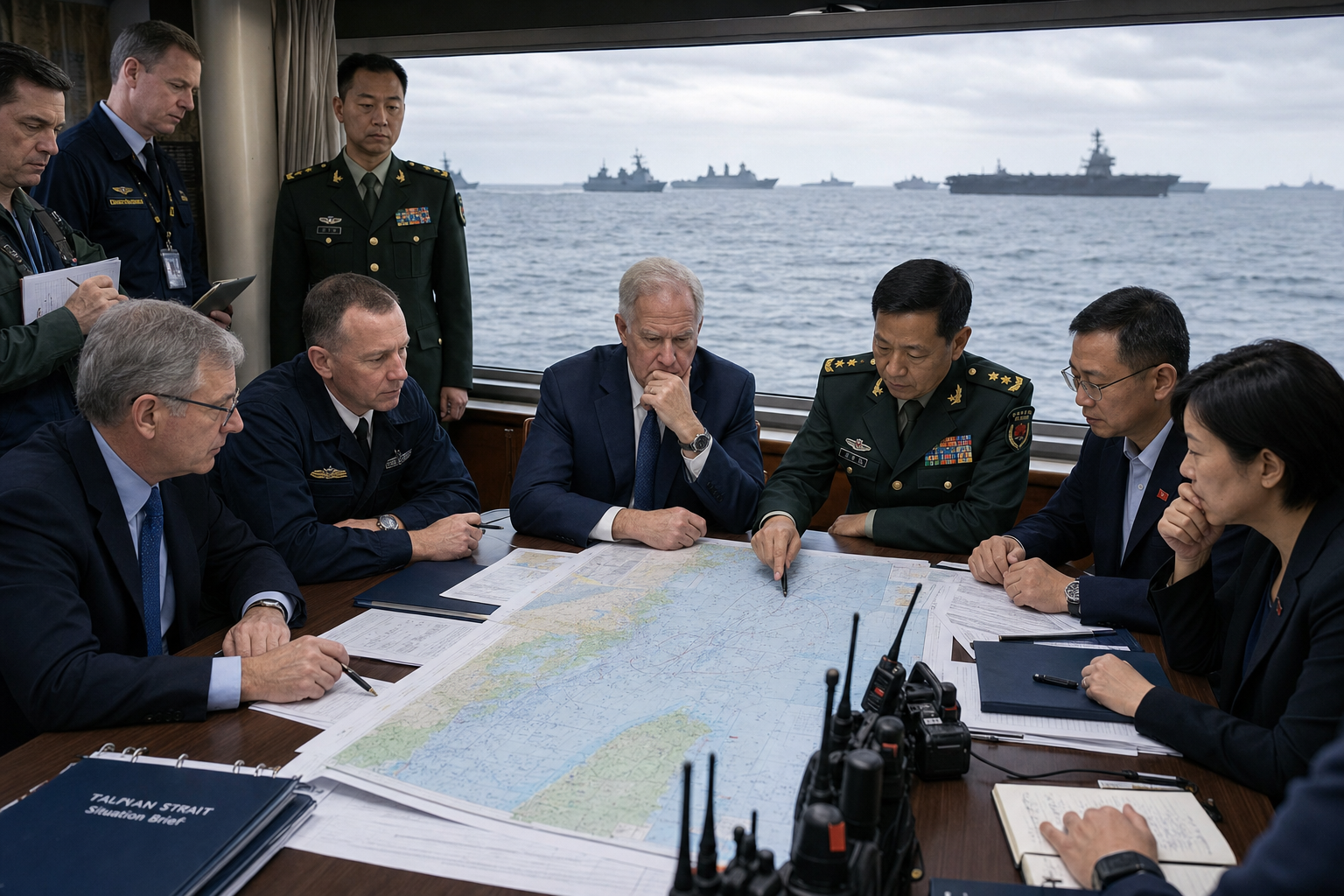
The article reports that Acting Secretary of the U.S. Navy Hung Cao said a planned $14 billion arms sale to Taiwan has been placed on pause while the administration ensures the military has enough munitions for ongoing Iran operations. Cao told Congress that the delay is a temporary measure tied to balancing U.S. weapons stockpiles, specifically referencing "Epic Fury." The article notes that the State Department and Pentagon did not immediately comment on his remarks. It also places the pause in a broader political and strategic context: President Trump has not committed to finalizing the sale, raising concerns about U.S. support for Taiwan amid Chinese pressure and Beijing’s claim that Taiwan is part of China. Trump recently said he discussed the matter with Chinese President Xi Jinping and later stated he made "no commitment either way" on the weapons sale, declining to say whether the U.S. would defend Taiwan in the event of a Chinese attack. The article highlights bipartisan concern in Congress, with lawmakers urging continued arms support for Taiwan as a deterrent against China. It also explains that the United States recognizes Beijing diplomatically but is legally required under U.S. law to provide Taiwan with defensive weapons, while China has increased military pressure on the island and has not ruled out using force.
Entities: Hung Cao, U.S. Navy, Taiwan, Iran, Epic Fury • Tone: analytical • Sentiment: neutral • Intent: inform
23-05-2026
The article examines how Chinese President Xi Jinping appears to be framing China-US competition through the lens of the Thucydides Trap, a theory popularized by Harvard scholar Graham Allison that describes the tendency for conflict between a rising power and an established hegemon. According to Allison, Xi raised the concept in his conversation with US President Donald Trump this month because he sees it as the best way to understand the danger in the current trajectory of bilateral relations. Allison argues that Xi recognizes that continuing with “business as usual” in diplomacy would likely lead to a catastrophic war, one that neither China nor the United States could survive. The piece places this view in the broader context of Xi’s long-standing engagement with the idea: he referenced the theory as early as 2013, and in 2015 acknowledged that major powers could create such traps through strategic miscalculation, even while rejecting the notion that the Thucydides Trap inherently exists. Overall, the article suggests that Xi’s latest remarks may reflect an increased awareness of the risks of great-power rivalry and a possible openness to rethinking China-US relations to avoid conflict.
Entities: Xi Jinping, Donald Trump, Graham Allison, Harvard University, John F. Kennedy School of Government • Tone: analytical • Sentiment: negative • Intent: analyze
23-05-2026
The article examines a new tension in U.S.-Taiwan policy after President Donald Trump warned, following his summit with Chinese President Xi Jinping, that he was not looking to have “somebody go independent.” In Taiwan, the remark was widely interpreted as a strong signal that Washington might be tightening its language on Taiwan’s status, echoing earlier moments when U.S. administrations publicly cautioned Taipei against moves toward formal independence. Analysts and observers in Taipei compared Trump’s comments to the George W. Bush administration’s rebuke of then-Taiwanese President Chen Shui-bian in 2003, suggesting a possible return to harder-edged U.S. messaging.
However, the article quickly complicates that interpretation by reporting Trump’s plan to speak directly with Taiwanese leader William Lai Ching-te about a pending US$14 billion arms package. If the call happens, it would be unprecedented between sitting leaders of the United States and Taiwan since Washington switched diplomatic recognition from Taipei to Beijing in 1979. That prospect could provoke strong anger in Beijing and raise questions about whether Trump is actually restraining Taiwan or instead shifting U.S. policy in a more volatile and unpredictable direction. The piece frames the situation as a moment of confusion and strategic ambiguity, where a blunt warning to Taiwan is followed by an extraordinary diplomatic overture that could deepen uncertainty across the Taiwan Strait.
Entities: Donald Trump, Xi Jinping, William Lai Ching-te, Taiwan, China • Tone: analytical • Sentiment: neutral • Intent: analyze