23-05-2026
House Republicans delayed a planned floor vote on a Democratic war powers resolution that would curb President Trump’s ability to continue military action against Iran without congressional approval. GOP leaders pulled the vote after realizing absences would prevent them from defeating the measure, even though Democrats argued they already had the votes to pass it. The episode reflects deepening congressional unease over the administration’s Iran policy, especially as the U.S. and Iran remain in a fragile ceasefire and lawmakers question whether the 1973 War Powers Resolution requires the president to seek authorization after 60 days of conflict.
The article describes a growing split among Republicans. Many still back Trump’s effort to weaken Iran’s nuclear capabilities, but a notable number now argue that the legal window for unilateral military action has expired. Rep. Brian Fitzpatrick said Congress must vote because “we’re past 60 days,” while Sen. Thom Tillis criticized the administration’s posture and signaled openness to authorizing force in a more formal way. Democrats accused Republicans of cowardice and political gamesmanship for avoiding the vote.
The piece also notes that recent votes have shown momentum for congressional oversight: the House previously tied 212-212 on a similar resolution, and the Senate advanced one with bipartisan support. Meanwhile, the White House claims the ceasefire means War Powers requirements no longer apply, and Trump has continued to signal readiness for renewed strikes if negotiations fail. The article frames the issue as an emerging legal and political showdown over war powers between Congress and the presidency.
Entities: House Republicans, Iran, President Trump, War Powers Resolution, Gregory Meeks • Tone: analytical • Sentiment: neutral • Intent: inform
23-05-2026
The article reports that the Trump administration was preparing a possible new round of military strikes against Iran while diplomatic efforts were still underway. According to sources familiar with the planning, no final strike decision had been made, but U.S. military and intelligence personnel were adjusting weekend plans and recalling readiness procedures in anticipation of possible action and Iranian retaliation. The White House said Trump’s position remained firm: Iran must not obtain a nuclear weapon or retain enriched uranium, and all options remained on the table. At the same time, Iran was reviewing a U.S. proposal for a deal to end the nearly three-month conflict, with an answer expected soon through Pakistan, which has served as an intermediary. Trump said Iran was eager to make a deal but warned that the administration needed strong assurances. Secretary of State Marco Rubio said diplomacy was preferred, though military options and contingency planning, including possible force to reopen the Strait of Hormuz, were being discussed. The article also notes that House Republicans dropped an effort to limit Trump’s authority to conduct military operations against Iran, signaling continued political space for the administration’s approach.
Entities: Donald Trump, Iran, White House, U.S. military, U.S. intelligence community • Tone: urgent • Sentiment: negative • Intent: inform
23-05-2026
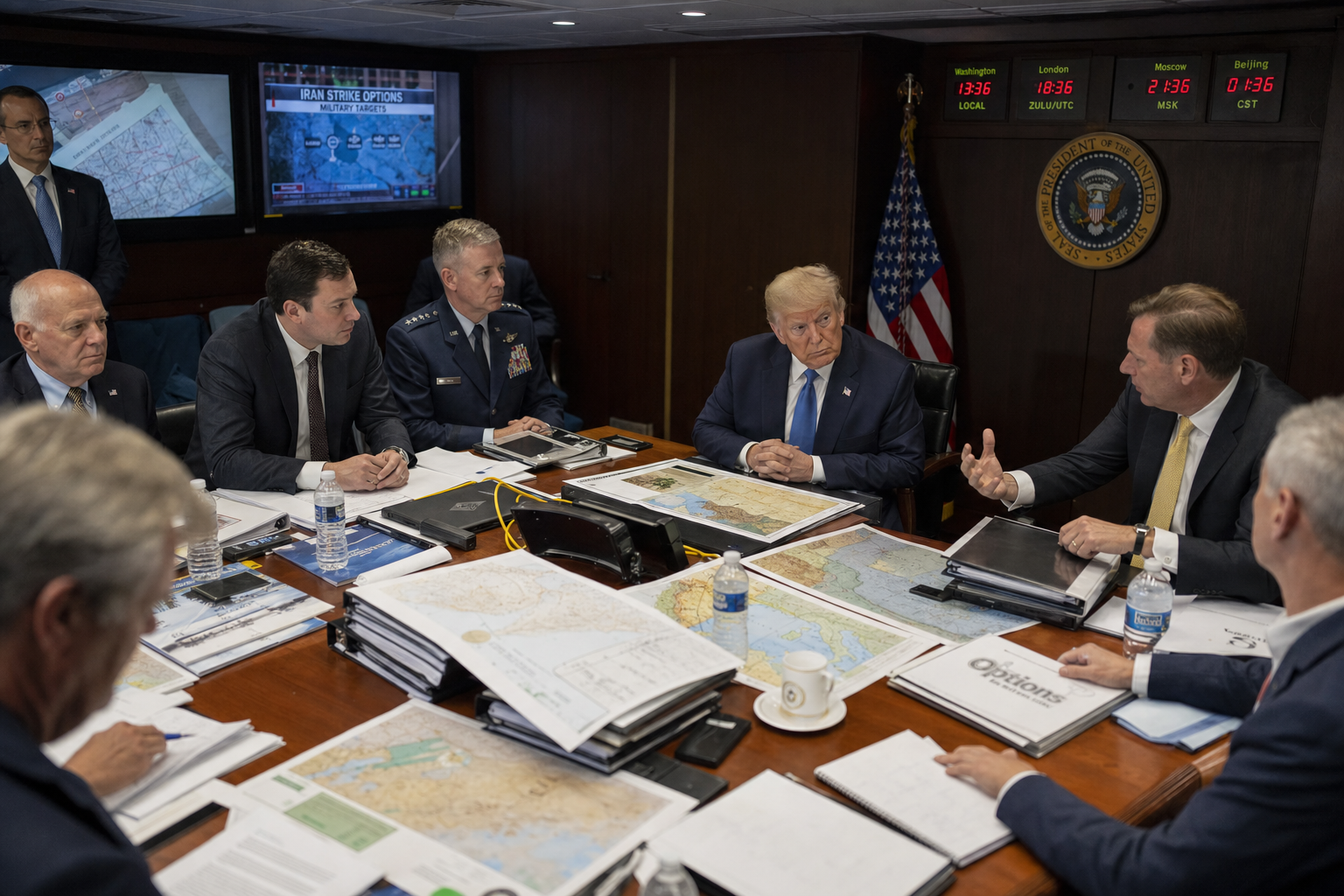
President Donald Trump met Friday with top national security officials to review options on Iran as diplomatic efforts continue but remain stalled by major disagreements. The White House meeting, described as routine, ended without a decision, underscoring the uncertainty around Trump’s next move. The article says Trump has grown frustrated with the pace of talks and has been presented with options that could restart military action, even though he has not yet chosen one. Earlier in the week, he reportedly came close to ordering strikes but held back after requests from Gulf nations.
At the same time, diplomacy is continuing through regional intermediaries. Delegations from Qatar and Pakistan traveled to Tehran in an effort to help end the conflict, and Iranian officials said discussions focused on preventing escalation. But Iranian Foreign Ministry spokesperson Ismail Baghaei said the gap between Tehran and Washington remains “very deep,” and reaching a deal will take more time and further negotiation. Trump has set a loose deadline of early next week for Iran to return a suitable proposal to end the war.
Trump’s schedule changes further highlight the seriousness of the situation. He canceled plans to go to his golf resort in New Jersey and said he would skip his son’s wedding in the Bahamas to remain in Washington during what he called an important period. The meeting included Vice President JD Vance and Defense Secretary Pete Hegseth, and Gen. Dan Caine also referenced an Oval Office meeting. Overall, the article portrays an administration weighing whether to continue diplomacy or move toward military action, with no clear resolution yet.
Entities: Donald Trump, Iran, Qatar, Pakistan, Tehran • Tone: analytical • Sentiment: neutral • Intent: inform
23-05-2026
This opinion article argues that the Trump administration should move quickly to shut down commercial air travel to and from Iran as part of a broader pressure campaign against the Islamic Republic. The authors contend that recent U.S. military and economic actions have already severely weakened Iran’s nuclear, missile, aviation, and air-defense capabilities, creating a narrow and temporary opportunity to intensify pressure before Tehran regains stability. The core claim is that Iranian airlines are not ordinary civilian carriers but tools of the regime and the Islamic Revolutionary Guard Corps (IRGC), used to move cash, weapons components, operatives, and fighters across borders.
The article focuses on Iran’s revived international flight network, especially airlines such as Mahan Air and Iran Air, and says the restoration of routes after the cease-fire gives the regime access to hard currency and covert logistics. It alleges that these flights have been used for bulk cash smuggling, procurement of drone-related components, transport of militants and Hezbollah weapons, and movement of operatives to help suppress unrest inside Iran. The authors emphasize that existing U.S. sanctions already cover these airlines and their enablers, so what is lacking is not legal authority but stronger enforcement. They argue that shutting the “air side” would undermine Iran’s ability to offset pressure from a maritime blockade and would close a critical channel for sanctions evasion and clandestine activity. Overall, the piece is a forceful call for immediate, aggressive enforcement against Iranian aviation as a strategic lever against the regime.
Entities: Donald Trump, Iran, Islamic Republic, Mahan Air, Iran Air • Tone: urgent • Sentiment: negative • Intent: warn
23-05-2026
The article argues that Israel, and especially Prime Minister Benjamin Netanyahu, has been marginalized by the Trump administration in U.S.-Iran cease-fire and negotiation efforts following the February 28 war against Iran. Netanyahu had initially presented himself as a close partner to Trump and a decisive force behind a possible joint U.S.-Israeli campaign that could topple Iran’s regime and destroy its nuclear and missile programs. But as the war unfolded, U.S. and Israeli priorities diverged: Trump became focused on ending the fighting, restraining escalation, and avoiding regional blowback, while Israel found itself cut out of key diplomatic discussions and reduced to relying on secondhand information. The piece emphasizes that none of Netanyahu’s core war aims were achieved. Iran survived, preserved leverage, and may now be heading toward a U.S.-Iran deal that resembles or even falls short of the 2015 nuclear accord Netanyahu opposed. Such a deal could include only temporary limits on nuclear activity, potentially omit Iran’s missile program, and lift sanctions in ways that strengthen Tehran and its proxies like Hezbollah. The article portrays the strategic partnership as costly for Israel: despite intensive military coordination and joint operations, Israel ended up dependent on U.S. approval and publicly waiting for Trump’s green light to continue striking Iran. The overall message is that Netanyahu’s war gamble has not delivered the decisive victory he promised, while Trump has become the dominant actor shaping the outcome.
Entities: Benjamin Netanyahu, Donald Trump, Israel, Iran, United States • Tone: analytical • Sentiment: negative • Intent: analyze
23-05-2026
The article reports that President Trump is weighing whether to resume military strikes against Iran after weeks of stalled diplomacy and an inconclusive cease-fire. A Friday meeting in the Oval Office with Defense Secretary Pete Hegseth, revealed publicly by General Dan Caine, suggested that senior officials were reviewing combat options. The possible targets under discussion include Iranian energy infrastructure, missile sites along the Strait of Hormuz, and the country’s stockpile of highly enriched uranium at Isfahan.
The piece explains that although U.S. and Israeli strikes have severely damaged Iran’s navy, air force, missile facilities, and other military assets, they have not produced a decisive strategic victory. Iran still retains access to much of its missile infrastructure, and its uranium stockpile remains buried underground. That leaves Trump with a difficult choice: escalate the war and risk higher oil prices, broader civilian suffering, and political backlash at home, or continue negotiations that critics say could signal weakness.
The article also highlights the legal and strategic controversy surrounding potential targets. Some advisers argue that attacks on infrastructure tied to the Islamic Revolutionary Guards Corps could pressure Iran’s leaders into concessions, while critics warn that strikes on civilian infrastructure could amount to war crimes. Meanwhile, Pentagon officials are concerned about depleted U.S. stockpiles of long-range missiles and other munitions. Overall, the article portrays a tense moment in which Trump’s next move could determine whether the conflict deepens or remains paused.
Entities: Donald Trump, Pete Hegseth, Gen. Dan Caine, Joint Chiefs of Staff, Iran • Tone: analytical • Sentiment: neutral • Intent: analyze
23-05-2026
The article examines Iran’s efforts to formalize control over the Strait of Hormuz by proposing fees, tolls, and related regulatory measures for vessels passing through one of the world’s most important shipping chokepoints. Analysts and maritime officials say the plan conflicts with international law, which guarantees freedom of navigation through international straits, and would likely be difficult to implement because of sanctions, insurance barriers, and resistance from shipping companies. Still, the proposal has unsettled global shipping markets and highlights how the war involving Iran could create lasting economic disruption well beyond the conflict itself.
The piece explains that Iran has recently taken several steps to assert control: launching a Persian Gulf Strait Authority, proposing a transit charge that could reach millions of dollars per vessel, and introducing an insurance scheme tied to cryptocurrency. Iran has also warned ships to follow a designated Iranian corridor or risk attack. But the U.S., the International Maritime Organization, insurers, and shipping operators have all signaled opposition. President Trump said the United States would not accept tolls on the waterway, and U.S. sanctions make any payments to Iran risky for Western companies.
The article also places Iran’s threats in a broader geopolitical context. By using the Strait of Hormuz as leverage, Iran may be testing the limits of international shipping norms and potentially encouraging other countries to consider tolls or controls over strategic waterways such as the Strait of Malacca. Although experts argue Iran does not truly control the strait and is struggling to export its own oil, the uncertainty has already contributed to a severe disruption in maritime traffic, stranded vessels and seafarers, and higher energy market volatility.
Entities: Iran, Strait of Hormuz, Oman, International Maritime Organization, Arsenio Dominguez • Tone: analytical • Sentiment: negative • Intent: inform